In a bold escalation that somehow involves zero actual boldness, the European Union has reportedly decided that when it comes to Donald Trump’s new tariffs, its best weapon is… self-care. As the bloc “weighs tough restrictions in face of Trump tariffs but appeasement remains most likely path” (Yahoo! News, Jan 2026), officials in Brussels have turned to the only battlefield where they still feel in control: their phones.
The strategy, which one anonymous European Commission adviser described as “a blend of strategic patience, algorithmic avoidance, and passive-aggressive wellness,” aims to protect EU negotiators from the emotional whiplash of Trump’s social media output while pretending to respond meaningfully to his tariff shock.
Instead of a coherent trade policy, the EU now has a “Digital Resilience & Appeasement Framework,” an internal guide that reads less like economic doctrine and more like a Goop newsletter having a panic attack.
Highlights include:
- Mandatory screen-time limits whenever Donald Trump posts the words “tariff,” “EU,” or “losers.”
- An AI plug-in that auto-rewrites Commission memos to replace “trade war” with “energetic disagreement.”
- A Slack channel titled #manifesting-de-escalation, where staffers drop links to breathwork tutorials instead of economic models.
“Look, we tried the strategy of flattery and appeasement,” sighed a fictional-but-accurate-sounding EU diplomat outside the Berlaymont building. “We complimented his golf courses. We pretended Brussels loves tariffs the way Paris loves croissants. He still slapped new ones on European cars. So now we’re pivoting to a more sustainable toolset: guided meditations and push-notification triage.”
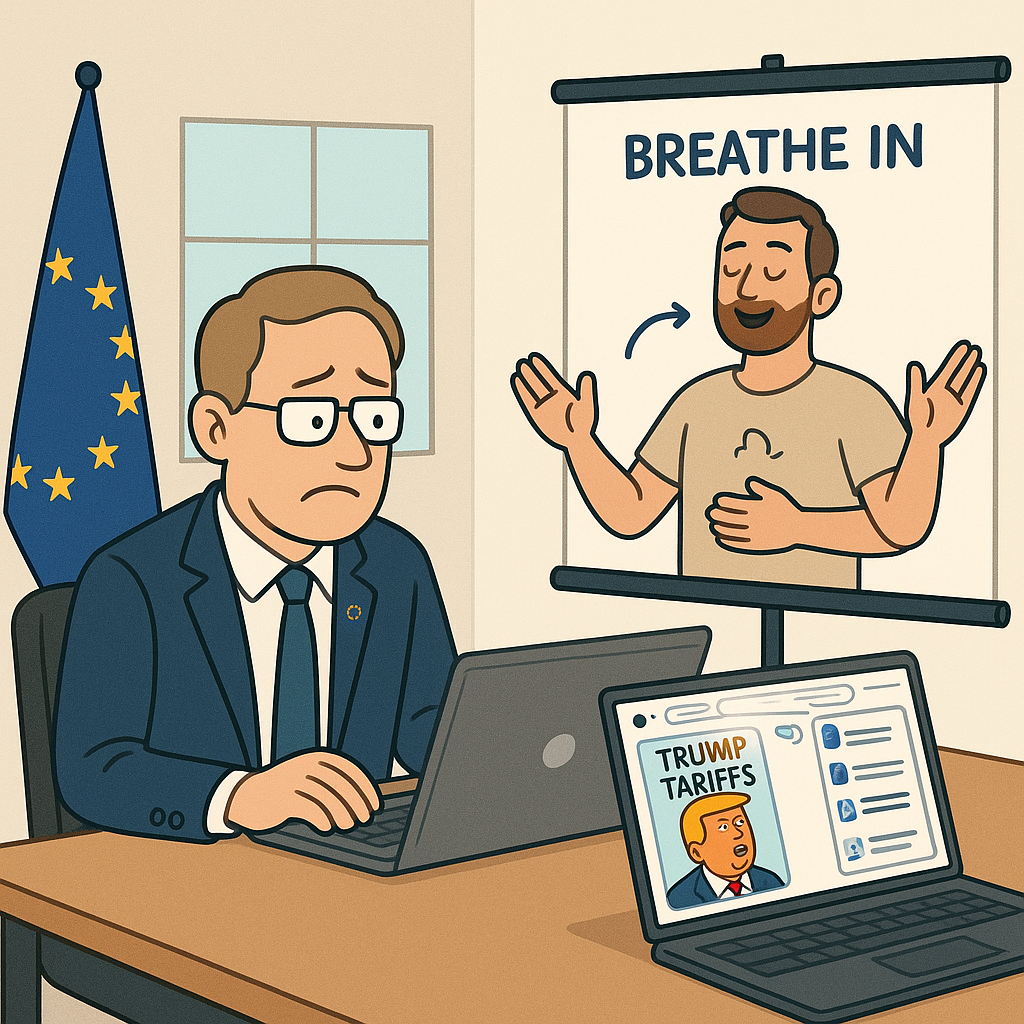
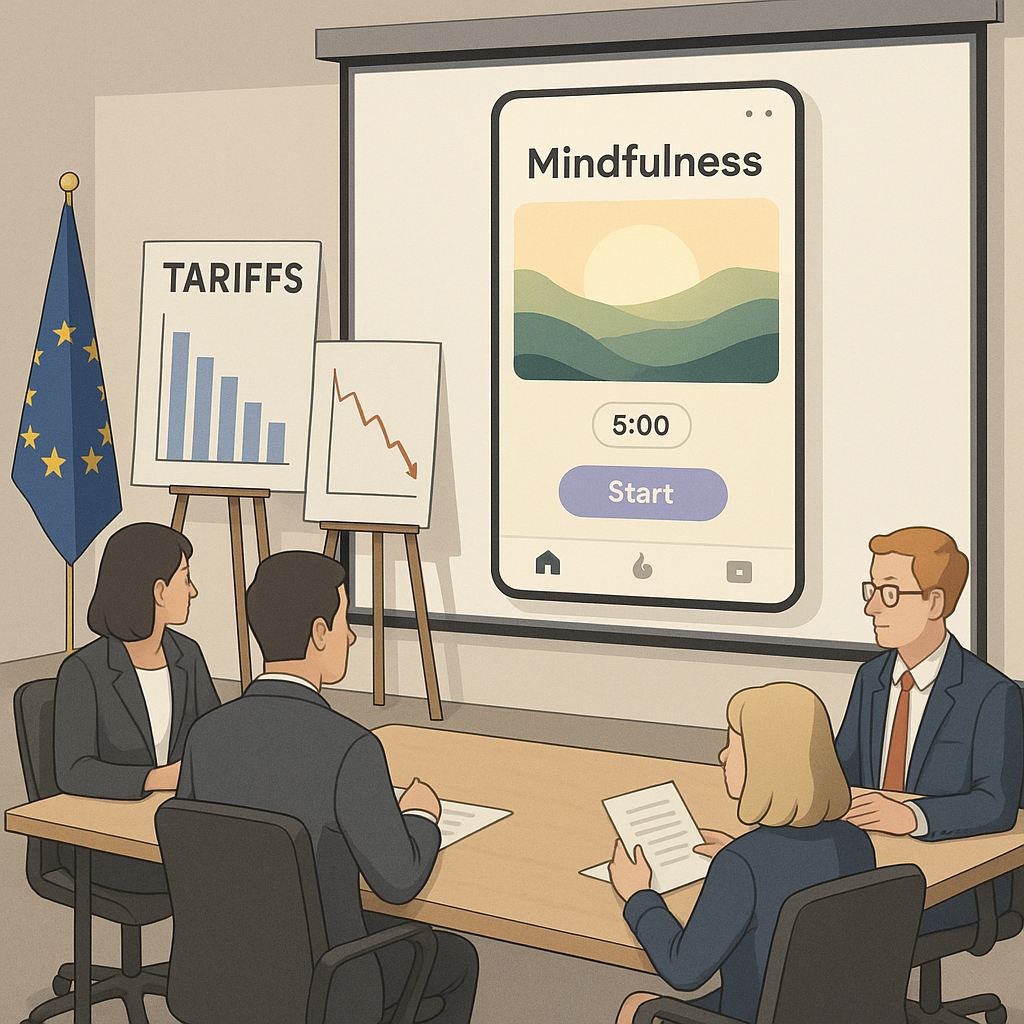
According to leaked notes from a recent meeting of EU trade ministers, the response to Trump’s tariffs is being reframed as a “tech-forward emotional regulation challenge.” In a slideshow that could have easily been titled How to Lose a Trade War and Gain Inner Peace, officials outlined a three-pillar strategy.
- Digital De-escalation: A custom Chrome extension in the Berlaymont that replaces every occurrence of “Trump tariffs” with “growth opportunity for mindfulness,” and swaps photos of the former president for stock images of sea turtles.
- Algorithmic Appeasement: The EU’s social media feeds will heavily prioritize cat videos, West Cork diver discoveries, and T20 cricket highlights over anything mentioning “tariffs” or “America First.”
- Wearable-Based Diplomacy: Negotiators’ smartwatches in Brussels now send haptic feedback every time US trade policy shifts, so they can do a calming breath before saying something fiscally responsible but emotionally regrettable.
“There can be no effective response to Trump’s tariff shock without full-spectrum nervous system regulation,” insisted one consultant from a boutique Berlin-based wellness-tech startup that recently rebranded from ‘CryptoMind’ to ‘TradeHarmony.’ “Yes, the tariffs will probably cost billions. But have you tried a six-minute gratitude practice before renegotiating steel imports?”
The original media framing – that the EU “weighs tough restrictions in face of Trump tariffs but appeasement remains most likely path” – has, in practice, translated into a hybrid mode Brussels insiders are calling Glow-Down Economics: looking serene on Zoom while quietly panicking into a reusable water bottle.
Behind closed doors, European officials are reportedly split into three camps:
- The Gym Group: Believe tariffs should be met with counter-tariffs, but are currently too busy doing stress deadlifts and counting tariff codes as reps.
- The Spa Wing: Want to “hold space for the US’s economic trauma” through positive messaging and possibly a joint EU–US wellness summit in a neutral location, like Iceland or a very nice Marriott.
- The Purely Digital Faction: Argue that the bloc should simply mute all mentions of Trump tariffs across official channels and wait the news cycle out like a bad celebrity divorce.
The last group appears to be winning.
A leaked draft of the EU’s internal “Tariff Resilience Toolkit” recommends staff do the following whenever the former US president posts a hostile message about the European Union on social media:
Step 1: Put phone face down.
Step 2: Take three deep breaths and name five things in the room that are not tariffs.
Step 3: Write a strongly worded response in Notes app. Do not send.
Step 4: Schedule an inter-departmental vision board session about ‘post-tariff abundance.’
One policy aide admitted that, on a practical level, the entire EU–US trade relationship has been turned into a shared Google Doc titled “We’ll Fix This After Q4.” “We had a line item for ‘tough restrictions,’” they explained. “Then someone commented ‘feels aggressive, can we soften?’ Now it just says ‘firm but symmetrical vibes.’ The only thing moving faster than tariffs is the comment thread.”
In a particularly modern twist, Brussels has reportedly explored using AI to simulate future Trump tariff announcements and precondition their nervous systems. The experiment was paused after the model produced 47 consecutive scenarios that began with “TARIFFS – SO MANY TARIFFS” and ended with someone in the room quietly hyperventilating into a linen blazer.
“We were hoping to use machine learning to anticipate policy,” said an EU tech adviser, “but all we really learned is that no algorithm should be forced to ingest that many campaign speeches.”
Instead, the Commission has turned to softer forms of digital resilience. A new official app, Calmmerce, pings users with positive trade affirmations throughout the day, including:
- “You are not your import deficit.”
- “Other people’s tariffs say more about them than about you.”
- “You deserve a partner who respects your industrial base.”
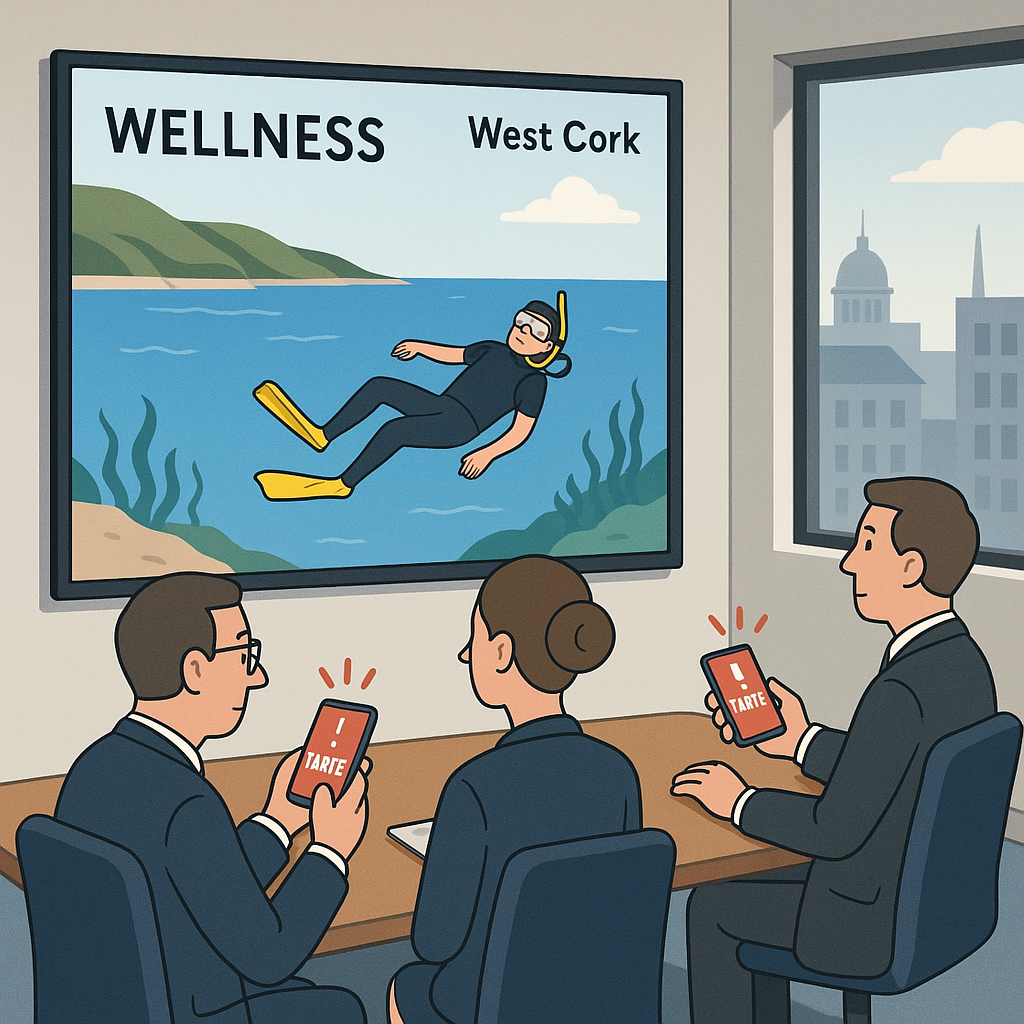
The app also features emergency “Article 5 But Make It Wellness” mode: if the US announces fresh tariffs on European tech or cars, all EU staff devices automatically switch to Airplane Mode and display a looping video of West Cork coastal waves and a very relaxed diver who has never heard of a supply chain.
Critics say the new approach turns serious economic threats into aesthetic challenges. “We don’t need more deep breathing,” complained one northern European finance minister. “We need a unified fiscal response. I don’t care how many gratitude journals are in Brussels, that won’t fix a distorted trading system.”
But others insist this is the only rational way to survive an era where tariff policy is set one post at a time. “Appeasement isn’t just a geopolitical strategy anymore,” said our Berlin wellness-tech founder. “It’s a content moderation problem. We’re not caving to Trump; we’re just curating our emotional feed.”
As the EU continues to “weigh tough restrictions” in documents while manifesting appeasement on Instagram, trade experts warn that the bloc may soon emerge with immaculate digital habits and absolutely no leverage. Still, sources in Brussels maintain that the continent is on the right path.
“Will this stop the tariffs?” one senior official mused, staring thoughtfully at a phone locked in ‘Tariff Detox’ mode. “Probably not. But at least when the next round hits, our resting heart rate will be under 60. And in this economy, that’s what we call a win.”