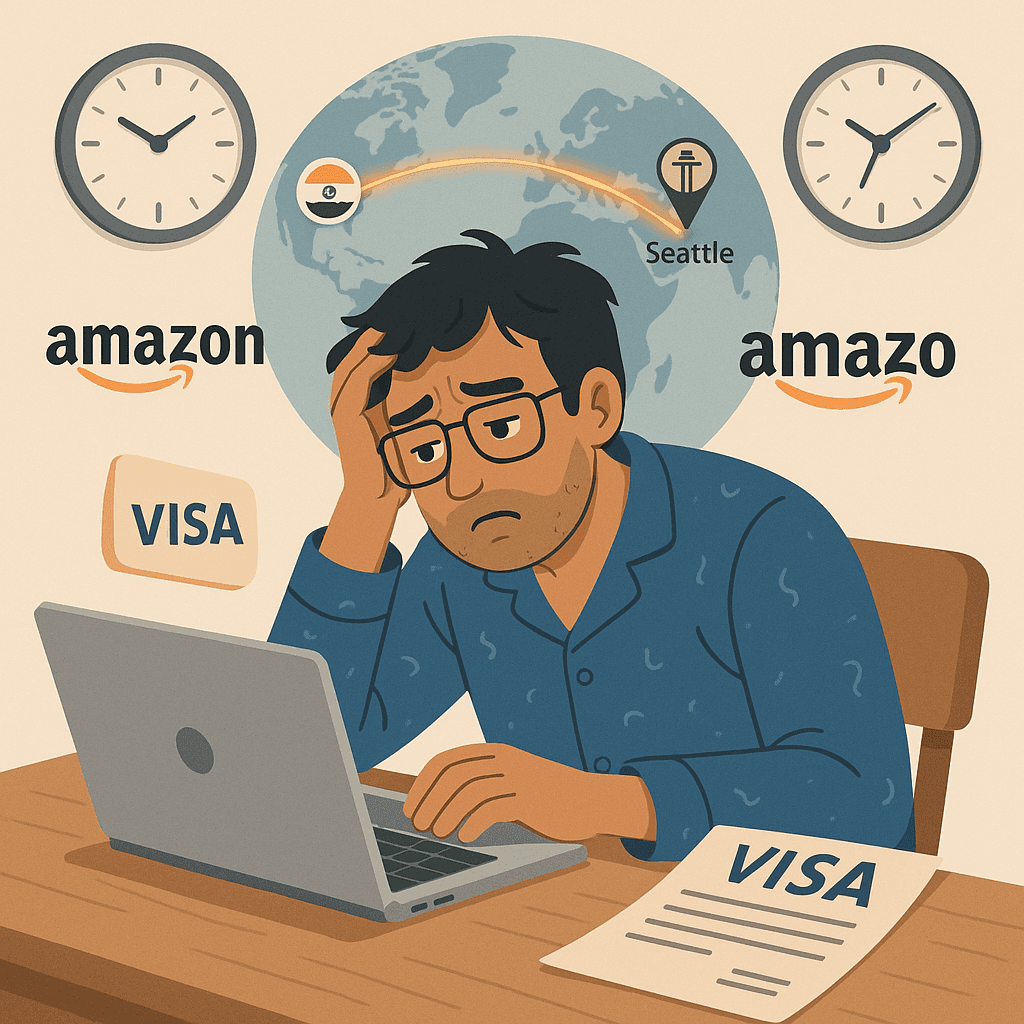
In a bold experiment to determine exactly how far a human can be from their desk and still be considered “on-site,” Amazon has begun encouraging H-1B workers stuck in India to work remotely, turning U.S. immigration limbo into the corporate equivalent of an always-on layover lounge (Travel And Tour World, Jan 2026).
The program, which quietly applies to hundreds of Amazon employees awaiting H-1B visa processing, has been advertised internally as a “flexible global opportunity.” In practice, it’s more like telling someone who missed their flight, “Good news, you live at the airport now, and we’ve enabled 2FA at Gate 41.”

The Travel And Tour World report describes Amazon’s move as either “the ultimate travel hack or a corporate trap,” which is a bit like asking whether Alexa is a smart speaker or a mass surveillance hobbyist. According to internal memos leaked by someone who “accidentally” uploaded them to the wrong S3 bucket, the company pitches the India-based H-1B workers a tantalizing deal:
- Stay in India, keep your U.S. job.
- Work U.S. hours from Bangalore, Hyderabad, or your parents’ living room.
- Explain to confused relatives why your ‘American job’ happens entirely on mute.
“It’s basically like being in Seattle,” said one Amazon engineer in Pune, “except my rent is lower, my parents think I’m unemployed, and my manager forgets I exist because I’m not in his time zone or his LinkedIn photos.”
On paper, this looks like a win-win: Amazon keeps its highly specialized workers, U.S. Citizenship and Immigration Services keeps losing mail, and India gets a growing population of pajama-clad knowledge workers on nightly Zoom calls with Seattle. In reality, the arrangement has created a new professional class: the Transcontinental Ghost Employee, fully employed but geographically rendered fictional.
Company spokespeople insist this is all about “talent retention” and “employee choice.” According to a fictional but spiritually accurate internal FAQ:
Q: Is this a travel perk?
A: Yes! You save money by not traveling while continuing to serve business needs in a location that is physically, legally, and emotionally inconvenient.
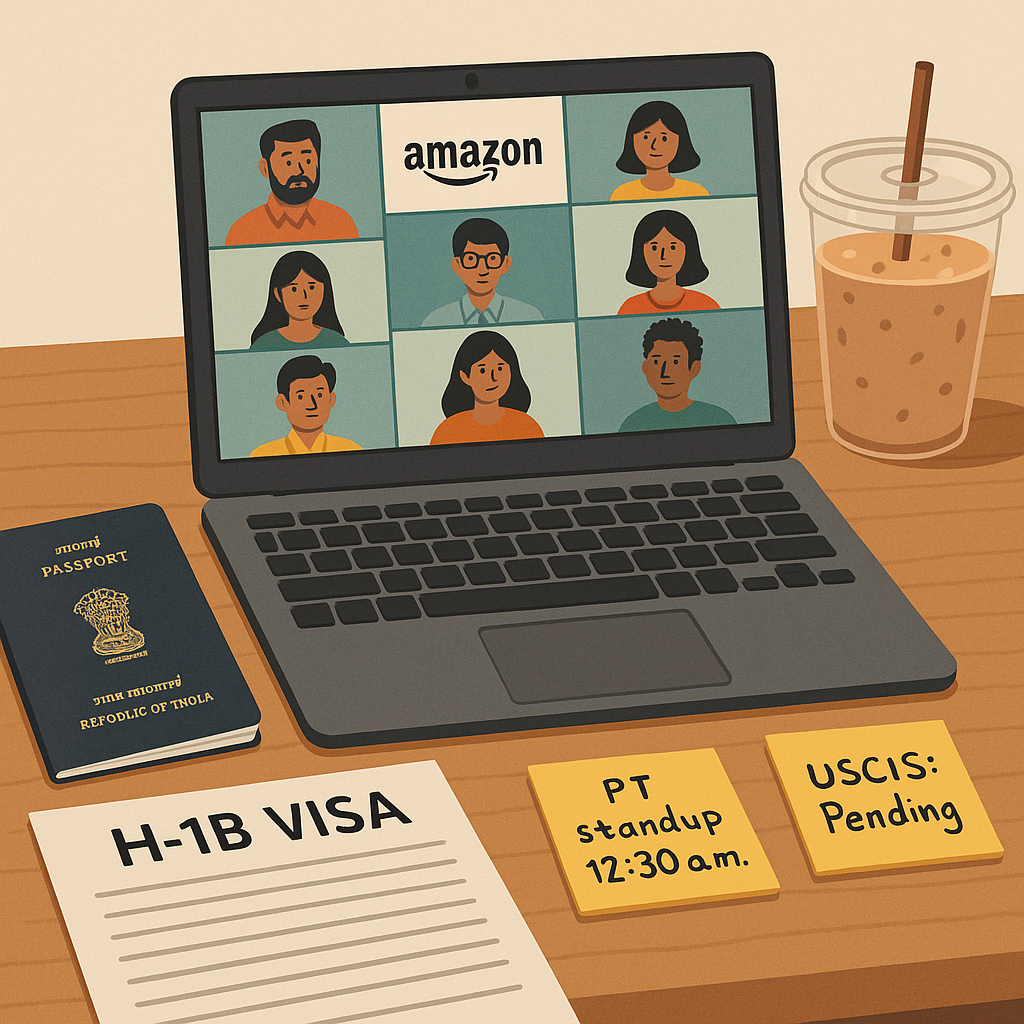
H-1B workers caught in this experiment exist in a quantum state between nations. In HR systems, they are tagged as “US-based: remote.” In the real world, they’re at a café in Chennai explaining to a barista why they’re arguing about Pacific Time standups at 11:30 p.m. local.
“I came to India for a three-week visit while my H-1B was renewing,” said Ananya, a software engineer who allegedly works for Amazon Web Services but is primarily employed by America’s visa queue. “Eight months later, my manager says I’m a ‘pioneer of distributed-first culture.’ That’s just a poetic way of saying ‘we’re not paying you Silicon Valley money or Silicon Valley rent.’”
Immigration lawyers note that the arrangement is technically legal but spiritually cursed. “The H-1B system was designed under the assumption that humans and their jobs would be in roughly the same place,” said one attorney. “Amazon looked at that and said, ‘What if… no?’”
The new policy has also created some deliciously absurd edge cases. One workday for an H-1B Amazon engineer in India reportedly included:
- 12:00 a.m. IST – Join 10:30 a.m. PT ‘casual coffee chat’ with Seattle team.
- 2:00 a.m. – Off-camera standup; camera off because everyone in your house is asleep and you are whispering your JIRA updates.
- 5:00 a.m. – Critical incident call; parents appear in background, asking if "this is that American scam job."
- 7:00 a.m. – Finally log off, just as India wakes up and the doorbell rings for yet another Amazon delivery.
Amazon leadership, meanwhile, is delighted. “We’re redefining what ‘relocation’ means in a digital-first world,” said an imaginary VP of Global Workforce Solutions, reading directly from a slide deck labeled “Synergy_Deck_FINAL_v7_FINAL2.pptx.” “In the old model, we spent thousands on immigration lawyers, flights, and housing. In the new model, our workers donate their circadian rhythms for free.”
Critics argue that this is not so much a benefit as a test to see how desperate people are to hold on to their H-1B sponsorship. The fear is simple: if you say no to 2 a.m. one-on-ones with a manager in Seattle, you are tacitly saying yes to being replaced with someone in a cheaper time zone who says yes faster.
“People don’t feel like they can refuse,” said a labor researcher who has been quietly cataloguing stories from Amazon, Microsoft, and other tech giants treating borders like minor UI bugs. “You have a structural power imbalance: Amazon controls the job, the visa prospects, and the illusion of a future in the U.S. The worker controls… their caffeine intake.”

Of course, Amazon isn’t the only company experimenting with remote work for H-1B talent stranded overseas, but it is the one large enough to turn a bureaucratic bottleneck into a scalable feature. The same corporate engine that brought the world one-day shipping has now delivered one-way remote work: shipped directly to your parents’ guest bedroom, batteries (and burnout) included.
Inside the company, managers are already brainstorming how to “productize” the limbo. One slide from a leadership offsite reportedly pitched:
- Follow-the-sun on-call rotations – U.S. workers sleep while India-based H-1B staff babysit microservices and their shattered dreams.
- Geo-flex performance calibration – Performance expectations rise in inverse proportion to your physical distance from an Amazon campus.
- Visa-backed retention metrics – Turn wait times at consulates into a key engagement KPI.
The irony, of course, is that the company famous for turning logistics into a science has essentially failed to ship its own workers. Packages can leave an Amazon fulfillment center in Delhi and reach Dallas in 48 hours. An H-1B software engineer’s body, however, is stuck in Ahmedabad for up to 18 months waiting for an appointment that keeps getting “rescheduled due to unforeseen circumstances.”
So is Amazon’s remote-work option for H-1B employees in India a savvy travel hack or a glittering corporate trap? The answer, like the visa status of half the workforce, is “pending.” It’s a travel hack if you ignore sleep, stability, and the awkwardness of running a “lunch and learn” at 1:30 a.m. local time. It’s a corporate trap if you notice that your entire life now revolves around a country you cannot legally enter.
Some workers are already rebranding their situation with the gallows humor typical of the tech sector. “I’m not stuck in India,” one Amazon engineer wrote in a group chat. “I’m just on an extended layover in Geo-Distributed Capitalism v2.0.”
Amazon, for its part, insists the initiative is about empathy and flexibility in a complex global environment. And in a way, that’s true. Nothing says empathy like telling someone, “We value you so much, we’ll keep you on payroll from 8,000 miles away, in a time zone that slowly erodes your sense of reality, until the U.S. government remembers you exist.”
Until then, the H-1B workforce remains the most optimizable resource in the world: geographically constrained, financially dependent, culturally dislocated, and permanently signed in to Amazon Chime. If borders are just lag, Amazon has figured out how to live with 400ms ping—so long as someone else pays the electricity bill.