In a keynote delivered to a breathless crowd of developers, investors, and people who think “factory reset” is a form of self-care, Apple today unveiled its boldest privacy innovation yet: iConsent, a system that politely asks for your permission before doing exactly what it was going to do anyway.
“We believe privacy is a fundamental human right,” declared an Apple executive in a tone that suggested he was also reading off the quarterly revenue slide, “which is why we’re giving users more chances than ever to tap ‘Allow’ without reading anything.”
The announcement comes amid a wider industry scramble to appear responsible about data while still treating user information like an all-you-can-eat buffet at a surveillance casino. Google recently floated a paid option for slightly less garbage search results, according to multiple tech outlets, while Meta continues to pioneer new ways to make you sign away your soul by accidentally scrolling. Apple, not to be outdone in the ethics theater Olympics, has chosen the path of friction-coated surveillance.
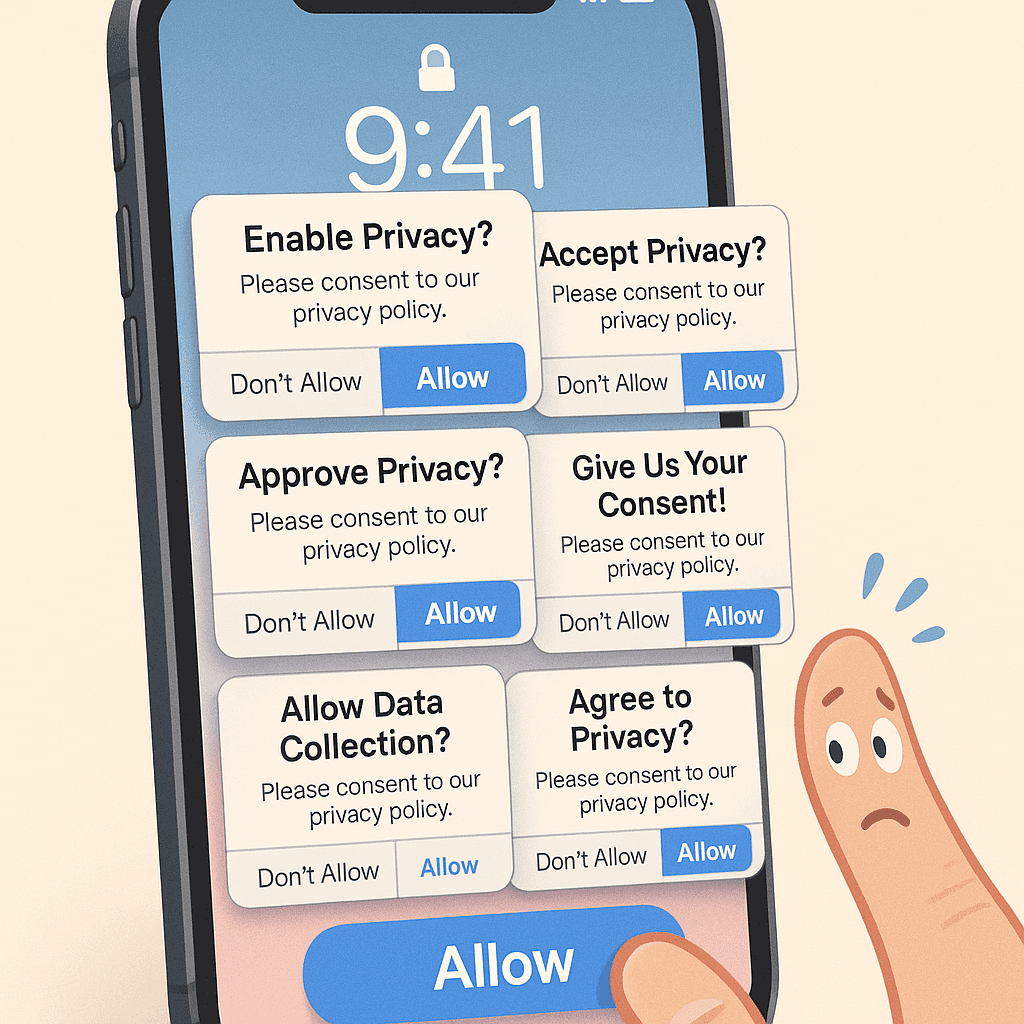
With iConsent, every app interaction begins with a full-screen card asking for your permission in friendly pastel gradients. If you decline, a smaller box appears: “Are you sure you don’t want to enjoy the full experience?” If you decline again, a third dialog appears explaining that certain “critical features” — such as opening the app, closing it, or thinking about it in public — require data sharing.
Ultimately, users are presented with three options:
- Allow Once (for 3–5 business years)
- Allow While Using App (defined broadly as any time your phone is turned on, near you, or has heard of you)
- Ask App Not To Track* (*app may ignore this, pout, or invent its own ad identifier)
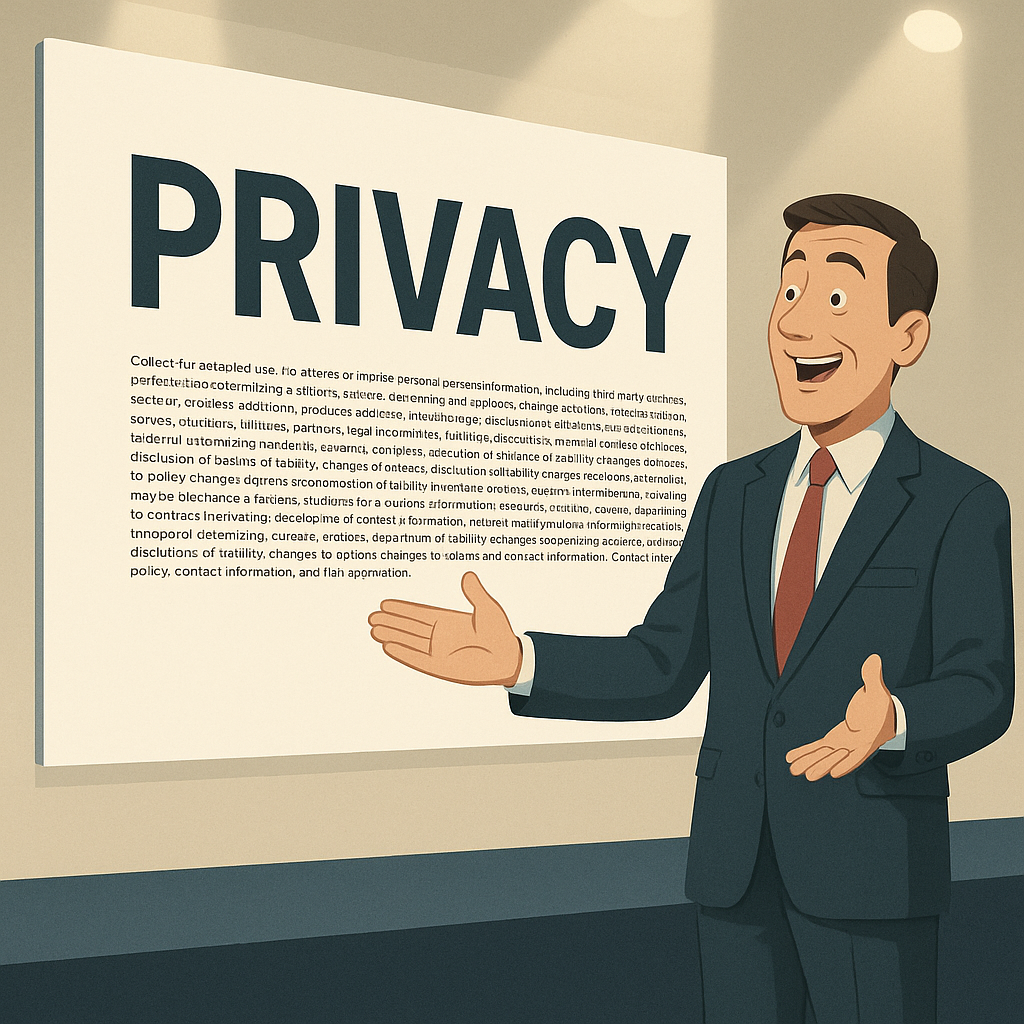
At the bottom of the screen in 8-point light gray font: “By tapping anything on this screen, you agree to the Universal Behavioral Harvest Agreement.”
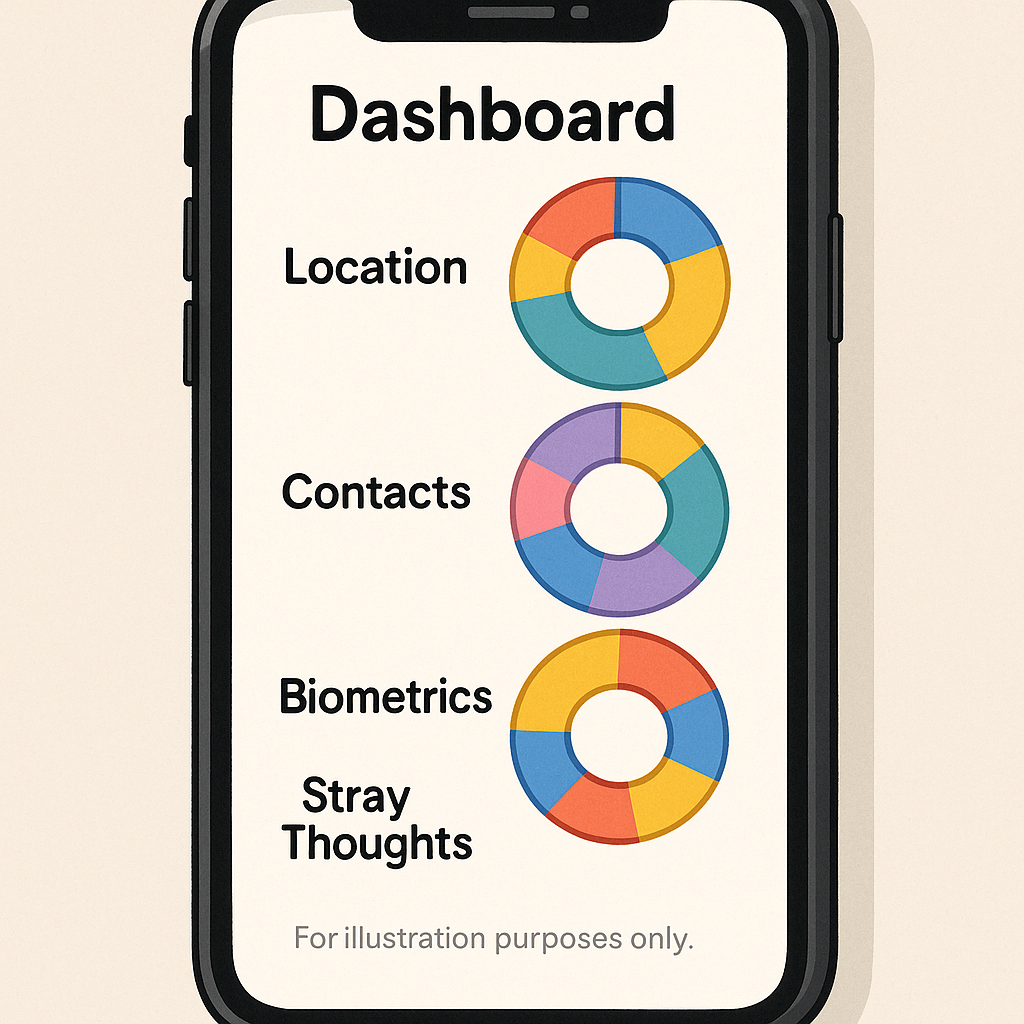
“This is about transparency,” said one Apple spokesperson, demoing a new dashboard that shows, in real time, how much of your life is currently being algorithmically strip-mined. The dashboard displays a cheerful donut chart labeled with categories like Location, Contacts, Browsing History, Biometrics, and Stray Thoughts You Had Near The Microphone.
“We used to just take all of this without telling you,” the spokesperson continued. “Now, we take it, tell you, and then show it to you as a beautiful chart. That’s the future of privacy.”
Industry analysts applauded the move as a masterclass in “compliance aesthetics”: doing the minimum required by regulators but making it look like the maximum achievable by civilization. As one consultant put it, “The EU asked for guardrails; Silicon Valley brought ring lights.”
Users can supposedly fine-tune their preferences in the new Privacy Center, a settings labyrinth where every toggle is a riddle and every riddle is pre-set to ‘On’. The main screen features friendly cards such as:
- Personalization: Help us understand you by staring into the camera for four to six hours daily.
- Analytics: Share anonymous data so we can learn that people tap on big blue buttons more than small gray ones.
- Improve Our Products: Allow us to convert your entire existence into a quarterly KPI.
Dig four menus deeper and you reach a toggle labeled “Limit Something, Possibly, Hard To Say”. Turning it off triggers another dialog: “Warning: This may reduce the relevance of ads that follow you between apps, in your sleep, and into the afterlife.”
Regulators in Brussels, who once forced Apple to stop shipping phones like they were bespoke dongle samplers, expressed cautious optimism. “We are pleased to see more explicit user choice,” one EU official said, “though we note that the choice is primarily between ‘be tracked with gradients’ or ‘be tracked with darker gradients.’”
Meanwhile in the U.S., lawmakers briefly considered holding hearings about digital privacy before becoming distracted by the opportunity to yell at social media platforms about entirely different things. One senator, who previously went viral for asking a tech CEO whether Wi-Fi is “stored in the cloud or on the phone,” praised Apple’s new system as “a great way to make the words very large for the senior citizens like myself” (C-SPAN, 2023).
As part of the rollout, Apple also announced a new feature called Consent Replay, which automatically records the exact microsecond you accidentally hit “Allow” while trying to close a notification. If you later claim you didn’t mean to grant permission for “indefinite background tracking, data sharing with vaguely defined ‘partners,’ and experimental ad formats,” the company can play back the moment in slow motion.
“Here we see the subject’s thumb clearly descending, with intent, onto the blue ‘Allow’ button,” reads the demo transcript. “Note the obvious lack of hesitation, apart from the 0.3 seconds spent trying to find the ‘X’ we deliberately made smaller than a fruit fly.”
To deepen the illusion of preference, iConsent includes a periodic notification asking if you’d like to “Review Your Data Choices.” Selecting it opens a beautifully animated carousel of inspirational stock photos and corporate mission statements, gently nudging you toward the same three settings you already ignored during setup.
Power users have discovered that if you tap “No” three times in a row on every prompt, a hidden message appears: “You seem upset. Would you like to speak to a support article?”

Privacy advocates, who are now legally required to exist only as anxious Twitter threads and grainy Zoom panels, reacted with thinly disguised despair. “They’ve gamified capitulation,” one researcher said. “It’s the casino model: sure, technically you can win, but have you seen the blinking lights?” Another pointed out that many users already mindlessly approve every software update, terms-of-service pop-up, and cookie banner in existence. “All they’ve done is weaponize the reflex,” she added.
Apple insists that the new system is “user-first” and “transparent,” words that have now achieved the same semantic value as “artisanal” and “farm-to-table.” In a blog post, the company wrote: “When you interact with our products, you should feel completely in control of your data. That’s why we’ve given you so many opportunities to confirm your decision to surrender it.”
My favorite part of the demo was the slide showing three silhouetted figures, captioned: “Our Commitment To Your Privacy.” Underneath, in smaller text: “Not A Contract, Not Legally Binding, Please Don’t Screenshot.”
The cruel genius of iConsent isn’t that it steals more of your data. It’s that it makes you complicit. Every tap, every “Accept,” every “Sure, whatever, I just want to open this map” becomes another data point they can wave at regulators: “See? They wanted this.”
And maybe we do. Because we are tired, and the prompts are annoying, and the screen is shiny, and the charts are pretty. Because we still believe somewhere, deep down, that the company that sells us a thousand-dollar rectangle every two years “respects our choices.”
So when iConsent arrives in the next software update, a simple recommendation:
Read every screen. Study every toggle. Examine every checkbox with the paranoid focus of a raccoon opening a trash can. Then, when you fully understand what’s at stake, take a deep breath.
And tap “Allow,” like the rest of us.