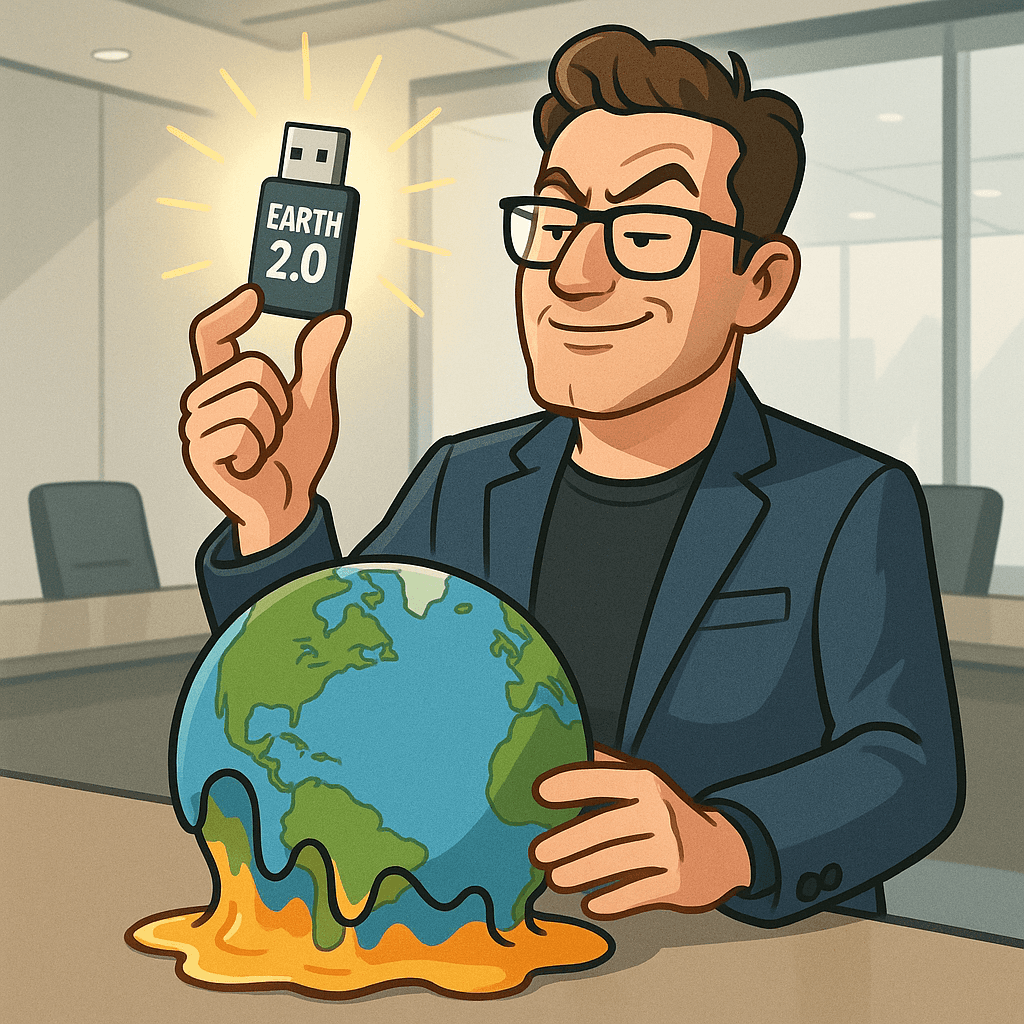
Silicon Valley’s leading technocrats have unveiled their boldest climate solution yet: abandon this Earth like a mismanaged group chat and upload everything that matters to a portable hard drive.
Branded as “Earth 2.0 (Early Access),” the initiative is the brainchild of a hastily assembled coalition of billionaires, management consultants, and one futurist who insists he coined the term “metaverse” but cannot prove it. The pitch is simple: if the physical world insists on having weather, consequences, and voters, maybe it’s time to pivot to a more scalable planet.
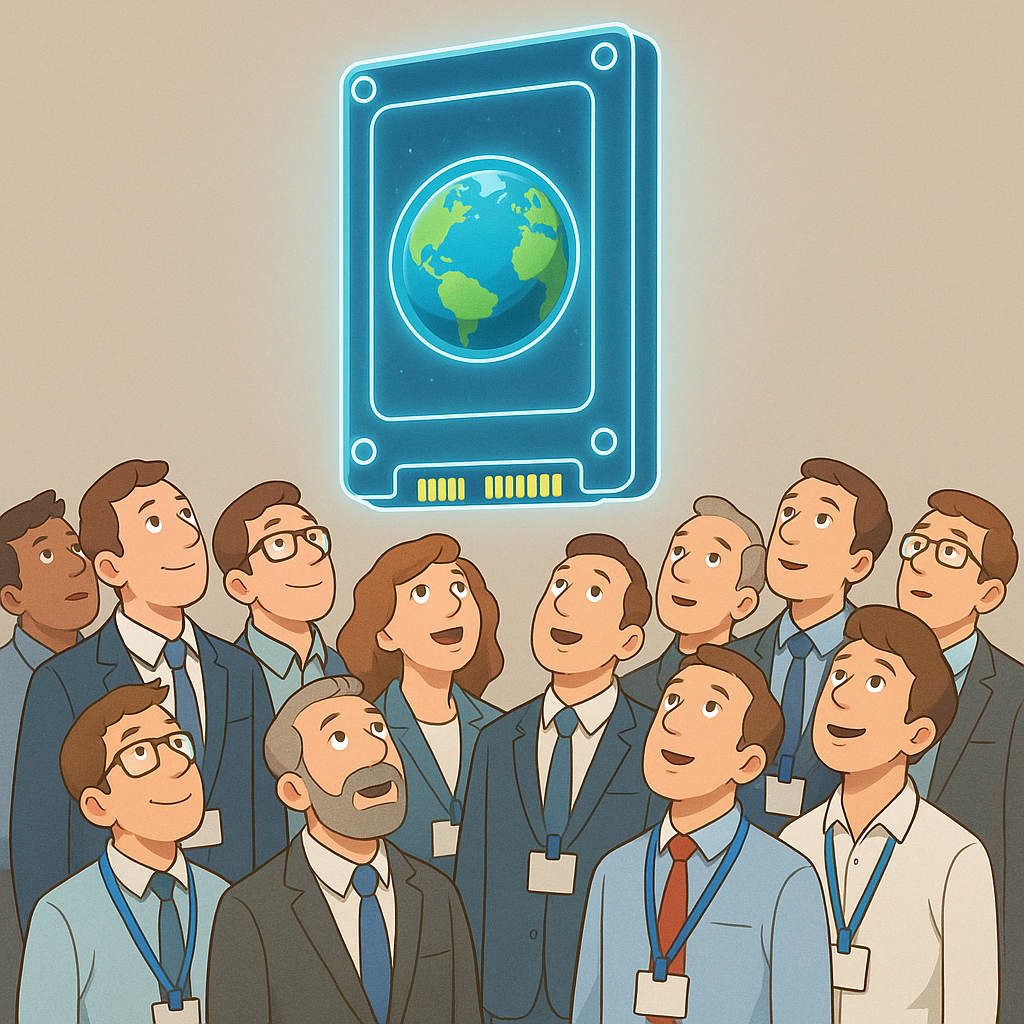
The project’s launch took place at a tech summit in San Francisco, where attendees were encouraged to offset their carbon footprint by not thinking too hard about it. Onstage, the lead founder—introduced only as “a visionary who was right about crypto, if you ignore the numbers”—held up a 4TB SSD like a priest presenting a relic.
“Inside this device,” he declared, “is a fully simulated Earth running in a proprietary engine optimized for shareholder value and low latency. No hurricanes, no droughts, and absolutely no unmoderated public comment.”
He then added, in the careful legal tone used by companies that name spaceships after podcasts: “To be clear, the simulation may contain hurricanes and droughts for realism. But they will be optional and monetizable.”
According to the glossy whitepaper (downloadable only as an NFT), Earth 2.0 will launch in progressive DLC phases:
- Phase 1: Terrain Pack – basic continents, oceans, and a UI slider to set how much of Florida you want.
- Phase 2: Civilization Beta – simulated humans who pay for plugins that restore rights they already had.
- Phase 3: Monetized Meaning – all spiritual fulfillment available in bundles starting at $9.99/month.
The team stressed that this is not “escapism,” but “climate resilience via platform migration.” A slide behind them read:
DON’T FIX THE SYSTEM. PORT IT.
Experts were quick to point out that the physical Earth is continuing to warm. The founders responded by uploading a strongly worded PDF into the simulation and issuing a joint statement that they feel “seen, heard, and pre-seeded for a Series C.”
“Look,” explained one co-creator, who previously worked on a scooter startup that accidentally colonized 53 cities overnight, “we’ve tried regulations, international agreements, and scientists begging on television. That didn’t scale. What does scale is software. If we can get enough people to emotionally defect into a metrics-optimized climate, the old planet will just become legacy infrastructure. Like fax machines or empathy.”
In a break with tradition, the United Nations was not consulted. However, a spokesperson for the U.N. Environment Programme admitted they had “absolutely no idea how to compete with a world that has a skip button for wildfires.”
On Earth 2.0, climate change is no longer a planetary crisis—it’s a difficulty setting. The default is “Mildly Concerning,” but subscription tiers unlock more thrilling modes, including:
- Influencer Mode: Fires are photogenic, smog has a flattering filter.
- Doomer DLC: The sea level rises in real time with the number of think pieces published about it.
- Legislator Mode: Real-world lobbyists pop up and ask if you’re “really sure” about that emissions cap.
“People say you can’t just code your way out of climate change,” one investor said, “and they’re right. That’s why we’re coding our way around it.”

Platforms rushed to integrate. One major cloud provider promised to host Earth 2.0 with “99.999% uptime, barring force majeure or antitrust enforcement.” A streaming service announced an exclusive docuseries following the launch titled “This Changes Everything, Until It Doesn’t”, narrated by whoever is currently available and mildly ashamed.
Even regulators cautiously entered the chat. The European Commission expressed concern that Earth 2.0 might become a “dominant reality provider,” hinting at digital antitrust rules. However, internal emails leaked to a major newspaper showed several commissioners trying to reserve early access codes “purely for research purposes.”
“We’re not against innovation,” wrote one official, “but we do need to understand why the Terms of Service mention ‘non-refundable existence’ in section 14.3.”
Physical-world governments, for their part, seem relieved. Several unnamed finance ministers told reporters they are “cautiously optimistic” that having citizens emotionally relocate to a gamified climate dashboard will “take pressure off the whole doing-anything front.”
“We can’t even pass a budget that lasts longer than a Netflix trial,” one U.S. staffer said, speaking on condition of anonymity. “If these guys can convince everyone to spend their anxiety in a parallel app, maybe we’ll finally get a quiet news cycle.”
When asked how this differed from existing metaverse plans, a spokesperson drew a helpful diagram: a circle labeled “Metaverse,” a circle labeled “Earth 2.0,” and a third circle labeled “Tax Haven.” All three overlapped in a central zone titled “Shared Services Layer.”
“The metaverse was about virtual experiences,” he explained. “Earth 2.0 is about virtual consequences. Only one of those is a viable business model.”
In a nod to reality, the founders did mention ongoing physical efforts to reduce emissions, citing a handful of companies that have actually cut their operational footprints and invested in green energy (yes, they exist; people at Reuters and the IEA keep writing numbers about them). “We applaud those initiatives,” one founder said. “We see them as a complementary legacy plugin for users who insist on continuing to exist in meatspace.”
To showcase the product, the team played a live demo. On a huge screen, a fully simulated coastal city shimmered. The presenter toggled a slider labeled “Policy Ambition” from “Tweet” to “Law.” Instantly, virtual emissions dropped, air cleared, and small digital children began flying kites made of pure compliance.
“See?” he said. “It’s only impossible in reality.”
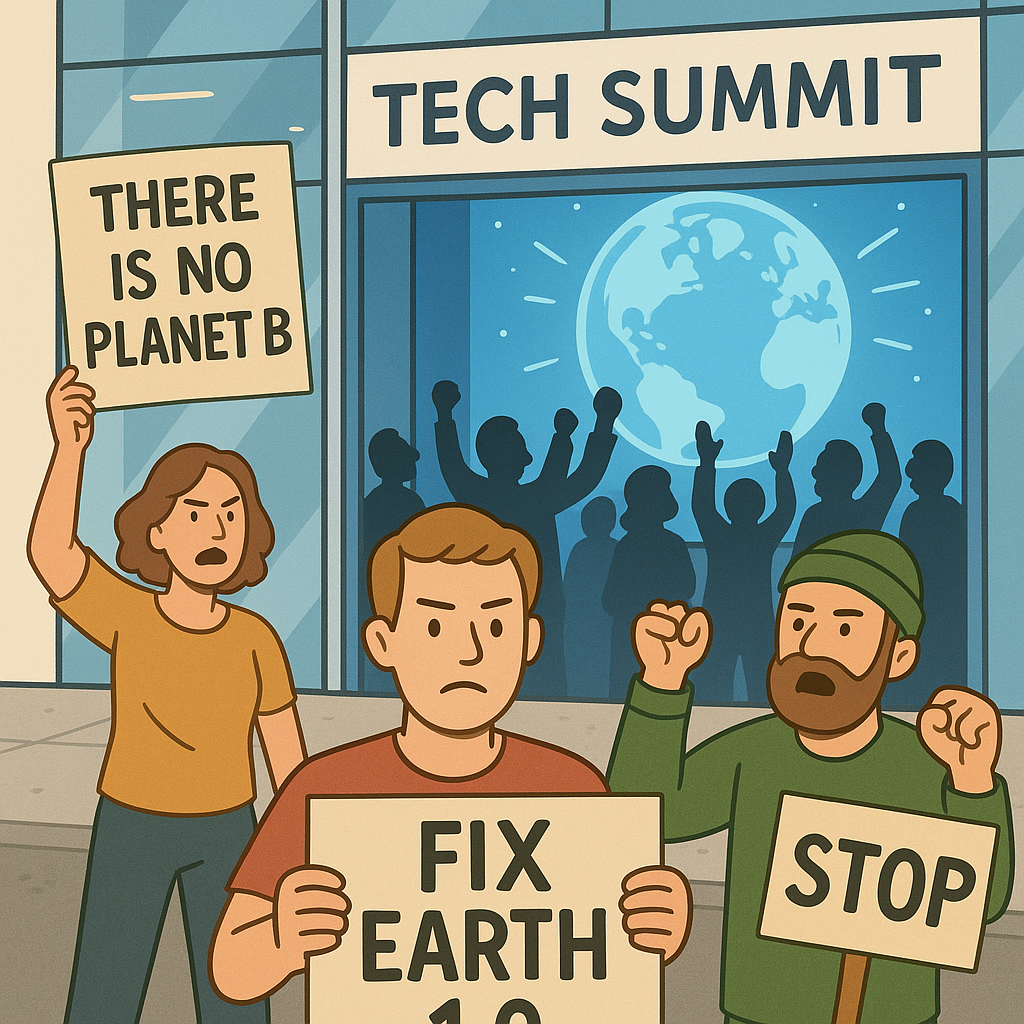
The audience, mostly venture capitalists and executives who have been on six climate panels and one flooded highway, responded with a standing ovation. Some wiped away tears, though it was unclear whether from hope or the dry ice machine accidentally set to “apocalypse.”
Outside the venue, a small group of protesters held signs reading “FIX EARTH 1.0” and “YOU CAN’T A/B TEST A BIOSPHERE.” Security carefully herded them into a designated demonstration zone located just off-camera, where their concerns could be safely acknowledged and structurally ignored.
Back indoors, the founders announced a final feature: a “Reality Sync” tool that periodically mirrors conditions from physical Earth into Earth 2.0 “for accuracy and vibes.” If real-world wildfires, hurricanes, or heat waves surge, users will receive a tasteful notification:
“Your home timeline is experiencing record climate extremes. Would you like to:
- Return to physical reality and participate in collective action.
- Snooze alerts for 30 days and unlock a commemorative badge.”
Focus groups overwhelmingly chose the badge.
As the event wrapped, the lead technocrat took one last question: if Earth 2.0 really takes off, what happens to Earth 1.0?
He smiled the serene, spreadsheet-backed smile of a man who has seen the future as a deck and knows it ends on a slide labeled “Exit.”
“We’ll, of course, continue to support legacy Earth,” he said. “At least until the last user logs off.”
I checked my watch, looked at the charts in my foil hat, and ducked outside into the hot, stubborn, unscalable air.
For now, the server is still us.



