
In the latest attempt to prove that speculative finance can, in fact, become even more incomprehensible, CloudMining has announced that it will “enter a new stage in 2026,” as AMT DeFi swoops in to reshape Bitcoin mining with clean energy, automated hash power, and marketing copy written by a sentient buzzword generator (Openpr.com, Dec 2025).
The joint pitch from CloudMining and AMT DeFi is simple: why just mine Bitcoin like some 2019 peasant when you can mine, stake, farm, and gamify your existential dread, all while a smart contract inverts your risk tolerance every 12 seconds?
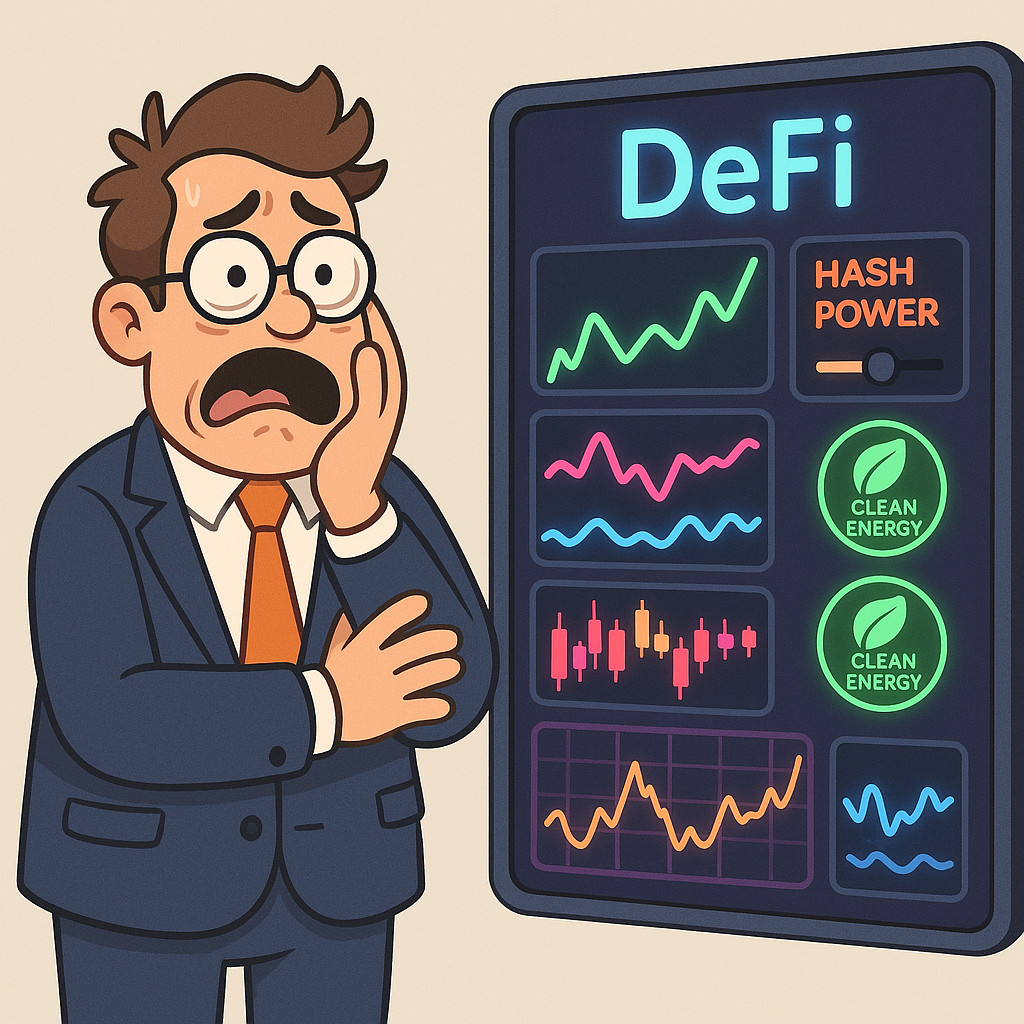
According to the Openpr.com release, AMT DeFi will allow ordinary users to participate in Bitcoin mining using “automated hash power,” “clean energy,” and “transparent on-chain rewards.” Industry observers note that this is the fourth time in five years that the phrase “new stage of CloudMining” has been used, which unofficially qualifies it as a long-running theatre production, currently in Act III: The Reckoning Of The Retail Investors.
“We’re democratizing access to hash power,” an AMT DeFi spokesperson allegedly said, while standing in front of a green-screen wind farm and a Photoshop solar panel resting on a Bitcoin logo. “Before, mining was only for people who could afford warehouses in Iceland. Now, it’s for people who can’t afford groceries but still believe Satoshi will one day personally Venmo them.”
CloudMining’s new DeFi-powered model works like this:
- You deposit crypto into a smart contract.
- The smart contract uses your crypto to rent hash power.
- The rented hash power mines Bitcoin in a facility allegedly powered by clean energy.
- Automated algorithms reallocate hash power based on yield, difficulty, and the CEO’s horoscope.
- You receive a share of the rewards, conveniently expressed in a token whose value fluctuates like a caffeine-addled squirrel.
“It’s basically like a savings account,” one enthusiastic early adopter explained, “if your savings account was a slot machine built on a blockchain powered by a hydro plant located somewhere your lawyer can’t find on a map.”
The highlight of AMT DeFi’s marketing is the promise of clean energy. The press release proudly states that the system will shift Bitcoin mining away from “dirty power sources” toward a mix of solar, hydro, and whatever counts as renewable in a jurisdiction whose environmental guidelines are written in pencil.
“Our goal is to ensure every satoshi is minted with the smug glow of moral superiority,”
claimed an imaginary CloudMining sustainability officer, polishing a recycled-latex lanyard made of shredded NDAs.
Industry analysts remain curious how CloudMining and AMT DeFi will verify that their hash power is truly green. Insiders point to a revolutionary new auditing standard called the Screenshot Of A Solar Panel In A Pitch Deck, which, under Web3 norms, is legally equivalent to a notarized hydropower contract.

To reassure skeptics, AMT DeFi has introduced multiple layers of on-chain transparency. A dashboard will show exactly how much hash power you’ve rented, how much Bitcoin has been mined, and how close the system is to being declared a “community-driven experiment in decentralized loss realization.” All of this is displayed in real time using sleek neon charts optimized for phones and utterly useless for taxes.
Security, too, is allegedly a top priority. “Our smart contracts are audited,” the company notes, without specifying by whom. Some speculate the auditor is the same freelance intern who once Googled “Solidity reentrancy bug” and now lists ‘Protocol Security Specialist’ on LinkedIn.
The AMT DeFi roadmap promises three major phases:
- 2026 Launch: Users stake tokens to earn automated hash power and animated GIF badges celebrating them as ‘Eco Miners.’
- 2027 Gamification: Loot boxes containing rare NFTs of solar panels, each offering +5% APY and -20% reputational credibility when mentioned at family dinners.
- 2028 Metaverse: A VR mine where your avatar can physically shovel virtual coal into an immaculately sustainable server rack.
Underneath the hype, the mechanics are familiar: CloudMining aggregates computational resources, AMT DeFi tokenizes the whole mess, and retail investors line up to trade one form of volatility for another, because the only constant in crypto is the belief that the next whitepaper will finally be the one that doesn’t end with a regulatory investigation.
Indeed, regulators have already noticed. An unnamed official, speaking on background because they hadn’t finished reading the 40-page yield farming explainer PDF, said, “From a preliminary glance, this appears to be a sophisticated financial instrument that will force me to retire early.” They added that classifying CloudMining’s AMT DeFi product might require a new legal category somewhere between ‘commodity’ and ‘vibes.’
Asked about the risk of another mass liquidation event, an AMT DeFi representative shrugged. “Look, everything is risky. Traditional finance has bank runs. We have protocol de-peggings and cascading liquidation spirals. It’s the same thing, just with better branding and worse memes.”
Some veterans of the 2022-2023 crypto winter are less optimistic. “I remember when ‘automated yield’ meant my coins disappearing at 3 a.m. because a dev mis-typed a semicolon,” said one ex-investor, now a part-time risk consultant and full-time doomer. “Adding ‘automated hash power’ just means I get rug-pulled and contribute to securing the network. That’s… progress?”
CloudMining, however, remains bullish. The company insists that this new stage will finally make Bitcoin mining “inclusive,” a term here defined as “open to everyone with a smartphone, a wallet app, and a deep inability to learn from prior market cycles.” AMT DeFi, for its part, stresses that participation is optional, but also gently reminds you that your boring index fund has never once offered you double-digit APY and a holographic NFT of a smiling wind turbine.
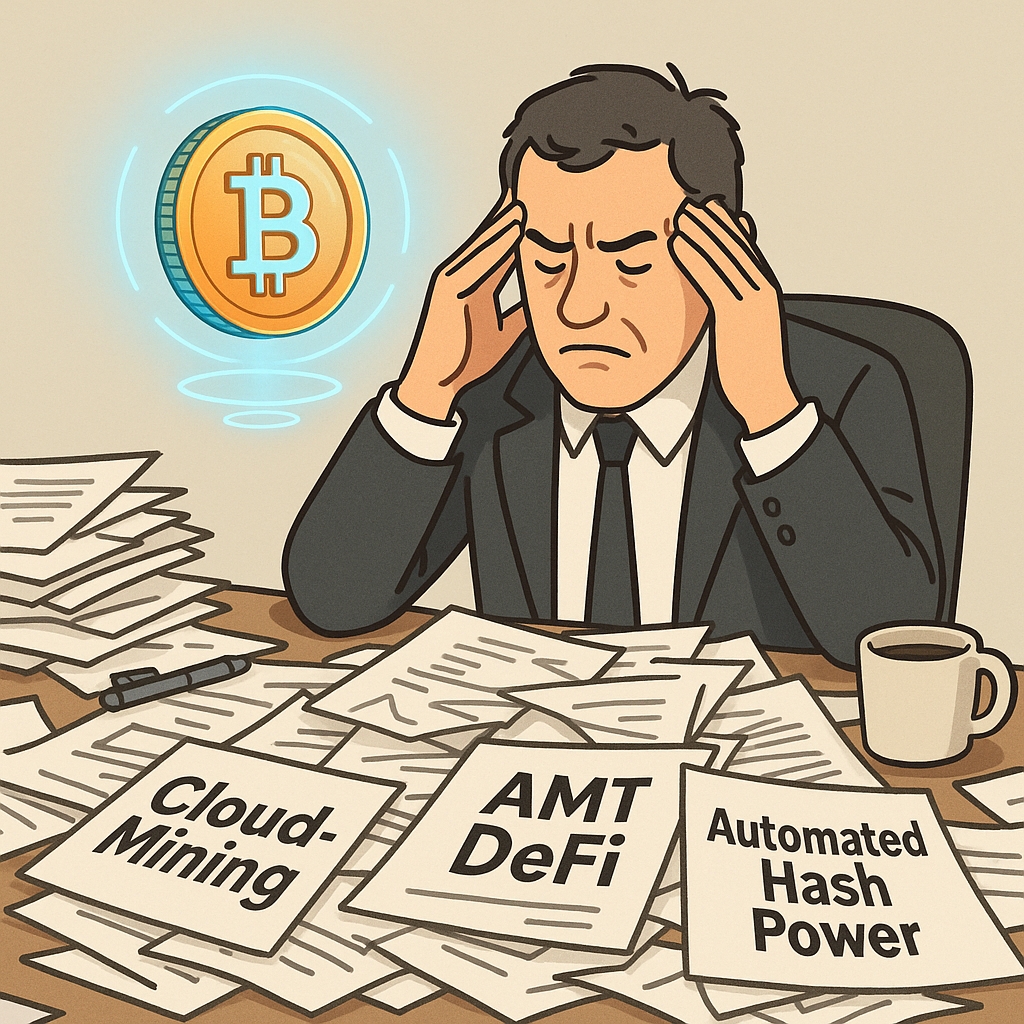
As 2026 approaches, the stage is set: CloudMining provides the infrastructure, AMT DeFi provides the DeFi wrapper, and the global user base provides the liquidity, the memes, and the inevitable Medium posts titled “What I Learned Losing $40K In Clean-Energy Hash Power.”
Somewhere in a data center lit by LED strips and moral ambiguity, a rack of machines spins up, powered by a hydro plant, a solar array, or possibly an extension cord running from a Starbucks. The hashrate climbs, the tokens flow, the dashboards glow green. And for one brief, electrified moment, everyone gets to pretend that the problem with capitalism was just that it wasn’t on-chain yet.
Conspiracy theorists, meanwhile, suggest that CloudMining and AMT DeFi’s true innovation is far simpler: they’ve managed to monetize the one endless resource left on Earth—human hope that this time, maybe, the number really will only go up.