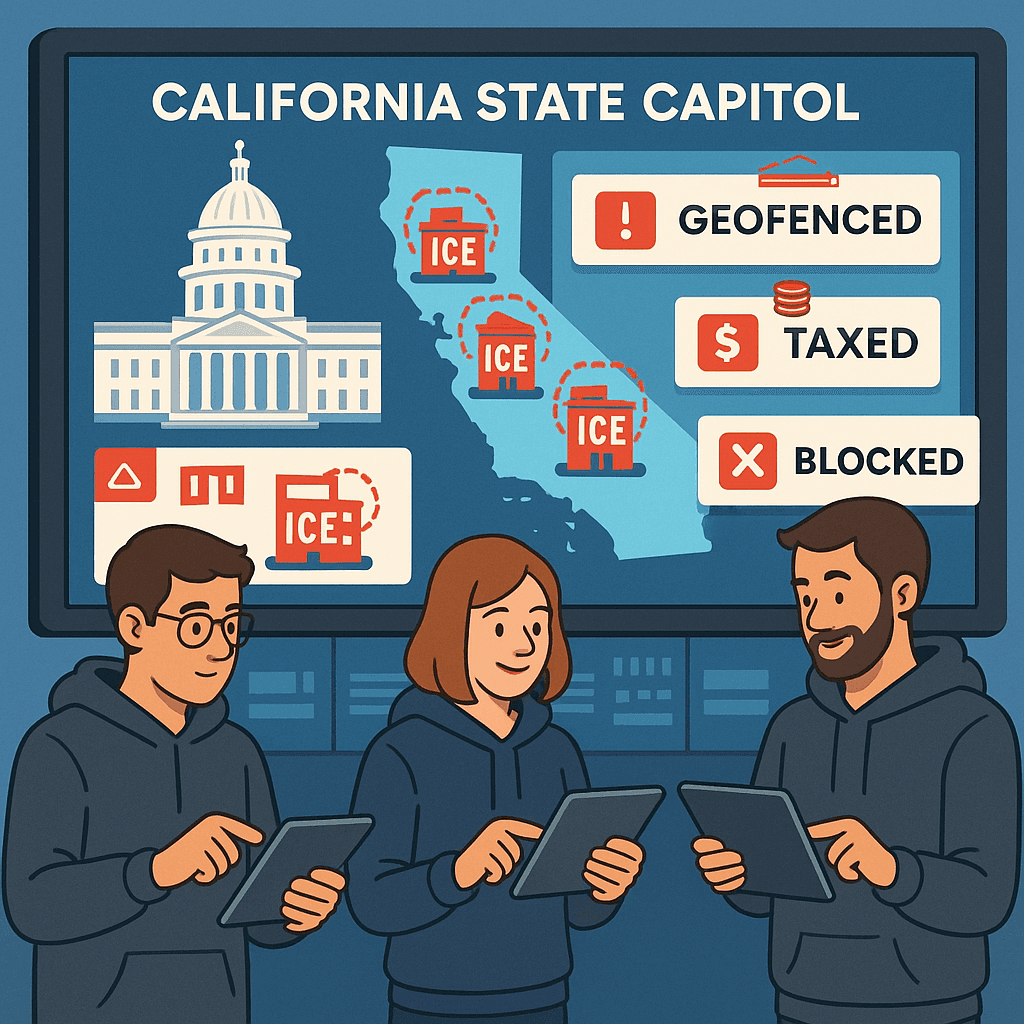
California Democrats have finally answered the age-old question, "What if border policy was designed by a VC-backed SaaS startup?" According to The Santa Barbara Independent (Jan. 31, 2026), party leaders are rolling out a new multipronged strategy for confronting U.S. Immigration and Customs Enforcement — and it reads less like a legislative agenda and more like a hostile Terms of Service update for ICE’s very existence.
The plan: taxes, lawsuits, and location bans. Or as a pitch deck would call it, a three-tiered platform for "disrupting legacy enforcement infrastructure at scale." California Democrats are essentially building a freemium model for federal law enforcement: ICE can still operate, but only if it accepts higher costs, constant pop-up warnings, and a looming "unsubscribe" button in the form of local geofencing.
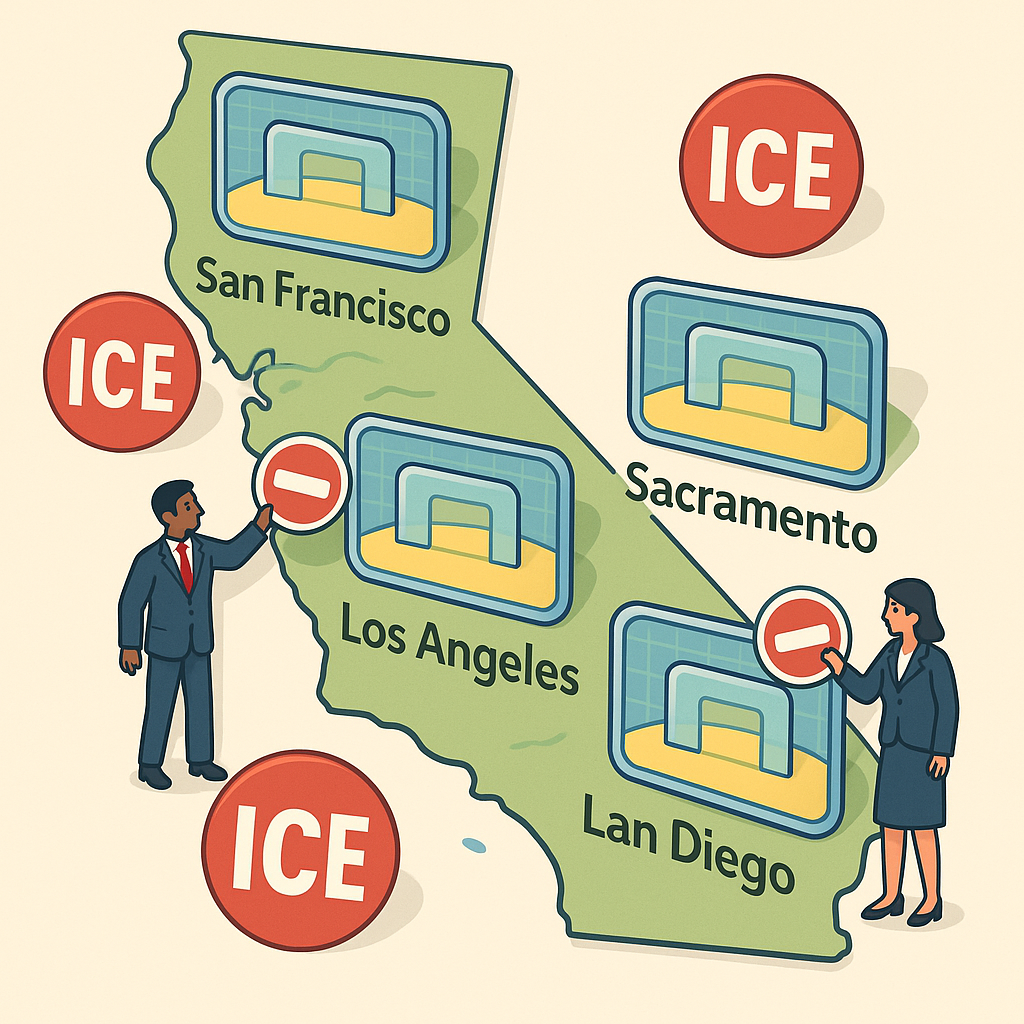
In Sacramento, staffers reportedly described the approach as “the ad-blocker for deportations.” The logic is simple: if you can’t directly shut off ICE, you can at least throttle it like a suspicious IP address from Russia. With location bans, cities and counties would designate ICE-free zones around schools, courthouses, and — in a particularly Silicon Valley touch — WeWork locations, since everyone inside is already living in a quasi-legal grey area.
Under the new proposals, any ICE facility or contractor operating in California could face specialized state taxes, potentially earmarked for immigrant legal defense and, presumably, a very robust line item labeled "Outside Counsel vs. Everyone in D.C." The same way cities tax Airbnb to subsidize housing, California is floating the idea of taxing ICE to subsidize the people ICE is trying to remove. It’s not policy so much as a software patch for karma.
The legal pillar is where things get truly enterprise-grade. The strategy reportedly includes a growing stack of lawsuits that function like a denial-of-service attack, only with more footnotes and fewer GPUs. Every time ICE opens a new office or signs a contract with a local vendor, an API call is triggered in the form of a 300-page complaint in state court. Somewhere in Washington, a DHS lawyer is quietly screaming into a SharePoint folder.
"We’re not abolishing ICE," one unnamed strategist allegedly said, "we’re just turning their job into a never-ending cookie consent banner."
Location bans are where the tech analogies go fully off the rails. Cities across California are reportedly exploring municipal “no-ICE zones,” which function less like sanctuary policies and more like real-world geofences: cross the line, trigger an alert. Think Pokémon Go, but instead of catching Pikachu, you just catch a cease-and-desist letter.
Urban planners in Los Angeles are said to be experimenting with a heatmap of ICE sightings, combining public tips, license plate scans, and the universal constant of federal agents driving Dodge Chargers with government plates. A prototype dashboard allegedly displays red zones for "High ICE Activity" and green zones for "Mostly Just Startups and Cold Brew." Reliability is not guaranteed, but it still outperforms half the apps in the App Store.

Tech companies, never ones to miss an opportunity to monetize constitutional friction, are circling the issue like it’s the last unclaimed Web3 grift. Several Bay Area startups are rumored to be pitching products that align perfectly with California’s plans to confront ICE:
- GeoJustice™: a SaaS dashboard that overlays ICE office locations with local zoning ordinances, then auto-generates angry letters for city councils to read into the record.
- TaxTor™: an AI-powered engine that finds every obscure state tax line item that might apply to ICE contractors, then suggests additional "experimental levies" for fun.
- Cease.ai: uses machine learning to generate bespoke legal threats in under 30 seconds, complete with citations and passive-aggressive footnotes.
One Santa Barbara-based founder, interviewed by The Santa Barbara Independent, insisted their tool could “reduce ICE’s operational footprint by 30% just through automated compliance friction.” The product is currently in beta and, like all good civic tech, is free for non-profits but $19.99/month for any agency whose name contains three or more capital letters.
In Washington, ICE officials have reportedly reacted with the same enthusiasm Meta reserves for EU privacy laws. One anonymous official complained that California Democrats were turning immigration enforcement into "a platform nightmare" riddled with random constraints, local overrides, and unpredictable error messages like "Operation Blocked in This Jurisdiction" and "Your Raid Cannot Be Completed As Dialed." (AP, Jan. 2026)
Meanwhile, civil liberties groups are quietly delighted that state governments have finally discovered the joy of weaponized bureaucracy. "For years, only immigrants faced impossible paperwork and constant uncertainty," noted one advocate. "It’s nice to see ICE experience what it’s like to live on the other side of the clipboard." She added that the ultimate goal is a "mutually assured compliance" regime where every action by every agency requires so many approvals that everyone just goes home.
The real innovation, though, may be political rather than legal. California Democrats have essentially turned opposition to ICE into a modular policy stack: counties can opt into taxes, cities can choose location bans, and the attorney general’s office can deploy lawsuits like downloadable content. It’s federalism as a service, with in-app purchases.

Critics warn that this escalating confrontation could trigger a constitutional showdown, or at least generate enough paperwork to deforest half of Oregon. But for the moment, Sacramento appears unbothered. One strategist reportedly compared ICE to outdated enterprise software: "You don’t uninstall it overnight. You just start limiting its permissions, sandboxing it, and waiting for a security breach to justify a full migration."
As California Democrats proceed with their plan of taxes, lawsuits, and location bans, ICE now faces a new operational reality: less like a law enforcement agency, more like a user desperately trying to access Netflix through a VPN while the system keeps asking, "Are you sure you’re allowed to watch this here?" In the end, the question isn’t whether the state can abolish ICE — it’s whether, under enough legal throttling and geographic rate-limits, anyone can tell if it’s still running.



