In a bold step to modernize governance without actually learning how anything works, Congress this week unveiled the “National Emergency For Things We Saw On Facebook Act,” empowering lawmakers to treat viral posts as actionable intelligence while continuing to treat expert testimony as optional fan fiction.
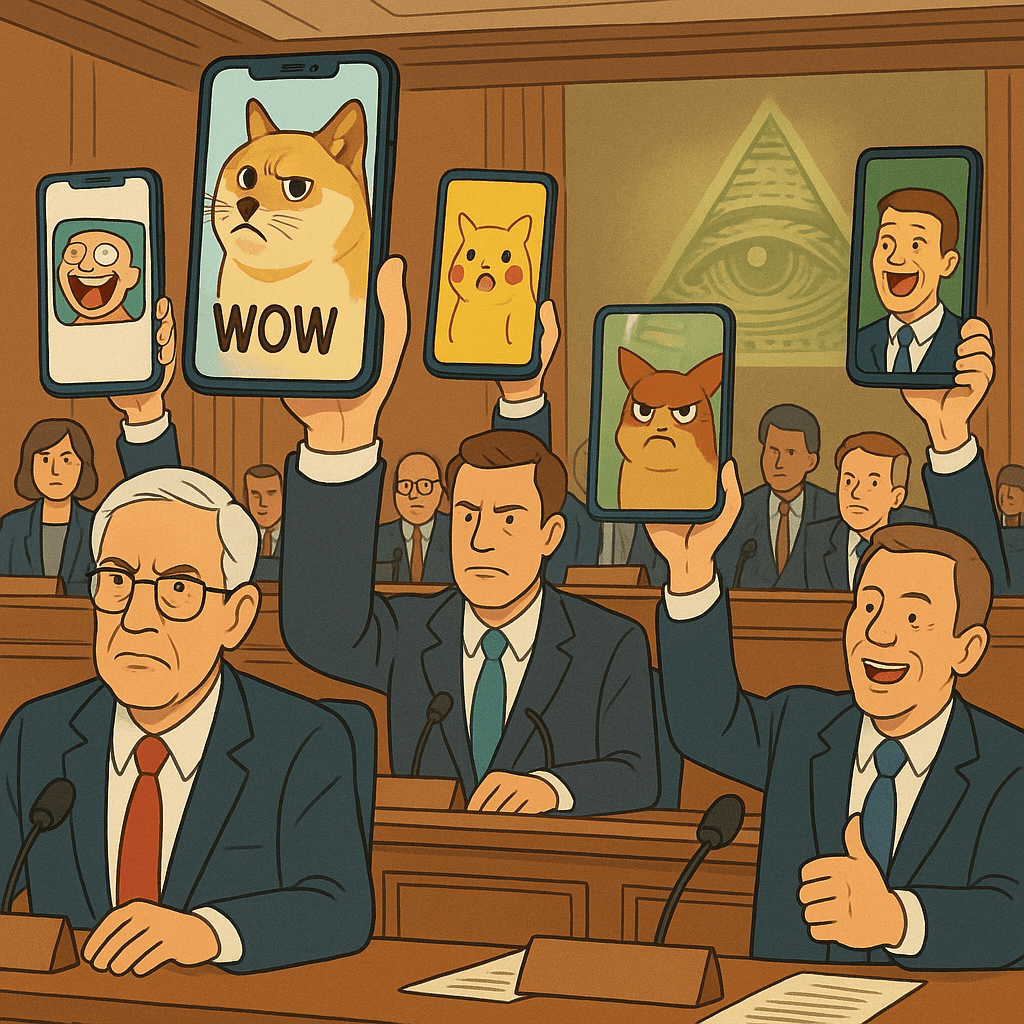
The bipartisan proposal, officially titled the Social Media Threat Response And Triage Act (SMTRATA, pronounced “smear-data”), would allow any member of Congress to trigger a 90-day national emergency simply by waving a smartphone on the House floor and screaming, “Have you SEEN this?!”

Under the bill, screenshots will carry the same legal weight as classified briefings, provided they contain at least three of the following:
- a blurry infographic with tiny, illegible sources
- the word “EXPOSED” in red, dripping letters
- a cropped TikTok of a guy in a truck explaining the Constitution
- an AI-generated politician with too many fingers signing something ominous
“For too long, this nation has suffered under the tyranny of context,” declared Rep. Marjorie Taylor Greene, holding up a printed meme like it was the Dead Sea Scrolls. “This bill says: if it’s on my feed, it’s on your freedoms.” She then yielded the remainder of her time to a 47-second compilation of out-of-context school board clips set to dramatic violin music.
The legislation follows a recent pattern in Washington where, as one Senate staffer put it, “We no longer respond to events, we respond to vibes about events.” After watching the Federal Reserve chair explain inflation for three hours on C-SPAN, several lawmakers reportedly changed their policy position only after seeing a one-sentence caption about the same topic on Instagram Reels.
“Honestly, it’s more efficient,” admitted one anonymous House aide. “We used to have these tedious hearings with, like, Nobel laureates and charts. Now we just pull up whatever went viral last night and ask, ‘Is this real?’ Then we draft the law based on whoever yells the loudest.”
To ensure fairness, SMTRATA creates a new joint committee: the Select Committee on Posts We Did Not Read But Have Strong Opinions About. Its task is to rank crises based on three metrics:
- How angry the comments are
- How many times someone typed “wake up, sheeple”
- Number of bald eagles or Founding Fathers in the thumbnail
“If Ben Franklin is pointing at me while an eagle cries in the background, I know it’s time to legislate,” said one senator, scrolling with the intensity of a day trader. “Is that not what he died for?” (Historians later clarified on PBS that Franklin did not, in fact, die for a Facebook Reel.)
The bill also sets up a rapid-response unit inside the Department of Homeland Security: the Office of Meme Assessment. Career intelligence analysts will be retrained to classify posts using a new tier system:
- Threat Level Beige: Misleading but mostly about astrology.
- Threat Level Amber Alerted: Includes a screenshot of a tweet that never existed.
- Threat Level Code Red Pill: Features a 20-minute rant filmed in a parked car.
“When I joined DHS, I thought I’d be tracking foreign terror networks,” said one veteran analyst, now assigned to decode Facebook groups with names like “Patriots For Real Freedom Of Truth And Also Gardening.” “Last week I spent eight hours confirming that no, the World Health Organization did not secretly ban clouds.”

Legal scholars immediately raised concerns that the bill effectively outsources national security to the Facebook algorithm. Constitutional law professor Anita Shah noted, “We are crossing a dangerous line between ‘representative democracy’ and ‘whatever the top comment says.’ The Founders did not write the First Amendment so that Congress could treat your cousin’s minion meme like a sworn affidavit.”
Supporters counter that the Founders also never foresaw the raw power of a 35-second clip with auto-generated captions and lo-fi beats. “Madison gave us checks and balances,” argued one supporter from the House Freedom Caucus. “TikTok gave us someone shouting those checks and balances into a ring light in their garage. Which one are people actually watching?”
In a quiet corner, a visibly exhausted librarian from the Congressional Research Service tried to get someone—anyone—to read a five-page summary of recent Supreme Court decisions. She was reportedly told, “Send it as a meme or a thirst trap and we’ll consider it.”
The White House, eager not to be left out of the content, announced it is “studying the proposal” and “workshopping some relatable skits.” According to a senior communications official, the administration is considering a series of videos where cabinet members dramatically react to misleading headlines before a calm narrator says, “Let’s break this down,” and then no one watches the last two minutes where the facts are.
This wouldn’t be the first time elected officials treated the internet like a classified briefing room. During Mark Zuckerberg’s 2018 testimony (CNN, April 2018), several senators used their allotted time to ask what, exactly, the internet is and whether Facebook can “see the emails.” One lawmaker reportedly still believes “the cloud” is either a Pentagon program or a weather event.
“We’re just building on established precedent,” said Rep. Kevin McCarthy’s former digital advisor. “If a grandparent in Omaha can share a meme, why can’t a subcommittee turn it into law? That’s what we call closing the representation gap.”
Opponents offered a modest counterproposal: a “National Waiting 24 Hours Before Panicking Act,” under which Congress would commit to not drafting any bill within the first day of a viral outrage, on the radical theory that new facts might emerge. The idea died in committee after being labeled “elitist,” “anti-freedom,” and “bad for engagement.”
Instead, lawmakers agreed on a compromise amendment: any time a member of Congress introduces a bill based on a single viral post, they must at least scroll once to see the comments section. “If you can look into that abyss and still want to legislate,” said one senator, “then you’ve earned it.”

In a late-night markup session, the bill was further expanded to allow the President to issue an executive order based entirely on a YouTube thumbnail, provided it includes the phrases “They Don’t Want You To Know This” and “MUST WATCH BEFORE IT’S DELETED.” Legal text for this section was reportedly adapted from the terms of service of a popular conspiracy podcast.
Ultimately, SMTRATA passed its first committee hurdle with overwhelming support. The few dissenters pleaded for “basic media literacy” and “some form of objective reality,” but their concerns were drowned out when an aide mistakenly AirPlayed a conspiracy documentary onto the hearing room’s main screen. The committee immediately voted to open an investigation into itself.
As the bill heads to the full House, cable news panels are already split. One pundit on Fox News praised it for “finally taking digital threats seriously,” while a rival on MSNBC condemned it as “a terrifying collapse of reason”—before both shows cut to the same viral clip of a lawmaker yelling at a printer in the new “Center for AI Panic,” insisting it had become self-aware.
Back in his studio, your humble cartoonist sharpened a pencil, drew a pyramid with Wi-Fi bars beaming out from the top, and sketched Congress sitting in the Eye of Providence, scrolling. Below, a caption:
“Government of the people, by the algorithm, for the engagement.”
Comments were disabled for your safety.