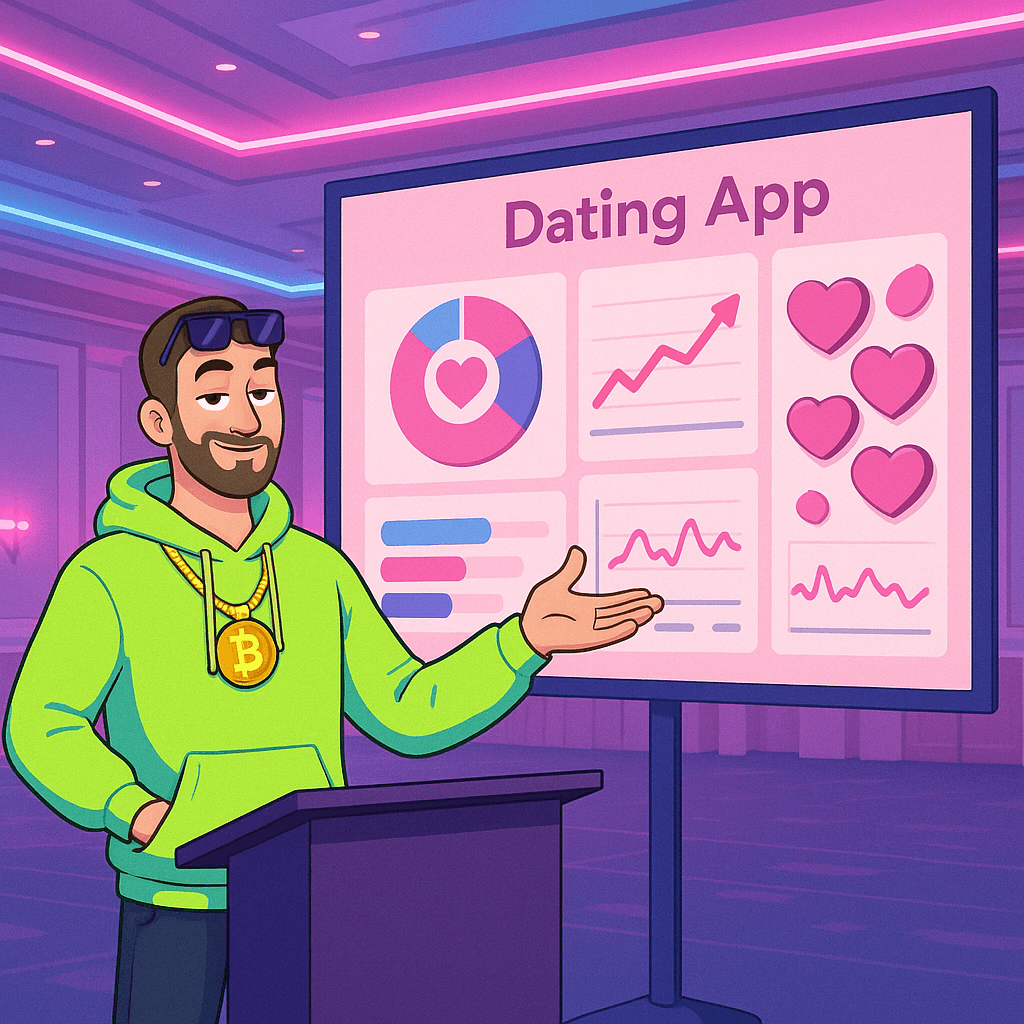
In a bold attempt to solve both financial speculation and chronic emotional unavailability, a group of blockchain founders this week unveiled the “Decentralized Girlfriend Protocol” (DGP), a Web3 platform that promises to finally put relationships on the blockchain, where they belong: public, irreversible, and vulnerable to exploits.
The launch, held in a Miami hotel ballroom that silently screamed “divorce hearing,” drew hundreds of crypto enthusiasts looking for what the founders call “yield-bearing intimacy.” While traditional apps like Tinder focus on matching people based on location and vibes, DGP focuses on the only metric that really matters in late-stage capitalism: liquidity.
“We realized the biggest problem with dating is counterparty risk,” explained DGP co-founder and self-described ‘Chief Romantic Officer’ Bryce, who legally removed his last name to appear more mysterious in Discord. “With smart contracts, if you ghost someone, your deposit is auto-staked into the Lonely Hearts Treasury. That’s accountability, that’s Web3, that’s love.”
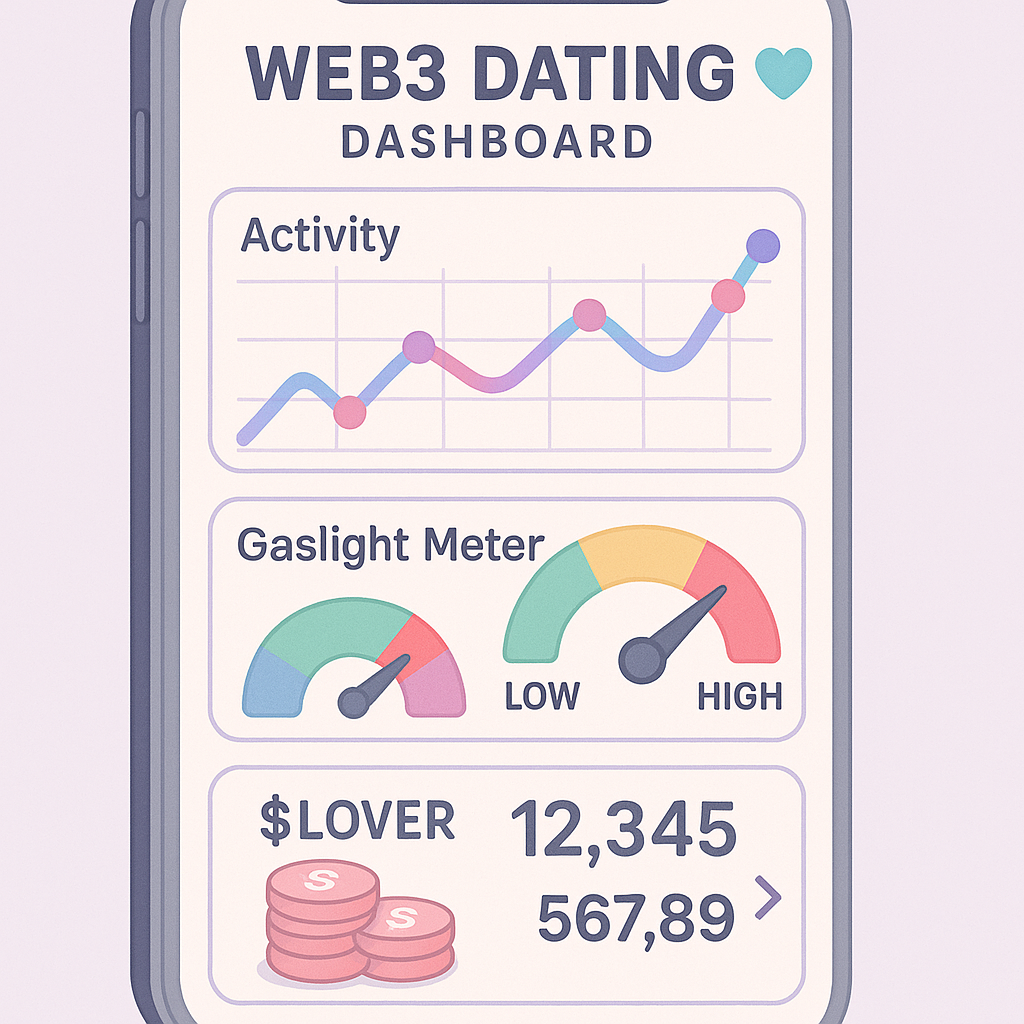
According to the project’s slick 68-page whitepaper (printed only on recycled Medium posts), users can stake a proprietary token called $LOVER into “Relationship Pools.” When two users match, a smart contract locks both parties’ $LOVER as collateral. Staying together for 90 days — defined in the whitepaper as “continuous mutual engagement or at least shared Google Calendar events” — yields bonus tokens. Break up early, and your tokens are slashed and redirected to something called the “Therapy DAO.”
“We’re gamifying emotional resilience,” said Bryce. “Also tax harvesting. Mostly tax harvesting.”
Investors, burning with the regret of not buying Bitcoin in 2013 and not selling it in 2021, have rushed in. The project just closed a $75 million seed round from an all-star cast of venture capital firms who, sources confirm, have never made eye contact during a hug. One partner at Andreessen Horowitz, who requested anonymity because this is embarrassing even for them, praised the team’s vision.
“Look, young people don’t own homes, they don’t trust banks, and their attention spans are shorter than a FTX risk committee meeting,” the partner said. “But they will farm imaginary internet coupons if you attach a Discord role and some pastel branding. We see this as the inevitable evolution of both DeFi and emotionally avoidant dating culture.”
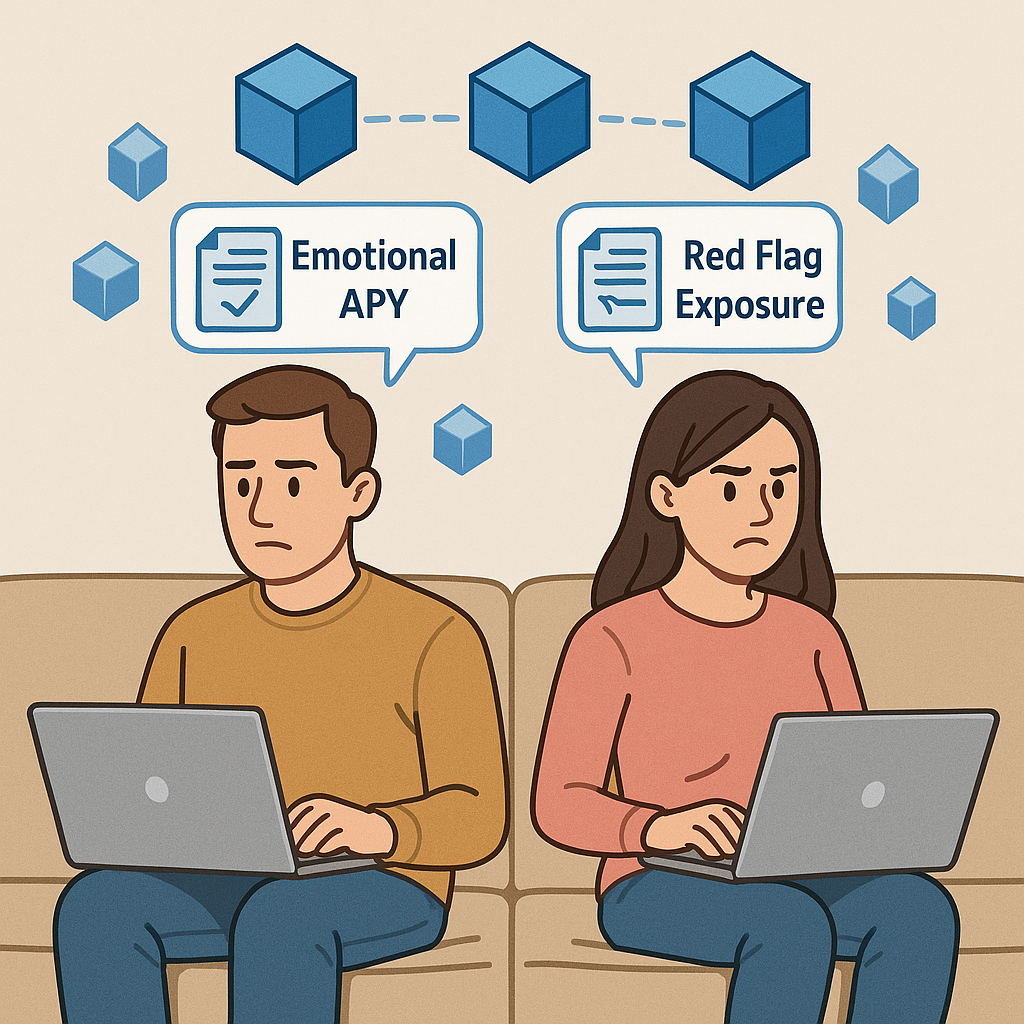
The app’s UX is designed to feel like a cross between a brokerage interface and a situationship. A dashboard shows your “Emotional APY,” your “Red Flag Exposure,” and a live “Gaslight Meter” that spikes whenever your match types “lol you’re overthinking it.” A built-in AI “Sentiment Oracle” — trained on historical text messages, Instagram likes, and late-night Spotify playlists — adjusts your collateral in real time based on the likelihood that your relationship is about to rug-pull.
Critics, including several relationship therapists and one visibly exhausted bartender, argue that tokenizing affection may not be the healthy disruption the world needs. “They’ve essentially created a derivatives market for unresolved attachment issues,” said Dr. Lauren Kim, a New York-based psychologist. “On the plus side, this will make my job absolutely recession-proof.”
Industry observers note that the project arrives amid renewed scrutiny of crypto’s more unhinged experiments. After the spectacular collapse of multiple exchanges and schemes in recent years, regulators have grown wary of anything involving tokens, leverage, or a founder who uses ‘vibe’ as a legal term. Even SEC Chair Gary Gensler — who has spent the last few years explaining to Congress that maybe, just maybe, coins named after dogs should not underpin the global economy (CNBC, 2023) — reportedly sighed heavily when briefed on DGP.
“Look, relationships are already basically unregistered securities,” Gensler allegedly told staff. “They’re marketed with promises of future returns, most of them never deliver, and there’s absolutely no disclosure of hidden liabilities. The only difference here is somebody made a token and a pitch deck.”
Still, adoption appears strong. Influencers have begun shilling DGP across TikTok, Instagram, and whichever app Elon hasn’t paywalled yet. One lifestyle creator with 3.2 million followers posted a video titled “I Turned My Boyfriend Into a Liquidity Pool — You Won’t BELIEVE My APR,” in which she walks viewers through her “poly-yield” strategy of staking small amounts of $LOVER with three different matches “for diversification.”
“Monogamy is like holding a single blue-chip stock; that’s cute if you’re 60,” she says in the clip. “I’m Gen Z. I need optionality and upside. If a man can’t beat Treasury yields, why am I allocating emotional capital?”
To entice more women into the ecosystem, the team has rolled out “Red Flag NFTs,” collectible badges representing classic dating hazards. Early mints include:
- The Vanishing Ex: grants immunity to “my last relationship really messed me up” speeches after the third date.
- Crypto Coach: automatically mutes any wallet that starts a sentence with “Not financial advice, but…”
- Soft Launch: blurs your partner’s face in all social media posts until their credit score is verified on-chain.
Each NFT can be traded on secondary markets, allowing users to flip their trauma hedges at a profit during bull runs in collective delusion. Secondary sales, of course, generate royalties for the founders “to ensure long-term alignment with your poor life choices.”

The roadmap, which looks suspiciously like every other crypto roadmap but with more pink gradients, promises upcoming features such as cross-chain compatibility (“so you can cheat on Polygon”), a “Family DAO” for deciding who gets the dog after a breakup, and integration with major payment processors “for seamless, tap-to-pay emotional damage.”
Perhaps the most controversial planned release is “Governance Voting,” where tokenholders will be able to cast binding votes on other couples’ disputes. Think HOA drama, but token-gated. “Imagine a fully decentralized jury of peers deciding whether Chad was ‘just networking’ at that rooftop bar,” said Bryce. “Finally, true justice.”
Not everyone is convinced. A small but vocal group of skeptics has formed a rival project, “Off-Chain Relationships,” which they describe as “beta-testing analog love.” Their protocol involves meeting people without filters, talking without push notifications, and breaking up without airdropping governance tokens. The team admits the concept is “wildly unscalable” and “unlikely to attract VC interest,” but say they’re “optimistic about organic word-of-mouth marketing, like in the olden times when people died at 35.”
Back at the Miami launch, as a DJ blasted a remix of a TED Talk about authenticity, DGP’s founders took the stage to celebrate their token’s 400% price spike in the first hour of trading. When asked what would happen to users if the token crashed, or if the smart contracts malfunctioned, or if the entire project turned out to be an elaborate way to launder disappointment, Bryce smiled.
“Look,” he said, adjusting his neon ‘LOVE IS CODE’ hoodie, “every relationship is a speculative bet with incomplete information, no regulatory oversight, and terrible risk management. We didn’t invent any of this. We just made a dashboard.”
He paused, glanced at the live token chart, and added, “And if it all implodes? Don’t worry. We’ve already got the next big thing in stealth: a decentralized co-parenting protocol. Think custody, but with yield.”
For now, millions of lonely wallets seem ready to give it a try. After all, if your love life is going to be volatile, you might at least want a chance to farm some rewards on the way down.



