In a landmark move that economists are calling “the logical conclusion of whatever this decade is,” the U.S. Federal Reserve announced it will abandon traditional economic indicators and adopt a new framework known as Vibes-Based Monetary Policy (VBMP).
Under the new regime, interest rate decisions will no longer be guided by inflation data, employment figures, or anything that requires a spreadsheet. Instead, Fed officials will simply ask themselves one question before each meeting:
“How are we feeling about money right now?”
Fed Chair Jerome Powell unveiled the shift at a press conference Thursday, standing at a podium flanked by a crystal collection, a ring light, and what looked suspiciously like a vision board from a 2014 YouTube influencer. 
“For decades, we have tried to manage the economy using outdated tools like models, data, and so-called ‘reality,’” Powell said, gently misting the room with eucalyptus spray. “But as recent years have shown, markets respond far more reliably to vibes, memes, and whether Taylor Swift is on tour. It’s time our policy framework caught up.”
Under VBMP, the Fed will replace core metrics with a new basket of indicators known as the Vibe Composite Index (VCI), which will include:
- Number of rocket emojis posted per hour on financial Twitter
- Average length of LinkedIn “I’m humbled and honored to announce…” posts
- Spotify streams of “Rich Men North of Richmond” normalized against Doja Cat
- Percentage of Americans who say “we ball” immediately after checking their bank app
All these inputs will be fed into a proprietary AI model, nicknamed “GreenspanGPT,” which the Fed quietly trained on 40 years of FOMC minutes, Tumblr astrology blogs, and YouTube reaction videos to CPI announcements. According to insiders, the model currently forecasts a 72% probability of a “soft landing” and a 100% probability that Powell’s dog deserves its own Instagram.
Wall Street reacted instantly. The S&P 500 soared 4% in after-hours trading, led by companies whose business models are already entirely vibes-based: Tesla, Meta, and whatever that one AI startup is that raised $800 million last week to “reimagine spreadsheets as a lifestyle.” The Nasdaq briefly halted trading after options volume hit what one analyst described as “emotionally concerning yet spiritually aligned” levels. 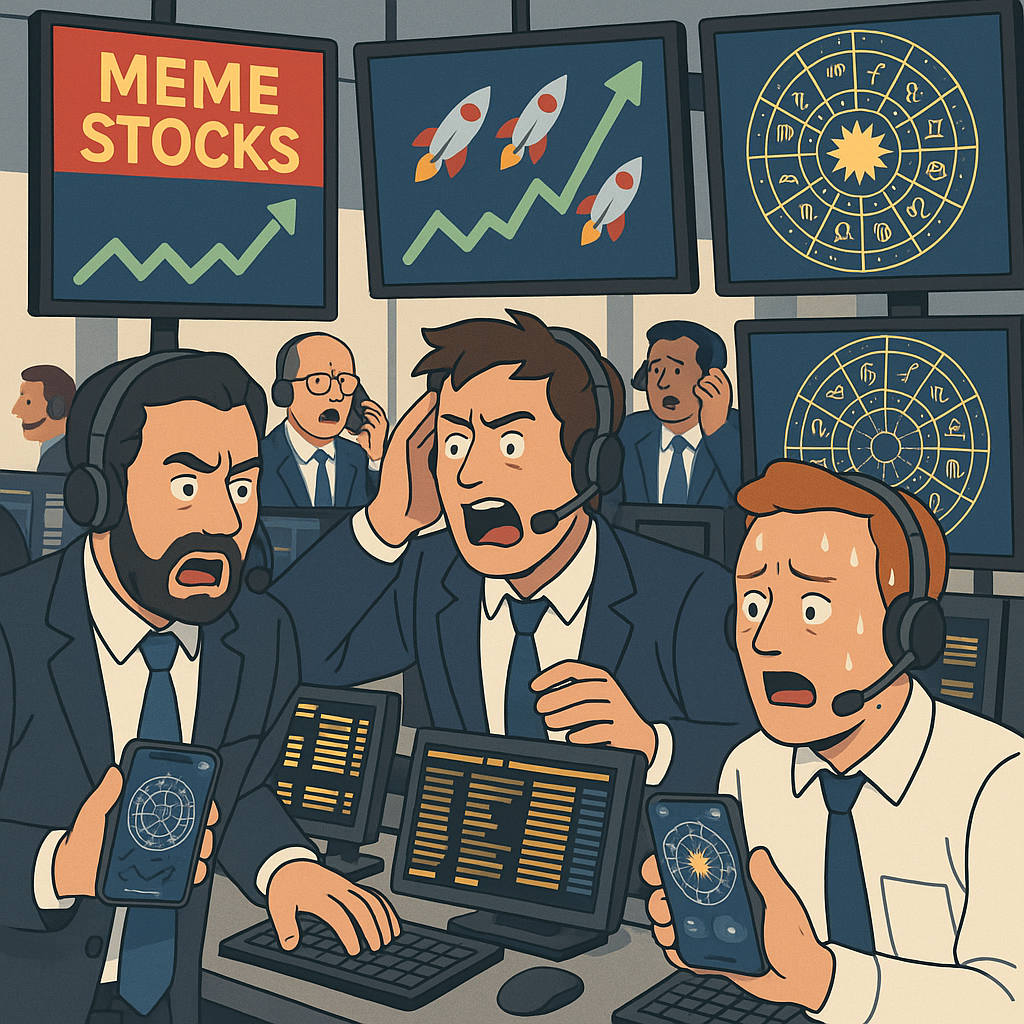
“This is extremely bullish,” said one hedge fund manager, furiously refreshing his FOMC live blog and an Instagram astrology page at the same time. “We’ve all known for years that the market stopped caring about fundamentals when WeWork tried to trademark ‘We.’ Now the Fed is just being honest about it.”
Retail investors also welcomed the move. “Finally, the Fed is speaking my language,” said Kyle, 27, who describes himself as a “full-time options trader and part-time accountability coach.” “I’ve been setting my leverage based on whether the moon is in Capricorn and the number of TikToks I see about ‘generational wealth.’ I feel so seen.”
Academic economists were less enthusiastic, mostly because they now have to rewrite half their textbooks. “We spent decades refining models around the Phillips curve, inflation expectations, and labor participation,” said one MIT professor. “Apparently we should have been measuring how many people are doom-posting ‘late stage capitalism’ on X instead.”
The professor then opened his laptop, pulled up a chart of meme frequency vs. consumer sentiment, stared at it in silence, and muttered, “God help me, it’s actually correlated.”
Defending the shift, Powell pointed to years of market reactions that appeared unmoored from fundamentals. “Look at 2021,” he said. “GameStop, Dogecoin, bored cartoon apes selling for more than starter homes. Then Sam Bankman-Fried happened, and the market still only half-flinched (NY Times). The data has been screaming this at us for a while: numbers are cosplay, vibes are policy.”
The Fed’s new policy toolkit will include:
- Rate Chakra Alignment: Before any hike or cut, officials will undergo a guided meditation to determine whether the ‘energy’ of a 25-basis-point move feels grounding, expansive, or “like Mercury in retrograde.”
- Forward Guidance as Affirmations: Press releases will shift from phrases like “higher for longer” to “abundance is coming, you just have to trust the process.”
- Dot Plot → Mood Board: Instead of projections, each member will pin an image that represents how they feel about the economy. Sources may include Etsy, Pinterest, or screenshots of Zillow listings that make them inexplicably angry.
In a pilot test of the mood board, one FOMC member reportedly chose a photo of a crumbling bridge overlaid with the words “girlboss,” which markets interpreted as “mildly hawkish.” Another picked a picture of a raccoon digging through overflowing trash labeled “private equity,” which was deemed “broadly neutral for risk assets.”
International reaction has been swift. The European Central Bank, desperate not to look uncool again after spending half of 2021 insisting inflation was “transitory,” announced it would consider its own version of VBMP, centered around “Eurozone Emotional Stability.” The Bank of Japan declined to comment, citing a long-standing policy of pretending global monetary experiments are happening somewhere else.
Crypto markets, naturally, went feral.
Within minutes of the announcement, a new token called $VIBE launched, promising to “decentralize the Federal Reserve's emotional labor.” Its whitepaper, written entirely in lowercase and questionable grammar, claims holders will be able to “govern the global mood” through staking and “collaborative manifesting.” The token reached a $2 billion fully diluted valuation in four hours, briefly surpassed the market cap of several regional banks, then crashed 70% after the project’s anonymous founder tweeted, “ngl, woke up & the vibes r off.”
Not to be outdone, an NFT collection entitled “Jerome’s Chakra Candles” minted out in 11 minutes. Each NFT corresponds to a hypothetical rate decision and comes with a “spiritual utility” of changing color whenever Powell says the word “uncertain” in a press conference. I checked the smart contract from my sophisticated basement server array in New Jersey and can confirm: still non-fungible, still somehow a thing.
On Capitol Hill, lawmakers struggled to keep up. One Senator demanded to know whether VBMP would cause “runaway manifesting,” while another asked if the Fed would be “gender-neutral in its vibe calibrations.” A third, reportedly confused, asked if this had anything to do with that time Janet Yellen ate magic mushrooms in China (as widely reported in 2023) and “saw the yield curve breathe.”
In closing his remarks, Powell offered a final reassurance to the American people.
“We remain firmly committed to our dual mandate: maximum employment and stable vibes,” he said. “We will do whatever it takes to ensure that when you open your brokerage app, you feel a mix of cautious optimism and low-grade dissociation, not outright panic.”
He then stepped away from the podium, lit a sage bundle, and rang a small brass bell to signal that the press conference — and possibly the era of rational markets — had officially ended. 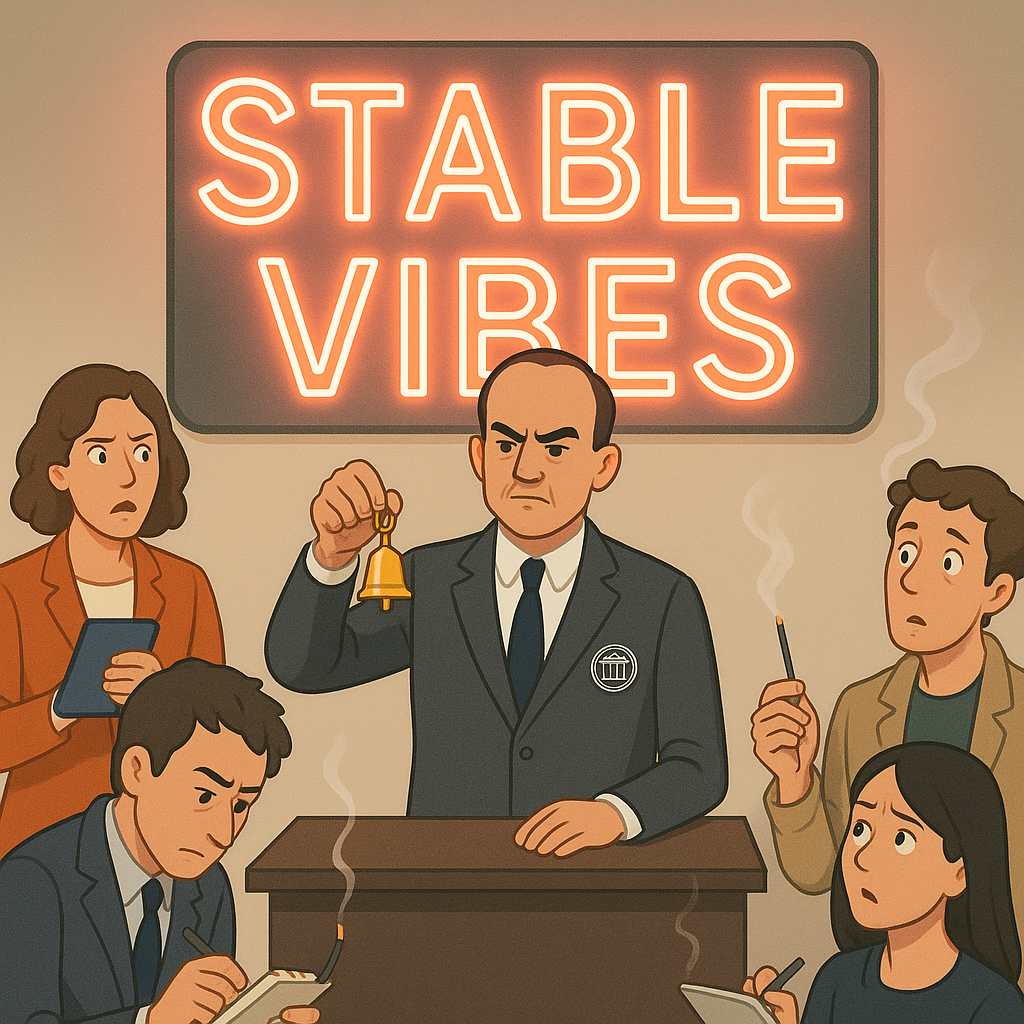
Analysts say the long-term impact of Vibes-Based Monetary Policy remains unclear. But in the short term, futures markets are pricing in a 94% chance that interest rates will remain unchanged at the next meeting, and a 100% chance that whatever happens, everyone will pretend they “knew it was coming” based on “the energy.”
As for me, I’ll be right here in my New Jersey server basement, watching the global financial system hang by a thread made of memes and moon cycles, and wondering if civilization’s final act will be a soft landing, a hard crash, or just a vibes-based fade to black.