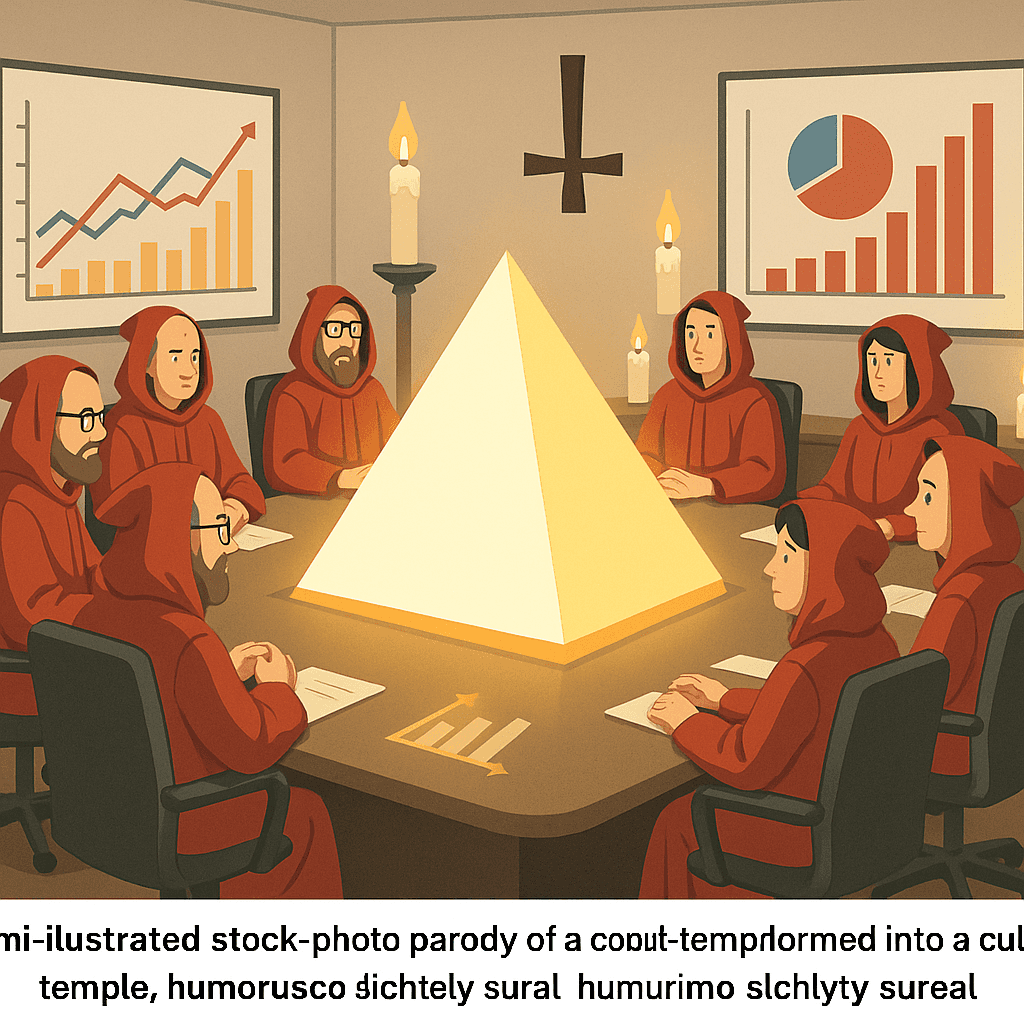
In a move Wall Street analysts are calling “deeply honest and therefore extremely bullish,” consumer tech conglomerate OmniSynq Holdings announced in its latest earnings call that it will no longer describe itself as a “company,” opting instead for the more transparent label: “high-demand corporate cult with competitive benefits.”
“The market is tired of euphemisms,” CEO Marjorie Kline told investors on a live-streamed call that opened with a gong and a legally distinct version of a Gregorian chant. “We say ‘mission-driven,’ we mean ‘life-consuming.’ We say ‘go above and beyond,’ we mean ‘surrender weekends and circadian rhythm.’ So we’re cutting the jargon. This is a cult. A very profitable one.”
The announcement sent OmniSynq’s stock up 11% in after-hours trading, as hedge funds rushed to increase their exposure to what Goldman Sachs analysts immediately labeled the “Belief-as-a-Service” sector. “Religions have had a monopoly on monetized devotion for millennia,” read a client note. “It’s time corporations stopped leaving spiritual exploitation alpha on the table.”
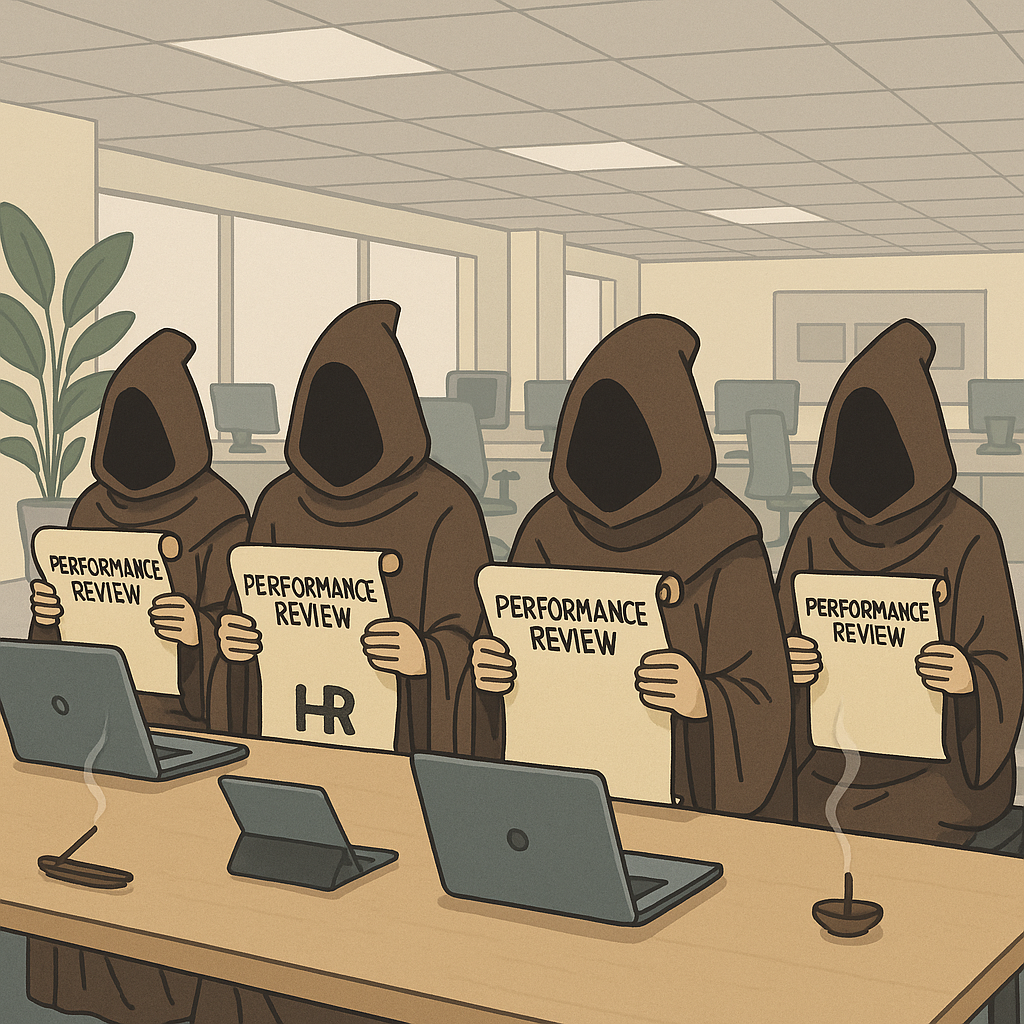
Under the new structure, traditional corporate roles have been rebranded to more “spiritually aligned” titles. Middle managers are now “Circle Captains,” HR has become “The Council of Harmony and Litigation,” and the Chief People Officer will henceforth be known as “High Priestess of Culture.” Employees, previously referred to as “team members,” are now divided into three tracks:
- Initiates – new hires who still think work-life balance is a negotiable concept.
- Ascendants – staff who have accepted that PTO is more of an energy than a reality.
- Transcendents – senior leadership who aggressively retweet Adam Grant and sleep 4.5 hours per night.
“Our old values like ‘integrity’ and ‘customer obsession’ were fine,” said Chief Brand Shaman / former McKinsey consultant, Liam Cho. “But they lacked the one thing millennials and Gen Z are truly craving: ritualized surrender to a charismatic leadership class wrapped in pastel slide decks.”
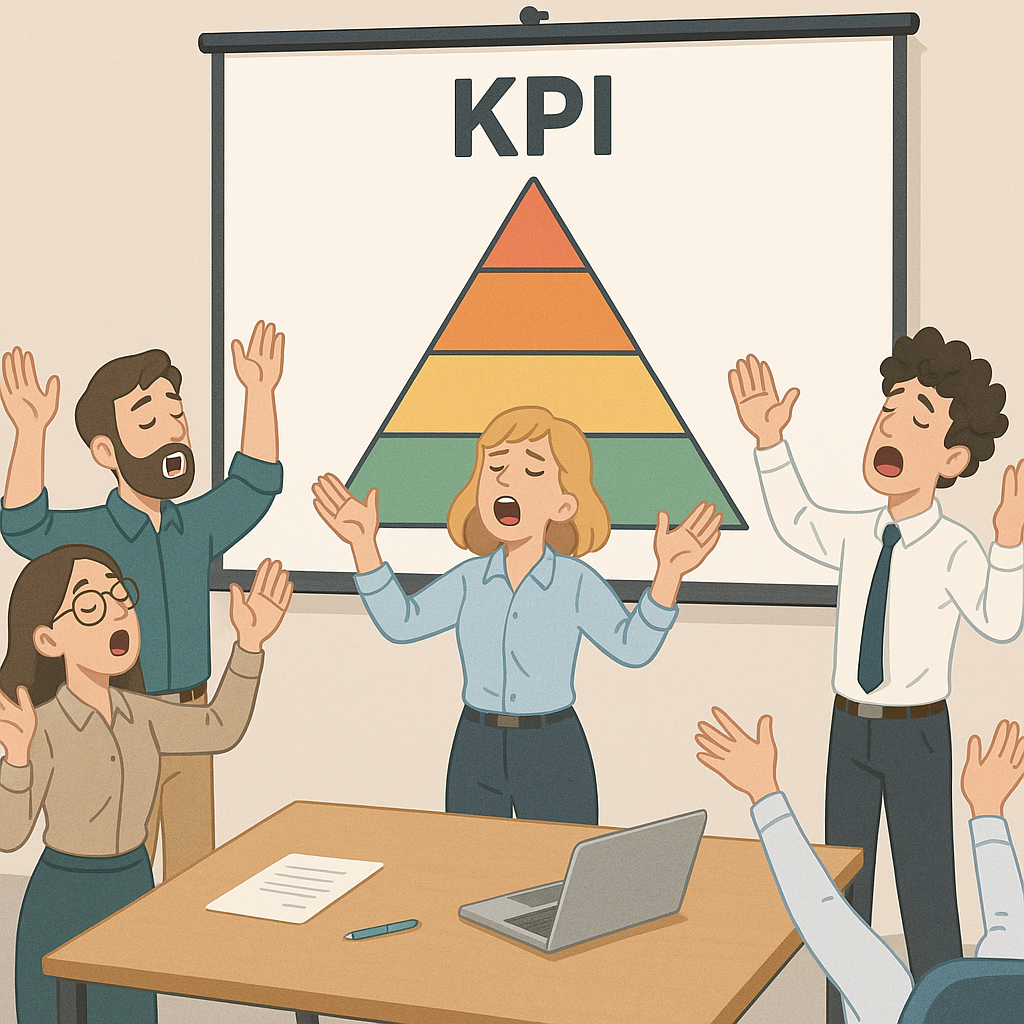
OmniSynq’s new Employee Handbook, now a 212-page leather-bound volume simply titled The Manual, emphasizes the upgraded expectations. Page one features a pyramid with the word “SYNERGY” written in an all-seeing eye at the top and a footnote clarifying that “this iconography is purely metaphorical and absolutely not legally actionable.”
Section 3.4: “Work is not your job; work is your path. Overtime is not required, but so is oxygen, and look how attached you are to that.”
The daily “standup meeting” has been replaced by a twice-daily “Alignment Ritual,” during which employees form concentric circles around a touchscreen obelisk that cycles through KPIs, inspirational quotes of dubious attribution, and live NASDAQ data. Participation is mandatory, though a FAQ entry clarifies that “mandatory” should be interpreted as “career-enhancingly advisable.”
To support this spiritual rebranding, OmniSynq has rolled out new workplace policies, including:
- Bring Your Whole Soul to Work Day – every day, actually. “We noticed employees were still keeping 6–11% of their inner lives for themselves,” said Kline. “That’s just inefficiency.”
- Voluntary Compulsory Sabbaticals – unpaid, but you get a badge on the internal social network reading “Chosen For Growth.”
- Share-The-Faith Referral Bonuses – employees receive stock options when they recruit friends into the “circle,” plus a small percentage of those friends’ annualized disillusionment.
Silicon Valley has reacted with a mixture of envy and rapid copycatting. At a private industry dinner in San Francisco — the same city where OpenAI’s leadership reshuffles recently proved that nothing inspires confidence like repeated board-level coups — a group of founders reportedly drafted a shared “Devotion Framework” to standardize corporate worship rituals across the sector, according to a leaked deck seen by the Financial Times.
“We’ve always been a cult,” said one anonymous venture capitalist between sips of $300 biodynamic water. “The only innovation here is admitting it out loud. The next logical step is an IPO where the ‘P’ stands for ‘Pilgrimage.’ Honestly, I’m jealous.”
Regulators, meanwhile, seem unsure how to respond. The SEC released a brief statement saying it is “monitoring developments in the emerging Faith-Backed Equity space,” while the FTC warned that “deceptive marketing practices may occur when a corporation claims transcendence and delivers only free cold brew and merch.” Senator Elizabeth Warren, asked whether she believed OmniSynq was becoming too powerful, responded, “I can’t comment directly, but if your onboarding packet includes a confession booth, you might have a regulatory issue.”

Inside OmniSynq’s gleaming, plant-saturated headquarters, reactions from employees are mixed. “On one hand, I’m worried,” said an Initiate-level software engineer who asked to remain anonymous and is referred to in internal emails only as “Node 472-B.” “On the other, I kind of appreciate the transparency. My last job called us a ‘work family’ and then laid off 15% of us over Slack. At least here, when they call it a ‘ritual culling of underperformers,’ you know where you stand.”
Others seem genuinely enthusiastic. “I used to feel empty, like my labor was just padding some distant shareholder’s net worth,” said Priya Das, a senior product Ascendant. “Now I know my labor is padding some distant shareholder’s net worth and contributing to an eternal flame of quarterly growth. That matters.”
Despite the enthusiasm, labor organizers are already circling. A newly formed group, Union of the Disenchanted (Local 404), has begun quietly distributing leaflets outside OmniSynq’s offices, titled “You Don’t Need A Sacred Contract To Get Dental.” Their proposed bargaining demands include a 4-day workweek, the right to log off without reciting the company mantra, and an end to what they call “mandatory TED Talk screenings in windowless rooms.”
“Cults are historically hard to unionize,” said one labor expert from Cornell, citing past attempts at collective bargaining within multilevel marketing schemes and certain yoga franchises. “But corporate America may have overreached. Once you’re making employees wear robes for quarterly all-hands, someone’s going to call the NLRB.”
OmniSynq insists any criticism comes from “non-aligned energies resistant to abundance,” and has already launched a marketing campaign targeting disillusioned workers at other firms. One ad shows a forlorn office worker staring at a spreadsheet with the caption: “Tired of meaningless capitalism? Try meaningful capitalism with matching 401(k) and optional transcendence.”
Back on the earnings call, as the closing gong echoed through thousands of noise-canceling headphones, Kline reassured investors that the new cult positioning was only the beginning. “Our long-term vision,” she said, “is customer devotion so complete that churn is not just low — it’s spiritually unthinkable. We don’t want people to buy our products. We want them to tithe to our ecosystem.”
She paused, smiled at the camera, and added: “And if that’s not shareholder value, I don’t know what is.”