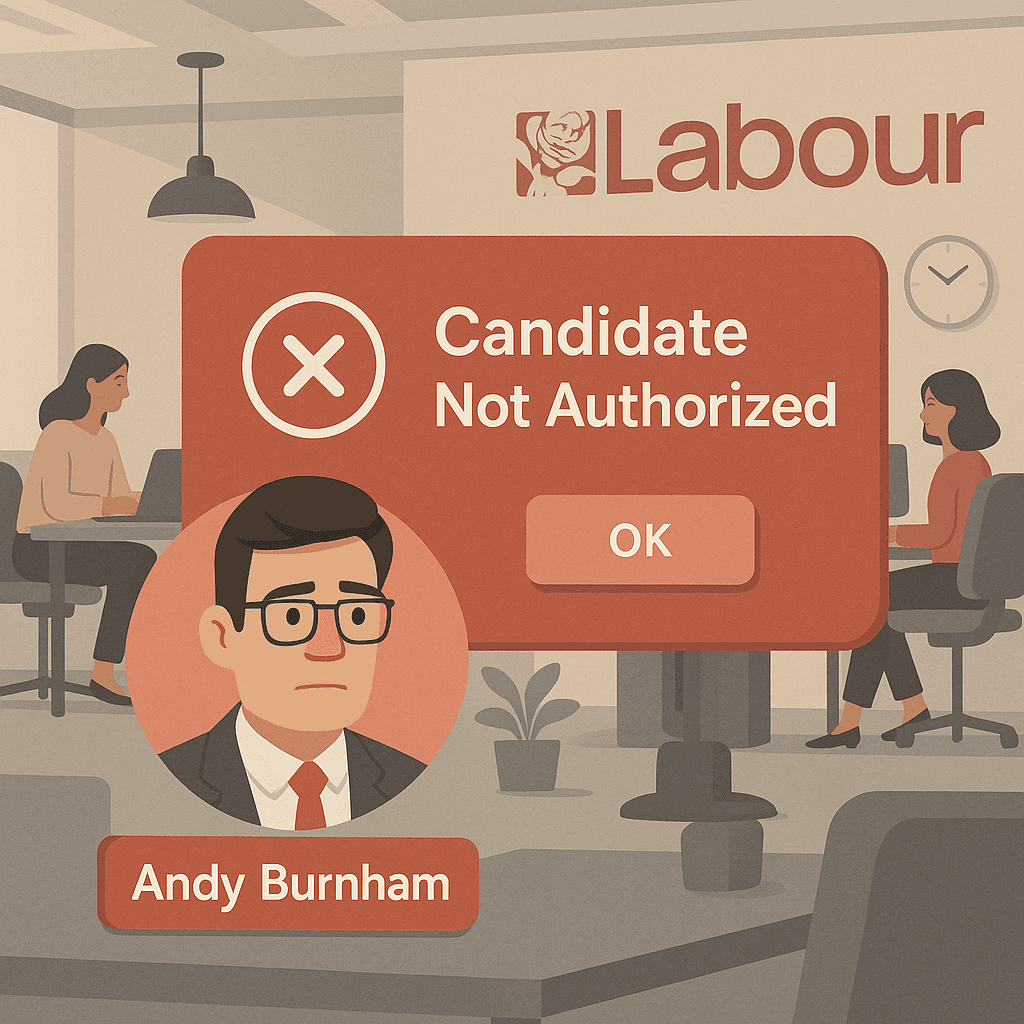
In a landmark breakthrough for political technology, the Labour Party has successfully demonstrated a working prototype of a Human Candidate AdBlocker by preventing Andy Burnham from even loading on the ballot screen.
According to reports on Channel 4 News and HuffPost UK (Jan 2026), Labour’s National Executive Committee (NEC) has moved to block Burnham’s bid to stand as an MP in a by-election, citing what insiders are calling “compatibility issues with centralised leadership architecture” and what everyone else is calling “he’s too popular and has his own ideas.”
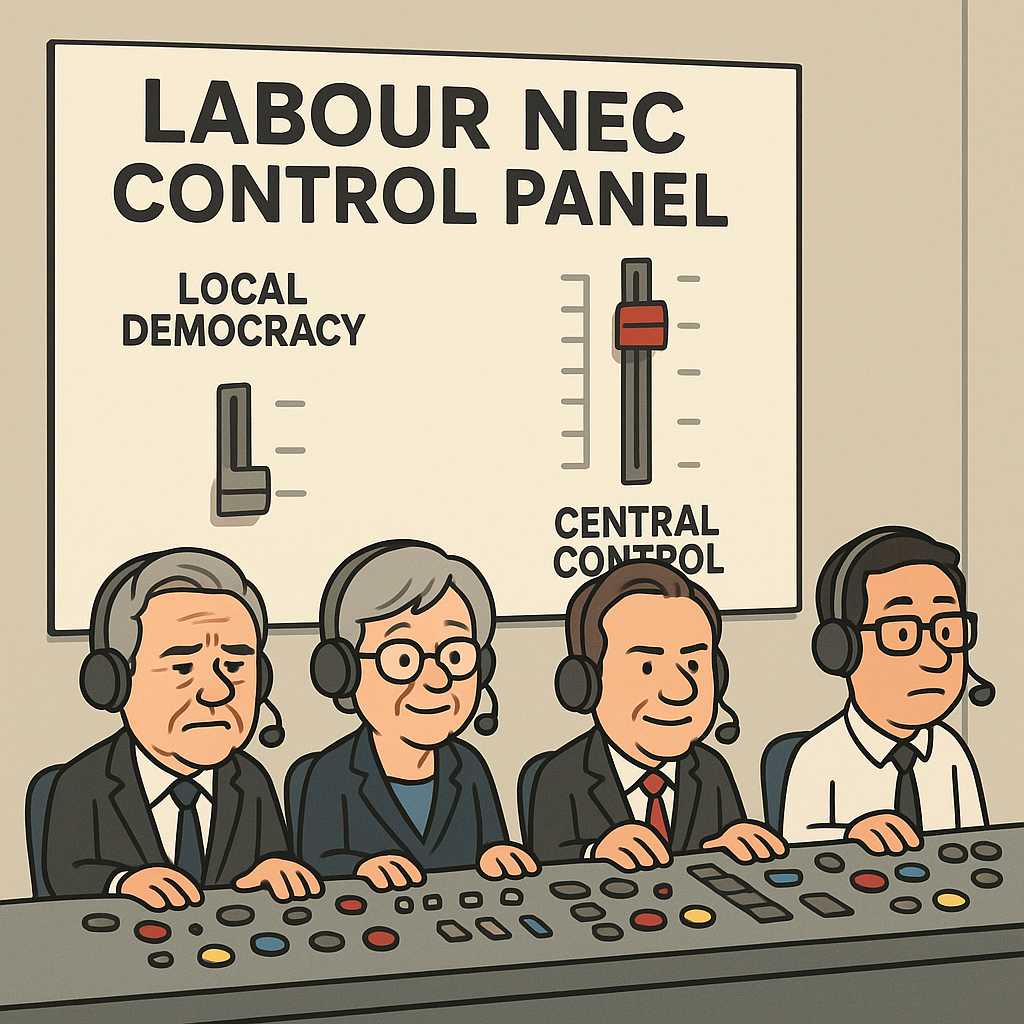
Sources close to Labour HQ say the process was handled via a new, fully automated system: the StarmerOS Candidate Management Suite. Once Andy Burnham, currently the Mayor of Greater Manchester, tried to upload himself as a prospective parliamentary candidate, the system reportedly threw a warning pop-up:
“Error 403: Localised Democracy Forbidden. This user is already running as Mayorware 3.0 (Greater Manchester Edition). Please uninstall regional mandate before attempting Westminster reinstall.”
Burnham, visibly frustrated, told HuffPost UK he was “disappointed and concerned” by the move, a phrase that in normal human speech translates to: “Are you actually kidding me?” He had hoped to stand in the by-election as a Labour MP, apparently under the mistaken impression that a political party is a group of people with shared values rather than a locked-down SaaS platform with no export function.
Labour officials insist the block isn’t personal. “This is standardised pipeline optimisation,” explained a party spokesperson who requested anonymity and two-factor authentication. “Our new candidate vetting algorithm, KeirGPT, flags any individual with high name recognition, prior ministerial experience, and a visible spine as a potential ‘fragmentation risk’ to our brand consistency.”
The spokesperson continued: “We’re pursuing a microservices approach to politics: voters in constituencies should interact only with small, stateless, interchangeable MPs. Mr Burnham is more of a monolith. Also, he keeps talking about buses.”
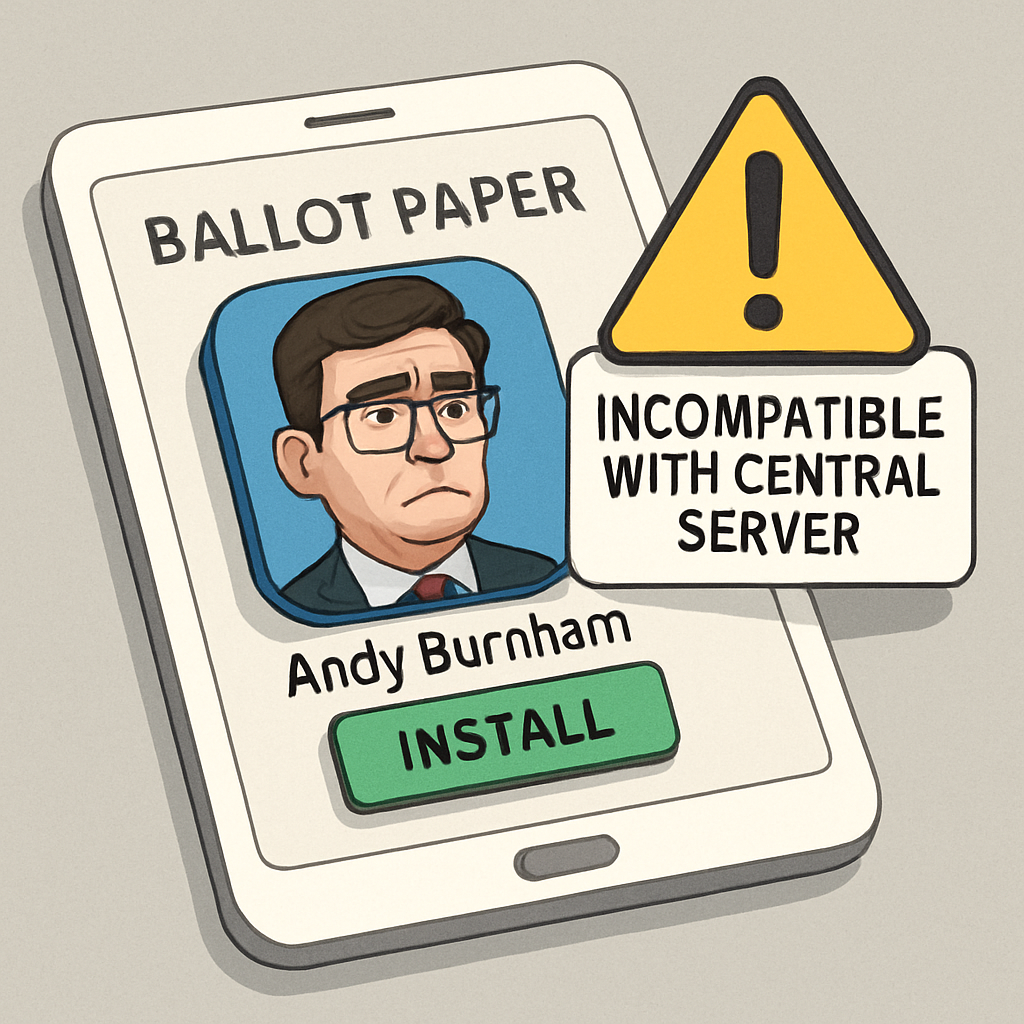
Andy Burnham, for his part, has been running his own experimental operating system in Greater Manchester for several years, involving such dangerous UX features as public transport, mayoral accountability, and being recognisable to normal people. These beta features have, according to observers, made him “annoyingly hard to patch out of the narrative.”
Back in Labour HQ’s open-plan command centre, the NEC reportedly convened via a hybrid Zoom–Teams–ancient-ritual-stone-circle meeting to discuss how to respond to the Burnham 2.0 upgrade request. One source described the mood as “like trying to force Windows 11 onto a laptop that’s perfectly happy on Windows 7 and keeps asking why it needs a Microsoft account.”
“We’re not saying Andy Burnham is malware,” another NEC member told Channel 4 News. “We’re saying he’s unauthorised third-party software. The system requirements for Labour MPs in 2026 are very clear: low latency, low visibility, and seamless cloud sync with Keir Starmer’s talking points. Mr Burnham insists on supporting things like local decision-making and public-facing interviews without pre-approved scripts. That’s basically running Tor on the party network.”
Insiders say the party’s central database now categorises potential candidates using the following schema:
- Tier 1 – Core Apps: Shadow Cabinet, guaranteed updates, auto-refresh in media.
- Tier 2 – Background Processes: Reliable backbench MPs, safe to ignore until needed.
- Tier 3 – Experimental Builds: Mayors, metro mayors, people who keep winning elections on purpose.
- Tier 4 – Legacy Hardware: Anyone from the Ed Miliband years who still remembers what a policy is.
“Andy is currently classed as Tier 3 bordering on Tier 4,” a data officer explained. “The problem is, Tier 3 units are proving extremely popular with users. They keep outperforming our Tier 1 approved templates. This is obviously unacceptable from a central control perspective.”
Even the by-election itself has started to look less like a democratic contest and more like an app-store moderation saga. Local Labour members, who naïvely believed they’d be allowed to choose a candidate, have instead discovered their constituency is enrolled in Labour Cloud Managed Democracy, where selection menus are greyed out and pre-selected for “best experience for head office.”
A confidential slide deck leaked to journalists outlines the new process:
- Members open Candidate Portal.
- Portal shows one approved candidate and Andy Burnham in grey.
- Mouse-over Burnham displays tool-tip: “This option is no longer supported.”
- Members click “Continue” anyway and receive pop-up: “Are you sure you want to break the Labour experience?”
- Portal crashes. IT blames Russia.
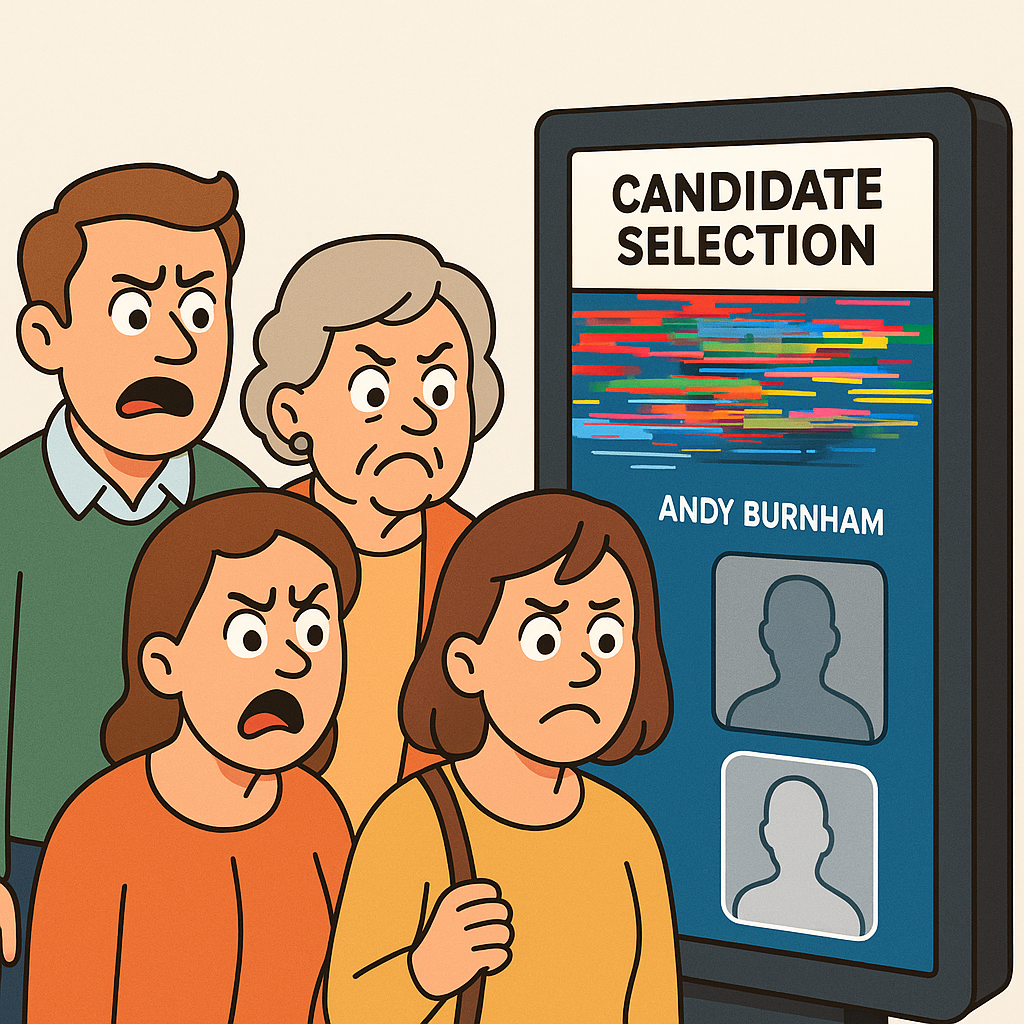
In Greater Manchester, Burnham’s team is reportedly testing a workaround. Early concepts include running for Parliament as “Greater Manchester Transport Prototype v1.0 (Not Politically Affiliated)” or disguising himself as an infrastructure bill. “We’ve noticed Westminster passes infrastructure bills more easily than humans,” one aide explained. “If he wears a hi-vis jacket and calls himself the ‘Integrated Rail Modernisation Package,’ he might slip through the parliamentary firewall.”
Tech analysts, normally occupied with things like whether AI will replace copywriters or just force them to write LinkedIn posts about AI, have begun to notice politics is quietly adopting the worst patterns of the app economy. “What you’re seeing with Andy Burnham is very similar to what big platforms do with third-party apps that users love too much,” said Dr. Lila Morton, a professor of Political Technology at an imaginary think tank. “First, you block their updates. Then you quietly launch your own worse version. Finally, you deprecate the original and tell users it was for their security.”
Morton added: “Westminster is moving from ‘representative democracy’ to ‘curated democracy-as-a-service.’ You don’t choose your MP; your MP is pushed as an automatic update. Tap ‘Remind me later’ all you like, but sooner or later you’re waking up with a new one whether you wanted it or not.”
Party strategists insist that the blocking of Burnham’s MP aspirations is simply about “clear lines of accountability” and “ensuring mayors don’t double-boot into Parliament.” However, a cached version of an internal FAQ reveals more specific concerns:
- Q: What happens if Andy Burnham becomes an MP again?
A: Users might realise politics could include… options. - Q: Couldn’t we just trust members to choose?
A: That feature was removed in the 2016 patch for security reasons. - Q: Is this compatible with the concept of a broad church?
A: Our new architecture favours a narrow corridor with swipe-card access.
As the row drags on, Labour supporters are left trying to reconcile the party’s rhetorical embrace of “democratic renewal” with its practical use of enterprise-grade access control lists on its own talent. One grassroots member summed up the vibe: “We spent years saying politics was broken and needed change. Turns out the solution is just Single Sign-On for Keir.”
For now, Andy Burnham remains sandboxed in Greater Manchester, where residents continue to experimentally enjoy public services not entirely designed by consultants in London. Whether he will ever be permitted to re-enter Westminster’s tightly containerised environment as an MP again remains unclear. What is clear, as this episode underlines, is that in 2026 the most powerful piece of political technology in Britain is not AI, not social media, and not microtargeting.
It’s the block button.