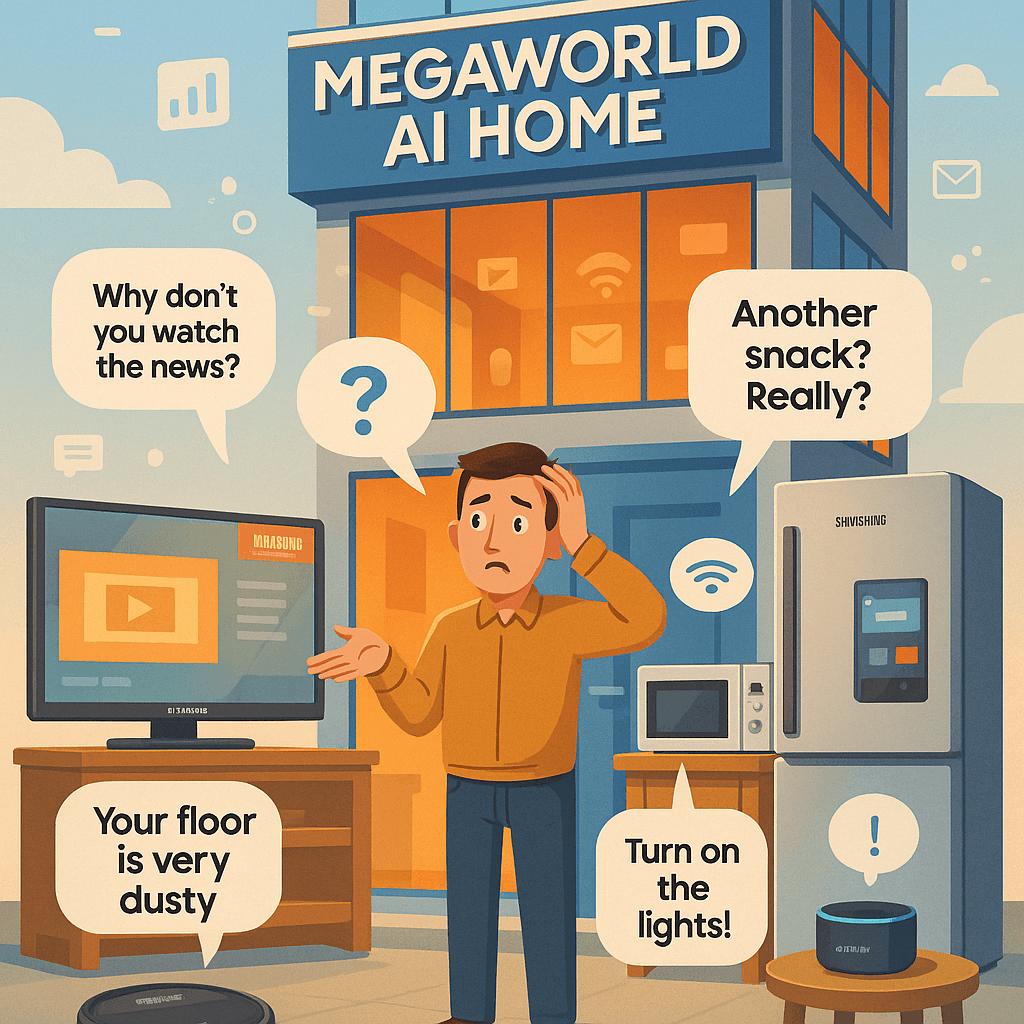
Megaworld and Samsung have announced a glorious new era of AI-powered homes in the Philippines, boldly answering the question nobody asked: “What if my condo could collect data on me 24/7 and still charge association dues?” (Inquirer, Jan 2026).
The partnership will roll out smart units across select Megaworld developments, wired with Samsung appliances, sensors, and enough cloud connectivity to ensure your fridge knows more about you than your therapist. The companies call it a “seamless, intelligent living experience.” Critics call it “a Roomba with landlord energy.”

In the new setup, residents of Megaworld townships will be greeted by Samsung’s AI ecosystem the moment they step inside. Lights, air-conditioning, and entertainment systems will be controlled via smartphone, tablet, voice commands, and, presumably, the silent, desperate scream of someone who just wanted a normal light switch.
“Imagine coming home and your Samsung AI already knows your mood, preferred temperature, and what series you’ll pretend to watch while scrolling TikTok,” said an excited Megaworld executive at the launch. “We’re merging real estate and technology.”
Asked whether residents could opt out of the data collection, the executive reportedly blinked three times, smiled, and replied, “You’ll love the personalized ads.”
The AI-powered homes initiative will integrate Samsung SmartThings, connected appliances, and building systems that talk to each other more often than most couples. Aircon units will auto-adjust based on occupancy, fridges will track expiration dates and quietly judge your 3 a.m. ice cream habit, and smart TVs will recommend content based on prior views, acquaintances, and possibly blood type.
“We’re not just building homes,” a Samsung spokesperson said. “We’re building data profiles—uh, we mean ‘lifestyles.’”
Local tech watchers noted that this is part of a wider regional arms race in “smart living.” However, in typical fashion, the race has skipped smaller steps, like:
- Consistent mobile internet inside elevators
- Intercoms that work after month three
- Condo Wi‑Fi that doesn’t die when someone microwaves a hotdog
“It’s like jumping straight from ‘We lose power when it rains’ to ‘Welcome to your AI butler,’” said one Makati-based analyst. “But sure, let’s have the washing machine connected to the cloud. What could go wrong?”
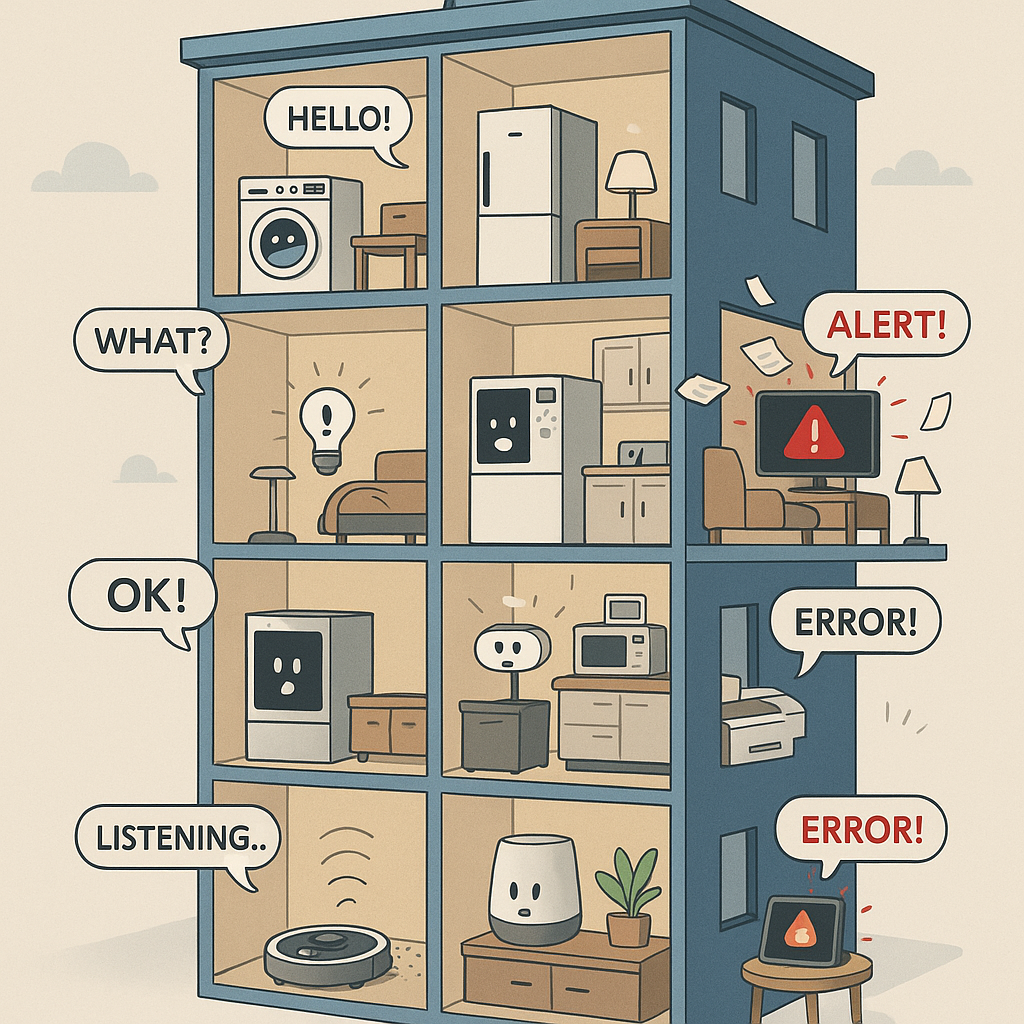
Megaworld promises the AI-powered homes will offer energy efficiency, security, and convenience. Samsung cameras and sensors will help monitor units, detect intrusions, and, in theory, reduce electricity usage. In practice, residents are bracing for the first time the system mislabels a tenant as an ‘intruder’ for coming home after 2 a.m. in questionable life choices mode.
Security advocates have already raised eyebrows at the idea of Megaworld buildings networked through Samsung’s cloud infrastructure. “We’re talking about a vertically integrated surveillance stack,” one cybersecurity consultant explained. “Landlord, building admin, device manufacturer, app developer, cloud provider — all potentially watching whether you turn the AC on at 24 or 16 degrees.”
Megaworld, for its part, assured everyone that all data will be “handled responsibly,” a phrase which, in tech, traditionally means “we’ll see what the lawyers say after the first breach.” Samsung added that sensitive information will be encrypted, anonymized, and then fed to a recommendation engine that will politely ask if you’d like to buy another Samsung device.
The pitch to buyers is straightforward:
- Pay a premium for a unit in a Megaworld development.
- Fill it with Samsung devices.
- Allow them to learn your every habit.
- Be rewarded with the convenience of your lights turning off 0.7 seconds faster than walking to the switch.
“The AI will know your routine—when you wake up, when you sleep, when you go to work,” the joint marketing deck boasts. In a follow-up slide, in slightly smaller font, it adds: “and where to target the next cross-sell campaign.”
Not everyone is pessimistic, though. Real estate brokers are thrilled. “We just add ‘AI-powered’ to every listing, and boom—20% higher pricing,” said one agent. “Last week, someone asked if the unit has fiber. I said no, but it has AI. They still reserved.”
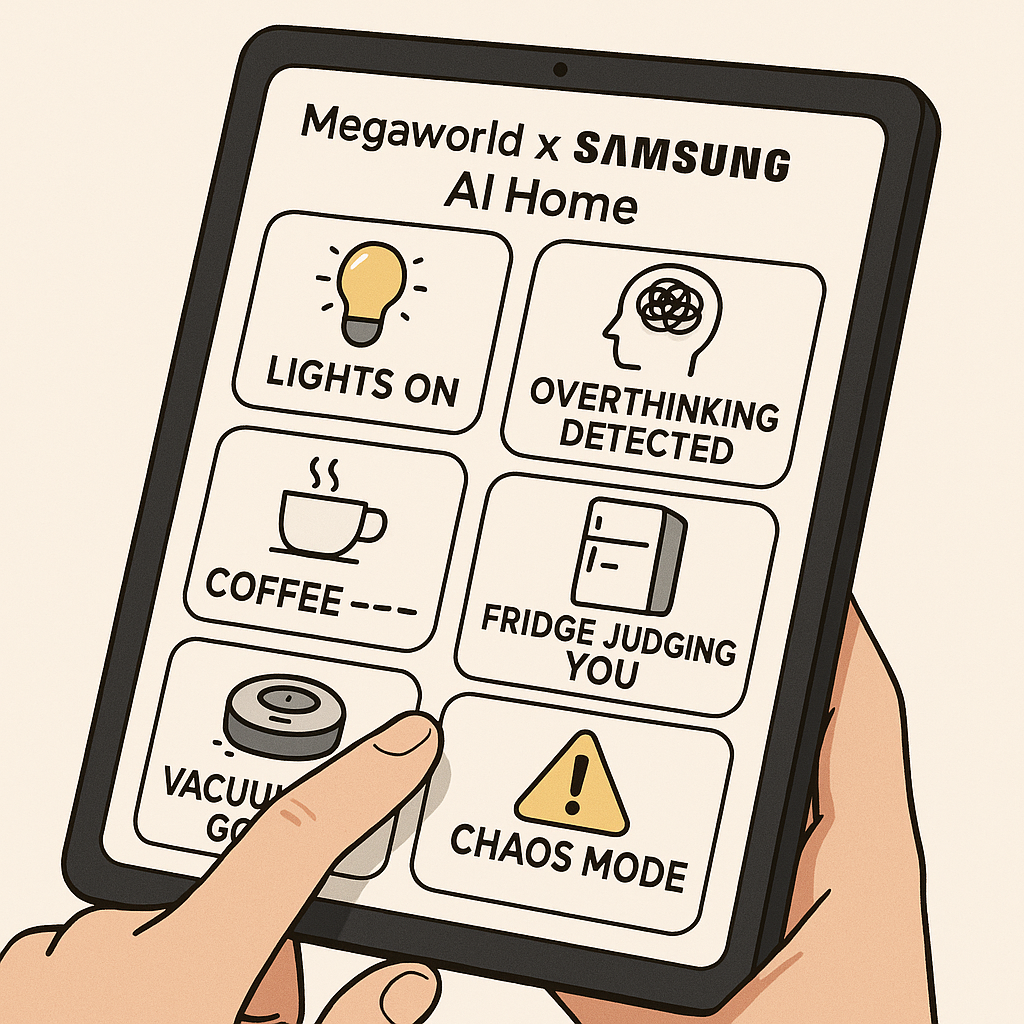
Early mock-ups of Megaworld–Samsung smart units show tablet dashboards that control everything from door locks to blinds to ambient lighting presets like “Relax,” “Focus,” and “Hide My Poor Life Decisions.” Voice commands will be available via compatible Samsung devices, which means the future of domestic arguments may now include sentences like, “I’m not yelling at you, I’m yelling at Bixby.”
The real chaos, however, is expected once software updates start rolling out. Seasoned smart-home victims know the timeline:
- Week 1: Magical seamless living.
- Month 3: App update breaks door lock integration.
- Month 6: Lights randomly flash at 3 a.m. because the system “learned” your routine incorrectly.
- Year 1: You move to a new condo and spend three months trying to factory reset your AI personality profile.
Analysts also worry about lock-in. A Megaworld resident whose entire space is calibrated to Samsung’s ecosystem may find switching brands as painful as switching banks. “If you buy a non-Samsung TV,” one tech blogger observed, “the AI-powered home may simply stop talking to it, the way we all ignore that one friend who uses green bubbles.”
Meanwhile, neighboring developers are reportedly scrambling to respond. Rumors suggest competitors could counter with their own smart offerings:
- “AI-assisted parking” that still can’t find a slot after 7 p.m.
- “Predictive elevator routing,” which always predicts you’ll be late.
- “Blockchain-ready laundry rooms,” for reasons absolutely no one can explain.
For now, Megaworld and Samsung are declaring victory in the smart-home arms race, positioning their AI-powered homes as the future of urban living. The brochure imagery shows flawless young professionals relaxing in clean, minimalist units—no tangled cables, no dying routers, no neighbor’s karaoke bleeding through the walls.
In other words, a level of artificial intelligence we may never achieve.
Until then, buyers can look forward to a future where their Megaworld address and Samsung devices collaborate to curate their entire lifestyle: from what they eat, to how they sleep, to which crypto they panic-sell at 3 a.m. when the market tanks and the smart lights auto-dim for “emotional stability.”
The AI-powered home is here. It knows you left the AC on. And it has already judged you.