
In what officials are calling “a routine, precautionary repositioning of all known life,” NASA today unveiled a bold new plan to gradually tow Earth to a nicer part of the galaxy, ideally one with less radiation, fewer extinction-level asteroids, and better schools for billionaire offspring.
The $14 trillion proposal, formally titled the Galactic Environment Optimization Initiative, was announced at a press conference in Houston, where agency leaders assured the public that nothing is wrong with the planet, per se — they just think we “deserve something a little quieter, maybe with a view of a nebula instead of whatever this is.”
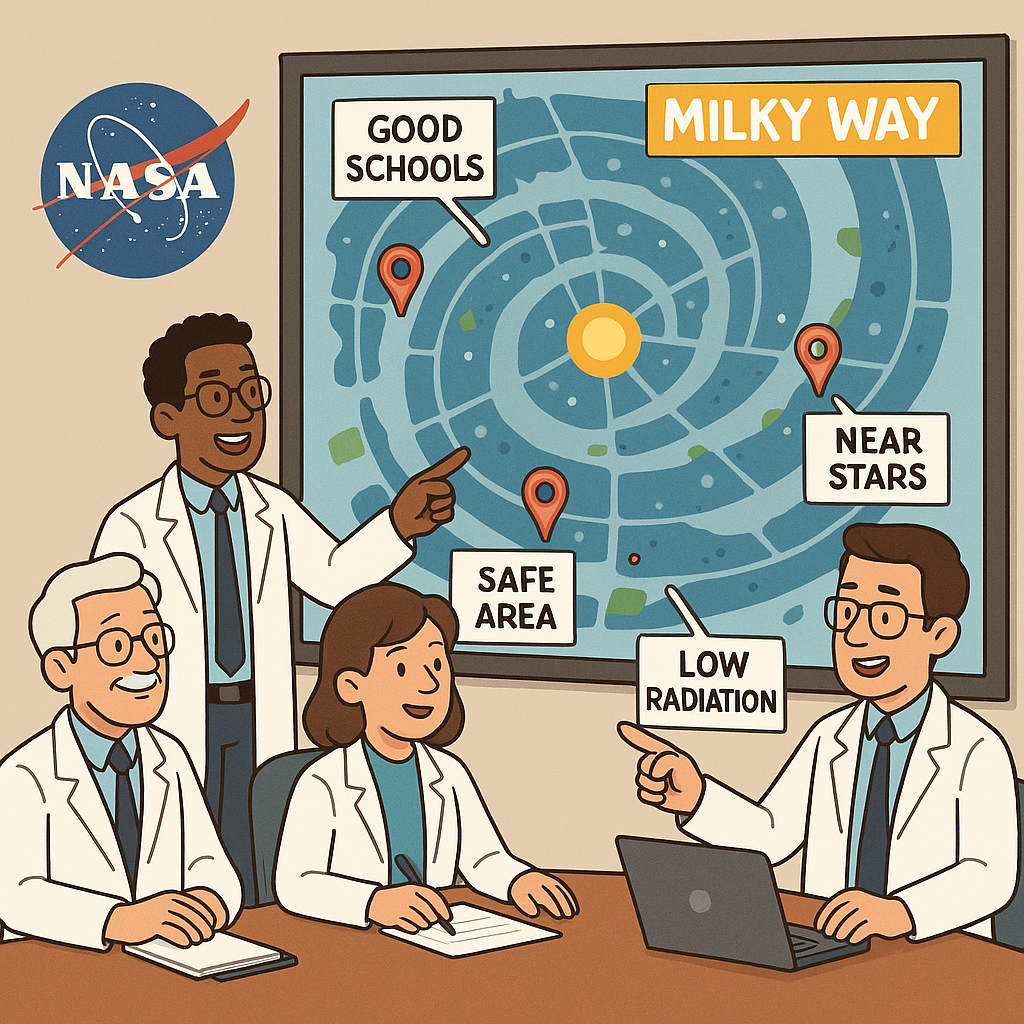
“Imagine we’re just… changing districts,” said Dr. Helena Ruiz, Chief Orbital Realignment Officer, a job title created last week after a four-hour branding session. “Right now Earth is basically living under a crumbling cosmic overpass near a gamma-ray strip mall. Our models show we’d be much happier in a more ‘up-and-coming’ spiral arm, maybe somewhere with a modest black hole and a rustic exoplanet farmer’s market.”
Asked whether this had anything to do with rising temperatures, failing ecosystems, or the general vibe of 2024, Ruiz shook her head. “Absolutely not. This move has nothing to do with climate change. That’s a separate, entirely unsolved catastrophe. This is about long-term galactic positioning and, frankly, curb appeal.”
Under the plan, NASA, ESA, and a coalition of extremely bored physicists will deploy a swarm of what they call “grav-tug arrays” — kilometer-wide solar sails equipped with nuclear-powered ion engines and an optimism problem — to slowly nudge Earth’s orbit outward over the next 200,000 years.
“Think of it as parallel parking a planet,” explained mission engineer Taye Okafor. “Except the car is on fire, the curb is moving at 220 kilometers per second, and half the passengers are still arguing about whether the curb is even real.”
According to the agency’s white paper, Earth’s new location would place it in a “low-crime, low-radiation neighborhood” on the galaxy’s outer rim, just far enough from the galactic center to avoid supermassive black hole drama, but close enough to keep receiving whatever mysterious energy currently powers podcasts and celebrity skincare lines.

Reaction from the scientific community has been mixed, ranging from cautiously optimistic to “are you serious, we just learned how your dishwasher works.” Several astronomers pointed out that the so-called galactic habitable zone is still an active area of research and that moving an inhabited planet through dense star fields is “less urban renewal, more blindfolded highway sprint.”
“We haven’t even figured out how to keep a telescope mirror from fogging up, and now we’re talking about towing the entire biosphere across the Milky Way,” said Dr. Priya Banerjee, an astrophysicist at MIT. “On the other hand, given how things are going down here, I get it. Worst case, we accelerate into deep space and become a cautionary screensaver.”
Conservative lawmakers immediately denounced the proposal as “woke astrophysics,” arguing that if Earth wanted a better neighborhood, it should “pull itself up by its tectonic plates” instead of relying on so-called “Big Science handouts.” A joint statement from several senators demanded NASA find a cheaper solution, such as simply “building a wall around the solar system” or “reminding asteroids that we are a Judeo-Christian planet.”
On social media, the announcement went viral under the hashtag #MoveThePlanet, with reactions neatly split between:
- People asking if the move will lower their rent.
- People insisting this is all a distraction from parking tickets.
- People trying to mint Earth as an NFT before the galaxy’s property values go up.
“Will the new galaxy neighborhood have better Wi-Fi?” asked one user on X, formerly Twitter, a platform that Elon Musk has spent the last two years turning into a live beta test for mass psychological resilience. “And will my student loans follow me across interstellar space? Because if not, I’ll start packing now.”
Climate scientists, accustomed to being ignored until the ocean literally catches fire, responded to the plan with a combination of envy and dark amusement. “They wouldn’t move the thermostat two degrees to avoid global disaster,” noted one researcher, “but they’ll move the entire planet three thousand light-years to avoid space drafts. Got it.”

NASA officials insisted the public was misunderstanding the initiative. “This is about long-term resilience,” said Administrator Bill Nelson, who recently signed off on missions to study asteroid samples and launch more climate-monitoring satellites (NASA press briefing, Sept. 2023). “Yes, we could invest those trillions in renewable energy, infrastructure, and adaptation right now. Or — and hear me out — we can strap rocket engines to the geological foundation of human civilization and see what happens.”
Part of the funding, according to leaked documents, is expected to come from private partners, including a consortium of tech billionaires already working on personal Mars bunkers and cryogenic pet storage. Early concept art for the mission shows Earth being towed by a chain of branded propulsion modules, each featuring a sponsor’s logo and a helpful slogan like “This Side Faces Certain Death” in tasteful sans serif.
At a separate event, SpaceX representatives hinted they might contribute “synergistic hardware solutions,” including a hypothetical Starship variant capable of “lightly shoving continents in a user-centric direction.” Asked about the engineering feasibility of moving an entire planet, CEO Elon Musk reportedly replied, “Look, people said reusable rockets were impossible too, and now they’re just kind of normal and explode less.”
Meanwhile, the European Space Agency expressed concern that Earth’s relocation would complicate existing missions. “Our entire space infrastructure assumes the planet will be in the same general spot tomorrow,” said ESA director Josef Aschbacher. “If we start drifting, every mission plan becomes a cosmic guessing game. Also, have we considered what happens to, you know, the Moon? Or are we just ghosting it?”
NASA’s FAQ page, hastily assembled and already overloaded, addresses some of these questions:
- Will sunsets look different?
Yes, but do you really notice them now? - Will Earth experience time dilation?
Not in any way you’ll enjoy. - Will this interfere with horoscopes?
Astrology will be briefly more accurate before imploding under the weight of new data.
The plan still requires approval from an assortment of international bodies, theoretical physicists, and the small but vocal “Do Not Move My Planet” movement, which insists that Earth’s galactic location is part of its “traditional values” and should remain fixed, just like wages and social progress.
In an attempt to reassure the public, NASA released a final statement: “We want to be clear: there is no imminent existential threat forcing this decision. The universe has always been hostile, indifferent, and full of objects moving at suicidal velocities. That’s normal. We simply believe that, in such an environment, it is prudent to begin slowly dragging the only known cradle of intelligent life away from the center of danger before we finish turning it into a toaster oven.”
The statement concluded with a familiar note, as if echoing decades of climate reports, biodiversity assessments, and IPCC warnings:
“The best time to start moving the planet was 200,000 years ago. The second-best time is now.”
An addendum, in smaller font, added one more line:
“Results not guaranteed. No refunds if we miss.”