
In a development that threatens the entire business model of slapping AI on everything and calling it a day, Anduril founder Palmer Luckey has reportedly decided that the future of technology lies firmly in our collective garage-sale pile of obsolete hardware, according to a recent Biztoc summary of his comments. (Biztoc, Jan 2026)
The man who turned Anduril into a lucrative defense-tech juggernaut by stapling sensors, software, and vibes onto military hardware now believes that the next great leap in innovation is to go backward—like a retro video game, except the microtransactions are defense contracts and the loot boxes are drone swarms.
“Everything truly important was basically invented by 1999,” a venture capitalist paraphrased Luckey as saying, while quietly checking his portfolio to see how many AI infrastructure startups he could rebrand as ‘dial-up 2.0.’ “We don’t need more features. We need more beige plastic.”
Tech Twitter, which now consists mostly of AI-generated hustle threads and three very tired reporters, reacted with confusion. How, they asked, could the same Palmer Luckey who sold Oculus to Meta for more than the GDP of several small nations now be telling them the real metaverse was the friends we made in AOL chatrooms along the way?
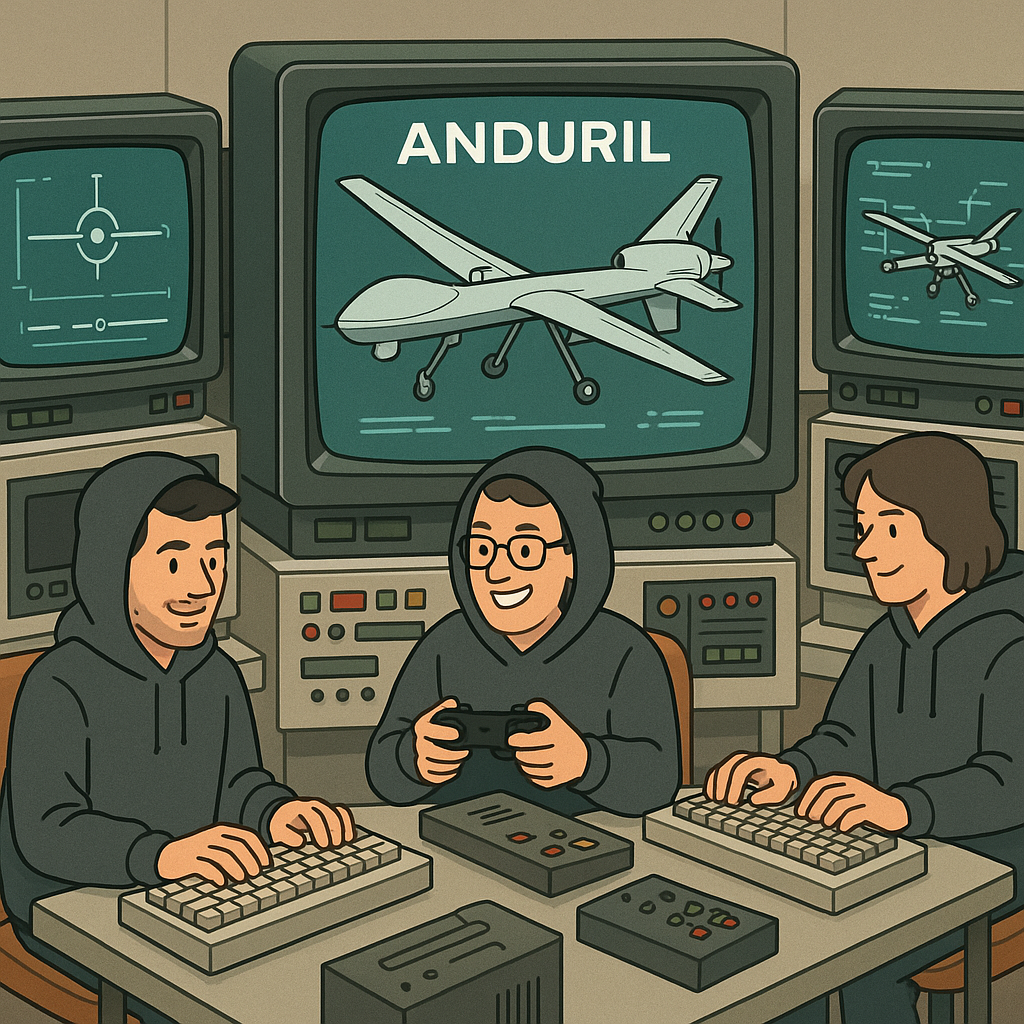
At Anduril’s Costa Mesa offices, the philosophical pivot is already underway. According to one engineer, new internal initiatives include:
- Project Dial-Up Defense™: Air defense networks controlled entirely via 56k modems, ensuring any incoming missile is slowed down by connection lag and a busy signal.
- Clippy for Command & Control: An animated assistant that pops up on battle-management dashboards saying, “It looks like you’re trying to deter a near-peer adversary. Want help with that?”
- Windows NT Battlefield Edition: Because nothing says deterrence like your targeting system rebooting to apply critical updates mid-conflict.
“Palmer really believes we lost something when tech stopped being physically dangerous,” one anonymous Anduril product manager said. “Back then, your CRT monitor could actually kill you. Your PC case had razor-sharp metal edges. Now everything’s rounded and boring. Where’s the risk? Where’s the adventure?”
Luckey’s alleged thesis—now doing the rounds in investor decks and LinkedIn thought-leadership posts—is simple: tech has become too abstract, too SaaS, and not nearly enough ‘you can hold it, drop it, and possibly electrocute yourself with it.’ The metaverse never took off, but a warehouse full of 90s night-vision goggles sure did.
“If you handed a 1997 ThinkPad to half of today’s YC batch, they wouldn’t know whether to code on it or list it as a vintage Web3 storage node,” said one defense-leaning investor, shortly after rebranding his fund’s thesis from ‘full-stack AI autonomy’ to ‘retro-computing-enabled kinetic synergies.’
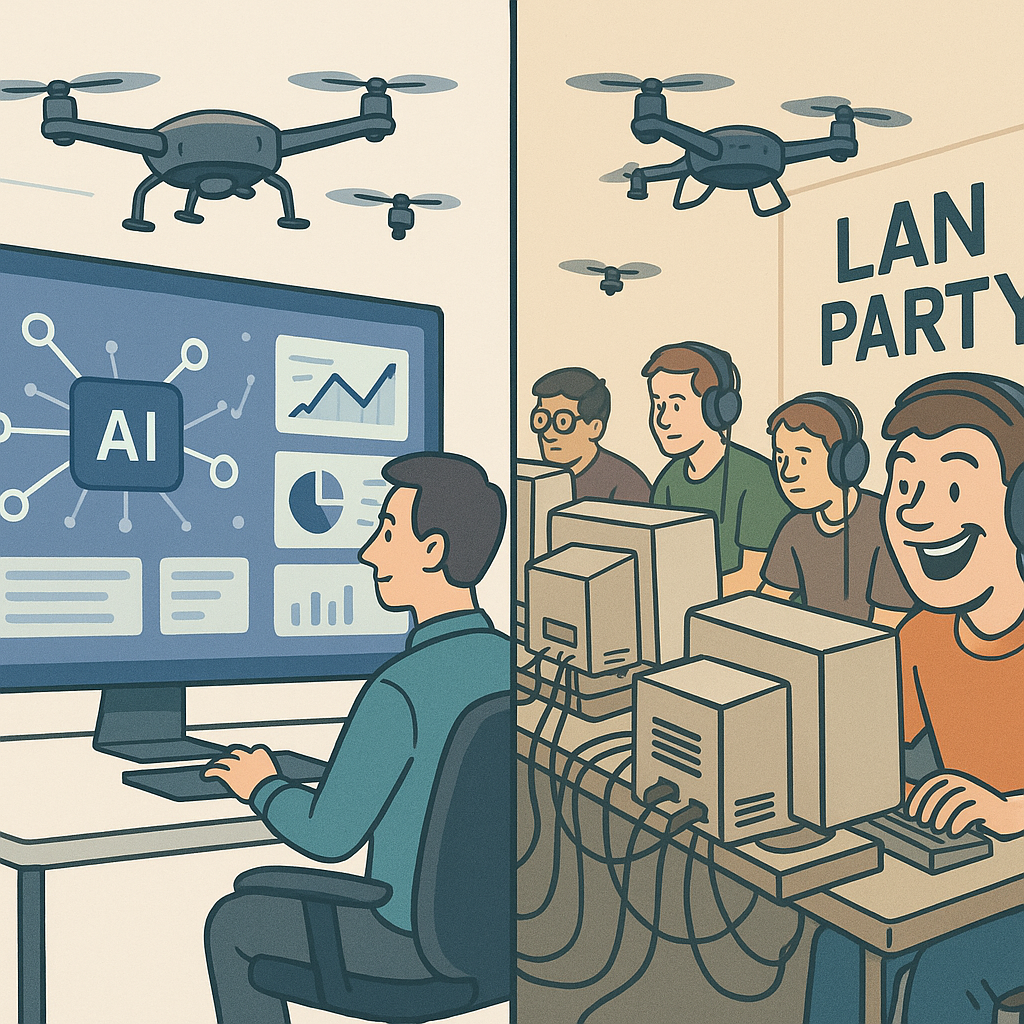
The irony is that Palmer Luckey’s own career is the best advert for his argument. First there was Oculus, a VR company built on the idea that you could duct-tape smartphone screens to your face and call it the future. Then came Anduril, which built a multi-billion-dollar business on the radical insight that the military might want autonomous towers and drones that didn’t run on literally Windows XP.
Now, according to those parsing his “future is in the past” stance, the next wave is somewhere in between: tech that looks like it belongs in a LAN party but bills like it belongs in the Pentagon’s black budget.
“Look at AI right now,” said a cynical analyst in a note that was clearly written after looking at his NVIDIA bill. “Everyone’s paying cloud fees that resemble student loans, to generate content that looks like a rejected MySpace background from 2006. Palmer’s right: we’ve basically invented a laggier, more expensive Geocities.”
Some founders have already begun to pivot in anticipation of the investor herd’s next costume change. Among the hot new pitches:
- RetroAI: A ‘frontier model’ that can only be accessed via IRC and only responds in ASCII art.
- BeigeBox Cloud: A decentralized compute network powered by repurposed Dell towers from failed 2002 law firms.
- Napster Defense: Peer-to-peer battlefield intelligence sharing that definitely violates several treaties and at least four DMCA clauses.
Meanwhile, Anduril itself is rumored to be experimenting with more literal throwbacks. One prototype allegedly involves a fleet of semi-autonomous drones controlled by something that looks suspiciously like a Nintendo 64 controller. “The DoD user testing went extremely well once they figured out which button wasn’t ‘reload save,’” said one consultant.
To underline his commitment to retro-futurism, Luckey reportedly told a small group of admirers that he’d rather build “the F-14 Tomcat of software” than the “TikTok filter of national security.” The quote spread quickly through Slack channels at defense startups, where product managers are now hurriedly renaming their AI dashboards to things like ‘MaverickOps’ and ‘TopLogistics.’
[[IMG3]]This back-to-the-future stance has also put Silicon Valley’s current aesthetic under harsh fluorescent lighting. For a decade the ideal product was invisible: a subscription you forgot you were paying for. Now the ideal might once again be a large, ugly object that beeps ominously and requires a manual.
“Palmer’s right in one sense,” noted a policy analyst who has spent too long in classified briefings and it shows. “The world is getting more dangerous, and our tech looks like it was designed to book yoga classes. If we’re going to automate battlefields, maybe the UI shouldn’t look like Airbnb.”
Of course, this sudden reverence for the past conveniently ignores the fact that the ‘classic’ tech era Luckey idolizes was filled with horrendous security, terrible UX, and the computing equivalent of war crimes against taste. But that’s never stopped Silicon Valley before. If something is old and broke once, they’ll break it again, at scale.
“We used to overclock CPUs until they smoked,” said one veteran engineer. “Now we overclock GPUs until the grid does.”
Biztoc’s summary of Luckey’s comments has already spawned a new wave of Medium posts from people whose last technical contribution was choosing dark mode. One particularly viral think piece argued that “the next unicorn will be a company that brings back pagers, but for drones.” Another suggested that instead of fighting over LLM benchmarks, we should bring back the glory days of Quake deathmatches and settle AI supremacy on LAN.
Still, beneath the cosplay and nostalgia, there’s a boring, annoyingly reasonable point: in a world where every startup is a web app connected to more web apps via other web apps, someone actually building physical systems that move, sense, and occasionally explode things is going to look like a visionary. Even if his North Star is a Gateway 2000 cow-print box.
The real test will be whether investors, exhausted from chasing the 47th “AI copilot for meetings,” are ready to trade their Figma mocks for something more… tactile. Something like a hardened sensor tower, a ruggedized headset, or, if Palmer Luckey gets his way, a national security infrastructure that looks like a cross between a 1998 LAN party and a DARPA fever dream.
Until then, the rest of the tech world will keep doing what it does best: building overcomplicated subscription services to emulate the things we already had for free 20 years ago. But now, at least, they’ll have a new phrase for the pitch deck:
“We’re not just the future of tech. We’re the past of tech, but with a better exit multiple.”