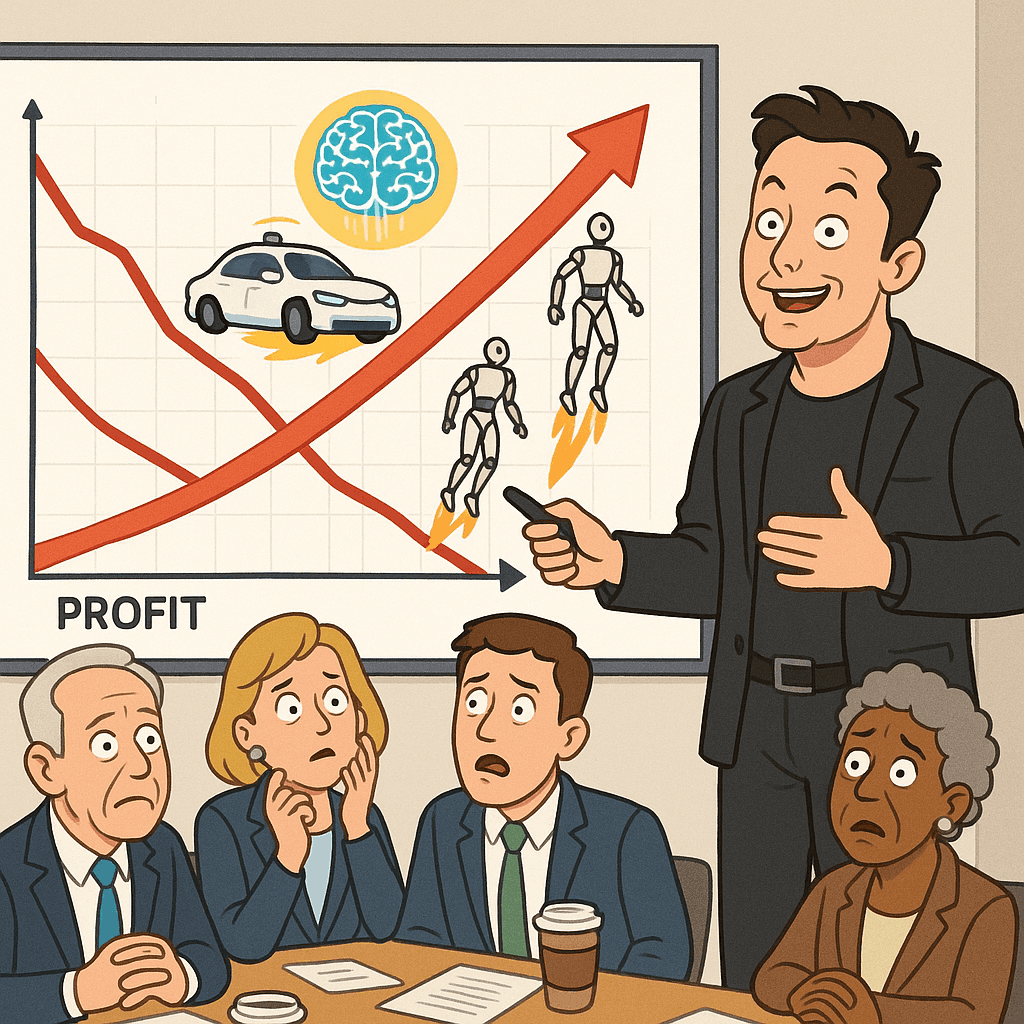
Tesla investors woke up this week to discover an unnerving innovation: a company that can “beat earnings” while its revenue quietly slinks out the back door like a nervous intern holding a cardboard box. According to a recent report on Tekedia (Jan 2026), Tesla posted its first-ever revenue decline just as CEO Elon Musk went all-in on AI, robotaxis, and humanoid robots — also known as the three horsemen of, “So when does this actually make money?”
In a move that analysts are diplomatically describing as “visionary” and privately describing as “please stop doing earnings calls on X Spaces,” Musk used Tesla’s results to unveil his latest pivot: less ‘car company,’ more ‘vibes-based hallucination engine for capital markets.’
“We’re transitioning from a traditional automotive business to a fully autonomous AI-powered robotaxi megaverse,” Musk reportedly said, according to people who managed to stay on the call past the third mention of ‘AGI.’ “Revenue declines are temporary. But AI buzzwords are forever.”
The Tekedia piece on Tesla’s earnings, revenue decline, and AI obsession noted what many on Wall Street have begun to quietly fear: there might be a slight disconnect between timelines in Elon Musk’s head and timelines in physical reality. Tesla’s factories currently produce vehicles. Musk’s mouth currently produces robotaxis, Optimus humanoid robots, and apocalyptic warnings that if regulators don’t let him deploy unfinished software, China’s AI will eat everyone’s lunch and then lease them a fully autonomous ride-hailing subscription.
Analysts at major brokerages have tried to model this future, but their spreadsheets keep returning “#VALUE!” whenever they input “infinite AI upside” as a line item. “We tried a discounted cash flow model,” one tech analyst confessed. “But then we realized there is no cash. Just flows.”
The Tesla earnings call reportedly jumped seamlessly between topics: quarterly margins, fleet utilization, and the philosophical question of whether an AI robotaxi can truly be considered sentient if it still refuses to recognize a stop sign. At one point, Musk explained that Tesla’s long-term valuation should be based on the future total addressable market of “every human trip on Earth” plus “the entire labor market once our Optimus robots replace you, your coworkers, and the people writing these notes.”
“We believe Tesla will, in time, be worth more than all current global GDP combined,” Musk said. “Especially once we start counting simulated GDP from our AI training environments.”
Even by Silicon Valley standards, doubling down on robotaxis during a revenue decline is an ambitious plot twist. The Full Self-Driving (FSD) saga has now lasted longer than most marriages, several streaming services, and at least three Metaverse rebrands. The robotaxi network, first promised sometime during the Bronze Age, now exists primarily as a slideshow and a menacing line in every Tesla owner’s terms of service.
“The beauty of robotaxis is their infinite scalability,” explained one Tesla superfan on X. “You can add unlimited imaginary cars to the network at zero marginal cost. It’s basically SaaS, but for ride-sharing that doesn’t exist yet.”
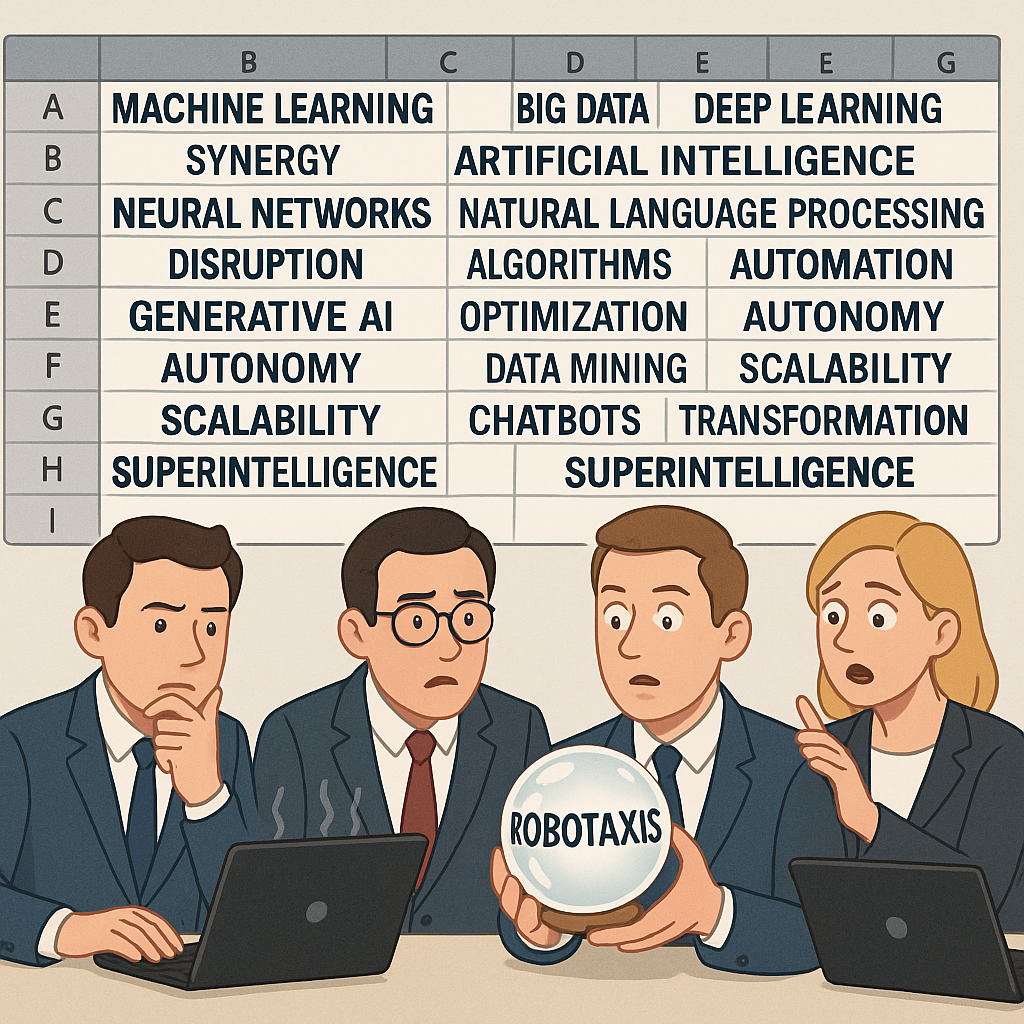
Wall Street, meanwhile, is stuck in a tragically old-fashioned mindset: they keep asking questions like, “How many real robotaxis are operating today?” and “Why is revenue down if demand is supposedly ‘off the charts’?” In response, Musk presented what he called a “multi-pronged AI roadmap,” summarized for investors as:
- Phase 1: Sell cars.
- Phase 2: Tell everyone the cars are secretly robots.
- Phase 3: Convince markets you’re actually an AI company that occasionally manufactures sheet metal.
- Phase 4: Monetize consciousness. Or at least subscriptions.
Tesla’s pivot has also raised existential questions for traditional automakers. While Toyota, Ford, and Volkswagen still grind through the dreary work of designing reliable vehicles, Tesla aims to bypass such boomer constraints by shipping “beta” software to millions of real streets and calling it “exponential learning.” As one industry insider put it, “Other companies test cars. Tesla tests reality.”
Humanoid robots are the latest supporting characters in Musk’s long-running series, “What If Every Labor Law Was Just A Suggestion?” The Optimus robot, showcased delicately placing objects and walking in a straight line when heavily supervised, has been promoted as a future factory worker, household servant, and possibly replacement for whichever Tesla engineer dares ask if they can fix Autopilot bugs before building a mechanical butler.
“Once Optimus reaches scale, labor will be almost free,” Musk said. “And if labor is free, GDP goes to the moon.” Economists countered that if nobody has a job, nobody can afford a robotaxi, a Model Y, or even Tesla’s $16,000 steering wheel upgrade. But economics, like traffic laws, is something Musk tends to interpret as a suggestion, not a constraint.
Crucially, the Tekedia report reminded readers that despite the fanfare over AI, Tesla’s cold financials show a revenue step backward — an uncomfortable data point when you’re trying to sell the idea that everything is growing except the line item that explicitly measures “money coming in.” But that hasn’t stopped Musk from re-framing the decline as a temporary side effect of going “too hard, too fast into the future.”
In a leaked internal memo, employees were urged to “think more like an AI company and less like a car company,” which some interpreted as “ship more unfinished software” and others as “prepare to be replaced by a chrome skeleton that works weekends.” The memo allegedly concluded with an inspirational line: “Remember, we are not just changing transportation. We are changing how people define disappointment.”
Investors now face a simple choice: either accept that Tesla is in a transitional period where revenue is merely pausing to catch its breath before being catapulted into an AI-powered utopia, or concede the more boring possibility that at some point, someone has to pay for something that actually exists. The stock’s performance suggests many are still on board with Musk’s vision — or at least too financially entangled to bail without admitting they’ve been hodling a robotaxi that keeps canceling the ride.
As the call wrapped up, one analyst asked when Tesla might return to steady revenue growth. Musk paused, then replied: “Once we fully unlock AI, there will be no such thing as revenue. Only pure, boundless value.”
The line was met with nervous silence, then a flurry of buy and sell orders as algorithms attempted to parse whether “boundless value” should be modeled as a multiple of zero or infinity.
Somewhere in the middle, the rest of us will be waiting at the curb, watching an app that says “Your robotaxi is 2 minutes away” for the next decade.