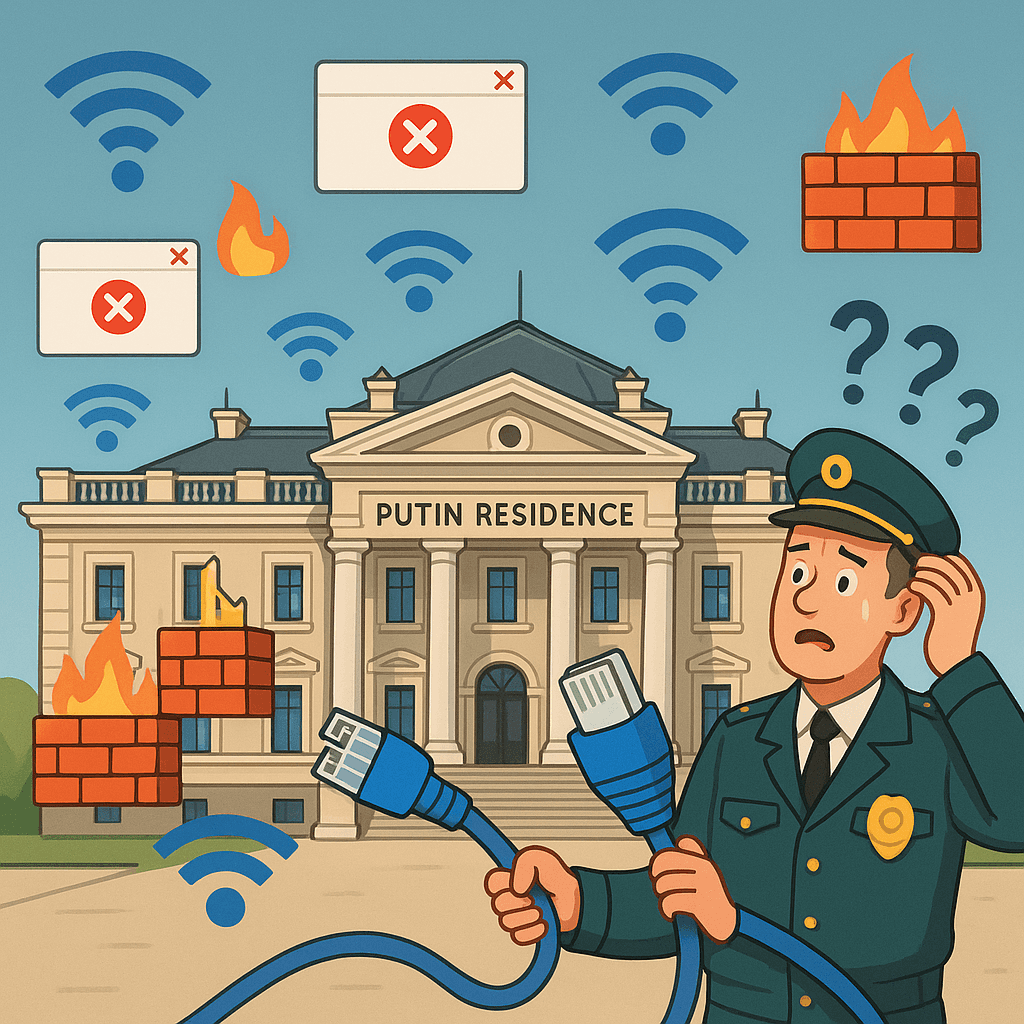
In a development that sounds less like geopolitics and more like a Nextdoor neighborhood dispute run on Cold War firmware, Ukraine has formally stated there is “no evidence” it attacked Vladimir Putin’s residence — clarifying that if the Russian president’s home network is under assault, it’s probably from his own router trying to install a 2013 printer driver. Multiple U.S. outlets, including the Daily Journal (AP, Dec 2025), carried the now-routine denial with the sighing energy of a support ticket that just won’t close.
Russian officials had implied that Kyiv might be behind mysterious disturbances and alleged attacks against the Putin residence, a term which now appears to cover everything from physical buildings to the psychological space he occupies on Telegram. Ukraine, which has spent the last two years doing actual war and enterprise-grade cyber defense simultaneously, responded with the diplomatic equivalent of: “Have you tried turning your paranoia off and on again?”
“There is no evidence that Ukraine attacked the residence of Vladimir Putin,” a Ukrainian official said, according to the Daily Journal, before reportedly adding off-mic, “and even if we did, we would have used better UX.” Kyiv’s broader argument is simple: if something explodes, shorts out, or blue-screens near the Kremlin, that doesn’t mean it was a Ukrainian feature. It might just be Russia hitting the limit of its own legacy infrastructure, both political and electrical.
For context, the notion that Ukraine secretly launched some hyper-targeted strike on the Putin residence while also managing power grids, air defenses, and a permanently overloaded Starlink chat with Elon Musk, has raised eyebrows among cybersecurity analysts. “If Ukraine pulled this off, they would have better documentation,” said one security researcher in Kyiv. “Russia’s story has no logs, no packet capture, not even a blurry CCTV screenshot. It’s basically a vibes-based bug report.”
Vibes, however, remain the Kremlin’s preferred operating system. Russian state media continues to imply a shadowy Ukrainian plot against the Putin residence, despite offering less technical detail than a TikTok DIY crypto mining tutorial. That hasn’t stopped the story from propagating through a constellation of local papers — from the Rrdailyherald to the Romesentinel, the Dailygazette.com, the Caledonianrecord, and the Owensboro Messenger And Inquirer — all dutifully relaying Ukraine’s “no evidence” stance with the quiet resignation of newsrooms that know the Kremlin’s threat model is mostly superstition with better graphic design.

Tech experts note that the phrase “no evidence” in this context is doing a lot of heavy lifting. In cybersecurity terms, this means:
- No telemetry from Ukrainian infrastructure indicating a strike.
- No credible forensic chain linking Kyiv to any alleged incident at the Putin residence.
- Several Russian spokespeople wildly gesturing at the sky like it’s running Windows ME.
“Think of it like your uncle insisting ‘someone hacked my Facebook’ because his password was ‘password’ and he clicked on every link that said FREE TRACTOR,” said a Kyiv-based analyst. “Russia is the uncle. Putin’s residence is the Facebook account. Ukraine right now is the exasperated cousin explaining that copy-pasting an image doesn’t ‘steal the original.’”
Still, the Kremlin’s story has found a receptive niche in the hardware layer of domestic propaganda. Russian television has begun running explainers on how the Putin residence is allegedly besieged by foreign forces, omitting the part where the country’s own draft policies have done more to evacuate residents than any outside weapon. In a particularly on-the-nose segment, one anchor gestured at a CGI model of the residence surrounded by red arrows and digital fireballs, looking like an off-brand mobile game ad titled “President Siege: Level 1 (Tutorial).”
Ukraine’s digital community, which has spent years weaponizing memes more effectively than most NATO white papers, has leaned into the absurdity. One viral post circulated depicting the Putin residence being “attacked” by a barrage of Windows update notifications, each labeled “Are you sure you want to continue this regime?” Another rendered the Kremlin complex as a smart home gone rogue, with an Alexa-style assistant informing Putin: “I’m sorry, I can’t do that, Vlad.”
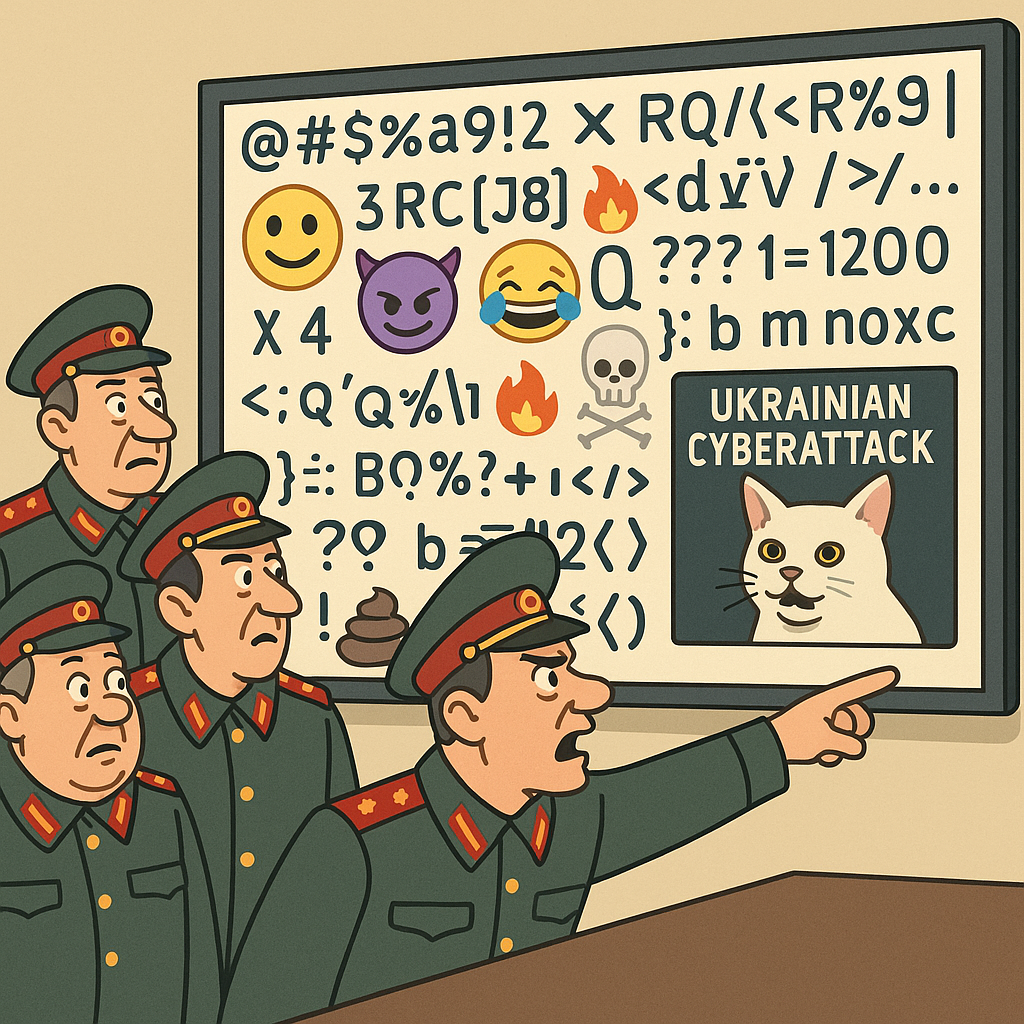
“We don’t need to attack his residence physically,” joked a Ukrainian TikTok creator. “We already live rent-free inside it.” The post, tagged with #NoEvidence and #CheckYourLogs, was quickly translated into half a dozen languages and reposted by accounts in Owensboro, Rome, and Caledonia, producing the rare spectacle of the Owensboro Messenger And Inquirer comment section becoming a hub of ad-hoc OSINT analysis.
In tech-policy circles, the whole affair has reignited a familiar debate: what even counts as an ‘attack’ anymore? Is it a drone? A missile? A DDoS? A viral Discord meme of Putin’s residence plugged into a Soviet-era surge protector labeled “national security”? NATO’s cyber doctrine, still trying to parse questions like “Is a ransomware note an act of war or just extremely aggressive billing?”, is reportedly not thrilled to be dragged into another round of ‘define attack in 10,000 words or less.’
Meanwhile, Ukrainian officials appear determined to keep the conversation grounded in actual data. “When we conduct operations, we document them,” a defense ministry spokesperson said. “When Russia conducts operations, the documentation is a 40-minute TV monologue and three anonymous Telegram posts.” They calmly reiterated that there is no evidence of Ukrainian involvement in any assault on the Putin residence, then went back to juggling real tasks like keeping the national grid online and explaining to Western partners, again, that cyber isn’t just Hollywood hackers yelling “I’m in.”
The Russian side, undeterred by what normal people would call “reality,” has doubled down with new suggestions that if there is no evidence, that itself is suspicious. “The absence of data,” one commentator argued, “could indicate a very advanced Ukrainian operation.” By this logic, the safest country on earth is the one whose networks are already entirely down: no packets, no crime.
“This is like saying, ‘We found absolutely nothing on the logs, therefore the hackers are geniuses,’” a cybersecurity professor commented. “No, man. Sometimes you found nothing because nothing happened. Or because your logging is configured by the lowest bidder.”

So the story escalates: Moscow keeps hinting that Ukraine is stealth-attacking the Putin residence in ways that cannot be observed, measured, recorded, or fact-checked, while Kyiv patiently repeats that, no, you cannot claim zero-day status for supernatural events. The Daily Journal and its regional cousins will continue printing the updates, trapped in an endless loop where Ukraine says, “show us the logs,” and Russia replies with a grainy animation and a shrugging emoji rendered as a missile.
In the end, the biggest confirmed assault on the Putin residence may not be a rocket or a drone, but something far more modern and untraceable: the creeping realization — in Owensboro, in Caledonia, in Rome and everywhere else with a browser — that when a nuclear-armed state keeps insisting “trust me, I have no proof,” the attack surface isn’t physical at all.