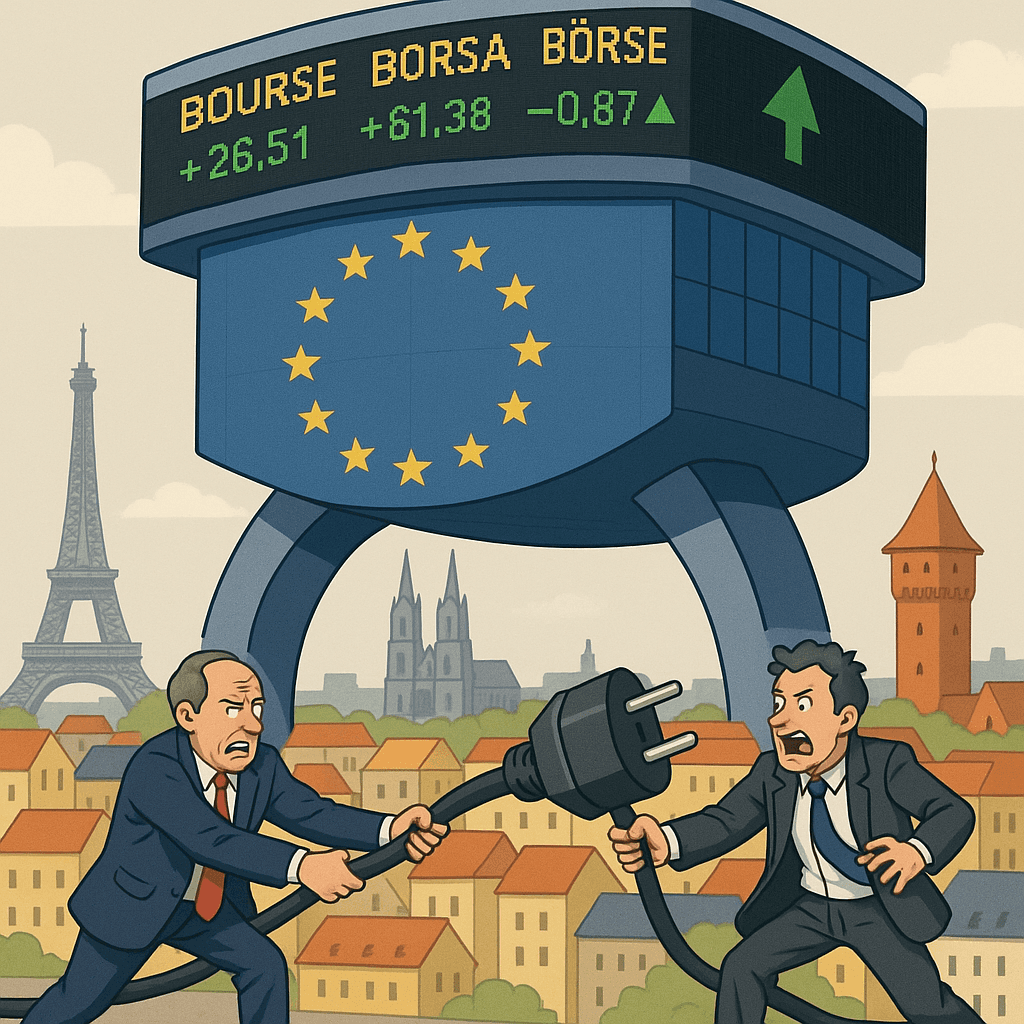
In a bold move to prove Europe can still centralize something other than bureaucracy and disappointment, the CSU has thrown its weight behind Friedrich Merz’s vision of a Single European Stock Exchange, pitching it as an existential battle for capital, listings, and influence across the bloc (Tekedia, Jan 2026). Think “Wall Street,” but with more umlauts, more committees, and an onboarding process that requires six stamps and a feelings workshop in Strasbourg.
Merz, the CDU leader whose eyebrows perpetually look like they’re shorting your future, wants to fuse the continent’s stock markets into one streamlined mega-venue. The plan, eagerly signal-boosted by the CSU, promises that every IPO from Lisbon to Ljubljana will pass through a single digital funnel. Critics say it’s an overreach. Supporters say it’s the only way to stop every interesting European company from running straight to the NASDAQ the moment it learns what a term sheet is.
According to the Tekedia report, the CSU is framing this not just as a financial reform, but as a grand geopolitical saga: a showdown over capital, listings, and influence. Silicon Valley has AI, China has manufacturing, America has the dollar, and Europe, apparently, will have the world’s most efficiently harmonized tick size regime. Somewhere in Brussels, a policy intern is already designing the logo: a heroic euro symbol straddling a candlestick chart that never quite breaks resistance.
The vision goes like this: instead of companies choosing between Frankfurt, Paris, Amsterdam, or “just giving up and going to New York,” a Single European Stock Exchange would offer one unified platform. You list once, get EU-wide visibility, and only have to pretend to understand one consolidated regulatory rulebook. In theory, it’s elegant. In practice, it’s Europe, so expect:
- A French liquidity committee vetoing a German market data fee structure.
- Italy demanding a separate premium listing tier for companies that promise not to move to Switzerland.
- And a Dutch working group on whether high-frequency trading violates their national right to be slightly chill about everything.
“This is about sovereignty,” a CSU-aligned policy advisor allegedly told an empty conference room, which then nodded in quiet agreement. “Why should Europe’s best startups celebrate their IPOs by ringing a bell in Manhattan, under a giant American flag, with CNBC hosts mispronouncing their names? They should celebrate by ringing a fully compliant pan-European audio-visual signalling device whose decibel level has been approved by three separate directorates-general.”
Of course, the current ecosystem isn’t exactly a well-oiled machine. Europe’s capital markets are a scattered mess of legacy exchanges, national pride, and very polite turf wars. You have Deutsche Börse trying to look serious in Frankfurt, Euronext cosplaying as a transnational powerhouse from Paris, Milan attempting a Midlife Renaissance, and the London Stock Exchange sulking in the corner like it rage-quit the group chat but still keeps reading the messages.
Into this comes Merz with a grand narrative: unite or fade into irrelevance. He is not entirely wrong. American markets hoover up global listings with the irresistible pitch: more liquidity, more analyst coverage, and memes. European retail investors, meanwhile, are still trying to convince their banks to let them buy a fractional share without sending a fax. The CSU’s support for this single-exchange vision is basically an admission that while Europe can’t out-meme WallStreetBets, it can at least try to reduce the number of settlement systems from “too many” to “slightly fewer.”
But under the rhetoric of a “fight for capital, listings, and influence,” there’s a quieter subtext: tech. A Single European Stock Exchange is less about marble trading floors and more about who controls the data pipes, the matching engines, and the API that every fintech app has to grovel before. If you build one dominant pan-European platform, you don’t just decide where companies ring a bell. You decide:
- Who gets real-time market feeds.
- Which algorithms get preferential colocation.
- Which scrappy Tallinn-based trading startup gets rate-limited into oblivion.
In other words, this isn’t just capital markets policy; it’s infrastructure monopoly cosplay.
“Imagine one seamless digital marketplace,” a CSU spokesperson enthused, probably standing in front of a PowerPoint gradient older than TikTok. “Retail investors from Madrid to Helsinki accessing the same order book, the same liquidity, the same user experience.” He did not elaborate on how this glorious user experience would interface with banks that still lock your account when you try to buy more than one U.S. ETF in a month, but details are for committees, not visionaries.
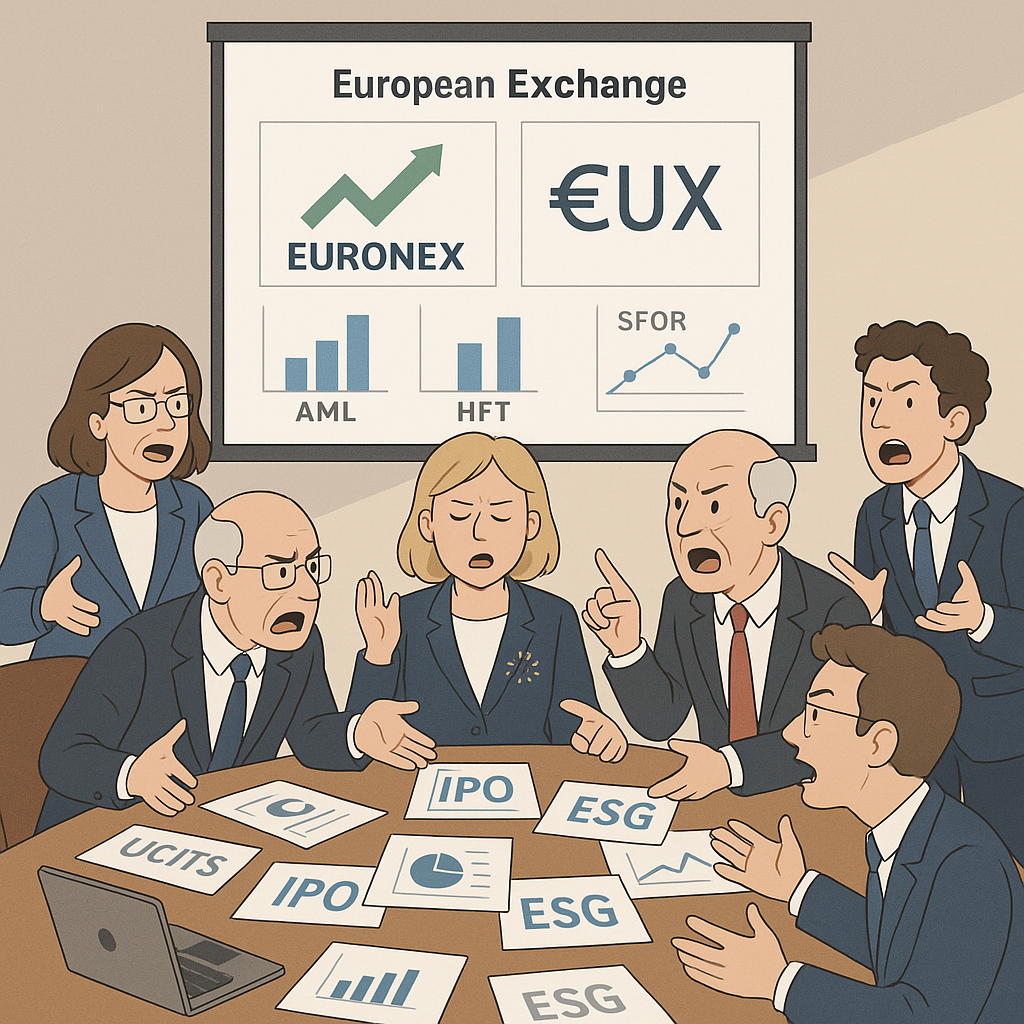
Meanwhile, the tech community is torn. Some fintech founders love the idea of integration. If there’s one thing developers hate, it’s having to write separate adapters for six different exchanges just to support “Buy” and “Panic Sell” buttons in their apps. A consolidated European exchange could, in principle, mean one API, one sandbox, and a single, blessed documentation portal that might even be updated more than once a decade.
Others are less enthusiastic. “Centralization is cute until the one matching engine has a hiccup and half of Europe can’t trade,” warned a risk engineer at a major neobank, who asked not to be named because, quote, “my boss still thinks Kafka is just an event streaming platform.” “Right now, if Paris goes down, you still have Frankfurt. If everything runs through one mega-exchange and that goes offline, congratulations, you’ve invented a continent-wide forced meditation app.”
Regulators, naturally, are thrilled. A Single European Stock Exchange promises exactly what Brussels dreams about at night: one giant, auditable, highly surveilled pool of trading data. MiFID enforcement becomes less like herding cats and more like watching a single, beautifully instrumented server farm. The European Securities and Markets Authority (ESMA) is rumored to already be drafting a compliance dashboard that lets officials zoom into flash crashes like they’re watching the financial equivalent of Google Earth for bad decisions.
There’s also the small matter of politics. The CSU may be selling this as a “European” project, but every capital city hears the same question in slightly different accents: who really gets to run it? Will the main servers hum quietly in Frankfurt, bathed in German proceduralism? Or will Paris insist that any exchange claiming to be truly European must be headquartered within striking distance of a Michelin-starred lunch? The Netherlands, experts warn, may attempt a diplomatic coup by offering Amsterdam as a compromise if everyone agrees to pretend that weed stocks are still a novelty.
“If this is about a fight for influence, let’s at least be honest that step one is a fight for office location,” a Brussels lobbyist sighed. “You can wrap it in whatever language you want about capital formation and global competitiveness, but at the end of the day somebody wants their building in the background of every CNBC Europe live shot.”
Still, for all the satire built into the idea of yet another grand European project, there is something unavoidable in the CSU’s argument. The current setup leaves European tech darlings courting U.S. capital the moment they gain traction. London is busy roleplaying Singapore-on-Thames, Zurich is outside the EU entirely, and the rest of the continent is trying to convince founders that “ringing the bell in Frankfurt” is spiritually equivalent to trending on Reddit. It isn’t.
So the Single European Stock Exchange pitches itself as the upgrade: a tech-forward, politically blessed, pan-continental marketplace where the next Spotify or Adyen can go public without changing time zones—or accents. Of course, that’s the dream. The reality will probably involve a three-year argument over logo fonts, a phased rollout that begins in 2034, and an eventual rebrand to something no one understands, like “EuroNextGenMarket Core+”.
If Merz and the CSU get their way, though, Europe’s financial future may really run through one giant, humming cluster of matching engines somewhere between Frankfurt and Brussels—a single, vast exchange where capital, listings, and influence converge into a perfectly regulated, beautifully centralized, occasionally unavailable API.
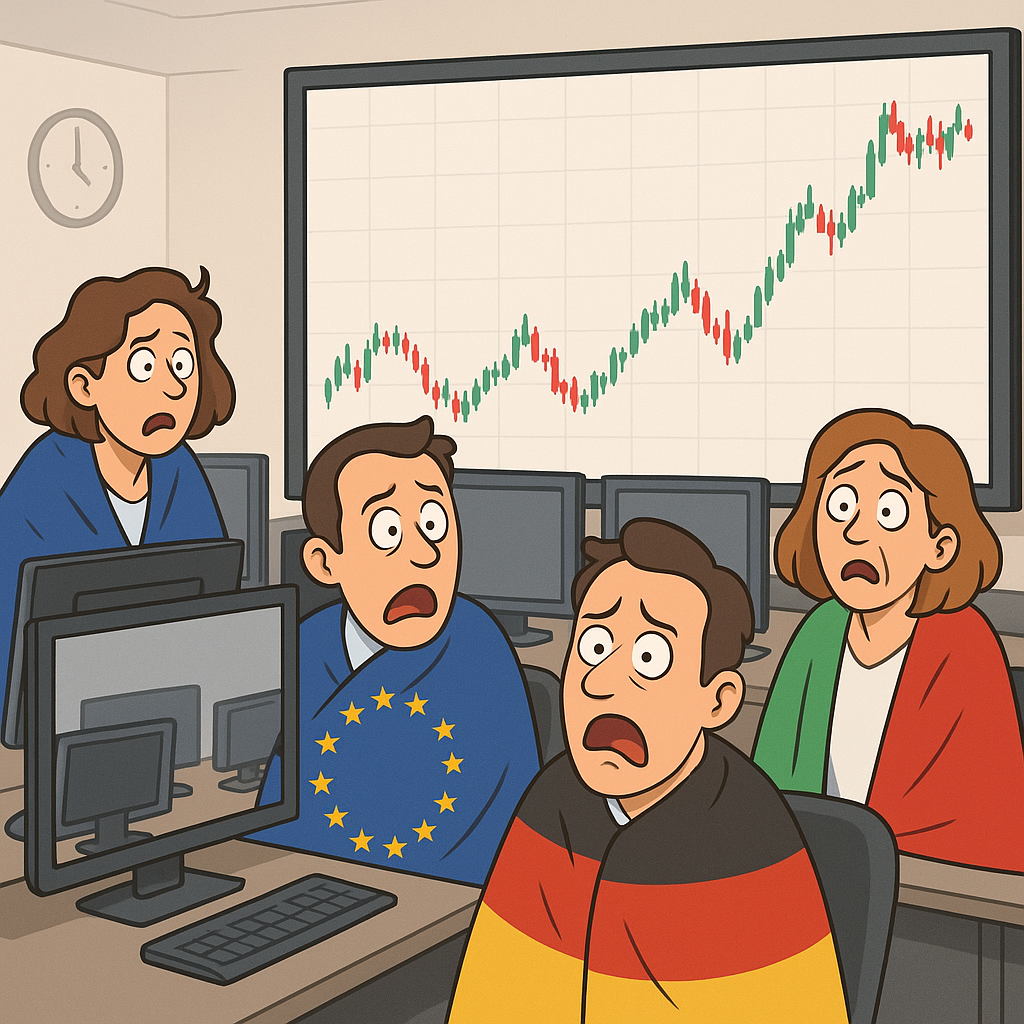
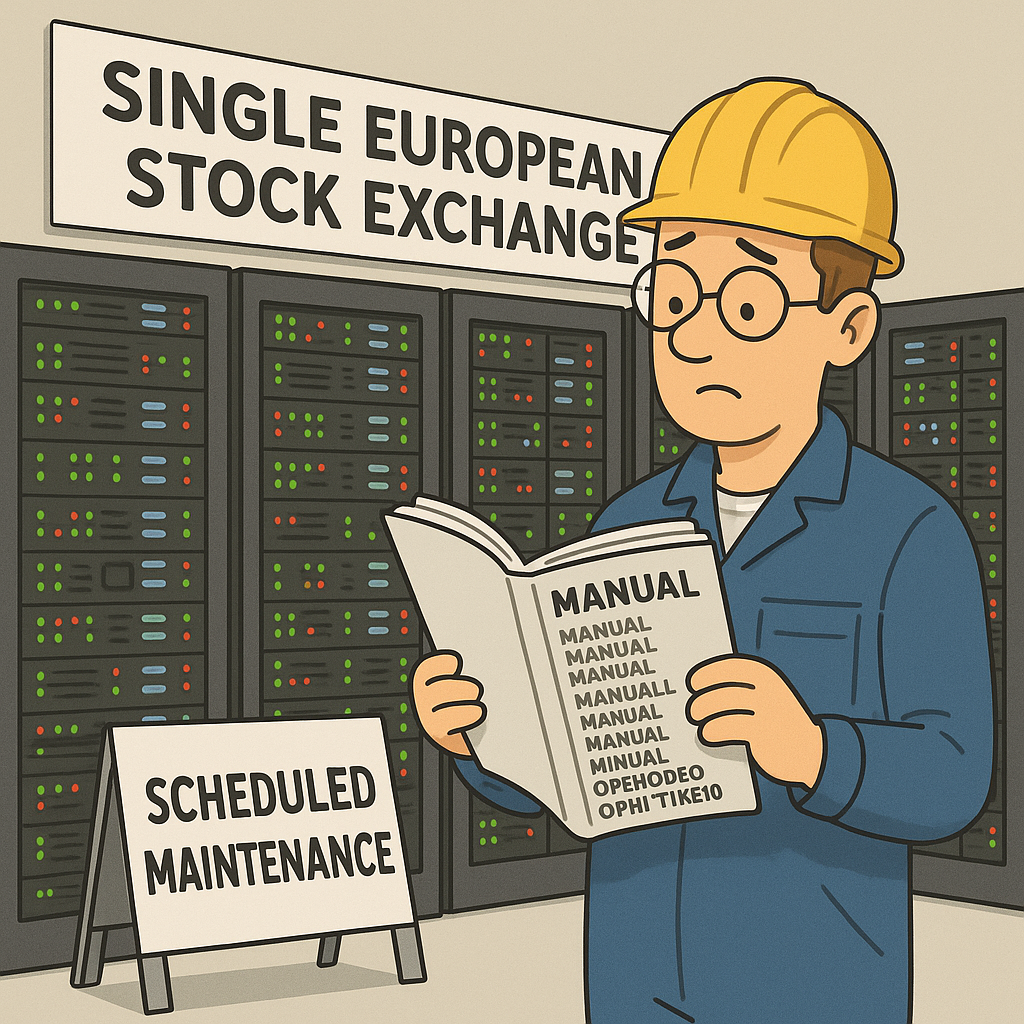
And when it does go down for “scheduled maintenance” on a random Tuesday at 2 p.m., millions of traders will stare at the same frozen interface and finally experience true European unity: being simultaneously locked out of their money by the same piece of tech.