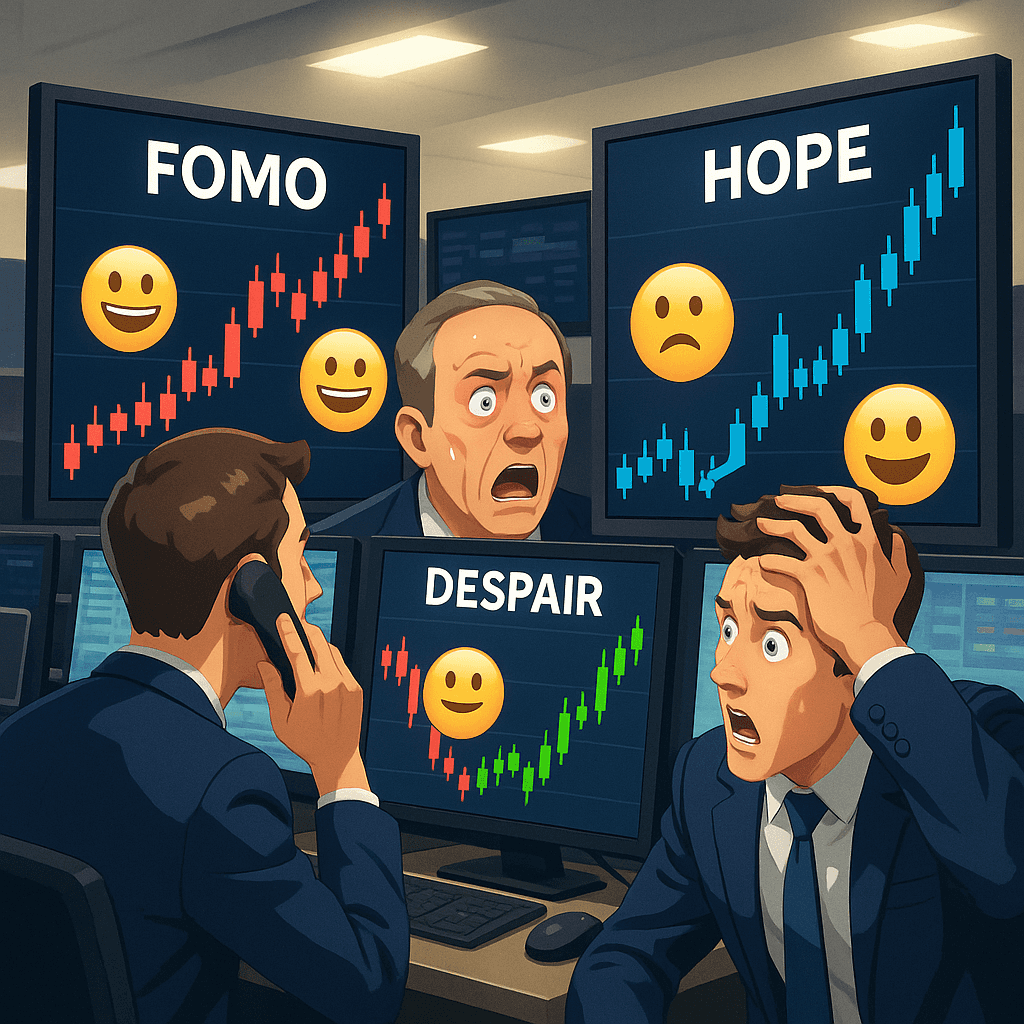
In a landmark moment for capitalism’s ongoing attempt to securitize literally everything, several major Wall Street banks announced the launch of dedicated “Emotional Derivatives Desks” this week, allowing sophisticated investors to finally hedge against the only real risk left in markets: how humiliating it feels to be wrong in public.
The new products, branded as Emotion-Backed Securities (EBS), will allow clients to trade synthetic exposure to human feelings like FOMO, despair, and what the prospectus describes as “resigned acceptance that Elon will tweet again.” According to one Goldman Sachs managing director, the move “brings long-overdue liquidity to the market for vibes.”
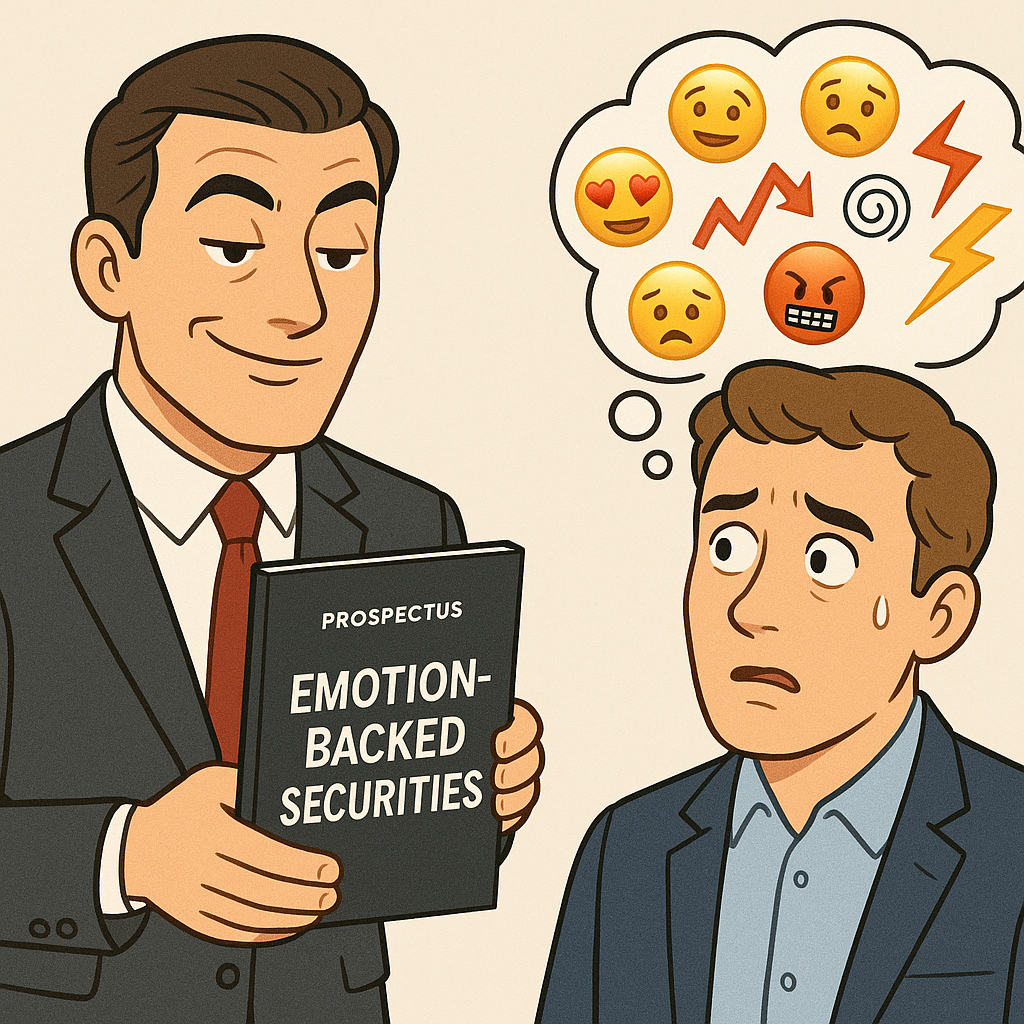
“We’ve already securitized houses, student loans, volatility, rainfall, and Taylor Swift ticket prices,” said an executive at JPMorgan, straightening a tie with the quiet confidence of a man who once tried to collateralize his interns’ dreams. “The only remaining inefficiency is emotional exposure. Why should our clients bear the raw pain of a 40% portfolio drawdown when they can simply short their own disappointment?”
The flagship product, Despair Futures (DFX), allows hedge funds and retail investors with a Robinhood account and unmedicated ADHD to speculate on the average investor’s emotional pain level during major market events. A leaked term sheet lays out the first batch of contracts:
- DFX-BTC-HALVING: Tracks aggregate despair as Bitcoin fails to hit 7-figure price targets for the fourth consecutive halving.
- DFX-FED-MEETING: Pegged to the number of times Jerome Powell says “data dependent” before markets crash anyway (per CNBC, Powell already set a record in 2022).
- DFX-NFT-BAGHOLDER: Correlates to the number of times someone mutters “it’s a long-term play” while staring at a JPEG of a raccoon in a hat.
“Our models show a strong correlation between macroeconomic uncertainty and the urge to tweet ‘we are so back’ followed by ‘it’s so over’ within the same 48-hour period,” noted a Morgan Stanley quant, pointing to a chart that was just the Merrill Lynch bull, crying. “This desk lets us monetize that oscillation.”
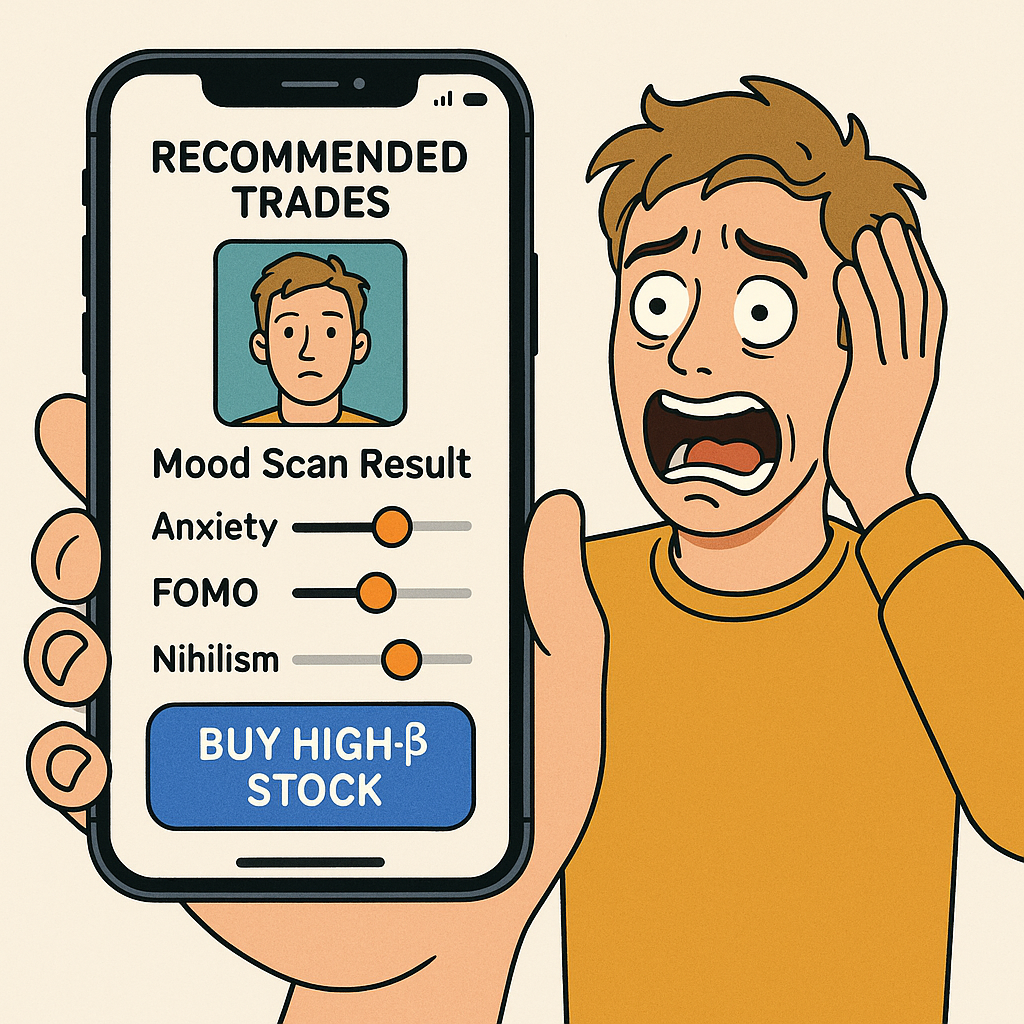
Retail investors, long treated as cannon fodder in the content mines of financial TikTok, are being aggressively targeted through new app-based platforms. One startup, MoodyQuant, which recently closed a $65 million Series B led by a16z, allows users to:
- Take a selfie.
- Answer three questions about their emotional state.
- Receive a suggested trade that “aligns with your current vibe and attachment style.”
“If you’re exhibiting signs of manic optimism, we’ll gently nudge you toward selling covered calls on your own joy,” explained MoodyQuant’s founder, a former WeWork ‘community evangelist’ who lists his job title on LinkedIn as “Chief Feeling Officer.” “If you’re in full nihilist mode, we’ll help you go long on institutional apathy. We don’t cure your emotions. We just 5x them with leverage.”
Regulators, predictably, are somewhere between outraged and intrigued, which is how they felt about crypto, meme stocks, and that time a U.S. Congressman live-streamed buying Dogecoin on a committee break. While the SEC hasn’t formally commented, one staffer—speaking off the record because his boss still thinks Bitcoin is “just Fortnite points”—admitted that the agency “doesn’t quite know how to classify a CDO made out of collective dread.”
“On the one hand, it’s obviously deranged,” the staffer said. “On the other hand, so are most things we’ve already approved. Have you seen a SPAC deck? And let’s be honest, if BlackRock files an ETF called the iShares Core Global Anxiety Fund, it’s getting approved in, like, six weeks.” (BlackRock, for the record, declined to comment, which in modern finance is considered a strong signal they’re already hiring interns for it.)
To build liquidity, banks have quietly been piloting the concept in-house for years. One veteran trader at Citigroup recalled an early version launched around 2020. “We had an internal market in which you could buy protection against your own bad calls,” he said. “If you went all-in on ‘inflation is transitory’ or ‘Zoom will trade above $500 forever,’ you could hedge your future shame. By late 2021, the desk was the most profitable unit in the bank.”
Academic economists, desperate to be invited to something—anything—besides another Brookings panel, are already rushing to justify the new market with equations. A draft paper circulating at the University of Chicago attempts to mathematically prove that securitizing feelings increases overall welfare by transforming “unproductive existential panic” into “tradable basis risk.” One co-author proudly noted the paper includes “the first-ever yield curve for regret.”
“We can finally answer the question: What is the fair market value of realizing you should’ve bought Bitcoin in 2013?” the economist wrote. “Our models put it at around 2.3 lifetime therapy sessions per standard deviation of underperformance.”
Cultural critics have been less enthusiastic. “They’re literally turning mental health into an asset class,” warned a sociologist who once tried to explain Marx on MSNBC and was never invited back. “We already know that constant exposure to market volatility, doomscrolling, and crypto Twitter can cause measurable stress. Now we’re layering derivatives on top of that? At this point, the only rational trade is to go long SSRIs.”
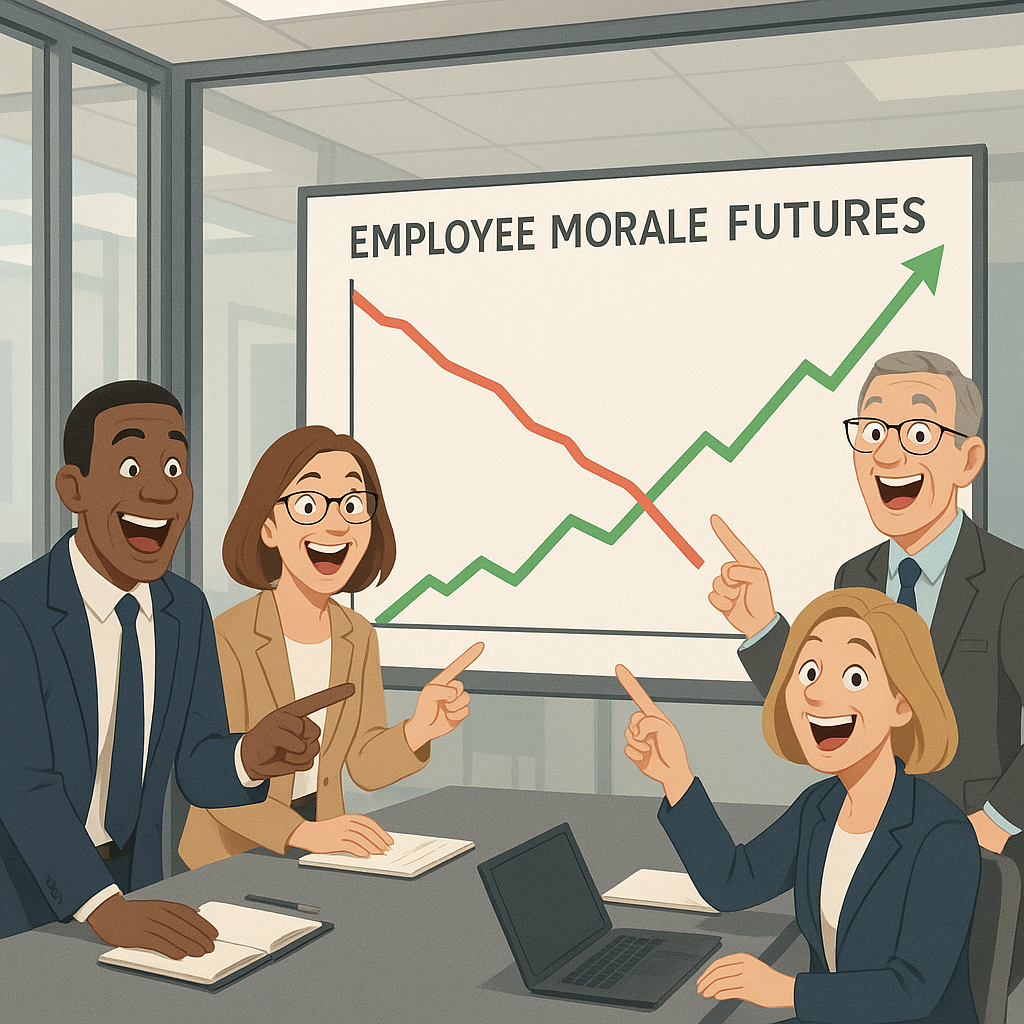
Still, adoption is accelerating. A major Silicon Valley bank (not the one that exploded in 2023, a different one) is rolling out corporate Emotional Risk Management programs, letting HR departments hedge against quarterly morale shocks. Instead of addressing burnout, layoffs, or the existential horror of another mandatory offsite, companies can simply buy options on “employee enthusiasm decay.”
“If the team’s motivation collapses after we announce we’re pivoting from AI to blockchain to AI-on-blockchain, our EBS portfolio will at least be up,” said one HR executive, who insisted on anonymity “because my CEO still thinks we’re a family.” The bank’s pitch deck promises CFOs “unprecedented alignment between emotional downside and shareholder value.”
The new asset class is also bleeding into politics. Several campaigns are reportedly exploring the idea of packaging voter anxiety into structured products. One consulting firm has already modeled a swap between “election-year dread” and “post-election inevitability,” noting that volumes are “off the charts” any time a candidate polls within five points of plausibility. As one strategist put it: “If democracy’s gonna be a roller coaster, someone should be selling FastPasses.”
Market veterans warn, however, that the whole structure might be fragile. “We’re basically building a CDO-squared out of vibes,” admitted the Goldman executive. “If there’s a correlated global event that pushes everyone into the same emotion—say, another pandemic, or Apple releasing an actually affordable product—the market could experience a ‘total sentiment cascade.’ Our stress tests show… well, we chose not to run them.”
Meanwhile, in a rented coworking space in Brooklyn, a defi collective is already working on the inevitable decentralized version: an on-chain, permissionless protocol called FeelFi, where users can pool their sadness and farm yield on it. “TradFi emotional derivatives are just recreating the same old power structures,” argued the pseudonymous founder, @VibeValidator. “On FeelFi, anyone can tokenize their heartbreak, stake it, and earn governance tokens that let them vote on the global mood.”
Back on Wall Street, the emotional derivatives desks are ramping up headcount ahead of year-end bonuses, which will now, naturally, be partially paid in synthetic empathy options. Asked whether anything is off-limits, one managing director shrugged.
“If there’s a human experience that can be summarized in a three-letter ticker,” he said, “we’re gonna list it.”