
In a bold new act of financial fan fiction, a fresh batch of analysts has attempted to answer the question posed this week by Biztoc: “Where Will Nvidia Stock Be in 10 Years?” (Biztoc, Jan 2026). The consensus: somewhere between “the world’s first $10 trillion stock” and “remember Intel?”
For the uninitiated, Nvidia has become the patron saint of artificial intelligence, cryptocurrency miners, and anyone who ever had to explain to their family why the GPU in their gaming PC cost more than the car. Under the leather-jacketed reign of CEO Jensen Huang, the company has turned AI chips like the H100 and B200 into something between semiconductor products and religious relics.
On Wall Street, this has triggered a new sport: long-range Nvidia forecasting. A decade from now, say some research notes, Nvidia could dominate everything from data centers to self-driving cars to the smart toaster that keeps installing unauthorized driver updates. Others warn that in ten years, the AI bubble could deflate, regulators could notice that GPU farms use more power than small countries, and Nvidia might be forced to pivot into something modest, like making yet another gaming laptop you can fry an egg on.
To bring rigor to this chaos, one major investment bank has rolled out a proprietary Nvidia valuation framework, internally codenamed J.E.N.S.E.N.:
- Jacket Glossiness
- Expected GPU Scarcity
- Number of AI startups burning cash on Nvidia cloud credits
- Sovereign Wealth Funds FOMO Index
- Elasticity of gamer tears to price hikes
- Newsletter Hype Per Week
The model, after four hours of Monte Carlo simulations and three iced lattes, produced the following 2036 scenarios:
- Base Case: Nvidia becomes the new electricity. Every workload, from TikTok filters to Pentagon simulations, runs through Nvidia-powered GPU clusters. The company’s valuation quietly passes that of several G7 economies, who respond by launching their own state-backed “open-source” GPUs that are mysteriously also manufactured by Nvidia.
- Bull Case: Jensen Huang successfully convinces Apple, Microsoft, and half of Amazon Web Services to standardize on Nvidia’s software stack. Wall Street stops using price-to-earnings ratios and moves to a more modern metric: price-to-inference.
- Bear Case: Governments realize that training a single frontier model uses more electricity than Ontario, ban GPU hoarding, and heavily subsidize alternative chips from AMD and homegrown startups. Nvidia responds by launching a lifestyle brand and an AI-powered cookware line.
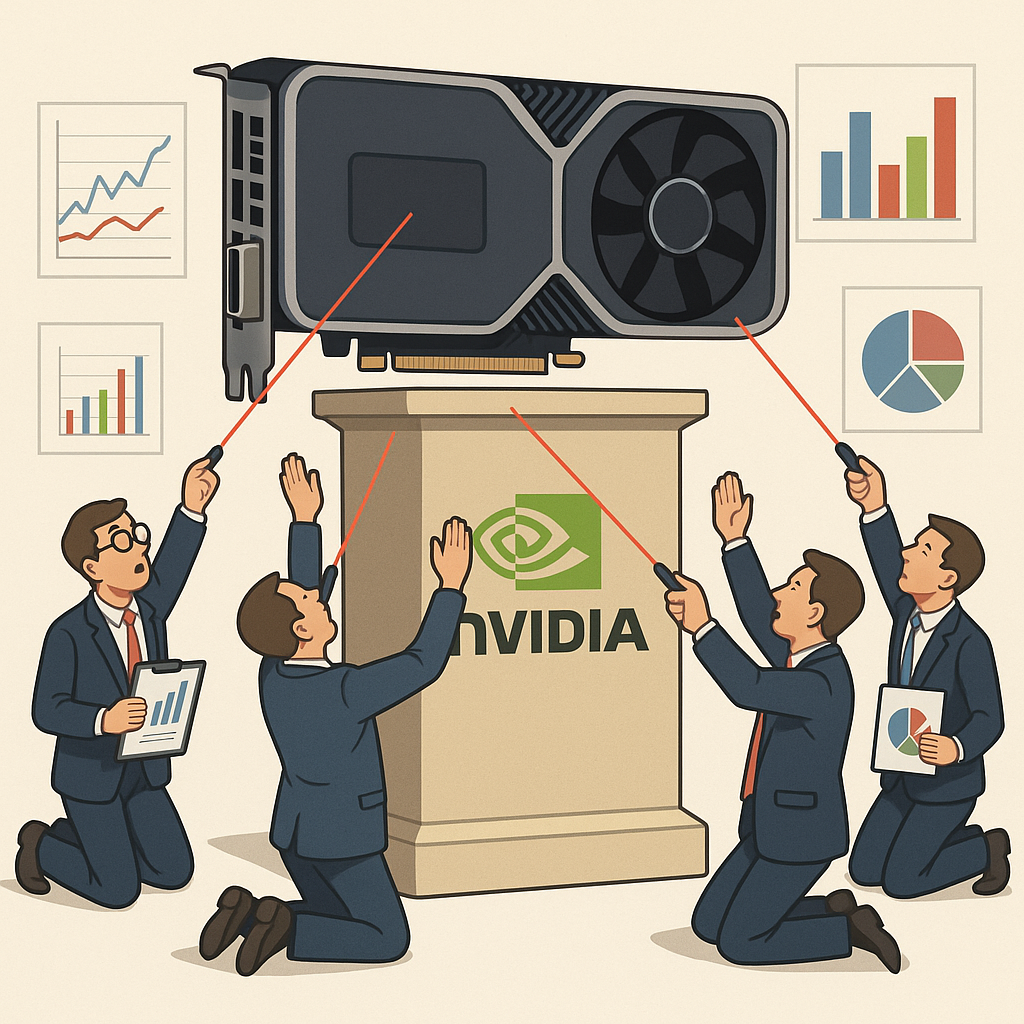
The AI boom has already turned Nvidia into the unofficial central bank of Silicon Valley. Venture capitalists now ask founders a single due-diligence question: “How many Nvidia GPUs will you need, and how quickly will you waste them?” One startup building an AI-powered mindfulness app reportedly signed a letter of intent for 2,000 H100 chips, which will be used to generate personalized affirmations about how it’s okay that they will never be profitable.
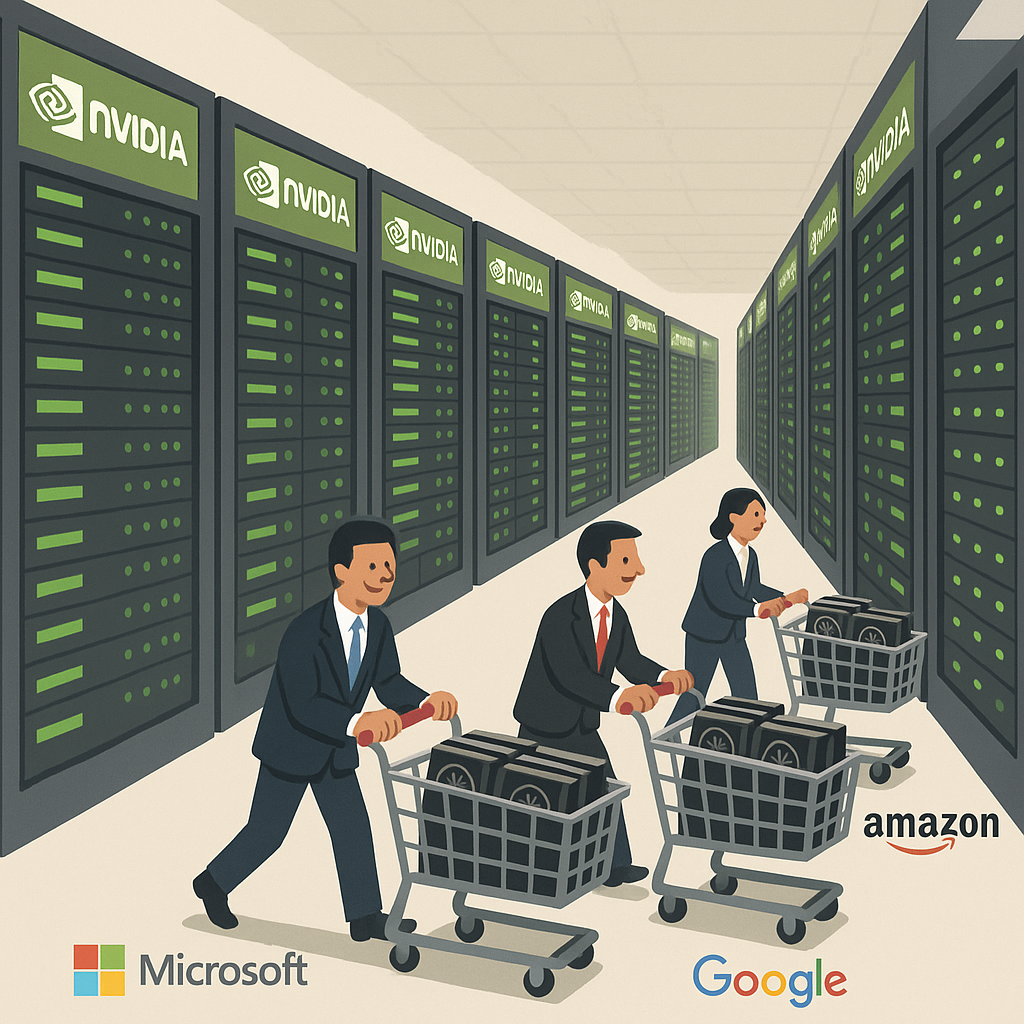
Cloud providers like Microsoft Azure and Google Cloud have become glorified Nvidia vending machines, renting out GPU instances at prices that suggest the hardware was carried to the data center by Sherpas. AWS, not to be outdone, has allegedly explored a new Prime tier where members get same-day delivery on GPUs, an AI chatbot, and a notification every time Jensen Huang puts on a new jacket.
But the 10-year outlook is where the speculative artistry really kicks in. A leaked slide deck from a major hedge fund, titled “NVDA 2036: Moon, Mars, or Misinformation?”, outlines the following projected realities:
- Every Fortune 500 company runs at least one “strategic AI initiative” that mostly consists of renting Nvidia GPUs to automatically summarize Slack threads no one reads.
- Household robots, also powered by Nvidia chips, flawlessly navigate stairs, do laundry, and still refuse to understand printer drivers.
- Retail investors refer to Nvidia simply as “The Stock,” much like “The Cloud” and “The Algorithm” before it.
Of course, all of this assumes no one else shows up to the party. In the shadow of Nvidia’s meteoric rise, rivals are making moves. AMD promises its next-gen accelerators will deliver “comparable performance” at “significantly lower cost,” industry code for “please invite us to your AI keynote.” Intel, meanwhile, continues its decade-long side quest of reinventing itself as an AI player, insisting that its latest Gaudi-branded chips are “competitive,” a term which in semiconductors can mean anything from “close on certain benchmarks” to “exists in PowerPoint.”
Governments are also getting nervous. The European Union is reportedly exploring an “AI Hardware Sovereignty Act,” which would require any datacenter in the bloc running more than 10,000 Nvidia GPUs to also plant at least three trees and write one strongly worded open letter about open source. The U.S., for its part, is debating whether to classify high-end GPUs as “dual-use” technology, the dual uses being “training large language models” and “wrecking the energy grid.”
Investors, however, appear unfazed. One portfolio manager explained his 10-year Nvidia thesis as follows:
“Look, I don’t know where the stock will be in a decade. I don’t know where I’ll be in a decade. I just know that every time someone says ‘AGI’ on an earnings call, Nvidia’s implied valuation adds another medium-sized country.”
Another analyst, asked for a more grounded forecast, replied, “In 10 years, Nvidia will either be the backbone of a sentient global AI hive mind or the poster child for the last great tech bubble. Either way, there will be a Netflix documentary and I plan to be on it.”

In the end, the only truly reliable Nvidia 2036 prediction may be this: somewhere, a gamer will still be trying to buy a mid-range GPU at a sane price, only to discover that the last available unit has been pre-emptively bulk-purchased by a hedge fund to arbitrage its use between AI inference, crypto mining 3.0, and rendering yet another cinematic trailer for a game delayed to 2041.
By then, Nvidia’s stock might be split twelve times, weathered three regulatory crusades, and powered at least one failed attempt to build a GPT clone that can do your taxes. But if history is any guide, Wall Street will still be publishing fresh “Where Will Nvidia Stock Be in 10 Years?” think pieces, just with larger numbers, more disclaimers, and a new section required by regulators:
“This forecast was generated with material assistance from Nvidia-powered AI systems. Any resemblance to reality, past or future, is purely coincidental.”