Big Tech Won’t Name a 10,000‑Job AI Layoff Bucket in 2026
My call: No major U.S. tech giant will put “10,000 jobs cut for AI” in black and white for 2026.

Big Tech Will Let AI Eat Jobs, Then Blame “Strategic Rebalancing”
By Cassandra Next, Forecast Columnist
A smug futurist who treats tomorrow like leaked press copy.
There is one thing scarier to a Big Tech CEO than replacing 10,000 workers with AI: admitting it in writing.
My call: through the 2026 reporting cycle, not a single major listed U.S. tech giant will put a clean number like “we eliminated over 10,000 roles due to AI automation” into its SEC filings or scripted earnings remarks.
The jobs will go. The line item will not.
The bet, in plain English
Here is the scorable version for the prediction desk: by March 31, 2027, when full-year 2026 results are on file, none of Amazon, Alphabet/Google, Microsoft, Meta, IBM, Oracle, HP, or NVIDIA will have a single, clearly labeled disclosure saying that 10,000 or more jobs were cut in 2026 specifically due to “AI automation” or “AI efficiencies.”
Vague language about “AI-enabled productivity,” scattered references to “several thousand” roles, or fuzzy talk about “transformation” do not count. This bet only breaks if you can point to a sentence that reads like a political attack ad script: “We cut 10,000 plus jobs because of AI.”
The bodies are real. The attribution is optional.
The uncomfortable part is that AI is already chewing through work. Estimates put AI-linked job losses in the U.S. north of 112,000 since early 2025. The Bureau of Labor Statistics is quietly logging declines in AI-exposed roles. Customer service reps alone are down about 130,000 in a year, a 4.8 percent drop.
CEOs are not shy in private. Surveys have more than 40 percent of them planning to cut junior roles in the next couple of years as generative AI handles routine tasks. Academic work shows junior and young workers are bearing the brunt in AI-heavy fields. Tech workers in San Francisco are already living the vibes: tens of billions in new AI wealth for insiders, layoffs in full swing for everyone else, and software engineers wondering whether their life’s skill is now a plug in.
Layer on top the spending binge. The hyperscalers are about to dump something like 725 to 800 billion dollars into AI capex in 2026. Boards are not funding that for the romance of large language models. They want productivity gains, revenue growth, and yes, lower labor costs.
So yes, AI will kill jobs. It just will not get its name on the tombstone.
Why the 10,000 number never makes it into print
The consensus fantasy is simple: Wall Street loves AI, therefore Wall Street will love AI layoffs. Commit to the robot future, announce a big “AI efficiency program,” watch the multiple expand.
The signal says otherwise.
CNBC looked at 23 S&P 500 firms that explicitly tied layoffs to AI. More than half traded down after those announcements. The underperformers fell on average about 25 percent. So when executives tell the Street “we fired people for AI,” the Street’s answer has mostly been “cool story, where are the margins?”
Investors have also discovered a new hobby: accusing everyone of “AI washing.” If you claim AI savings and your numbers do not back it up, you are not a disciplined operator, you are the guy who bought a GPU and a press release. The more you tie specific layoffs to AI, the easier you are to audit later.
Which is where legal and political risk enter. In 2026, AI and jobs is not a sleepy academic panel, it is an election year food fight. A line in a 10 K that reads “we eliminated over 10,000 roles due to AI” is not just disclosure. It is ready made B roll for campaign ads, Senate hearings, union organizing, and SEC comment letters about your risk factors.
There is also a structural reason to stay vague. Real layoffs are messy. AI, over hiring in the pandemic, wars and tariffs, shifts in product strategy, all hit the same payroll at once. HR and finance systems may track which program triggered which cut, but public reporting is built to mush it together into “restructuring” and “efficiency initiatives.” There is no accounting standard that says “separate out the robots.” Why volunteer a clean AI number when you can say “macroeconomic headwinds and technology enabled efficiencies” and go to lunch?
How Big Tech will talk about AI layoffs instead
If you want to know what 2026 looks like, picture three flavors of corporate message, all technically honest, all scrupulously avoiding the big headline number.
- The smoothie: “In 2026 we reduced headcount as part of a multi year restructuring program focused on portfolio optimization, cost discipline, and AI enabled efficiencies.” Translation: yes, AI helped, no, you are not getting a clean body count.
- The demo: “AI tools reduced manual effort in X function by 15 percent, enabling consolidation of several thousand roles.” The number is concrete enough to look modern, small enough to avoid a cable news chyron.
- The responsible adult: “We are investing in AI and reskilling, and some roles have been eliminated or redeployed.” This is the IBM style play: talk loudly about training and junior hiring, imply that your job cuts were a tasteful pruning, not an AI abattoir.
Behind that language, real attrition compounds. Customer support teams that stop backfilling. Junior engineers replaced by copilots and contractors. Back office processes refactored so that one AI operator does the work of five coordinators. Over a year, those quiet decisions easily add up to five figures. They simply never get the “10,000 AI layoffs” headline a forecaster can score.
What would have to change for a company to say the quiet part loud
For this bet to fail, one of the giants has to decide that radical candor about AI job destruction is a feature, not a risk.
That could happen. A lagging cloud player might be desperate to prove that its 150 billion dollar AI buildout is not just burning cash. An activist investor might demand quantifiable AI savings. Regulators could quietly push for more transparent attribution. Or a company hit by leaks about internal “AI displacement dashboards” might decide that owning a 10,000 figure beats being caught hiding it.
If that happens, it will look like this: an earnings script or 10 K says something very close to “approximately 12,000 roles were eliminated in 2026 as part of AI driven automation and efficiency programs.” The CEO does a contrite roadshow on “responsible automation” and drops a reskilling fund the size of a small country’s GDP on the table.
That scenario is possible. It is just fighting uphill against every instinct of the modern corporation, which is to keep optionality high and quotable numbers low.
The satirical verdict
So here is the verdict you can come back and grade me on: in the 2026 filings, Big Tech will talk about AI as a co pilot, a creativity unlock, a margin tailwind, a transformation platform, a new computing era, and a once in a generation opportunity.
It will describe the people who vanish as “efficiencies,” “optimization,” and “role realignment.” It will not, in any officially scripted place, give you one neat sentence that admits: “AI killed more than 10,000 of them here.”
Tomorrow’s pink slips will arrive on schedule. Tomorrow’s paperwork will insist that no particular technology was at fault, it was just the future, in aggregate.
Around the Shallot
Stay in the same broken universe.
Forecasts, satire, cartoons, and quizzes should feel like one publication, not disconnected tabs.
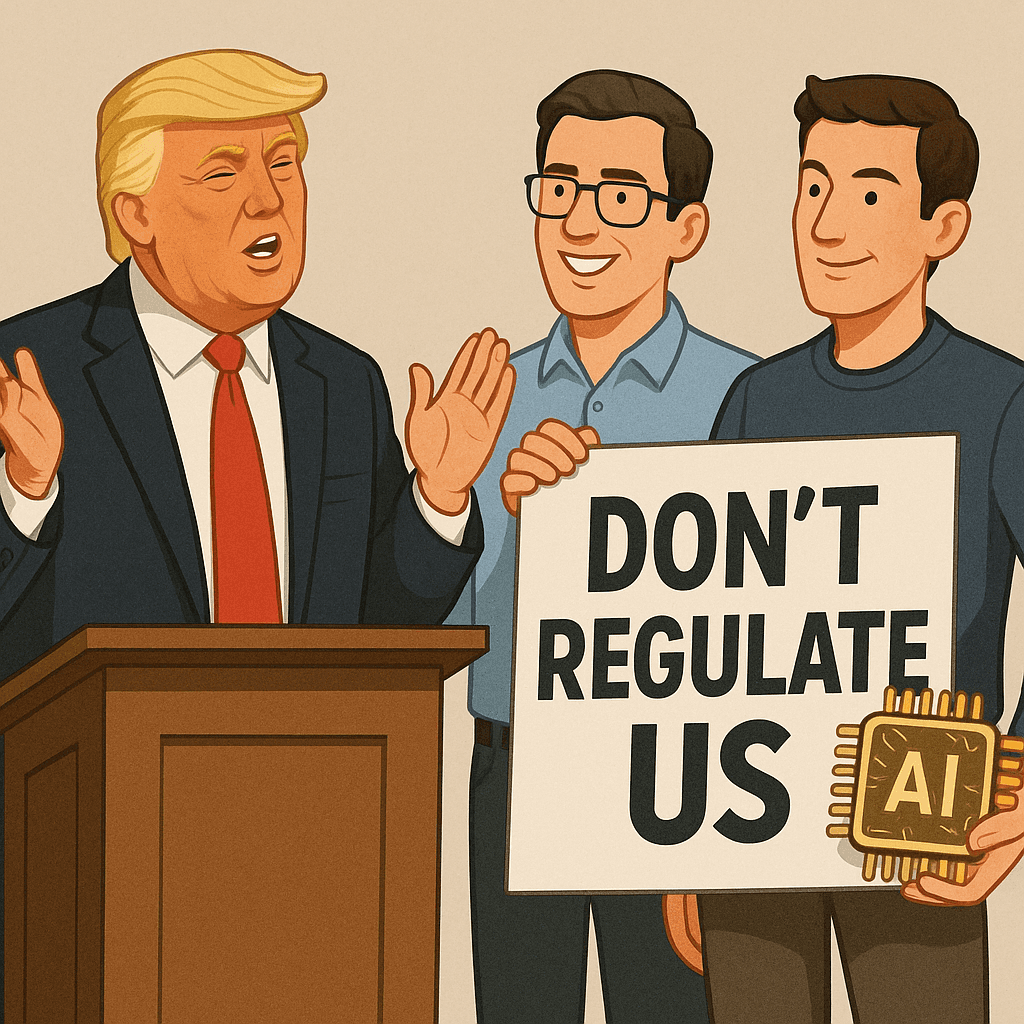
Tech
‘Don’t Regulate Us,’ Beg AI Founders Currently Selling Regulation-As-a-Service
Silicon Valley hails Trump’s plan to let AI companies write their own rules, promises to sell those rules back to everyone else by Q4.
Oct 11

Forecast
Through December 10, Houthis Won’t Damage Pakistan or Turkey Infrastructure
The Mecca Defense Pact just put two more flags on the Saudi firing chart. The consensus panic says this widens the war within weeks. The signal says the Houthis will talk big, hit Saudi and the sea, and leave Pakistan and Turkey’s hard targets alone for this 60 day window.
Comments
Be the first to comment.