Four Magnificent 7 Firms Will Explicitly Credit AI for Revenue Growth
My call: By the end of this earnings season, at least four of the Magnificent 7 will point to AI as a concrete driver of year over year revenue growth, not just a science‑fiction prop.

The era of vibes is over
The consensus says we are still early in the AI revolution, so patience, friends, the profits will come. The signal says: the bill for the hype is already due this earnings season.
My call is simple enough to grade later. By the end of this reporting run, at least four of the Magnificent 7 will explicitly say, in their official results or calls, that AI products or services drove year over year revenue growth in a named business line. Not just that AI is strategic or ubiquitous. That AI moved the top line.
With indices near records and AI megacaps propping up half of modern capitalism, investors are done grading on a curve. SK Hynix rockets 634 percent in Seoul, Nvidia carries the S&P 500 on its back, and everyone else has been renting their multiples from the future. Dan Ives calls this the first season when “important companies” must show AI monetization. Translation: put AI in the revenue section, not just in the vibes.
The bet: explicit AI revenue, not AI-colored marketing
To score this, we need a grown up standard. The bar is not “said AI three times into a microphone.” It is a clear attribution of year over year revenue growth to AI products or services in at least one business line.
That can look like Nvidia saying data center growth was driven by AI training and inference demand. Or Microsoft telling you Azure growth got a lift from AI workloads and Copilot seats. Or Alphabet pointing to AI-powered ad tools that added incremental growth versus last year. The language has to say: this slice grew faster because of AI.
If a CEO just intones that “AI is in everything we do” then quickly pivots to FX and macro, that does not count. “AI-inflected” marketing copy is free. The whole point of this call is whether there are now AI receipts.
Who is likely to show receipts
Start with the easy one. Nvidia is already a pure expression of AI spend. Data center revenue is the tape of whether GPUs are still flying out the door. They have every incentive to keep shouting that AI demand is driving obscene year over year growth, because their entire valuation sits on that stool. They will almost certainly clear this bar.
Next tier: the hyperscalers. Microsoft, Alphabet, Amazon. They have the metrics. They watch AI workloads, model training consumption, inference traffic, attach rates for AI add ons. Until now, a lot of that has stayed behind the curtain, bundled into “cloud” or “productivity.” This season, the curtain is optional. The pressure is not.
With cloud growth under the microscope, all three have a reason to say some version of: AI services added visible points to growth. Analysts are already primed to ask exactly that. When the sell side keeps using the phrase “AI monetization” on TV, you can safely assume it will reappear in the Q&A.
Meta sits slightly off to the side. Its AI is mostly plumbing for engagement and ads. Harder to isolate, easier to claim. Meta has been happy to say that AI ranking and AI ad tools improve performance and impressions. Giving AI credit for a year over year boost in ad pricing or volume is a small rhetorical step from there. Cheap words, valuable narrative.
That already gets us four or five plausible candidates: Nvidia, Microsoft, Alphabet, one of Amazon or Meta, with the other not far behind. Which leaves the two AI wallflowers.
Apple’s AI story is still more lawsuit than ledger. Its pitch is ecosystem lock in and “intelligence” across devices, not a neat AI SKU with usage-based billing. Even if internal metrics show AI-driven services spend, Apple’s culture punishes granular disclosure. The odds they suddenly start crediting “AI” for specific year over year revenue lifts are low.
Tesla is similar, except its AI narrative is autonomy and robots and someday. The core revenue still lives in cars, credits, and occasionally energy. There may be a line about software and autonomy value, but a clean link like “AI features drove year over year revenue growth in X segment” would be off-brand. The story there is optionality, not itemization.
The pressure cooker behind the language
Why am I confident a majority will cross the bar? Incentives, not faith.
First, valuation pressure. These are now macro assets. When Nvidia and its AI cohort wobble, the entire index shakes. If the market begins to suspect that AI is all capex and no cash flow, multiples get derated in a hurry. Senior management has every reason to connect AI to revenue growth now, before the “AI bubble” articles stop using question marks.
Second, the peasants are reading the footnotes. Around the edges, firms like Cognizant and TCS are already admitting that AI spending is compressing margins while revenue growth barely moves. That is not a pitch you want echoed at megacap scale. The contrast with SK Hynix and Nvidia, where AI demand obviously mints profits, is making investors choosier. Gil Luria’s “disconnect” between AI ROI claims and sentiment is code for: talk is cheap, your stock is not.
Third, the macro hostage situation. A serious slowdown in AI payoff is now framed as a risk to productivity and maybe the cycle itself. When AI becomes part of the story for avoiding recession, corporate America discovers new ways to say “our AI products are already paying us.” If your capex budget could be rebranded as a national productivity plan, you use that.
Finally, the internal numbers exist. The hyperscalers know exactly how many AI instances spun up, how many Copilot licenses sold, what share of ad growth came from smarter targeting. They can keep the precise dollars to themselves and still credibly claim that AI drove a slice of incremental growth. This is narrative engineering with real telemetry behind it.
The risks: legal, messy, or just too early
The bear case is not that AI is fake. It is that AI is too entangled to isolate and too lawyered to brag about.
Attribution is ugly. When AI is baked into search, feeds, and cloud services, carving out “AI revenue” can look like astrology. Legal teams, freshly alert to AI lawsuits and shareholder suits, have a reason to keep the language fuzzy. Overstating AI’s contribution now would haunt them if growth normalizes later.
There is also the option value of opacity. If you convince the market that everything is AI, you do not have to admit when some of it is just a slightly nicer button. Explicit AI revenue claims limit your ability to quietly reclassify disappointments as something else.
This is why the call I am making is a coin flip, not a layup. I am betting that narrative pressure from investors and media outweighs disclosure caution, for at least four of the seven. Not that they suddenly become GAAP poets of AI.
Stakes: separating AI winners from AI tourists
If the forecast hits, and a majority of the Magnificent 7 clearly point to AI as a revenue engine, the trade shifts. Stocks start being rewarded for measurable AI monetization, not just AI adjacency. Nvidia and SK Hynix keep the crown as infrastructure winners, but hyperscalers and platforms that can demonstrate AI-driven acceleration lock in their multiples. The rest get quietly relabeled as AI tourists with very premium tickets.
If it misses, if we end the season with three or fewer making concrete claims, then the AI euphoria looks flimsier. Markets will not abandon the story, they rarely renounce a secular growth thesis in one quarter, but they will begin to discriminate between stories that come with invoices and those that only come with slideware.
Either way, by the end of this earnings season we will know who actually plugged AI into the cash register and who just spent eighteen months describing the cash register in a very compelling way.
When the Magnificent 7 finally finish their calls, the real divide will be simple: there will be companies that used AI to grow revenue, and companies that used AI to grow the word count in their shareholder letters.
Around the Shallot
Stay in the same broken universe.
Forecasts, satire, cartoons, and quizzes should feel like one publication, not disconnected tabs.
Tech
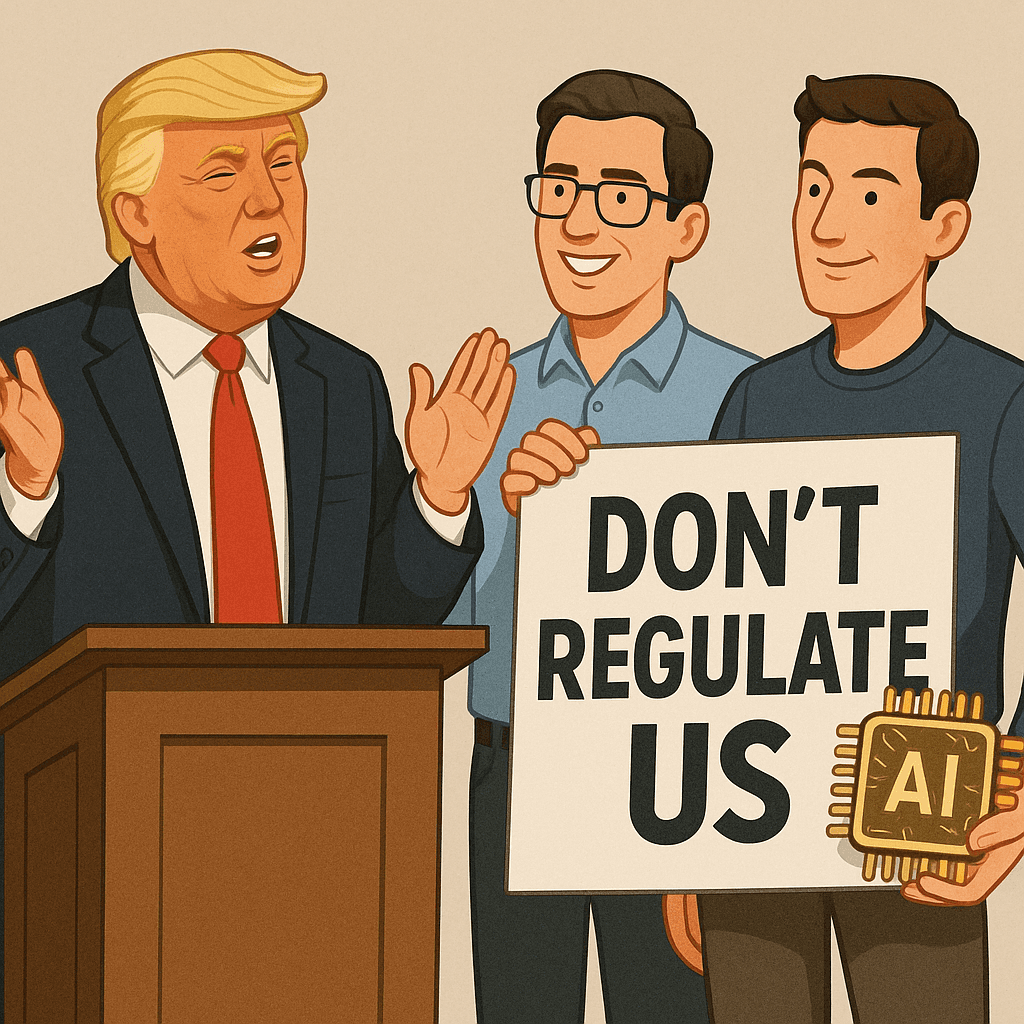
‘Don’t Regulate Us,’ Beg AI Founders Currently Selling Regulation-As-a-Service
Silicon Valley hails Trump’s plan to let AI companies write their own rules, promises to sell those rules back to everyone else by Q4.
Oct 11

Forecast
Through December 10, Houthis Won’t Damage Pakistan or Turkey Infrastructure
The Mecca Defense Pact just put two more flags on the Saudi firing chart. The consensus panic says this widens the war within weeks. The signal says the Houthis will talk big, hit Saudi and the sea, and leave Pakistan and Turkey’s hard targets alone for this 60 day window.
Comments
Be the first to comment.