By 2026, AfD Won’t Enter Any German Coalition Government
No German state or the federal republic signs a formal coalition deal with the AfD before December 31, 2026.
The party that wants in, and the system that says “nein”
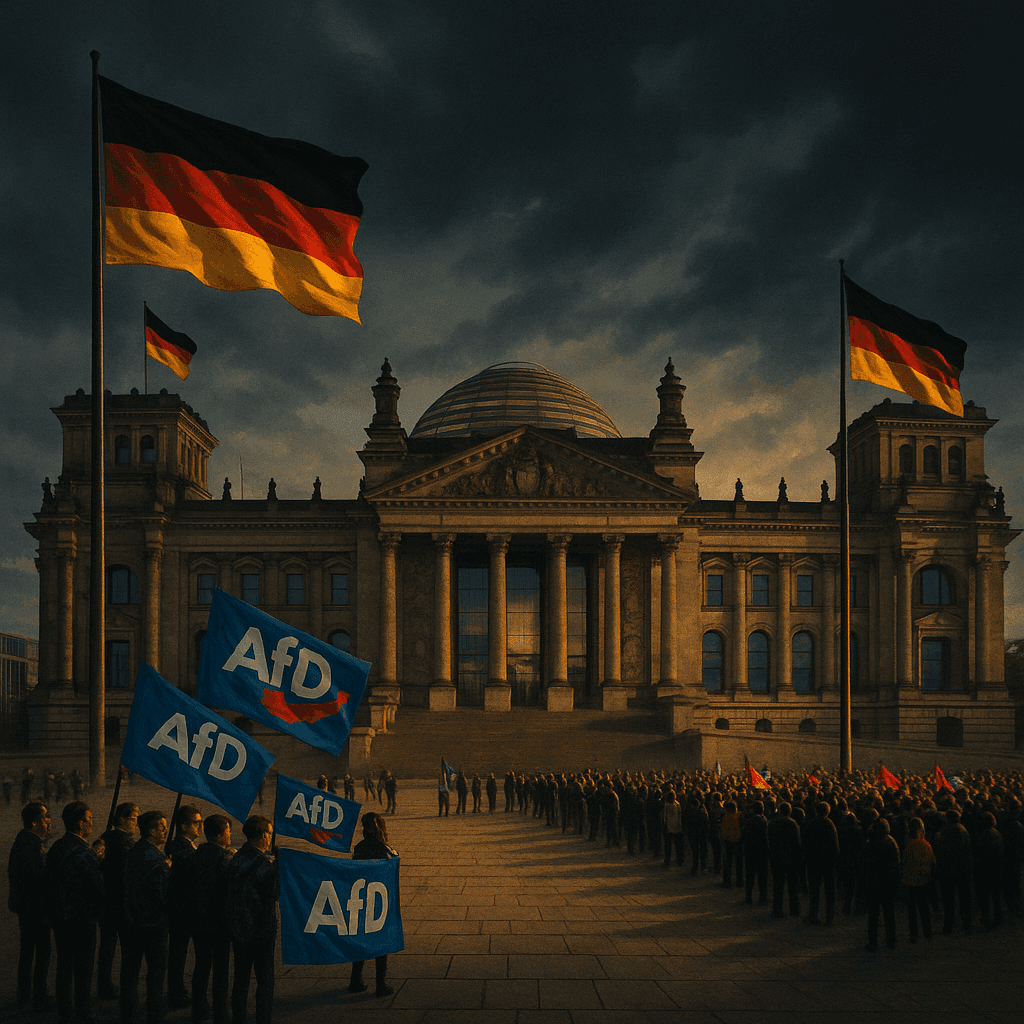
Alice Weidel walked out of the AfD convention in Erfurt talking like a prime minister in waiting, flanked by jubilant delegates and one inflatable eagle that looked like it had survived three previous empires and a failed product safety inspection. “We are a people's party with 30 percent support. And we will govern.” That is not protest party cosplay. That is an application for office submitted in triplicate.
Polls back the swagger. Nationally, the AfD hovers around 30 percent, in parts of the east it leads by double digits. In Saxony Anhalt the manifesto reads like a national identity workshop: end the “guilt complex,” teach pride, wave the flag. In POLITICO’s polling, two thirds of AfD voters say a Trump style “Make Germany Great Again” pitch makes them more positive about a candidate.
On the street, the AfD is the party of patriotic vibes and lower energy bills, a one stop shop for angry pensioners and disillusioned apprentices. On paper, in the files of the domestic intelligence agencies, it is something else. In five states it is officially classified as a confirmed right wing extremist organization. At federal level it is under surveillance as suspected extremist.
That is the collision: a party that smells mainstream to a growing slice of voters, and a security apparatus that files it under "constitutional hazard." Which side breaks first by New Year’s Eve?
The call: the firewall holds in form, if not in spirit
Here is the scorable bet.
Resolution axis: By 23:59 CET on December 31, 2026, no state or federal government in Germany will be formed on the basis of a formal, written coalition agreement that includes the AfD as a coalition partner and allocates it cabinet posts.
Informal tolerance deals, budget votes, or issue by issue cooperation do not count. We are talking about the classic German coalition treaty, signatures, ministries, the works.
My call: that line does not get crossed in this window.
Not because Germany is magically immune to the European far right arc. Because moving from moral panic to ministerial oath requires three big levers to flip at once, and none of them look remotely ready on a 120 day timer.
Driver 1: The math screams AfD, the incentives scream “everyone but”
The AfD’s central argument is arithmetic. If you are first in Saxony or Thuringia, why are you not in the cabinet? The answer so far: because German parties can always build something ugly but workable that excludes you.
CDU, SPD, Greens, FDP, Left, everyone still has a formal keine Zusammenarbeit line. That line is unpopular with AfD voters, but very popular with the parts of the electorate that the other parties still need.
In practice, this means more baroque coalitions. CDU–SPD–Greens. SPD–Greens–Left–FDP. Minority governments that squeak through on abstentions. Every leader would rather explain an unstable four party circus than front a press conference with an AfD minister waiting at the end of the table.
As long as the math allows a non AfD majority, the cordon sanitaire survives out of sheer self preservation. And in every state that matters this year, that majority is still arithmetically conceivable, if politically miserable.
Driver 2: Extremist stamps are coalition poison
The most underrated player in this story is not Weidel, not the CDU base, not the eastern street. It is the Bundesamt für Verfassungsschutz and its state cousins.
When your domestic intelligence service has you filed as a confirmed extremist organization in Brandenburg, Lower Saxony, Saxony, Saxony Anhalt and Thuringia, then anyone forming a coalition with you is not just “opening up to new partners.” They are voluntarily sharing a cabinet table with a party their own security briefers list as a threat to democratic order.
That sets a floor under the taboo. It turns a coalition with the AfD from a controversial choice into a potential career suicide note for every minister who signs the treaty.
Could courts eventually soften that classification? Could the AfD win legal relief? Yes, in theory. But litigation calendars are measured in years, not months, and there is no visible fast track that lands a clean bill of constitutional health this year.
Driver 3: Patriotism is winning the culture war, not the coalition talks
The AfD’s smartest move is not its stance on energy or Brussels. It is its ownership of uncomplicated national pride.
In POLITICO’s survey, 44 percent of AfD supporters say Germans are not proud enough of their history, far higher than in other parties. They are delighted by “proud to be German” language. In Saxony Anhalt the party wants schools to stop “perpetuating a guilt complex” in youth and instead issue a “call for patriotism.”
That does two things. It makes establishment critics sound like they are against feeling good about your own country. And it puts the AfD on the same page as other European far right brands that used flag and nostalgia to walk into government offices.
But culture war victory is slow burn institutional change. You can win the argument about flags on TikTok and still fail to get a single ministerial car by Christmas. Political norms usually collapse via a long corridor of euphemisms. Before a coalition, there is “issue cooperation,” then committee deals, then confidence and supply, then a serious opinion piece about how “the cordon has run its course.”
Germany is at the stage of angry op eds and a few local flirtations. It is not yet at “here is the draft coalition contract” and nobody in power is rushing to speed run all the intermediate steps.
What would have to go wrong with this bet
To falsify this forecast inside the year, several dominoes must fall in very short order.
- A Landtag election that leaves no stable majority without the AfD or a four party Frankenstein coalition with a one seat margin.
- A state level CDU boss in the east who decides Berlin can shout itself hoarse while he “takes responsibility to govern with all democratic parties.”
- A visible softening of the extremist stigma, either through courts or clever AfD message discipline, that lets business groups and churches say “we dislike it, but we can live with it.”
All this would need to converge, plus weeks of coalition talks, plus the drafting and signing of a detailed coalition agreement, plus the swearing in of a cabinet. The German system is built to be slow on purpose. You do not slide into a coalition by accident between two talk show appearances.
My read: over the next months you will see the soft breach instead. Minority governments that survive on AfD abstentions. Committee chairs traded for quiet votes. Local CDU figures testing phrases like “cooperation with all democratically elected parties.”
The firewall will start to smoke. It will not yet burst into flame.
Watch the language, not just the numbers
If you want an early warning system, ignore the horse race bar charts for a week and look for three things.
One, official CDU resolutions that shift from “never with the AfD” to “never while it is extremist.” That tiny clause is a whole escape tunnel.
Two, written cooperation deals below the coalition level in any Landtag. A confidence and supply pact is just a coalition on training wheels.
Three, the tone of ARD, ZDF, Spiegel, FAZ, SZ when they do coalition math. The first time a serious outlet prints the AfD alongside the SPD and Greens as a normal option, the culture has moved even if the cabinet list has not.
Those signals will probably flash amber within this horizon. The cabinet doors, I am betting, stay locked.
Germany will spend the rest of the year explaining that of course the AfD is unfit to govern, it is merely indispensable for passing the budget. Nothing says patriotic renewal like saving the homeland from extremists with the help of their votes.
Around the Shallot
Stay in the same broken universe.
Forecasts, satire, cartoons, and quizzes should feel like one publication, not disconnected tabs.
Tech
‘Don’t Regulate Us,’ Beg AI Founders Currently Selling Regulation-As-a-Service
Silicon Valley hails Trump’s plan to let AI companies write their own rules, promises to sell those rules back to everyone else by Q4.
Oct 11
Forecast
Through December 10, Houthis Won’t Damage Pakistan or Turkey Infrastructure
The Mecca Defense Pact just put two more flags on the Saudi firing chart. The consensus panic says this widens the war within weeks. The signal says the Houthis will talk big, hit Saudi and the sea, and leave Pakistan and Turkey’s hard targets alone for this 60 day window.
Comments
Be the first to comment.