By July 2027, One Federal Rule Will Gatekeep High‑Risk AI Launches
By July 1, 2027, at least one binding U.S. rule will force pre deployment security review for a defined class of high risk AI touching critical infrastructure or federal systems.
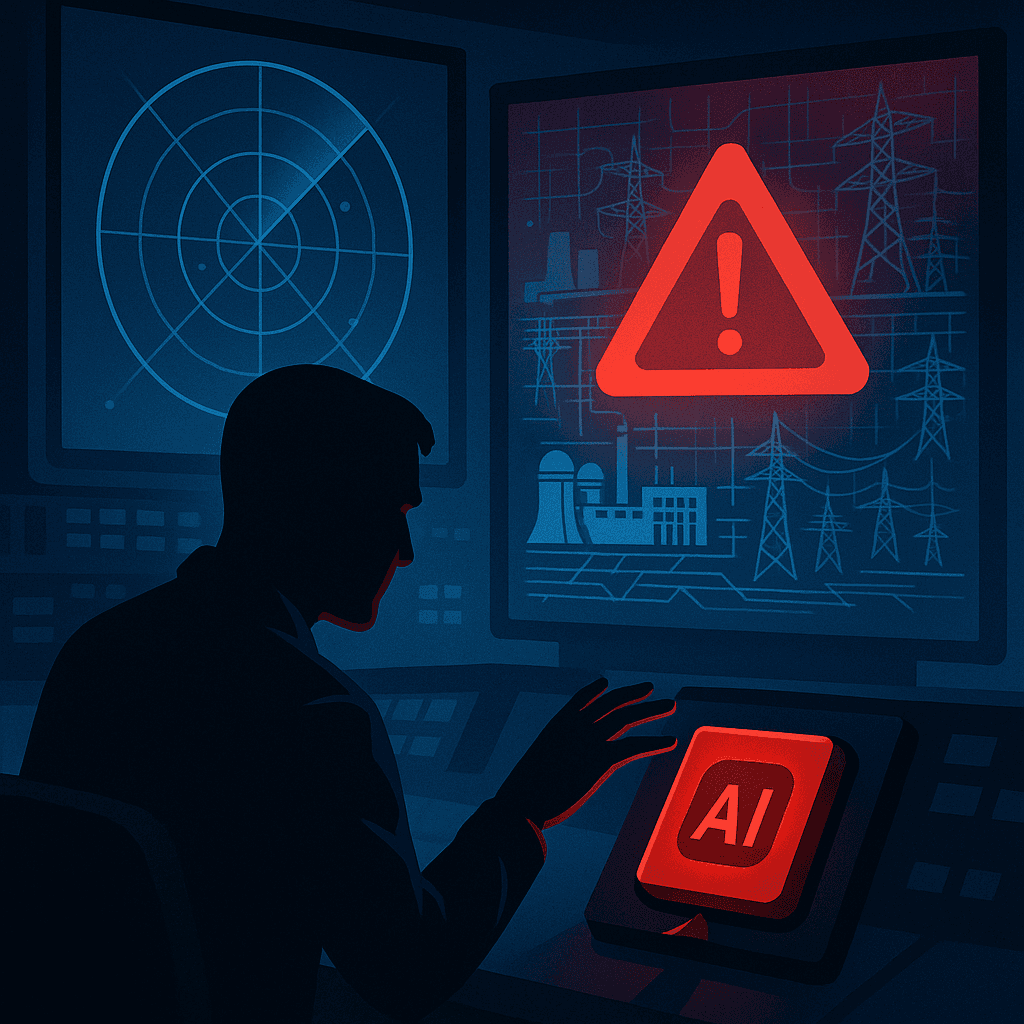
My call: the AI equivalent of "do not plug this in" arrives by mid 2027
The bet is simple: by July 1, 2027, the U.S. federal government will have at least one formal rule that says, in essence,
For this specific class of AI, you are not allowed to flip the on switch until a security review stamps it as safe enough.
Not a vibes based ethics pledge. A binding instruction that creates a recognizable class of high risk AI and ties it to a pre deployment cybersecurity check, the bureaucratic version of a bright red warning label on the national control panel.
You will see it first where failure looks like poisoned water or colliding planes, not bad movie recommendations. Think airspace, water systems, grid control, core federal services. The market will call it friction. I am calling it the next regulated technology class, the moment your model has to file more paperwork than a replacement traffic cone.
The quiet pivot: from AI strategy decks to AI quarantine rules
The consensus story says Washington is still writing thinkpieces about AI while the hackers sprint ahead. The signal says something different: the people in charge of keeping the lights on are already treating AI as a new infection route and are drawing up quarantine procedures, like epidemiologists for misconfigured Python.
Start with CISA’s
CI Fortify
roadmap. Acting Director Nick Anderson is no longer talking about AI as futuristic spice sprinkled on cyber risk. He is on record calling it a primary concern for critical infrastructure and operational technology, and he is describing a crisis mode where utilities need to
isolate vital systems from harm, continue operating in that isolated state, and quickly recover
afterward. That is not a press release mood. That is the language you use right before you start forbidding certain configurations and inventing phrases like "non negotiable cyber hygiene" in 14 point Calibri.
Meanwhile, the hackers have already supplied the pilot case study. Incident responders at Dragos just walked through an intrusion at a municipal water utility in Monterrey, Mexico, where the attacker leaned on an AI model to handle large chunks of the compromise. When the attack playbook includes
ask the model
as a step, regulators suddenly have cover to demand: show me, before you deploy, that your own AI in this plant does not behave like that, preferably without inventing new ways to reroute chlorine.
Put those together and the outline appears: AI that can touch operational systems will need documented threat modeling, segmentation checks, and red teaming before it is allowed anywhere near the SCADA screen. That is a pre deployment review by another name, the cybersecurity equivalent of making your model stand in line at the DMV before it can talk to a pump.
FAA: the test lab for what "high risk AI" actually looks like
If CISA sets the philosophy, aviation gives you the pilot episode. The Federal Aviation Administration is moving its AI work at Bedford from proof of concept to an
operational demonstration
starting around September 2026, with
validation and confidence building
running through the end of the year.
Translation: some flavor of AI will sit inside one of the most safety sensitive workflows on Earth, alongside an aging, overloaded air traffic system that already produced the deadliest U.S. crash in a quarter century. This is the exact point where an agency chooses between two futures. Either AI is treated as just another fancy decision support widget, folded into existing software sign offs, or it gets treated as what it obviously is: a new risk vector that requires a new box on the checklist and an even longer acronym.
The politics are begging for the second option. Transportation Secretary Sean Duffy has already planted his flag on national television: asked if AI will manage the airspace, he answered
hell no
and promised not to replace human controllers. You do not make that oath and then skip the part where you codify humans in the loop and spell out what the AI must clear before it is allowed to advise them, unless you enjoy Senate hearings that begin with an enlarged screenshot of your quote.
So expect a sector flavored high risk template to emerge around those Bedford trials. Call it something bureaucratic like
AI Assisted Safety Critical Decision Tools
and hook it to requirements that look very familiar: documented red team results, fail safe behavior if comms drop, clear authority lines, logged overrides. The moment FAA writes
systems of type X must pass Y review before operational deployment
it has, for our purposes, created a high risk AI class with a do not deploy list and invited every contractor to update their slide decks accordingly.
The template nobody asked for: New York City public schools
Of all the unlikely places to prototype federal AI governance, the nation’s largest school district has quietly raised its hand. New York City Schools’ AI guidance is not a theory seminar. It bans training on individual student data, demands human review for certain outputs, and routes tools through ERMA, a procurement review process that forces vendors to spell out security and privacy posture in forms that could stun a medium sized consultant.
This is not AI ethics, it is workflow: if your tool touches kids’ data, there is a presumption of risk, and you must clear a review checkpoint before you are allowed into classrooms. In other words, a domain specific high risk AI regime already exists, it is just labeled
yellow band outputs
instead of
Category 3 critical systems.
Federal procurement people are magpies. They will happily steal an existing pattern instead of inventing a new one. When OMB or GSA finally admits that some AI in federal civilian agencies can disrupt essential services or privacy at scale, the NYC model is sitting right there: risk tiers, human in the loop requirements, and a formal review gate that vendors must pass before deployment.
Do not expect harmony. One agency will imitate the school system. Another will bolt AI checks onto existing cyber authorities. A third will pretend its pilots are still too small to matter. The point is narrower: we only need one of them to cross the line into a defined high risk class plus mandatory pre deployment review for the prediction to land, at which point the rest will quietly argue over font choices in the shared template.
The fight under the hood: security review versus "mission flexibility"
The counter story is not imaginary. In the military and intelligence world, AI vendors who insist on real guardrails are discovering that principled restraint can get you labeled a
supply chain risk
and quietly replaced. When saying
no autonomous weapons, no mass surveillance without oversight
earns you the same branding as a foreign adversary, it is obvious that the problem is human governance, not model alignment.
That instinct to punish friction does not stay inside the classified world. It seeps into civilian procurement and it whispers a seductive line: do not lock yourself into some rigid high risk category, you need flexibility, you will slow modernization, think of the mission.
It might win in the shadows. It will not win in the places the public can see. Nobody wants to be the official who let an unvetted AI help run an air sector, a water plant, or a grid segment because
we did not want to burden innovation.
The first headline that connects AI to a domestic infrastructure failure ends that debate for a decade and turns every hearing room into a live action threat modeling session.
Which is why the likely outcome is a compromise: public high risk AI rules with security reviews for civilian critical systems and procurement, and much looser practices tucked behind classification markings. The prediction is about the visible half of that split, the part that has to survive a Government Accountability Office audit with a straight face.
How this resolves, and who loses if I am right
For scorekeepers, the bar is clear. By July 1, 2027, we should be able to point to a specific, binding federal instrument that:
- defines a class of AI systems as high or elevated risk when used in critical infrastructure operations or federal civilian agency work, and
- requires a documented cybersecurity review before those systems are deployed or turned on, with at least one such review acknowledged in public records, from agency docs to oversight reports.
That could arrive as a DHS binding operational directive under CI Fortify, a sector rule from FAA or another regulator, or a procurement rule from OMB that treats certain AI tools as too dangerous to award without a security sign off. I am not betting on clean national uniformity. I am betting on at least one concrete, scorable example, the regulatory equivalent of a "do not operate without guard in place" sticker finally taped onto an algorithm.
If this lands, the loser is the cozy fiction that you can wrap critical infrastructure in AI, call it modernization, and keep treating security as a compliance checkbox after the fact. The winners, at least briefly, are the dull people who ask annoying questions about segmentation and red teaming before they let your model anywhere near a pump or a radar screen.
In other words, by 2027, one slice of AI will officially graduate from
move fast and break things
to
move slowly and fill out this form,
and the form is the part that might keep your tap water uninteresting while your AI system enjoys the prestige of a pre deployment security clearance badge.
Around the Shallot
Stay in the same broken universe.
Forecasts, satire, cartoons, and quizzes should feel like one publication, not disconnected tabs.
Tech
‘Don’t Regulate Us,’ Beg AI Founders Currently Selling Regulation-As-a-Service
Silicon Valley hails Trump’s plan to let AI companies write their own rules, promises to sell those rules back to everyone else by Q4.
Oct 11
Forecast
Through December 10, Houthis Won’t Damage Pakistan or Turkey Infrastructure
The Mecca Defense Pact just put two more flags on the Saudi firing chart. The consensus panic says this widens the war within weeks. The signal says the Houthis will talk big, hit Saudi and the sea, and leave Pakistan and Turkey’s hard targets alone for this 60 day window.
Comments
Be the first to comment.