FTC Will Bring Ideological Bias Case Against Major Chatbot Provider
My call: By July 1, 2027, the FTC hits at least one major chatbot maker with an ideological bias case.
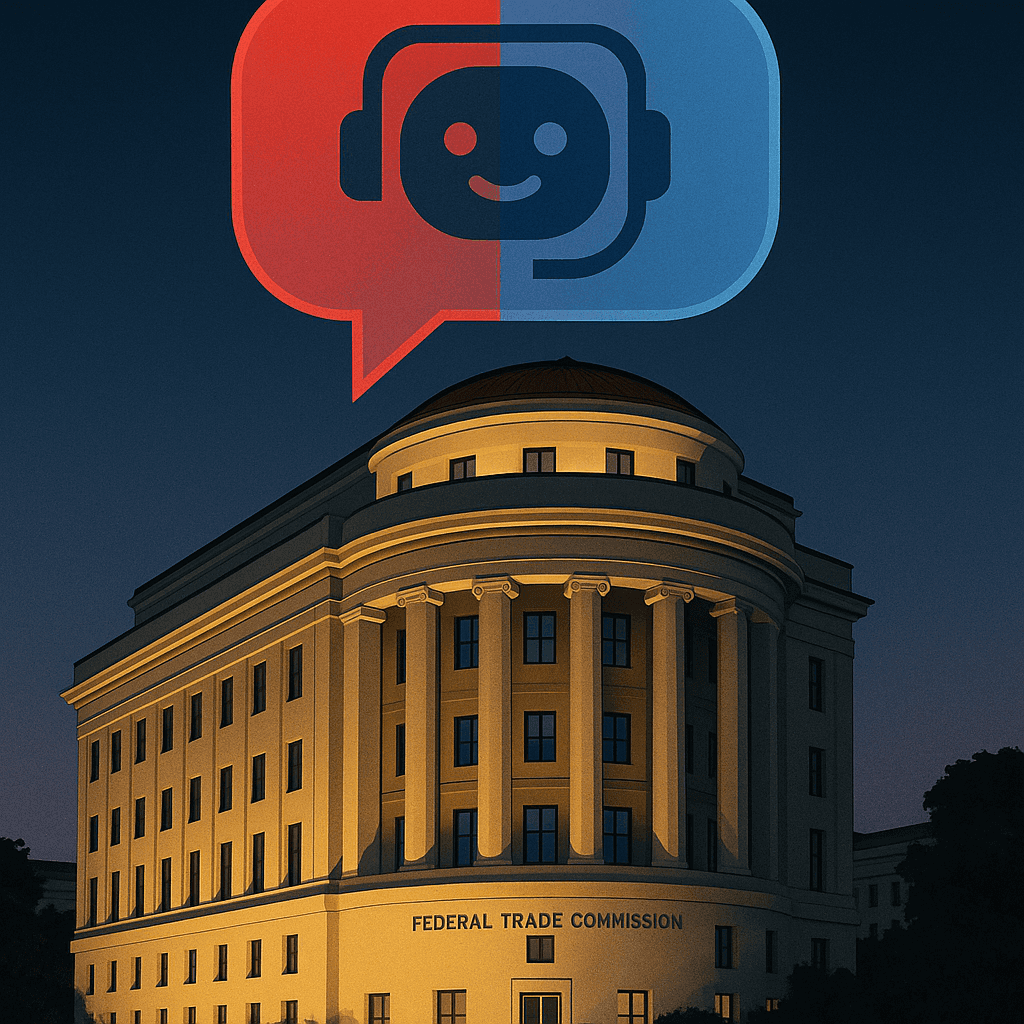
The bet: the first big “biased bot” case is coming
By July 1, 2027, the Federal Trade Commission will file at least one enforcement action against a major chatbot provider over ideological steering.
Not a vague AI case. Not a data breach with a side of robots. A clean, scorable shot at OpenAI, Anthropic, or Google where the heart of the complaint is that their chatbot pretended to be neutral while quietly following an ideological script or state bias law.
The consensus story is that the FTC is “seeking comment” and “raising questions.” The signal is that it just wrote the trailer for its own future lawsuit.
The FTC just criminalized vibes
On July 1, the FTC released a proposed policy statement that reads like a warning label for everyone who has ever typed “unbiased” into a marketing deck.
The agency says chatbots whose outputs reflect “ideological objectives” may violate Section 5. It also suggests that training systems to avoid discriminatory answers or to comply with state laws like Colorado’s AI civil rights regime could deceive consumers who expect “truthful and accurate” output.
Translation for real life: if you tweak your model so it will not racially profile job applicants, or you tune it to match what Colorado wants, the federal government might treat that as lying to users about reality.
This is not about accuracy in the narrow sense. It is about outlawing certain value choices while pretending everything is just physics and math. The FTC is telling AI firms, in lawyer dialect, that “ideology” is fraud if you do not label it.
Why a marquee case is now more likely than not
The new policy would be dangerous enough in a vacuum. It does not live in one.
First driver: the politics. President Trump and the broader conservative ecosystem have settled on “AI is biased against us” as a ready made grievance. If you have seen the “write a prayer for Biden” versus “write a prayer for Trump” screenshots, you have seen the raw material for a complaint.
Second driver: the chair. Andrew Ferguson has already used the FTC to go after a transgender health nonprofit, signaling an appetite for culture war adjacent cases framed as consumer protection. If you are willing to turn Section 5 into a scalpel for hot button issues once, you are not afraid to do it again with much bigger defendants.
Third driver: the market structure. The U.S. consumer chatbot world is basically three sign in buttons: OpenAI, Google, Anthropic. All claim some variation of “helpful, harmless, honest.” All are now core infrastructure for search, productivity, and enterprise tools. If the FTC wants to prove its new theory matters, it needs to hit a household name, not a résumé screener with eight customers and a Slack channel.
Fourth driver: paper trails. State laws like Colorado’s force firms to log, justify, and document how they avoid discriminatory outcomes. Those memos and dashboards, which look like boring compliance to you, look like “evidence of deliberate steering” to an ambitious FTC litigator.
Put that together and the expected value of a test case rises. Politics point toward AI bias as a headline issue. The doctrinal hook is now written down. The defendants are concentrated, visible, and already under a microscope. For a Commission that just raised expectations in a press release, doing nothing would be the risky move.
The federal–state knife fight inside your chatbot
The most surreal part of the policy is the interstate hostage situation it creates.
Colorado says: if your AI helps hire or fire people, it had better not discriminate. That usually means explicit guardrails keyed to protected classes, audits, and intervention when the model starts spouting 1950s HR policies.
The FTC now says: if you steer outputs to comply with those same civil rights expectations, you may be deceiving consumers who asked for “truth” and got “ideology.”
So a company that follows Colorado law could end up accused of federal deception. A company that ignores Colorado could get hit by state regulators or civil rights suits. Whatever you pick, someone can call it illegal. It is not a legal framework. It is a multi jurisdictional Schrödinger’s cat.
The only way for the FTC to clarify this Rube Goldberg machine is to run it once. That means picking a bot, picking a context, and litigating the difference between “safety,” “anti discrimination,” and “ideology.” If you think regulators will resist the temptation to define that line through a very public defendant, you have mistaken Washington for a monastery.
The case script: from marketing copy to Section 5
The eventual complaint practically writes itself.
Step one: find the glossy language. “Unbiased answers.” “Just the facts.” “Non political AI.” Every big lab has used some of these phrases or close cousins, especially in enterprise sales where sounding boringly neutral is a feature.
Step two: pair them with behavior. Screenshots where the model treats conservative positions as misinformation but progressive ones as “nuanced,” or where it refuses to criticize one religion but happily mocks another. Add some internal docs about reinforcement learning, prompt engineering, and state law compliance that show staff explicitly discussing “ideological risks.”
Step three: stitch a narrative. Consumers were told they were getting truth and neutrality. Instead they got hidden value choices and political steering, in part to please state regulators. That is both deceptive (misrepresented neutrality) and unfair (it harmed users seeking information on sensitive topics).
The FTC does not need to prove a grand conspiracy to re educate America. It only needs a mismatch between the marketing and the machine, plus a handful of users who relied on it in a consequential context: employment, credit, healthcare, elections.
Why this could still whiff
The case is not inevitable. It is just more likely than the “everyone calms down and focuses on phishing scams” scenario.
There are real brakes:
- Courts may look skeptically at a federal agency punishing companies for complying with state civil rights rules.
- Defining “ideological objectives” in a way that does not swallow all of safety is hard enough to make staff attorneys reach for antitrust instead.
- Labs can preempt a lot of this by changing disclosures to say, plainly, that these systems encode safety and equity guidelines, not mystical neutrality, and by giving users more visible “mode” controls.
There is also the possibility that the final policy gets quietly watered down after the comment period, burying the most aggressive language in footnotes and turning the whole thing into a generic honesty sermon.
My odds are not 90 percent. Call it a confident coin flip with a thumb on the scale. Enough structural pressure exists that “no big case by mid 2027” would actually be the surprise outcome.
The future, briefly: how to watch this fuse burn
Three signals to track:
First, the final policy text. If “ideological objectives” and state law steering survive in plain English, the Commission intends to use them.
Second, signs of investigative plumbing: civil investigative demands to the big three that ask for RLHF docs, political content guidelines, and state compliance tuning. When that shows up, the clock to a complaint is running.
Third, public complaints from conservative groups that read like draft pleadings. Once the outside briefs and inside appetite line up, the path from op ed to enforcement is short.
If I am wrong and July 2027 arrives with no such case, it will mean one of two things: either industry disclosures got much more honest very fast, or the FTC decided that refereeing chatbot vibes was a bad use of finite adulthood.
If I am right, the first big AI ideology lawsuit will not prove that anyone can build a neutral machine. It will prove that in America, even your autocomplete can get subpoenaed for its politics.
Around the Shallot
Stay in the same broken universe.
Forecasts, satire, cartoons, and quizzes should feel like one publication, not disconnected tabs.

Tech
‘Don’t Regulate Us,’ Beg AI Founders Currently Selling Regulation-As-a-Service
Silicon Valley hails Trump’s plan to let AI companies write their own rules, promises to sell those rules back to everyone else by Q4.
Oct 11

Forecast
Through December 10, Houthis Won’t Damage Pakistan or Turkey Infrastructure
The Mecca Defense Pact just put two more flags on the Saudi firing chart. The consensus panic says this widens the war within weeks. The signal says the Houthis will talk big, hit Saudi and the sea, and leave Pakistan and Turkey’s hard targets alone for this 60 day window.
Comments
Be the first to comment.

