Nvidia-Led AI Mega-Caps Will Outrun The S&P 500 Through 2026
My call: the Nvidia-led AI mega-caps still beat the S&P 500 through year-end, even if inflation keeps the Fed in a higher-for-longer cage.
When AI Becomes the Safe Haven
By Niles Overton, Forecast Columnist
The storm is inflation, the shelter has RGB lighting
Picture the scene: oil over 100, the 10 year glued near 4.5, Fed officials rehearsing the phrase "data dependent" in the mirror, and yet the Nasdaq and the Philadelphia Semiconductor Index are levitating like it is 1999 with better hoodies. Nvidia is flirting with a 5 trillion dollar market cap, record indices are running on four or five tickers, and Goldman is on a podcast explaining that no, this is not a bubble, it is a defensive trade now.
In 2026, buying the world’s most speculative chips has become the responsible choice. Your financial adviser used to push municipal bonds. Now the line is: "Have you considered sheltering in 80 times forward earnings?"
My call is simple enough to score: the Nvidia led AI mega caps keep beating the S&P 500 on a total return basis through December 31, 2026, even if inflation stays north of 2 percent and the Fed leaves real rates at or above today’s levels. Higher for longer will hurt a lot of things. The AI complex, I think, still ends the year ahead of the field.
The call: AI still wins the race against gravity
Here is the resolution axis, so you can screenshot this for later. Take a market cap weighted basket of eight names that more or less are the AI trade: Nvidia, Microsoft, Meta, Amazon, Alphabet, Apple, Tesla, Micron. Compare their total return to the S&P 500 from now to December 31, 2026. Score me on who wins.
The background is unfriendly. Iran driven energy shocks are bleeding into prices. The Fed’s updated inflation path has quietly erased the soothing rate cut fantasy that was supposed to carry this whole AI data center build out. Some scenarios now include the unthinkable twin: no cuts in 2026, and maybe a hike.
Yet money keeps running toward the very thing that was supposed to be most rate sensitive. AI is trading like a utility that discovered religion and 80 percent gross margins. That is the behavior I am betting on: not that AI rallies forever, just that it limps in ahead of a tired S&P during a late cycle slog.
Driver 1: The 755 billion dollar habit
Start with the number that makes everyone in semiconductors walk a little taller. Goldman’s Shawn Tuteja pegs hyperscaler and data center capex at roughly 755 billion dollars this year, up around 38 percent year on year. That is not a venture pitch deck. That is real cash leaving big tech treasuries and landing in GPU factories and memory fabs.
Hence the steady drumbeat of "another beat" from Nvidia and friends. The reason semiconductor earnings keep coming in ahead of consensus is not a mystical AI narrative. It is purchase orders. Meta is guiding higher capex because components are scarce and prices are up. That is what inelastic demand looks like when CFOs have surrendered.
True infrastructure cycles do not turn on one ugly CPI print. Hyperscalers are not deciding between adding another GPU cluster and buying office snacks. They are rewiring their core compute stack. Slowing that to defend operating margins is a board level fight, not a quarter to quarter tweak.
My base case: the growth rate of this spend moderates, the language gets more sober, and everyone starts saying "efficiency" a lot. The dollar amounts, however, stay huge into year end. That is enough for Nvidia, Micron and the cloud titans to keep delivering faster earnings growth than the median industrial or bank trying to live in a 4 percent world.
Driver 2: Defensive growth by process of elimination
The other driver is less flattering to AI and more damning of everything else. Higher for longer is brutal for small caps that roll their debt. It is rough on discretionary consumers who just discovered what 20 percent APR really means. It hurts capital heavy cyclicals that need financing when credit spreads are twitchy.
Nvidia, Microsoft, Alphabet, Apple, Amazon, Meta and Tesla have the opposite problem. They are so cash generative that they cannot invent buybacks fast enough. They also now sit at the heart of every major index. Nvidia alone is a giant chunk of the S&P and Nasdaq. When passive money flows into "the market," it is actually flowing into this little AI council of elders.
That means even if multiples compress as real yields stay elevated, these stocks get two forms of protection. First, they have real earnings growth off a massive base, so a bit of multiple shrinkage still leaves them ahead of slower growing sectors. Second, the plumbing of modern markets auto funnels cash toward them whenever risk appetite is anything above full cardiac arrest.
Investors have stopped asking "Is AI a bubble?" and started asking "Which mega caps do I hide in while the Fed works out its issues?" When the question shifts like that, the answer is almost always the names already at the top of the leaderboard.
The thing that breaks the trade
If the macro regime alone were enough to crush AI, it would have done it already. We have had re accelerating inflation, vanishing rate cuts, and an oil spike, all while the Nasdaq marched to new highs. Something else has to go wrong to flip this from "defensive AI" to "oh right, this is tech again."
That something is a visible air pocket in the capex and earnings story. MarketWatch highlighted the nightmare scenario in which hyperscalers admit they overbuilt, slash AI data center budgets, and let everyone digest. Analysts at Panmure Gordon gamed out a world where that knocks 15 percent off the S&P and more than 30 percent off tech hardware.
Translated into resolution language, the risks that would make my call wrong look like this:
- At least one major hyperscaler publicly cuts or sharply slows AI capex for 2026 and 2027, in a way that clearly contradicts the current 755 billion dollar spend narrative.
- Nvidia delivers a quarter where growth decelerates hard, guidance underwhelms, or order visibility obviously shrinks, and the stock trades like the spell is broken rather than as a buyable dip.
There are other wild cards. A serious TSMC disruption that hits volumes more than pricing. A clampdown on exports that bites into data center demand before pricing power can adjust. Aggressive antitrust or AI specific rules that put a policy ceiling on how large these profits are allowed to get.
But for the next few months, the cleanest and fastest way to flip AI from safe haven to hazard zone is a self inflicted capex diet from the same boards currently competing to sound the most all in on AI.
Signals to watch while everyone pretends this is fine
If you want a running scorecard on this forecast, watch four things.
First, Nvidia earnings and guidance. The actual numbers matter less than the slope. Does data center revenue stay on a relentless, if slowing, climb, or does the company suddenly start talking about "normalization" and "digestion" more than it talks about "demand we cannot meet"?
Second, hyperscaler capex language. When Microsoft, Meta, Alphabet, Amazon and Apple talk about 2026 and 2027, do they grudgingly keep lifting budgets, or do they debut a new vocabulary of discipline and optimization that adds up to smaller checks for GPUs and memory?
Third, the Fed’s dot plot and real yields. The forecast here does not require cuts. It just assumes we avoid a renewed hiking cycle brutal enough to force a wholesale repricing of all long duration assets at once. Higher for longer is survivable. Higher and rising would test even this crowd.
Fourth, breadth. If the percentage of S&P members beating the index keeps shrinking while Nvidia and its friends do all the heavy lifting, that is actually supportive of my call. The narrower the leadership, the more the machine keeps buying the same few names because it has no one else to invite.
Satirical verdict: the new Treasury bill is a GPU
So here is the verdict, stated plainly so we can all laugh at it later if the air pocket shows up on some random Thursday afternoon. Into year end, I expect the AI mega cap basket to beat the S&P 500 on total return, even with inflation stuck above target and the Fed sitting on its hands.
This is not a call that AI is risk free. It is a call that in a market addicted to index concentration and growth scarcity, investors will keep treating "Nvidia plus its large cap entourage" as the least bad place to hide. The danger is not macro gravity. The danger is the pilot announcing that hyperscaler capex was maybe a bit much and they will now be testing the parachutes.
Until that announcement arrives, the safe haven of choice is a warehouse full of very expensive chips, which is less absurd once you remember that the other safe haven is cash in a banking system that nearly blew itself up buying actual Treasurys. In 2026, prudence means owning the bubble everyone swears is now a bond.
Around the Shallot
Stay in the same broken universe.
Forecasts, satire, cartoons, and quizzes should feel like one publication, not disconnected tabs.
Tech
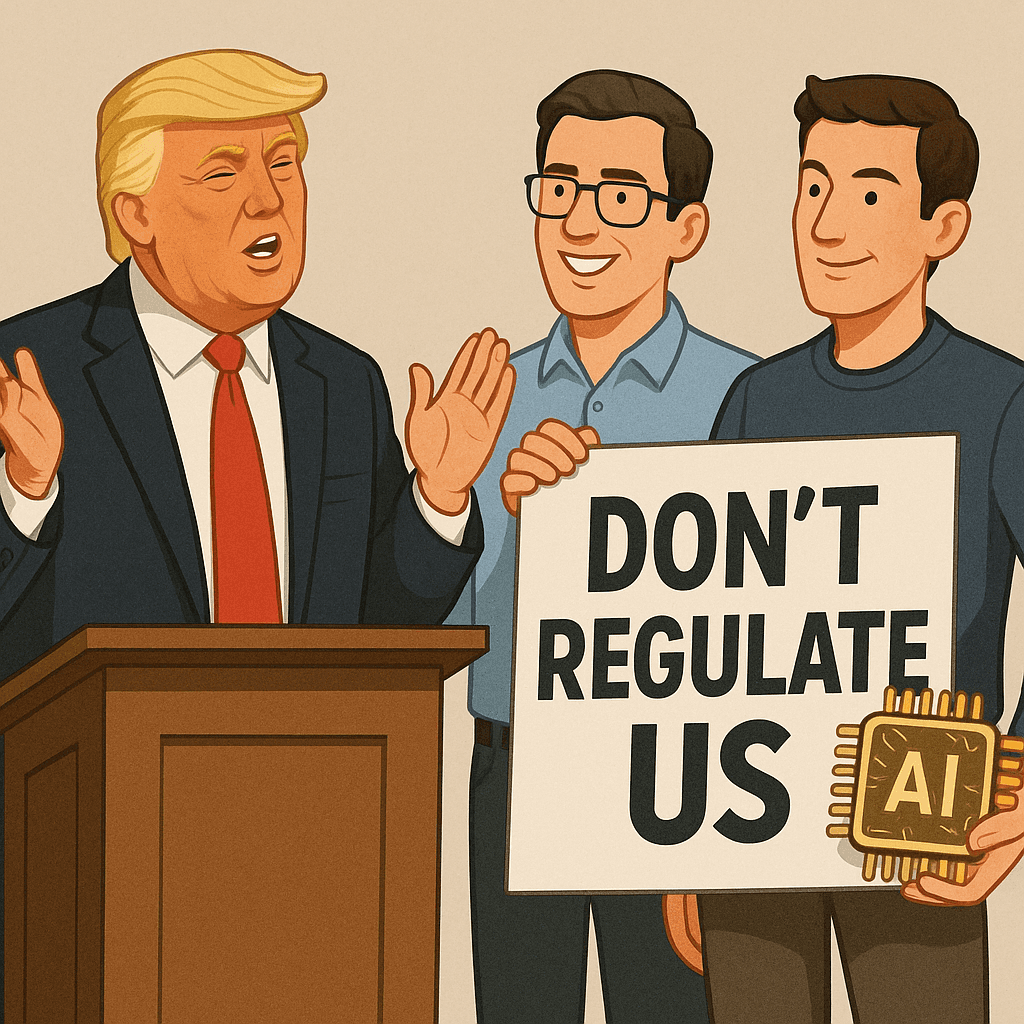
‘Don’t Regulate Us,’ Beg AI Founders Currently Selling Regulation-As-a-Service
Silicon Valley hails Trump’s plan to let AI companies write their own rules, promises to sell those rules back to everyone else by Q4.
Oct 11

Forecast
Through December 10, Houthis Won’t Damage Pakistan or Turkey Infrastructure
The Mecca Defense Pact just put two more flags on the Saudi firing chart. The consensus panic says this widens the war within weeks. The signal says the Houthis will talk big, hit Saudi and the sea, and leave Pakistan and Turkey’s hard targets alone for this 60 day window.
Comments
Be the first to comment.