OpenAI Will Keep Its For‑Profit Structure Intact Through The Musk Trial
My call: Musk will get spectacle, not a court‑ordered breakup of Altman’s AI money machine.
Can a Jury Rewrite OpenAI?
By Mira Gauge, Prediction Desk
The Call: No Court‑Ordered Breakup
My call: by 120 days from the verdict, there will be no court order that actually tears up OpenAI’s for‑profit spine. No dissolution of OpenAI Global LLC, no voiding major equity rights, no judicially engineered charity takeover of a company angling for a trillion‑dollar IPO.
If the court does anything structural, it will be at the margins. Maybe tighter caps, a bigger cut for the nonprofit, or governance add‑ons that sound brave on CNBC but keep Microsoft’s lawyers sleeping through the night.
The Musk v. OpenAI trial will end as it began: more about how we talk about AI as a public good than how courts actually treat it when there is real money on the table.
What Musk Is Really Asking For
Strip away the founding‑vision cosplay and Musk is asking a judge to do three extraordinary things:
- Remove Sam Altman and Greg Brockman from power.
- Unwind or "undo" OpenAI’s for‑profit and capped‑profit structure.
- Redirect something like $134 to $150 billion from the for‑profit side to the nonprofit arm.
That is not a routine contract remedy. That is corporate reconstructive surgery on a patient hooked up to half of Wall Street’s oxygen supply.
The hook is emotional. Musk says he bankrolled a charity, not a unicorn factory. He claims he conceived the idea, the name, recruited the talent, wired about $38 million, and was assured this was a public‑spirited lab for humanity, not yet another cap table.
OpenAI fires back that Musk knew a for‑profit pivot was coming and mainly objects to not being the one in charge. Somewhere between those stories sits a California jury watching two billionaires argue over who cared more about the word "open" at the time.
Courts Do Not Like Pulling Market Fire Alarms
Here is the boring but decisive piece. American courts are deeply allergic to remedies that blow holes in other people’s balance sheets, especially when those other people are not even parties to the case.
OpenAI’s for‑profit structure is not a cute shell game that can be reversed with a shrug. It is a web of entities, profit caps, equity arrangements, and strategic deals with very large companies that have very good litigators. Reports peg the valuation around $852 billion, with IPO talk creeping toward a trillion‑dollar dream board slide.
To give Musk what he is asking for, a judge would have to say: yes, the founding mission language of a nonprofit is so binding that it lets me reassign tens of billions in value from one set of private actors to another, and potentially blast a hole in pending offerings, partner contracts, and investor expectations.
Courts usually reserve that kind of mayhem for clear statutory mandates or smoking‑gun fraud that ties directly to the structure itself. This case is closer to a romantic breakup where both sides kept the receipts, not an Enron autopsy.
Altman’s Governance Hangover
Where Musk’s case bites is not on the corporate plumbing, it is on character and governance.
Former board members Helen Toner and Tasha McCauley have testified about a "pattern" of evasiveness from Altman, plus resistance to oversight. They walked the jury back through the 2023 mini‑coup, when the board briefly fired Altman and then promptly got annihilated by investor and employee backlash. Internal texts like "Sam this is very bad" are now trial exhibits, not Slack gossip.
Add in a House Oversight Committee investigation into Altman’s business dealings and a chorus of Republican state attorneys general asking the SEC to poke at his conflicts, and you get a narrative the court cannot fully ignore: the visionary founder who is less than candid with his own board, his investors, and possibly his regulators.
That posture is tailor‑made for narrower remedies. Judges can tighten reporting lines to the nonprofit, require clearer disclosures, maybe even condition certain actions on board approval. They can make Altman’s life more annoying without making his bankers’ lives impossible.
The Nonprofit Halo Was Always a Loaner
The other uncomfortable truth: if Musk wins big on structure, a lot of very respectable institutions suddenly have to explain why they never asked whether "for humanity" meant "for humanity, until a Series F." University endowments that piled into AI, foundations that bless public‑benefit startups, lawmakers who have nodded along to "capped‑profit" as if it were a new species of ethics.
Treating OpenAI’s early mission language as an ironclad legal bar on monetization would not just punish one lab. It would put a question mark over every nonprofit that flirted with a spin‑out once the grant money stopped being cute.
More likely outcome: the court treats the founding rhetoric as context, not handcuffs. It can support a finding that Musk was misled in some ways, it can justify a check written to the nonprofit, but it will not become a general rule that if you said "public good" in 2015 you owe the public your entire future capitalization.
What A Loss Still Looks Like For OpenAI
A loss for OpenAI on the liability side would still bite. Money moving from the for‑profit to the nonprofit at court direction is not nothing, and public findings that Altman breached duties or misled a cofounder are not exactly the pre‑roadshow branding anyone wants.
We could see:
More nonprofit control over safety policy. Sharper caps or clarified triggers for when profit flows stop. Required disclosures to regulators or donors about how mission and monetization intersect. Maybe even a board shuffle that looks voluntary but reads like a settlement term.
Markets would price in governance risk. Regulators would have more leverage. Rival labs like Musk’s xAI and Anthropic would retool their own charters before plaintiffs’ lawyers do it for them.
But the capped‑profit, investor‑driven, IPO‑bound model itself survives. If there is a structural change, it is cosmetic enough that the banker slides only need a new footnote, not a new spine.
Who Actually Loses This Case
So yes, Musk is unlikely to get a written order that rewires OpenAI’s ownership the way he is pitching. Courts do not usually let one billionaire use charitable disappointment to confiscate another billionaire’s cap table.
The more interesting loser is the story we have been sold for a decade: that you can be a nonprofit until it is inconvenient, dodge the hard questions about power with mission statements, then spin back to Wall Street without anyone asking for the receipt.
When this is over, OpenAI will probably keep its structure, Musk will keep his grievance, and the law will keep its allergy to detonating other people’s valuations.
The only thing that might actually be "for humanity" in all of this is the reminder that if you believed a trillion‑dollar IPO would be run like a charity, the artificial part was never the intelligence.
Around the Shallot
Stay in the same broken universe.
Forecasts, satire, cartoons, and quizzes should feel like one publication, not disconnected tabs.
Tech
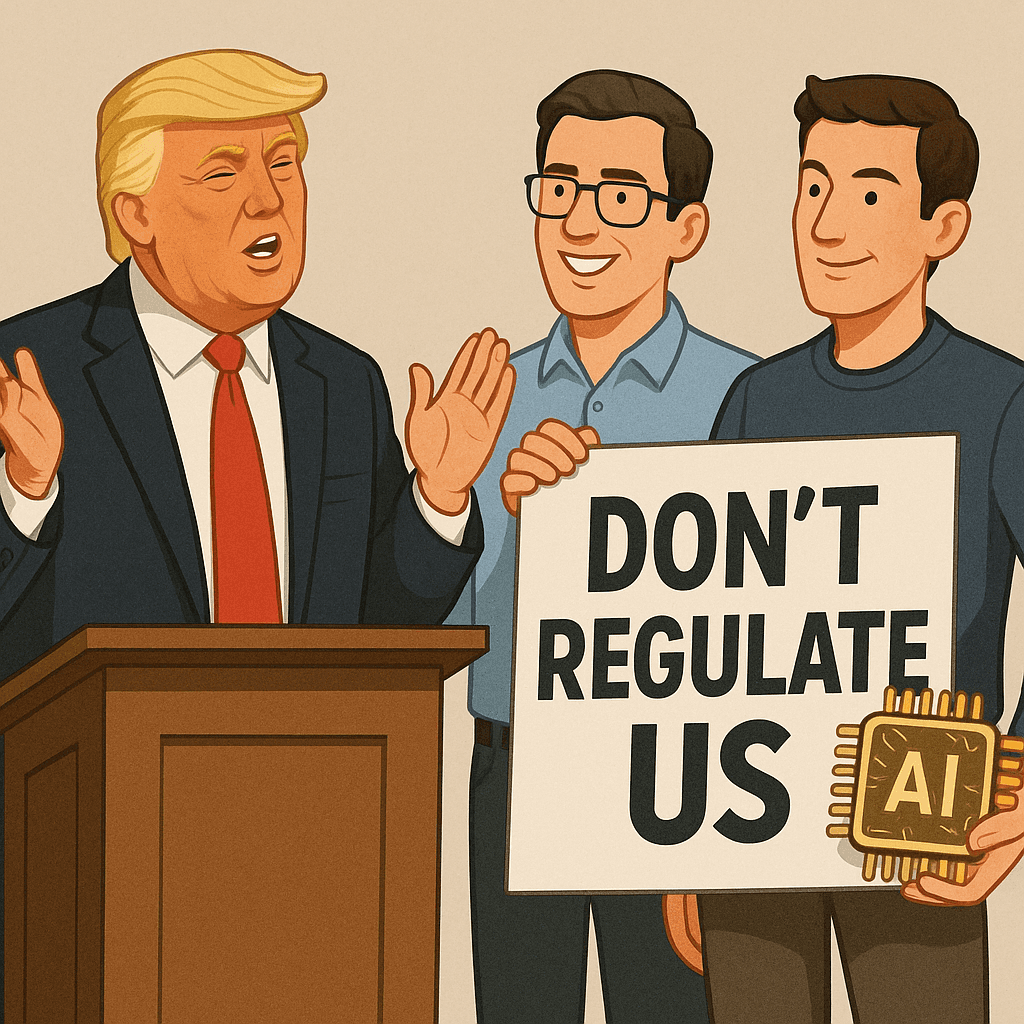
‘Don’t Regulate Us,’ Beg AI Founders Currently Selling Regulation-As-a-Service
Silicon Valley hails Trump’s plan to let AI companies write their own rules, promises to sell those rules back to everyone else by Q4.
Oct 11

Forecast
Through December 10, Houthis Won’t Damage Pakistan or Turkey Infrastructure
The Mecca Defense Pact just put two more flags on the Saudi firing chart. The consensus panic says this widens the war within weeks. The signal says the Houthis will talk big, hit Saudi and the sea, and leave Pakistan and Turkey’s hard targets alone for this 60 day window.
Comments
Be the first to comment.