SpaceX IPO Won't Reach the $1.75 Trillion Valuation Target
My call: the IPO prices below the $1.75 trillion dream, or it never prices at all.
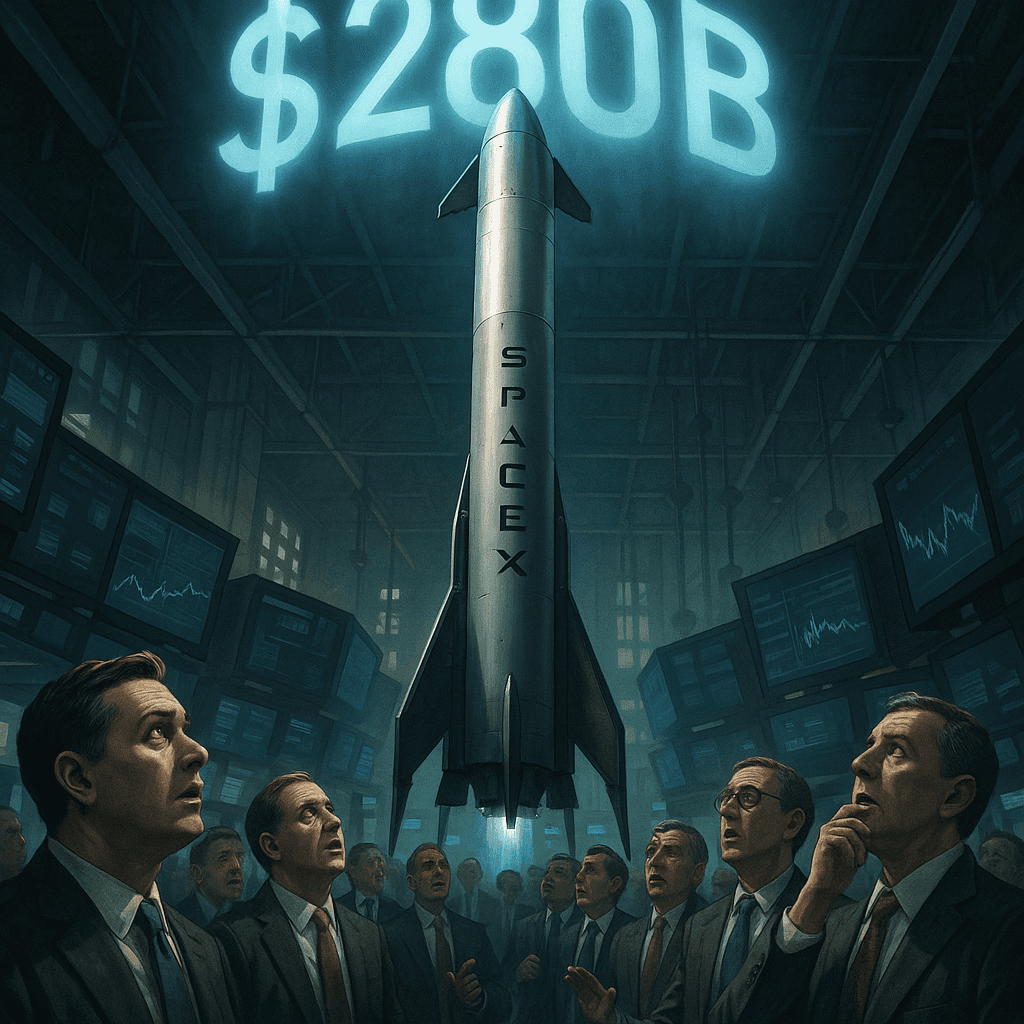
The $1.75 Trillion Magic Trick
SpaceX is asking public investors to treat a capital intensive rocket and satellite operator that lost roughly $4 to $5 billion last year as a $1.75 trillion growth icon. To get there, you wave a cloth labeled "$28.5 trillion TAM" over an $18 to $19 billion revenue base and invite the market to applaud.
I expect the applause to be more muted. Within four months, if this IPO prices at all, I think it prices below $1.75 trillion on a fully diluted basis.
The bullish story is that SpaceX is not merely a rocket company. It is a "generational" platform selling launch, global internet, and the orbital AI backbone of the 2030s and beyond. In that telling, paying something like 80 times trailing sales is not excess; it is vision.
The simpler reading is that the public market will pay a premium for Elon Musk and for AI, but not both premiums at once on a record size, loss making IPO and still claim it learned anything from the last decade.
The Numbers Are From Earth
SpaceX's filing drags the myth into daylight. Revenue sits around $18 to $19 billion. Losses cluster near $4.3 to $4.9 billion. Capital expenditure is heavy into Starship, more Starlink satellites, and an orbital AI infrastructure business that is mostly PowerPoint.
Price that at $1.5 to $1.75 trillion and you are paying something like 80 times sales. The top 15 U.S. companies, including the ones actually printing cash from AI, sit closer to 7 times. Even by generous tech standards, that is not stretching the envelope so much as firing it on a Super Heavy and hoping no one notices gravity.
The core businesses are good, but boringly quantifiable. Launch is about $4.1 billion of revenue. Starlink connectivity is around $11.4 billion. A fledgling AI segment lands near $3.2 billion. All of this is impressive. None of it suggests that margins will suddenly look like software once you factor in replacing thousands of satellites and building orbital data centers that live in a regulatory cage match.
Then there is the $28.5 trillion total addressable market. Of that, $22.7 trillion is supposedly corporate AI that SpaceX will help serve from space, powered by solar, in orbit. This is less a financial model and more a sci fi Kickstarter reward tier.
The Drivers Pushing Valuation Back to Orbit
To get $1.75 trillion across the finish line, three things all have to go right at once: AI mania, Musk mania, and megacap IPO mania. I think at least one of those blinks when it confronts the order book.
First constraint: size. Raising on the order of $75 to $80 billion is not a vibes exercise. The underwriters need mainstream long only funds and sovereigns who run models, even if grudgingly. Those investors may happily own Musk, but they still have to explain internally why a rocket and satellite operator deserves a revenue multiple that makes NVIDIA look like a value play.
Second constraint: disclosure. In private markets, SpaceX could float any valuation it wanted, then quietly trade stock at that sticker. In public markets, the S-1 sits in front of the SEC and every buy side analyst with a calculator. The wilder the $28.5 trillion story, the more that scrutiny shows up as a valuation haircut, not a medal.
Third constraint: reputational risk. Every bank on this syndicate remembers what happens when a trophy IPO "breaks" in the aftermarket. Pricing a record setting deal so aggressively that it trades down is not bold; it is career limiting. Better to take the win at, say, $1.2 to $1.6 trillion and let day two trading deliver the upside than to spray equity into the market at the absolute ceiling and pray.
Finally, governance. Musk will walk onto Nasdaq with CEO, CTO, and chair titles, plus majority voting control. That is a dream for believers in the One True Founder model. For a nontrivial slice of institutions, it is a checklist item under "apply discount here." Key man risk is not theoretical when the key man is also running Tesla and several side quests.
The Case for the Trillion Plus, Without the Extra 0.75
None of this means SpaceX limps out at a sad little valuation. If anything, the base case is still spectacular: a trillion plus megacap IPO that crowns Musk as the king of both orbits and order flow.
The bull case is easy to sketch. SpaceX is the only way to buy the Musk space story in size. Starlink has real scale and, if unit economics improve, decent eventual margin. Starship, if it hits cost and cadence targets around 2026, could pull launch costs low enough to unlock new industries. Layer in an AI from orbit narrative and you get a genuine scarcity asset for public portfolios.
So yes, investors will pay up. They just do not need to pay all the way up at pricing. Especially when there is a wave of other AI infrastructure names lining up to go public over the next 12 to 24 months. Blow all your multiple budget on Musk's TAM slide now and you are stuck telling Anthropic and its friends that your DCF ran out of faith.
The reasonable compromise is obvious: SpaceX accepts a small discount to its own press clippings, the IPO still becomes the largest in history, and the Street calls it discipline instead of defeat. If the stock rips in the aftermarket, Musk gets his $1.75 trillion and then some, and the banks get to say it was the market, not them.
What Would Prove Me Wrong
There is a reality in which I eat this column. It looks like this. The final price range comes out with a top end already shading into $1.75 trillion, and the roadshow discovers a wall of demand from sovereigns and AI obsessed funds who are happy to underwrite 20 years of Musk optionality. Recent AI IPOs are trading as if gravity is a suggestion. SEC comments on TAM language are polite, not pointed. The banks, seeing a fully covered book at the high end, shrug and take the money.
That world is possible. I just think the combined weight of size, scrutiny, and governance tips us back to a slightly more terrestrial altitude.
The Satirical Close
So here is the explicit bet: within 120 days, if SpaceX prices this IPO, it will not be at $1.75 trillion or higher once you count every share and option in orbit. The valuation will be spectacular, just not sci fi spectacular.
If I am wrong, Musk will have convinced Wall Street to pay 80 times revenue for a loss making rocket factory chasing a $28.5 trillion dream, and at that point the only honest research rating left for the market is "strong sell on sobriety."
Around the Shallot
Stay in the same broken universe.
Forecasts, satire, cartoons, and quizzes should feel like one publication, not disconnected tabs.

Tech
‘Don’t Regulate Us,’ Beg AI Founders Currently Selling Regulation-As-a-Service
Silicon Valley hails Trump’s plan to let AI companies write their own rules, promises to sell those rules back to everyone else by Q4.
Oct 11

Forecast
Through December 10, Houthis Won’t Damage Pakistan or Turkey Infrastructure
The Mecca Defense Pact just put two more flags on the Saudi firing chart. The consensus panic says this widens the war within weeks. The signal says the Houthis will talk big, hit Saudi and the sea, and leave Pakistan and Turkey’s hard targets alone for this 60 day window.
Comments
Be the first to comment.

