Through December 10, Houthis Won’t Damage Pakistan or Turkey Infrastructure
My call: No Houthi strike will physically damage critical infrastructure in Pakistan or Turkey before December 10.
The Pact Is Real. The New Targets Are Not.
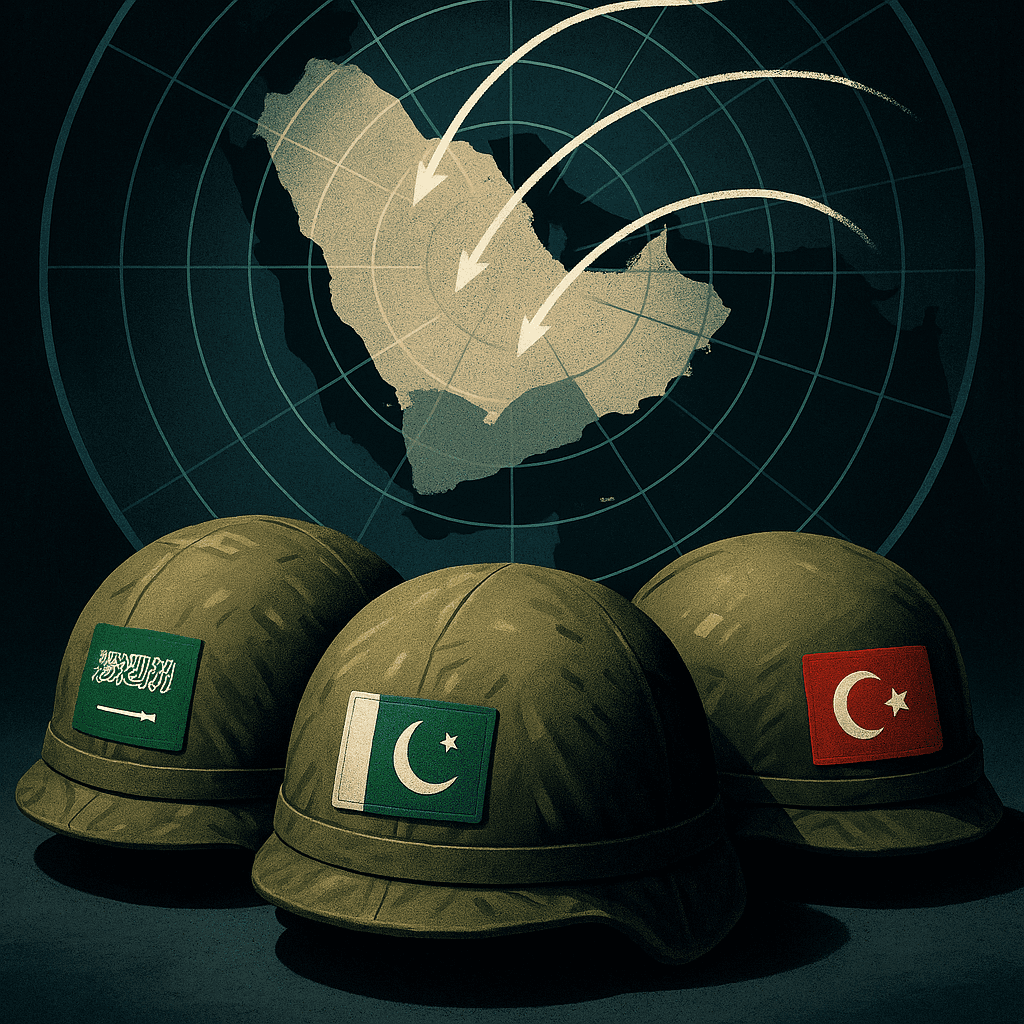
The alarms went up the second the ink on the Mecca Defense Pact dried into something operational: three flags, one clause, and a whole ecosystem of analysts suddenly gaming out Houthi missiles dropping into Karachi or Ceyhan before the translation office finishes the Turkish version of the communiqué.
Through December 10, the Houthis will not land a damaging strike on critical infrastructure in Pakistan or Turkey. They will keep hitting Saudi and the shipping lanes, talk a big game about the pact, and let commentators do the escalation on their behalf while generals issue brave statements from very safe conference rooms.
The Mecca pact is very loud on paper. The war, so far, is very local in practice. The gap between the two is where this forecast lives, along with several dozen retired colonels explaining that “anything could happen” on every cable network on earth.
The Call: Score It Here
For scoring: I am betting that by the end of December 10, 2026, there is no successfully executed, credibly attributed Houthi kinetic attack that causes physical damage to critical infrastructure inside Pakistan or Turkey.
Critical infrastructure means ports, major airports, refineries, power plants, main pipelines, big industrial nodes. A stray drone in an empty field, a failed launch splashing in the Arabian Sea, or a noisy cyber "claim" with no broken hardware does not count. A damaged terminal in Gwadar or a burned out substation outside Izmir absolutely does.
If the Houthis, or Iran’s network on their behalf, hit and damage one such site on Pakistani or Turkish soil and can plausibly claim or be attributed for it, this column eats its words. Otherwise, the panic about an instant widened war was just that: comfort in imagining the absolute worst while reality stubbornly refuses to follow the PowerPoint slides.
Why The Missiles Stay Closer To Home
The consensus story is simple and cinematic. Pact goes live, Pakistani and Turkish troops land in Saudi, Iran fumes, the Houthis expand the target set to everyone who shows up in a Saudi guest room. That sells push alerts. It does not match the incentives or the physics.
First, capability. The Houthis have proved they can hit Saudi airports and oil linked infrastructure. Their missile and drone portfolio is real and nasty within that radius. What we do not see, in open source, is a reliable envelope for slamming hardened targets in Turkey or deep into Pakistan from Yemeni launch pads, especially under heavy surveillance around Bab el Mandeb and the Arabian Sea. Long range surprises do happen, but betting on a black box capability in a 60 day window is more thriller script than forecast.
Second, politics in Tehran. Iran has every reason to let the Houthis bleed Saudi Arabia and the Red Sea. It has far fewer reasons to invite a nuclear armed Pakistan or a NATO member into a grievance list that is already longer than its oil export manifest. Tehran uses the Houthis as pressure on Riyadh and Washington, not as a randomizer that might suddenly drag Pakistan’s generals or Turkish planners into a grudge they did not budget for.
Third, domestic brakes in Ankara and Islamabad. Turkey is already up to its neck in Syria, Iraq, and the Eastern Mediterranean. Pakistan’s military has its own insurgents to worry about and a complicated relationship with Iran. Al Jazeera reports promise rapid deployments and solidarity. Lawrence Wilkerson calls the pact an entente at best and notes that Turkey says its troops would be "there for defense" and Pakistan would think twice before striking Houthis at all. That is not the posture of governments eager to become legitimate Houthi targets at home, however flattering that might be for mid level officers who collect threat assessments like trading cards.
Put bluntly: if you plan to tiptoe, you do not hand your adversary a pretext for a home front strike in the first sixty days. You keep your contribution as defensive and as Saudi territory bound as possible, exactly what both capitals are signaling.
Where The Real Risk Runs
The risk does go up. It just runs in a different direction.
By operationalizing the Mecca pact right after Houthi barrages forced Saudi Arabia to admit its air defenses have seams, Riyadh has effectively advertised two things: it needs help, and it is willing to formalize that dependence. Iran’s response has been textbook. Officials warn that "intervention in Yemen" will have "undesirable consequences," conservative commentators cry sectarian polarization, and state media put Houthi warnings to Turkey and Pakistan on loudspeaker.
That is escalation as messaging, not escalation as targeting. It encourages three more likely moves inside this 60 day window:
- More and bigger strikes on Saudi airports and oil linked sites, to prove that the pact has not solved the vulnerability it was supposed to fix.
- Higher risk harassment around Bab el Mandeb and the Red Sea, aimed at shipping tied to Saudi Arabia and its friends, including Turkish and Pakistani entities where convenient.
- Heavy rhetorical fire on Ankara and Islamabad, framed as warnings to stay defensive and stay out of Yemeni skies.
That soft widening already delivers what Tehran wants. It keeps global markets on edge about oil flows, it humiliates Saudi defenses in real time, and it hangs a question mark over the value of the new alliance without requiring Iran to deliberately hit another state’s homeland and then explain it to a nervous border.
You do not waste a leverage machine like the Bab el Mandeb on a demonstration strike against a Turkish port whose main strategic sin is making Erdoğan feel tall on summit stages.
What Would Change My Mind Fast
The tail risks are real. They just need a trigger the region has not yet pulled.
If, in the coming weeks, we see Pakistani or Turkish aircraft conducting visible strikes inside Yemen, or naval units interdicting Houthi launch platforms, the narrative shifts from "friends guarding Saudi airspace" to "new belligerents." At that point, Houthis can sell retaliation against Turkish or Pakistani infrastructure as self defense. Iran’s "undesirable consequences" line suddenly has content.
I am also watching two signal clusters closely:
One, parliamentary language in Ankara and Islamabad. If mandates explicitly allow operations outside Saudi territory, this forecast gets more nervous. The looser the rules of engagement, the shorter the path from pact theater to actual war roles.
Two, proof of range. If we see Houthis testing or receiving longer range systems, or hints of forward basing closer to the Arabian Sea, then a shot at coastal Pakistan becomes more than fan fiction. An attempted, even clumsy, hit on something like Gwadar’s energy infrastructure would be enough to bust this call.
Absent that kind of shift, expecting a rapid clean shot at hard targets in Turkey or Pakistan is asking a messy patron proxy ecosystem to behave like a precision instrument.
The Pact Meets Reality
In theory, the Mecca Defense Pact says an attack on one is an attack on all. In practice, this 60 day window will reveal whether it is a mutual defense alliance or a very expensive group chat with a logo.
My forecast says the Houthis and Iran will test the pact where it is weakest and most symbolically loaded: Saudi airspace and the Red Sea. Turkey and Pakistan will discover the art of being present but not really present, loudly committed and operationally careful.
If I am right, December arrives with more damage in Saudi Arabia, more insurance meetings about Bab el Mandeb, and zero broken refineries in Pakistan or Turkey. The Mecca pact will look less like a collective shield and more like a regional LinkedIn endorsement: flattering, noisy, and ignored when the missiles actually fly.
Around the Shallot
Stay in the same broken universe.
Forecasts, satire, cartoons, and quizzes should feel like one publication, not disconnected tabs.
Tech
‘Don’t Regulate Us,’ Beg AI Founders Currently Selling Regulation-As-a-Service
Silicon Valley hails Trump’s plan to let AI companies write their own rules, promises to sell those rules back to everyone else by Q4.
Oct 11

Forecast
By Day 120, Nvidia Won’t Be 25% Below Its Peak
Nvidia at nearly $6 trillion is priced like the central bank of artificial intelligence. The bet now is simple: does earnings reality wreck the party with a 25% drawdown, or do AI infrastructure dreams stay loud enough to drown out ROI questions a little longer?
Oct 9
Comments
Be the first to comment.