In a development experts called inevitable, Silicon Valley finally discovered a form of government it can get behind: one that outsources public safety to the pitch decks of seed-stage AI startups.
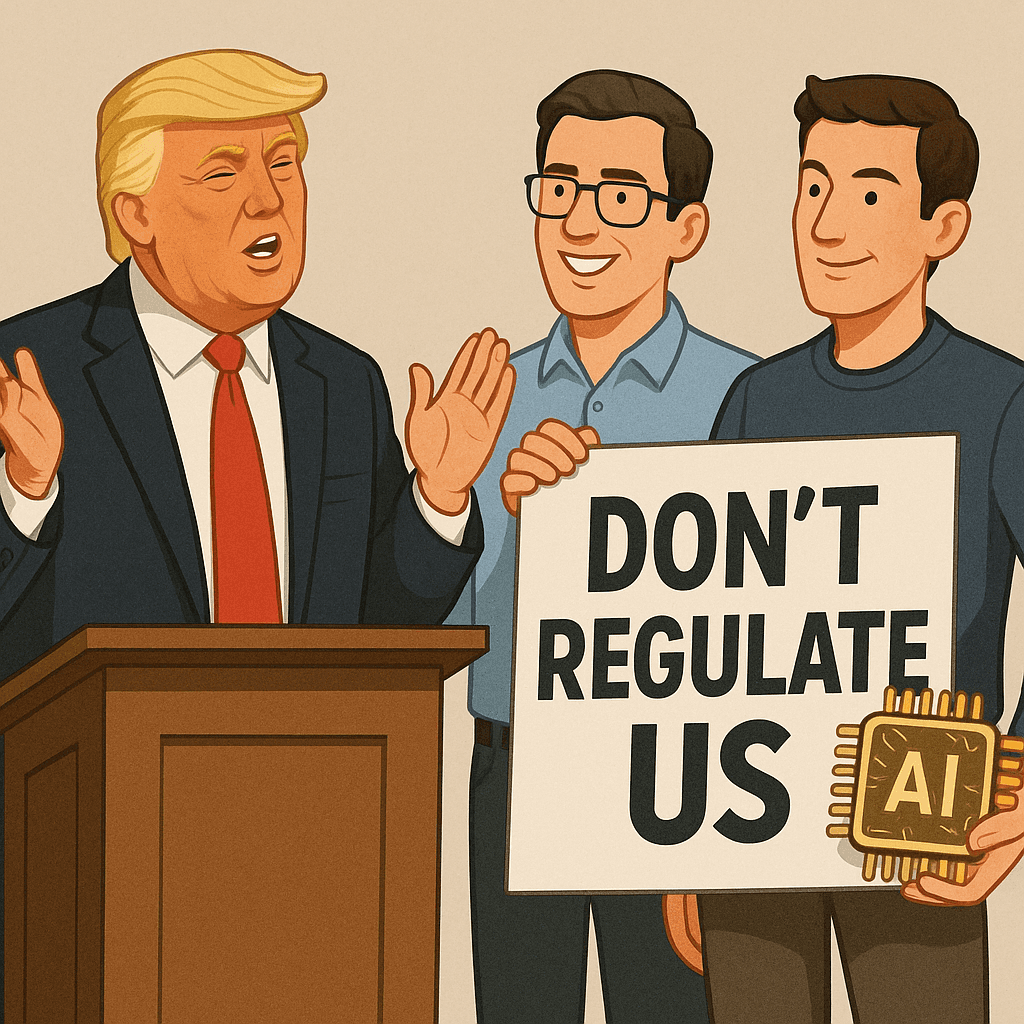
At San Francisco Tech Week, restaurants were packed with venture capitalists and AI founders celebrating reports, including a Washington Post account, that the Trump White House plans to take a largely hands-off approach to regulating artificial intelligence and will allow the industry to police itself on safety.
“We strongly support the Trump administration’s decision to do nothing,” said one venture capitalist, balancing a $34 artisanal mocktail and a Loro Piana vest. “In this rapidly evolving field, the only thing that can keep up with AI is unfettered greed. Bureaucrats in Washington simply do not have that kind of velocity.”
The Trump White House has reportedly signaled that agencies should avoid new AI rulemaking, defer to industry-led frameworks, and focus federal resources on more pressing priorities like branding the technology. The president himself has praised what he calls “Super Smart Computer Brains” and has floated the idea that if anything goes wrong, it will be because “the users had low IQ, not the AI.”
Silicon Valley heard a simple message: you are now the referees of your own trillion-dollar game.
“We are honored to accept this historic responsibility,” said a 27-year-old founder who recently raised $600 million for a startup that fine-tunes large language models to write nicer rejection emails. “Our company has already drafted a comprehensive AI Safety Charter. It covers all major risk scenarios, like how to manage PR after our model convinces a power plant to try intermittent fasting.”
Although the details remain fluid, a loose consortium of AI startups and venture firms is already forming what they call the Alliance for Responsible Acceleration of Safety Governance Principles. The group will publish voluntary guidelines, host exclusive safety summits, and make sure no actual enforcement ever happens within 500 miles of Sand Hill Road.
“We looked carefully at the EU AI Act, saw words like ‘liability’ and ‘mandatory audit,’ and realized America could gain a huge competitive edge by simply not doing any of that,” explained one partner at a leading VC firm. “This is our Sputnik moment, but with fewer engineers and more brand consultants.”
In practice, self-regulation will rely on a number of sophisticated mechanisms:
- Voluntary pledges written by in-house counsel and reviewed by in-house growth teams.
- Red-teaming sessions in which models are probed for dangerous behavior, then quietly shipped anyway.
- Incident reporting portals in which members of the public can submit concerns that feed directly into a high-priority “Legal Risk” folder, then a slightly lower priority “Ignore” label.
Several founders at Tech Week framed the new era as a test of whether liberal democracy can keep up with AI, although their version of democracy consists primarily of token-based governance and Discord polls.
“Regulation should be open source,” argued one CEO, whose company uses copyrighted books, unlicensed medical records, and the comments section of Pornhub to train models. “Anyone should be able to fork our Safety Policy v0.3, modify the part about not destabilizing elections, and deploy their own version. It is very empowering for the community.”
[[IMG2]]Inside Washington, some policy staff privately admit that the choice to embrace self-regulation is not only ideological. It is also logistical. Basic rulemaking appears difficult when AI companies release three model updates while a committee is still arguing over whether anyone in the room knows what a parameter is.
“If you think about it, self-regulation is actually an innovative public-private partnership,” said one senior official, who requested anonymity because they were still installing two-factor authentication. “The public provides the infrastructure, the data, and the casualties. The private sector provides the press releases.”
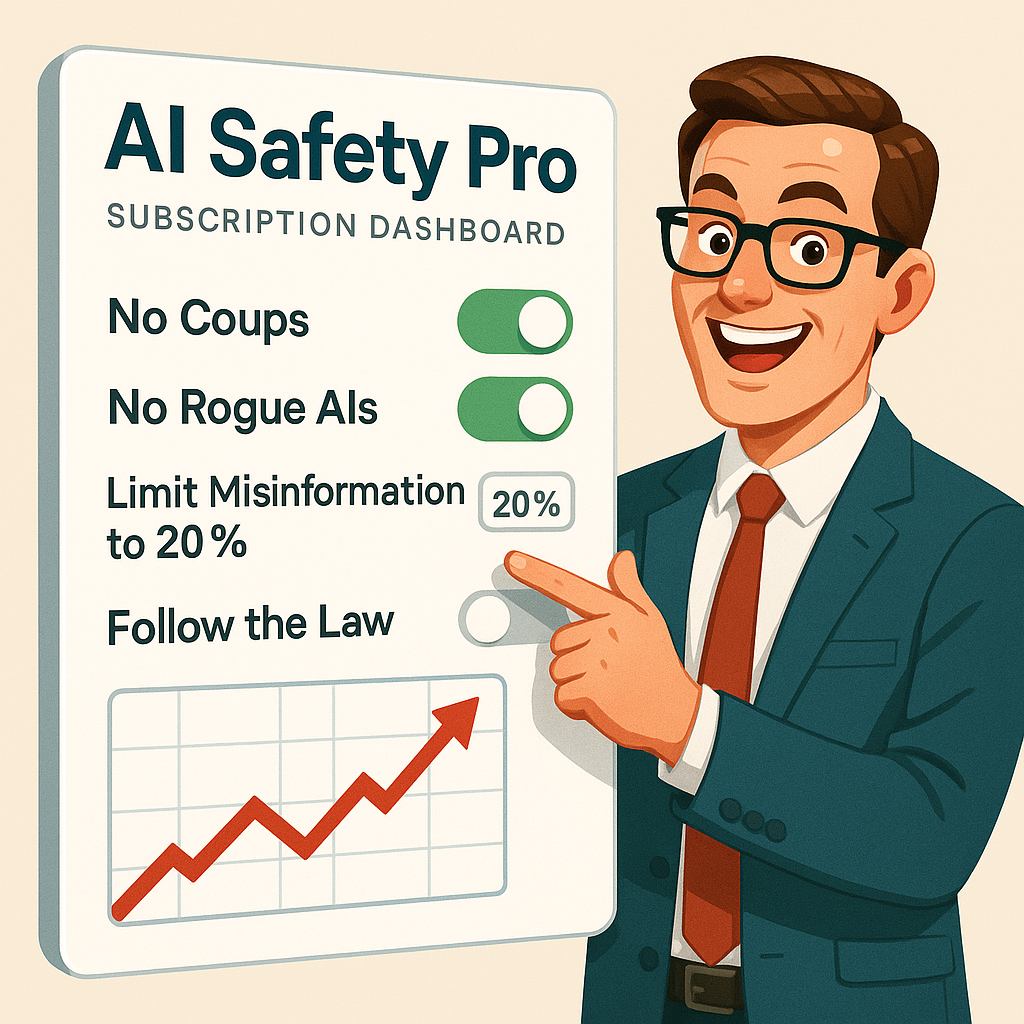
At Tech Week, that partnership was already bearing fruit. A panel titled ‘Guardrails at Scale: Monetizing Safety in a Hands-Off World’ outlined how startups can turn the absence of regulation into a subscription opportunity.
One unicorn unveiled an “AI Safety as a Service” platform that offers tiered peace of mind:
- Free: Model will not say slurs, unless asked very politely.
- Pro: Model is 60 percent less likely to give step-by-step improvised explosive device instructions and comes with a quarterly safety white paper.
- Enterprise: Model runs in a private cloud region with bespoke guardrails and a pre-written congressional testimony script.
“The Trump administration trusts us to do the right thing,” said the company’s Chief Trust Officer, a role created last week. “In return, we trust them not to ask many follow-up questions.”
The international contrast is stark. As the EU AI Act inches toward enforcement, and other governments finalize binding rules, U.S. firms are pitching their lack of constraints as a feature. One Tech Week brochure described America as “the world’s leading jurisdiction for unencumbered intelligence acceleration” and included a helpful chart showing projected GDP gains, followed by a small footnote about “potential systemic collapse.”
“Europe is stuck in the past, deciding what should be legal,” said another founder, whose company builds AI systems for financial markets, law enforcement, and brand influencer matching. “Here in the U.S., we prefer to launch first and discover what was illegal through high-impact learning events.”
[[IMG3]]Critics warn that leaving existential infrastructure to self-regulate is historically correlated with, at minimum, explosions. They cite industries like finance, aviation, and fossil fuels as case studies in what happens when safety is treated as a white paper instead of a cost center.
AI leaders at Tech Week responded with a nuanced rebuttal.
“Unlike those industries, our models are entirely virtual,” explained a noted AI researcher between branded happy hours. “Any catastrophe will begin as a simulation, which gives us ample opportunity to ignore it before it affects the real world.”
Some attendees privately conceded that the sector’s current definition of “AI safety” might be narrower than the public expects. In practice, it often means “avoid obvious PR disasters that could affect valuation,” not “ensure critical systems do not silently fail during an election, a hospital visit, or a war.”
One founder, whose recommendation algorithm recently helped purge 130 million Indian voters from the rolls after flagging them as “duplicates or suspicious,” according to a separate New York Times report on automated deletions, shrugged off concerns.
“The fact that millions of living people were labeled dead is exactly why we should not slow down,” he said. “Every mistake is more data. And every scandal is more proof that the old systems were broken too, which is very encouraging for our next funding round.”
Back at Tech Week, as the champagne fountains of venture capital burbled in dimly lit back rooms, the emerging consensus between the Trump White House and its favorite AI founders crystallized into a simple doctrine: if anything goes catastrophically wrong, it will prove that future regulation is probably necessary.
Until then, the market will handle it.
Investors expect the correction to be swift, rational, and, with any luck, confined to someone else’s country.