By 2028, Two Major U.S. Social Platforms Will Stall in Daily Use
My call: By the 2028 election, at least two big U.S. social platforms will be flat or shrinking in daily use, even as their money goes up.

My call: by the 2028 U.S. election, the American social web will be past its peak. At least two of the big five platforms in the United States, Facebook, Instagram, TikTok, Snapchat, X, will have daily active use that is flat or falling versus 2024 once you adjust for population growth.
The feeds will not go dark. Your uncle will still be subtweeting AOC from his recliner. But the easy growth era of mass, public social media in the U.S. is ending. The platforms will respond in the traditional American way. Fewer users, higher ARPU, more ads, and a generous side of AI spam.
The call: what has to happen to prove "post‑social"
Here is the testable bet.
By November 5, 2028, at least two of these platforms in the U.S. market, Facebook (core app), Instagram, TikTok, Snapchat, X, will report daily active user numbers that are no higher than their best‑available 2024 U.S. DAU baselines, after adjusting for U.S. population growth.
Score it on whatever the companies or credible third parties still publish in 2028: U.S. or North America DAU, daily unique visitors, or methodologically serious traffic estimates. If human daily use is flat or down on a per‑capita basis on at least two of the five, the "post‑social" internet clears the bar.
If four of the five are still growing cleanly in U.S. DAU relative to 2024, the obituary for the social web was premature. You are not post‑social, you are just tired.
The signal: users are quietly walking out of the party
The consensus story says Americans are more online than ever, so social media must be winning. The signal says something else: the town square is shrinking around the cameras.
Petter Törnberg’s work at the University of Amsterdam tracks visits and posts on Facebook and Twitter/X from 2020 to 2024 and finds almost a 50 percent drop. Not some marginal dip, a cliff. At the same time, a growing share of Americans at both ends of the age curve, 18 to 29 and 65 plus, report using no social media at all.
Pew’s surveys show Facebook’s U.S. penetration basically frozen in place. The share of adults who have ever used Facebook has crawled from 68 percent in 2016 to about 71 percent in 2025. Twitter/X and Snapchat use both peaked back in 2018 and have drifted down since. The Incogni survey in 2026 has more than half of respondents saying they post less now than five years ago.
These are not the stats of a booming medium. They are the stats of a mature one where people still show up, but treat the experience the way Lamar Jackson treats Instagram. Occasionally useful, rarely delightful, and mostly a place where other people tag you.
The contradiction: revenue up, relevance sideways
Here is the confusing part. The North American social media services market is projected to climb from around 60 billion dollars in 2023 to north of 90 billion by 2028. Global traffic rankings still put Google, YouTube, and Facebook near the top of the internet. This does not look like an industry in decline.
That is because DAU and dollars have divorced. The platforms are learning to make more from the users they have, not by adding many more users. Better ad targeting, more video, more subscriptions, more creator cuts, more shopping features. Growth is happening in revenue per user, not in how many Americans still open the app every day.
This is the core driver of the forecast. Once a social platform saturates a country, demographic shifts and boredom start to bite. Young people peel off to group chats, gaming, Discord, private servers, places that feel social but are not "social media" in the public, feed‑based sense. Older users either age out, burn out, or age into television again.
The platforms can keep total minutes numbingly high. Autoplay and infinite scroll are very good at that. But the ceiling on unique daily humans is real, and the evidence from Facebook, X, and Snapchat suggests the U.S. is already bumping into it.
The politics: everyone hates social media and cannot quit it
Politicians are now structurally addicted to the thing they are trying to strangle. AOC calls social media a public health risk and wants to break up big tech while thriving on Instagram and TikTok. Trump tried to ban TikTok, crusades against Section 230, and still treats X and Truth Social as his lifeline to the base.
Multiply that incoherence across Congress and statehouses and you get regulatory pressure without a coherent endpoint. TikTok bans on the table, age verification schemes, renewed antitrust talk, elaborate speech rules dressed up as safety. Every one of those adds friction to the big platforms and raises the odds that marginal users log in less or stop entirely.
At the same time, AI turns the feeds into a low budget information war. Foreign operations like China’s "Green Cicada" bot network on X are a preview, thousands of AI‑run accounts poking at U.S. politics. Generative tools crank out plausible text, faces, voices, and videos at trivial cost. Authenticity becomes another unpaid cognitive tax, and some people simply opt out of paying it.
That mix, political hostility plus AI chaos, does not usually produce steady, compounding daily active use. It produces a hollowed out public square where institutions, media, and campaigns are still yelling into the mic while more citizens quietly leave the venue.
The countertrend: TikTok, inertia, and the bots that pad the stats
There is a real upside scenario. TikTok and Instagram still have headroom in the U.S. Their short‑form video machines are very good at manufacturing compulsion. AI assistants could also make feeds smoother, safer, and more entertaining. Behavioral inertia is powerful. People open apps they claim to hate for years.
If regulation ends up mostly performative, if there is no serious TikTok restriction, and if Meta and ByteDance keep making the products less terrible to sit inside, you can easily imagine four of the five majors still growing per‑capita DAU through 2028. The post‑social thesis would be wrong on the letter even if right on the vibe.
There is also a measurement trap. Platforms can quietly expand what counts as daily active, loosen their regional breakdowns, and commingle human use with bot and AI traffic. It would not be the first time an industry discovered creative definitions of a user right before its growth stalled.
The stakes: smaller audience, louder noise
If the forecast holds, 2028 will not look like a detoxed democracy. It will look like a country where fewer Americans participate in big public feeds, while elections are still routed through them and hostile AI systems are very happy to fill the empty space.
Campaigns will chase shrinking but still measurable audiences on Facebook, Instagram, TikTok, and X. Lawmakers will keep threatening the companies that host their posts. The market will celebrate record social media revenues. Commentators will lament polarization on platforms that a rising share of young and old Americans no longer touch.
In other words, the social web will have completed its evolution from public square to cable news set with a comment section, a place where most people do not show up every day, but the same characters are always on screen, shouting to an audience that statistically looks a little more like bot traffic every year.
By 2028, the post‑social internet is not everyone logging off. It is everyone important staying online long after the crowd has gone home so that the algorithms and the influence operations do not have to argue with actual humans anymore.
Around the Shallot
Stay in the same broken universe.
Forecasts, satire, cartoons, and quizzes should feel like one publication, not disconnected tabs.
Tech
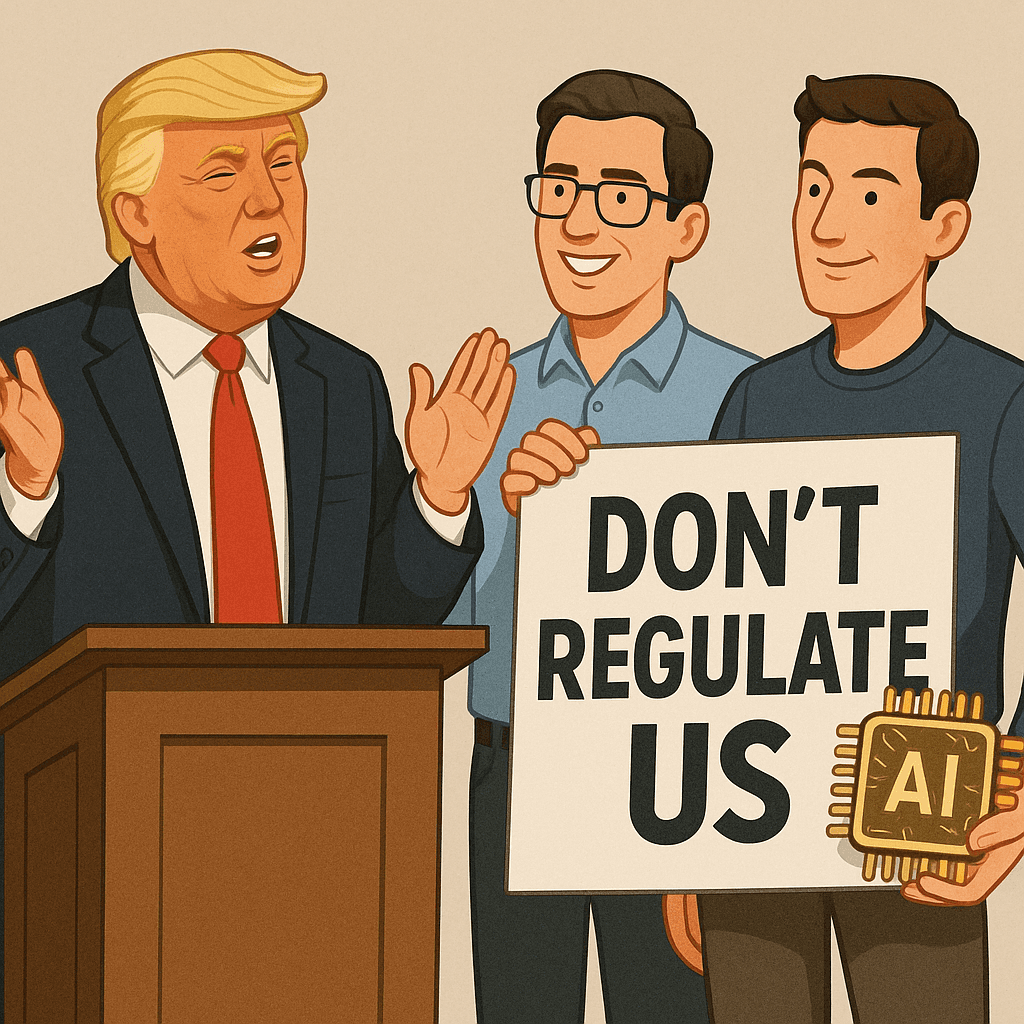
‘Don’t Regulate Us,’ Beg AI Founders Currently Selling Regulation-As-a-Service
Silicon Valley hails Trump’s plan to let AI companies write their own rules, promises to sell those rules back to everyone else by Q4.
Oct 11

Forecast
Through December 10, Houthis Won’t Damage Pakistan or Turkey Infrastructure
The Mecca Defense Pact just put two more flags on the Saudi firing chart. The consensus panic says this widens the war within weeks. The signal says the Houthis will talk big, hit Saudi and the sea, and leave Pakistan and Turkey’s hard targets alone for this 60 day window.
Comments
Be the first to comment.