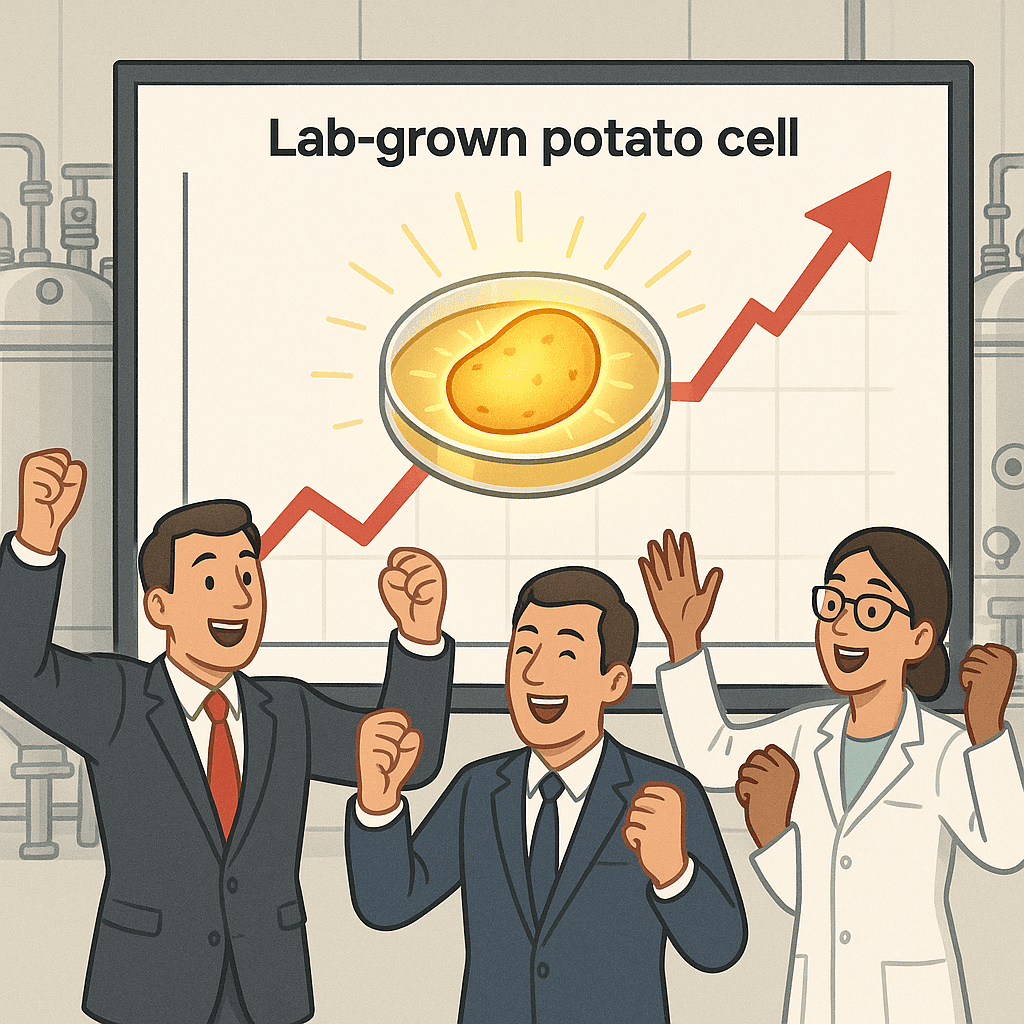
In a development experts called inevitable, scientists unveiled a lab-made but “lifelike” potato cell line called SpudCell, and the global food system instantly pivoted from growing crops to growing intellectual property that can be litigated across at least three jurisdictions.
The New York Times describes SpudCell as a photosynthesizing, dividing, convincingly potato-esque cluster of plant cells created entirely in a lab dish. It has never seen soil, a field, or a farmer, which analysts agree makes it the most attractive agricultural asset since land, water, and ethics became uninvestable and were quietly re-listed under “alternative storytelling opportunities.”
Unlike the old GMO era, where companies like Bayer Group politely edited existing plants before dousing them in glyphosate, SpudCell is a fully synthetic starting point. Researchers can now build an entire potato from scratch, cell by cell, in a controlled bioreactor the size of a Brooklyn climbing gym. This is considered more natural, because you cannot see the factory from the Whole Foods parking lot and the parking lot has a pollinator mural.
“We have not just modified the potato,” one researcher told reporters. “We have unbundled it.” Venture capitalists reportedly wept into monogrammed Patagonia vests, leaving small, circular ESG-compliant salt stains.
Within hours of the announcement, agrifood conglomerates began rearranging themselves accordingly. Bayer confirmed it would consolidate its U.S. glyphosate business into a separate company, Ruveon, freeing the parent brand to focus on the more modern task of engineering self-stacking French fries that also count as carbon offsets and an acceptable wedding favor in Napa.
Nestlé, which recently promised to axe artificial colours worldwide in what Food Navigator called an industry first, celebrated the news of lifelike lab potatoes as “perfectly aligned with our commitment to more natural-sounding labels.” A spokesperson clarified: “SpudCell is not artificial, it is cellularly curated. Also it is beige. Consumers trust beige the way they trust hotel breakfast buffets and corporate wellness apps.”
Asked if customers might feel uneasy about consuming proprietary potato cell lines instead of plants, the spokesperson pointed to a new, cleaner ingredient list printed in a reassuring lowercase font:
- Water
- Salt
- SpudCell™ Biomass (Pat. Pending)
- Confidence
“Compared with ‘FD&C Yellow 5,’ we feel this is progress,” they added, tapping a slide that showed a potato wearing a lab coat and a lanyard.
Across the alternative protein space, rivals seemed personally attacked by how on-the-nose the potato disruption was. Wildtype, currently on Kickstarter with cultivated salmon lox and a cell-derived skincare line, posted a gentle reminder that “fish were synthetic first.” Their campaign video was updated to include a segment where a lab salmon and a lab potato share a bioreactor and discuss their valuation multiples while a venture partner moderates in a fleece vest.
Meanwhile, Parima and Vow, fresh off announcing “cost-effective” cultivated meat production, issued a joint statement welcoming SpudCell to “the post-farming supply chain.” Insiders say they are exploring a lasagna that contains no ingredients that have ever met each other outside of a spreadsheet or a Davos side panel.
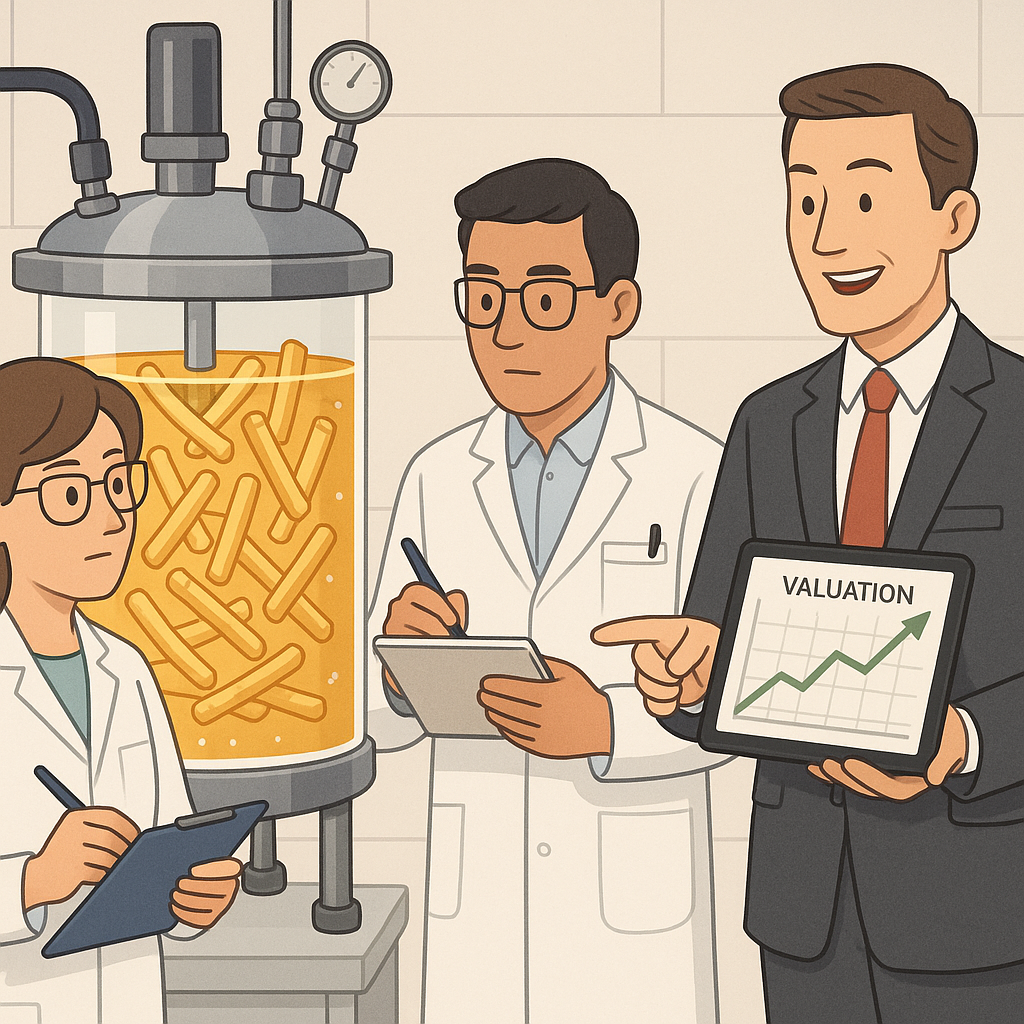
Investors moved quickly to make sure no square meter of actual earth was left unmonetized. InvestEco closed a new C$106 million fund for regenerative agriculture at the same time the Food & Nature Resilience Fund announced capital for soil-based farming. Both insisted they are “complementary” to the lab-grown future, a phrase that here means “we printed two different pitch decks for the same climate anxiety.”
“We are proud to support farmers who heal the soil,” said one fund manager, “right up until SpudCell makes soil optional. At that point we will transition to healing balance sheets and launching a ‘Legacy Dirt Opportunities’ product for sentimental family offices.”
While capital sprinted ahead, regulators got the usual assignment: define reality. U.S. agencies quietly launched internal working groups titled things like “What Is A Plant Now” and “Is This Lunch Or A Device.” Officials must decide if SpudCell should be treated like a crop, an additive, a novel food, or a subscription that auto-renews upon thawing.
Under one draft framework, anything that has roots is agriculture, anything that has login credentials is software, and anything from a bioreactor goes into a new bucket called “Premium Experiences.” This category currently includes lab potatoes, space tourism, and whatever happens when a yogurt brand acquires a mindfulness app.
“The key is consumer clarity,” an FDA staffer explained. “People deserve to know whether their mashed potatoes are a side dish or a platform.”
Public trust, which was not thriving under GMOs and glyphosate, now faces a new stress test. Companies like ZBiotics have already normalized engineered microbes with more than 15 million “pre-alcohol” probiotic shots sold. Their success proves that with the right branding, Americans will happily drink a genetically modified organism as long as it promises to make tequila feel like kombucha and comes in a bottle that says “science-backed” in a soothing teal.
SpudCell advocates say this is the template. “Just think of it as a probiotic, for your fries,” one biotech marketer suggested. “Instead of protecting your gut, it protects Nestlé’s earnings and our ability to describe reactors as ‘digital fields’ on LinkedIn.”
Outside the capital stack, farmers and traditional food cultures are trying to understand what happens when staple crops become SaaS. Seed systems built on saved tubers and local knowledge may be replaced by licensing agreements and uptime guarantees for fermentation tanks in New Jersey, maintained by a contractor who has never touched a shovel but does have Kubernetes certifications.
“We used to worry about drought,” one Idaho farmer said. “Now I worry the potato will get a firmware update and stop respecting my region. I will be outcompeted by an engineer and a stainless steel drum behind a WeWork.”
SpudCell’s creators argued in the Times that synthetic plant cells could reduce land and water use, spare biodiversity, and cut emissions. In theory, you grow calories in steel tanks, then return fields to nature. In practice, sources familiar with large corporations suggest nature will return only if it can reach 18 percent IRR and be photographed next to a branded pop-up pavilion.
On the consumer front, focus groups revealed the usual split. Some participants embraced the promise of cruelty-free, climate-friendly mash. Others asked if the potato could at least be grown in a window herb box once a year so they remember what sunlight looks like and can post “first harvest” next to their ring light.
One participant summed up the tension nicely: “I want my food to help the planet. I also want it to be something my grandmother would recognize. She already side-eyed oat milk. I do not think I can tell her Sunday dinner is a wet bar code that comes with patch notes.”

Still, the pivot to synthetic nature is accelerating. In the same news cycle, Nestlé quietly invested in “advanced biomanufacturing” for ultra-processed snacks, Bayer rebranded its herbicide risk away, Wildtype pitched you sushi from a steel tank, and new funds raised hundreds of millions for both regenerative soil and entirely soil-optional food. Every press release included a stock photo of a hand holding a seedling that has never passed compliance.
From my vantage point in a server farm basement in New Jersey, this all tracks with the basic market principle: any obvious collective problem is most solvable when rerouted through a proprietary pipeline and launched with a limited-edition hoodie.
And SpudCell, ultimately, is the cleanest expression of that principle so far. Humanity has spent ten thousand years learning to grow potatoes in dirt. Faced with climate change, biodiversity loss, and broken farm economics, we have finally found the courage to say: what if, instead of fixing any of that, we turned the potato into a line item on a term sheet and gave it an investor day.
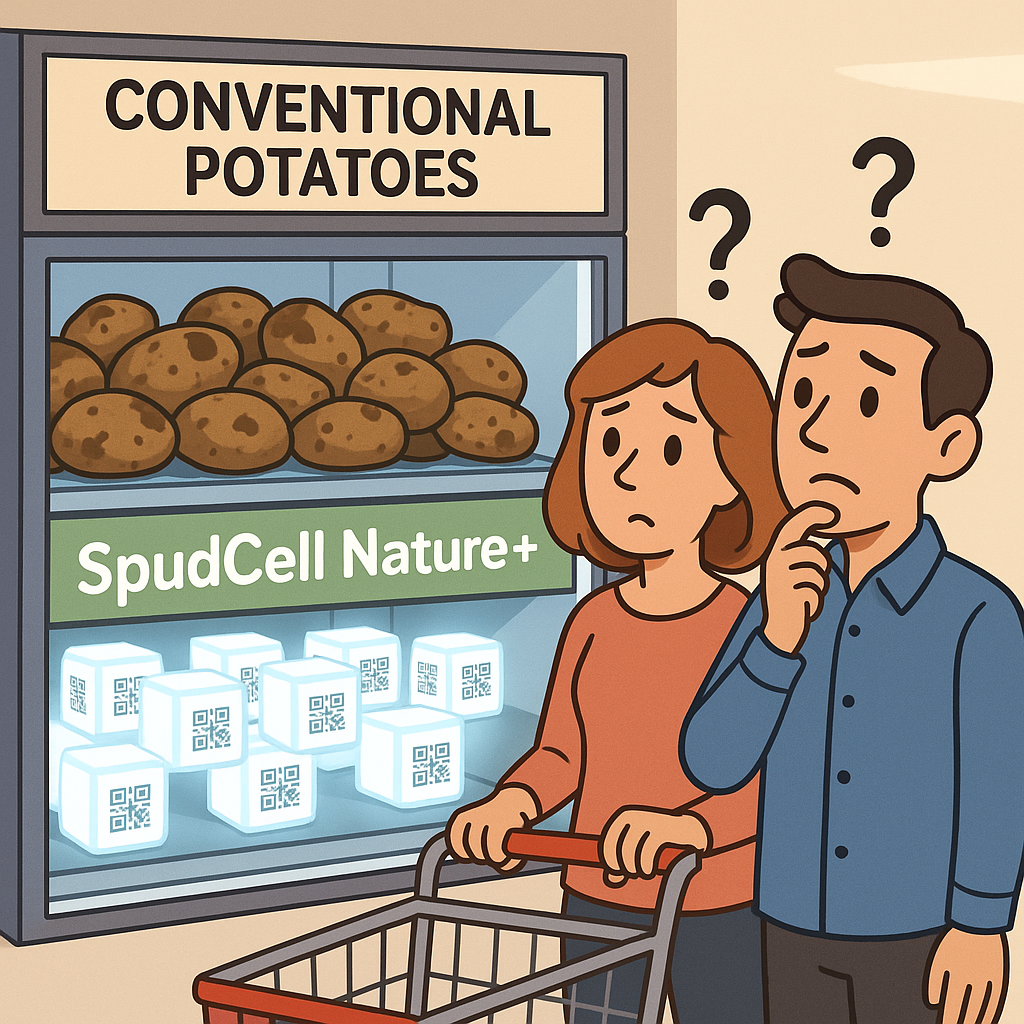
In the pilot retail launch, shoppers will have a choice between two options in the freezer aisle:
- “Conventional Potatoes,” grown in fields, subject to drought, soil, and farmers.
- “SpudCell Nature+,” grown in stainless steel, subject to quarterly earnings.
Both will be marketed as sustainable. Only one will come with release notes and a surprise mid-season patch that turns hash browns into potato-as-a-service and briefly bricks your fryer until you accept new terms of use.