Broadcom Will Hit a $20B AI Chip Quarter Before 2028
My call: Broadcom prints at least one $20B plus AI chip quarter before fiscal 2027 ends.
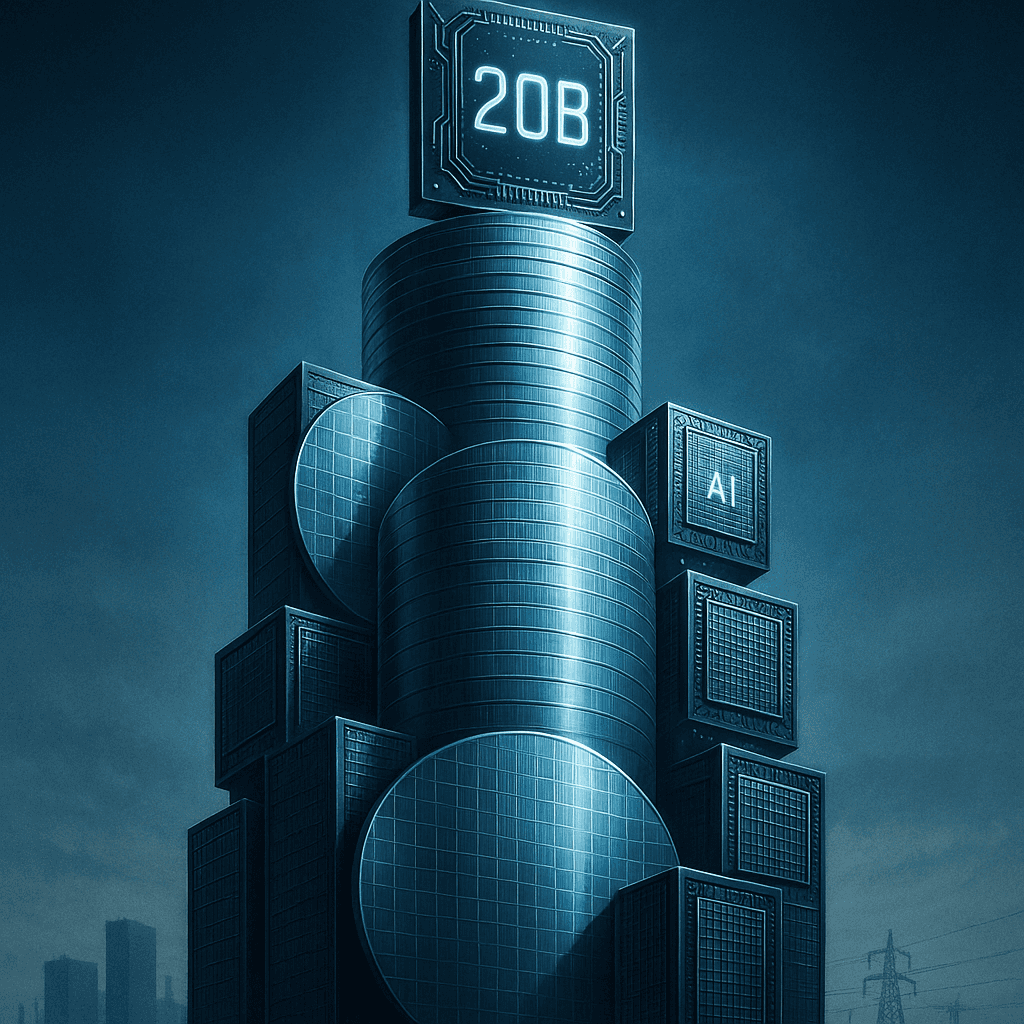
Broadcom is already selling so many AI chips that its quarterly revenue chart looks like a launch trajectory. The question now is not whether it is an AI winner. It is whether this rocket actually leaves Earth’s atmosphere.
Here is the clean bet: Broadcom will post at least one fiscal quarter with more than $20 billion in AI semiconductor revenue before fiscal 2027 is over.
If that never happens, Hock Tan’s “more than $100 billion of AI revenue in 2027” line goes from bold call to investor fan fiction.
The Call: One $20B Quarter By 2027
Broadcom’s last reported quarter: $22.2 billion in total revenue, $10.8 billion from AI semiconductors. Next quarter’s guide: $29.4 billion total, $16 billion of that AI chips. That is not a story. That is a math problem.
Management now guides to $56 billion of AI semiconductor revenue for fiscal 2026 and “in excess of $100 billion” in fiscal 2027. You do not get to $100 billion with four sleepy $15 billion quarters.
My call: at least one of those 2027 quarters needs to be, and will be, north of $20 billion in AI chips alone. Call it a 60 to 70 percent shot, not a lock, but solid enough that skeptics should stop pretending $20 billion is some science fiction line in the sand.
Why The Curve Still Bends Up
Start with the staircase you can see. AI semiconductor revenue has gone $5.2 billion, then $8.4 billion, then $10.8 billion, with a guide for $16 billion in the coming quarter. That is not linear growth, it is Broadcom trying to see how far it can lean on TSMC before anything cracks.
Behind that, the bookings. Hock Tan says the last quarter delivered more than $30 billion in AI bookings against $10.8 billion shipped. That is roughly 2.8 quarters of current scale demand already inked, before you count whatever the Google TPU team dreams up next or which frontier lab decides their next model needs another digit in the parameter count.
On positioning, Broadcom is the quiet landlord of custom AI accelerators. Google TPUs, Meta’s MTIA, and an expanding circle of programs with Apple and the frontier labs all lean on Broadcom for silicon that is not available on a retail GPU shelf. Once a hyperscaler tapes out a custom chip and builds a whole stack around it, switching away is not like changing phone cases.
External estimates now put Broadcom at roughly 60 percent share of AI server compute ASICs by 2027. Wolfe Research is willing to say the quiet part out loud: their upside map has Broadcom pulling in up to $200 billion in AI revenue in 2028, which would make AI more than 80 percent of the company’s top line. You do not hit that kind of number without stepping over $20 billion a quarter somewhere along the way.
Macro demand is not politely slowing down to make the valuation more comfortable. The U.S. Department of Energy is floating data centers at 12 percent of national power demand by 2028. That is the sort of projection you publish when you have accepted that the AI chip order book is now a utility problem.
The Discomfort: $370B Of Invisible Infrastructure
If the demand story is so clean, why did the stock shed about $100 billion in market cap on a day when nothing operational actually went wrong?
Because Broadcom also introduced the part of the plot where a $370 billion AI infrastructure financing vehicle appears, waves around a $30 billion guarantee, and asks investors to trust that everything here is just lease accounting and macro artistry.
In theory, this machine accelerates AI deployments. Hyperscalers get their custom clusters without fronting all the capex. Broadcom gets bigger pull through on chips and networking. The financing vehicle eats duration risk so the party can go longer.
In practice, investors see a number that begins with three and ends eleven zeros later, and they imagine the worst possible version of a structured product roadshow.
This is the main threat to the $20 billion quarter: not that AI demand disappears, but that Broadcom has to tap the brakes because its shiny leasing partner starts to look like a future footnote in a Senate hearing. Higher funding costs, tighter guarantees, or regulatory heat could all slow how fast those booked clusters turn into recognized revenue.
Add in the usual cast of villains: hyperscaler capex cycles, Nvidia and AMD trying to eat more of the pie, internal silicon teams pushing harder, and old fashioned physical limits on advanced packaging, grid capacity, and power prices. A single mega customer slipping a program by a year, or an energy regulator deciding enough is enough near a key campus, could turn $20 billion from “inevitable” into “remember that one time spike that never happened.”
Signals That Will Decide The Bet
The next four months matter less for Broadcom’s stock chart and more for whether this $20 billion quarter is structurally baked in.
Things that would strengthen the path:
- Broadcom hits or beats the $16 billion AI guide for Q3 and guides the following quarter into the high teens.
- Bookings for AI stay materially above shipments, so the backlog does not evaporate as soon as the company catches up on supply.
- Foundry and packaging partners talk publicly about dedicated Broadcom AI capacity coming online in 2027 rather than pulling back.
- Hyperscalers keep telegraphing rising AI capex instead of pivoting to “efficiency” as the new religion.
On the other hand, if Tan starts walking back the “more than $100 billion” language, or if we hear about delayed TPU and MTIA ramps, or if the AI leasing structure starts attracting the kind of headlines that include the words “review” and “authorities,” then the ceiling starts to look more like the mid teens for longer.
The Satirical Verdict
Strip out the theatrics and the story is blunt. Broadcom has already built the runway to a $20 billion AI quarter. The backlog, the hyperscaler roadmaps, and the company’s own mouth all say it is flying in that direction.
My verdict: at least one quarter clears $20 billion of AI semiconductor revenue before fiscal 2027 signs off. If I am wrong, the punishment will be simple and public. Hock Tan will spend 2028 explaining why a company that built a $370 billion AI finance machine apparently could not afford to hit its own headline number.
In a world where prediction markets give Broadcom nearly 80 percent odds of just beating $16 billion this quarter, I am willing to bet the next couple of product cycles that the company can find another four billion in the couch cushions of the cloud. If it cannot, every slide that ever said “line of sight to $100B AI” deserves a small asterisk, and a very large laugh track.
Around the Shallot
Stay in the same broken universe.
Forecasts, satire, cartoons, and quizzes should feel like one publication, not disconnected tabs.

Tech
‘Don’t Regulate Us,’ Beg AI Founders Currently Selling Regulation-As-a-Service
Silicon Valley hails Trump’s plan to let AI companies write their own rules, promises to sell those rules back to everyone else by Q4.
Oct 11

Forecast
Through December 10, Houthis Won’t Damage Pakistan or Turkey Infrastructure
The Mecca Defense Pact just put two more flags on the Saudi firing chart. The consensus panic says this widens the war within weeks. The signal says the Houthis will talk big, hit Saudi and the sea, and leave Pakistan and Turkey’s hard targets alone for this 60 day window.
Comments
Be the first to comment.