Mecca Pact Members Won’t Fight A Branded Joint War Before August 2027
My call: No Mecca‑branded shooting war before late August 2027.
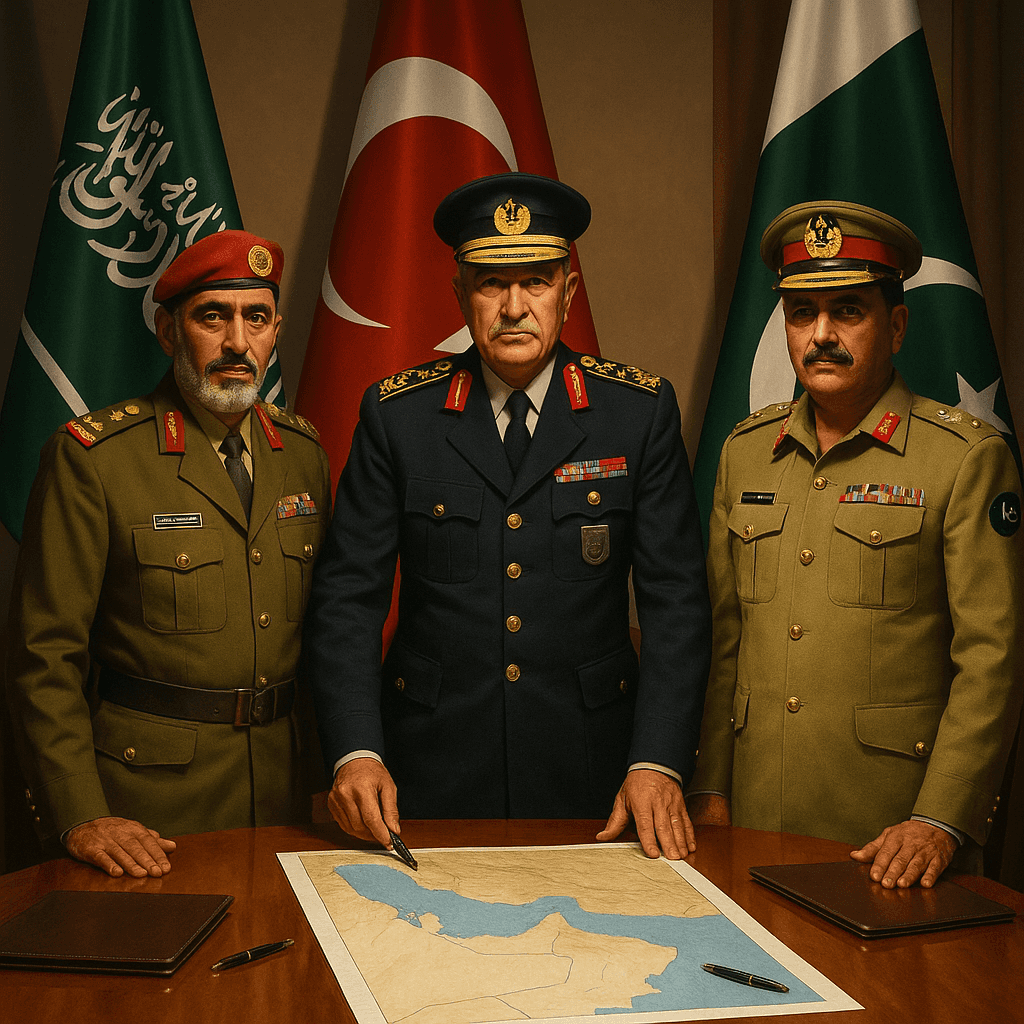
The Mecca Defence Pact is entering its first year as a logo looking for a war. It has a communique, a carefully lit group photograph, and at least three competing English spellings on the letterhead. What it does not have, over the next twelve months, is a branded joint shooting war.
Give it until 29 August 2027. In that window, I do not expect a joint Saudi–Türkiye–Pakistan operation that actually fires weapons under a Mecca Joint Defence Agreement flag. There will be summits, working groups, maybe a glossy launch video with orchestral strings and a CGI falcon circling the Kaaba. The first real combat test will wait.
That runs against the emerging narrative in parts of the region, the one that says Mecca 2026 is the Sunni NATO moment and that the only question is which crisis drags it into the water first: Hormuz, Yemen, Iraq, or some yet to be named militia with a Telegram channel and a drone habit.
Look closer at the incentives and the plumbing. This pact is being built as leverage, not a starter pistol.
The Call: A Year Of Posturing, Not Firing
To score this cleanly, here is the testable bet.
Forecast: By 29 August 2027, there is no documented operation where at least two of the three Mecca members jointly engage in live combat, and that operation is explicitly framed by governments or credible media as conducted under the Mecca Joint Defence Agreement or a named Mecca pact task force.
Solo or bilateral adventures do not count. Nor do training exercises that accidentally get spicy. Nor does quiet advisory or logistics work tucked behind other frameworks.
If Riyadh, Ankara, and Islamabad announce that a Mecca Joint Task Force has opened fire in a real operation, I am wrong. If they instead keep fighting their usual separate wars while issuing communiqués vowing unity, I am right.
Driver 1: Alliances Talk Fast, Armies Move Slow
The Mecca Joint Defence Agreement was signed on 7 August 2026. That is very recent for an alliance that is supposed to coordinate three big, politically touchy militaries across air, land, and sea.
Mutual defence clauses look decisive on parchment. In the real world, using them requires all the boring, friction filled infrastructure underneath: interoperable communications, shared targeting rules, legal authorities, air tasking orders that do not crash into each other.
There is almost no public evidence that Saudi, Turkish, and Pakistani forces have stood up a Mecca specific joint command, permanent liaison structure, or rules of engagement that could turn a summit photo into a live operation in months, let alone launch a complex mission in a crisis without tripping over rank, language, and ego.
These militaries can and do work together, but mostly through bilateral and ad hoc channels. Pakistan already provides trainers and personnel in the Gulf. Türkiye runs its own playbook in Syria and Iraq. Saudi Arabia is trying to exit one quagmire in Yemen, not franchise a new one.
The Mecca pact, for now, sits on top of that messy reality as a brand, not as a functioning war machine. Brands are fast. War machines are slow.
Driver 2: Riyadh Wants Deterrence, Not A Congressional Meltdown
The second constraint is sitting in Washington, not in Mecca.
Saudi Arabia just watched President Trump ship a civil nuclear agreement to Congress, complete with reporting about conditions linked to Israel normalization and future Saudi security behavior. In other words, the same US that has been the kingdom's security spine for decades is now debating whether to let Riyadh play with reactors while holding a leash on its regional adventures.
If you are Mohammed bin Salman, this is not the moment to test a new autonomous war alliance in a way that freaks out the one country still able to veto your air force's spare parts and your next generation of reactors.
The Mecca pact is therefore useful as a bargaining chip. It tells Washington that Saudi Arabia has other phones to dial. It tells Iran and local actors that Riyadh can convene more than just Gulf monarchies if it needs cover. It does not need to be used in combat to do that job. In fact, using it too early, and too loudly, would invite exactly the kind of Congressional conditions and Israeli panic that limit Saudi room for manoeuvre.
Deterrent architecture is most attractive when it stays hypothetical. Once bullets start flying, everyone has to choose sides, attach conditions, and update their threat models. A theoretical Mecca pact is flexible. A blooded one is not.
Driver 3: Iran Is Signalling Caution And Flirting With The Architecture
On the other side of the gulf, Iran is behaving like a regime that wants leverage, not an immediate excuse for joint Sunni war games.
Tehran is under sanctions strain. Eleven sanctioned Iranian tankers are reportedly loitering near Sri Lanka, a floating billboard for how badly the oil economy is boxed in. Yet in Hormuz, where Iran has every capability and incentive to play spoiler, it has just allowed Iraqi tankers through after repeated requests.
That is not the posture of a state seeking a dramatic showdown with a brand new defence pact built around its rivals.
Instead, Iran is reportedly being courted for some form of association with the Mecca framework. If true, that turns the pact from a Sunni alignment signal into a half baked prototype for a broader regional security order. Once Iran is in the conversation, or even publicly weighing observer status, it becomes politically awkward for Riyadh and Ankara to use the same pact as the banner for kinetic operations against Iran or its proxies.
Inviting someone to your new neighbourhood watch while simultaneously assembling a posse to raid their backyard is a hard sell, even in West Asia.
Driver 4: Too Many Side Deals, Not Enough Shared Triggers
The final brake is fragmentation.
Pakistan is rapidly deepening its own separate defence links in the Gulf, most notably a new Protocol Agreement with Kuwait and an expanding Saudi defence pact. Bangladesh is openly mulling joining Mecca after its elections. Other Gulf states are eyeing the arrangement from the sidelines.
This looks less like a tight alliance and more like a tangled lattice of overlapping promises and options. In that environment, if a crisis hits, every capital has choices.
Riyadh can reach for legacy Gulf Cooperation Council habits, American backstops, or its bilateral channels with Pakistan. Türkiye can invoke NATO optics, its own unilateral doctrines, or Muslim solidarity without ever saying the words Mecca Joint Defence Agreement. Pakistan can act under its Kuwait or Saudi arrangements and insist that it is not dragging itself into a wider bloc war.
There is no clear, public definition of what counts as aggression that would automatically trigger Mecca branded action rather than one of these safer, more deniable umbrellas. Until those triggers and chains of command are nailed down, decision makers will prefer the old tools they know how to use.
What Could Prove This Wrong
There are real paths to a faster, hotter outcome.
A spectacular attack on a holy site, a major strike on Saudi infrastructure, or a dramatic tanker seizure in or near Hormuz could generate such public fury that leaders feel compelled to validate the Mecca pact immediately. A small, symbolic joint air or naval mission, stamped with a Mecca crest and accompanied by triumphant communiqués, would be enough to falsify this forecast.
There is also the possibility that more joint planning is happening offstage than open sources suggest. These militaries know each other, and they have all done coalition work before. A pre baked joint task force could exist in a drawer, ready to be branded as Mecca at short notice.
I am pricing those scenarios as the exception, not the rule. They require a shock big enough to override the nuclear deal politics, the tentative outreach to Iran, and the bureaucratic drag inside three powerful but cautious militaries.
The Stakes: Power, Prestige, And A Very Expensive Letterhead
If I am right, the Mecca Defence Pact spends its first year as a stage prop in a larger play. It will be cited in speeches, name checked in communiqués, and perhaps embossed on the backdrop of a joint exercise where everyone fires at inoffensive sand.
It still matters. A pact that never fires a shot can reshape bargaining power, invite or exclude neighbours, and help Gulf states argue that they are no longer wholly dependent on the American security umbrella. It can also disappoint domestic audiences who thought they were watching the birth of an ummah wide shield, not a very elaborate WhatsApp group.
If I am wrong, and Mecca gets its first real combat test within a year, we will learn something sharper. We will know that Riyadh was willing to risk Washington's nerves, that Ankara and Islamabad were ready to own a new shared front, and that Iran misread the room badly enough to pull three large militaries into a joint fight.
Either way, the Mecca pact will tell us what kind of security order the region is building. A cautious architecture of overlapping promises, or a bloc that plans to fire together as well as pray together.
For now, I am betting that the most dangerous thing the Mecca Defence Pact does in its first year is upgrade its logo to vector format.
Around the Shallot
Stay in the same broken universe.
Forecasts, satire, cartoons, and quizzes should feel like one publication, not disconnected tabs.
Tech
‘Don’t Regulate Us,’ Beg AI Founders Currently Selling Regulation-As-a-Service
Silicon Valley hails Trump’s plan to let AI companies write their own rules, promises to sell those rules back to everyone else by Q4.
Oct 11
Forecast
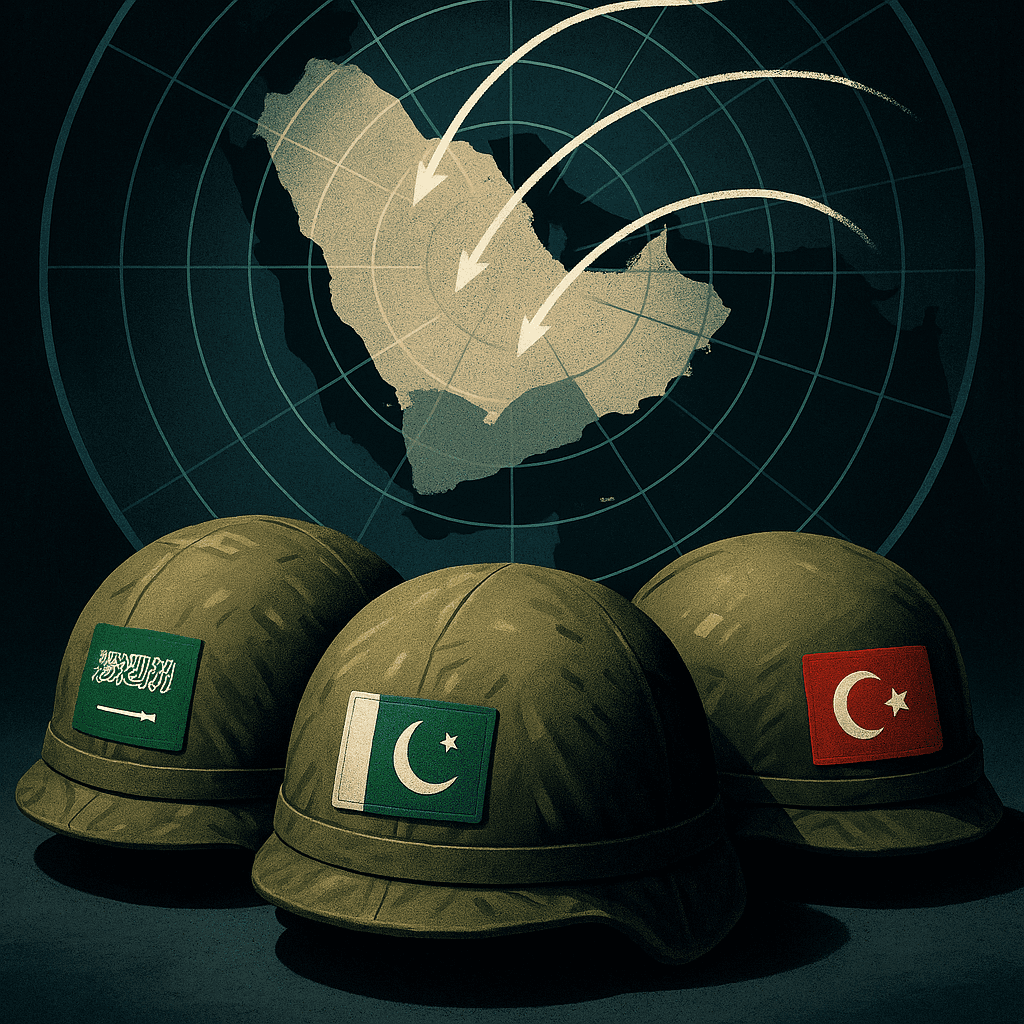
Through December 10, Houthis Won’t Damage Pakistan or Turkey Infrastructure
The Mecca Defense Pact just put two more flags on the Saudi firing chart. The consensus panic says this widens the war within weeks. The signal says the Houthis will talk big, hit Saudi and the sea, and leave Pakistan and Turkey’s hard targets alone for this 60 day window.
Comments
Be the first to comment.