Nvidia Stock Will Avoid 30 Percent Slide by End of 2027
By the end of 2027, Nvidia will not be 30 percent or more below its late 2026 level.
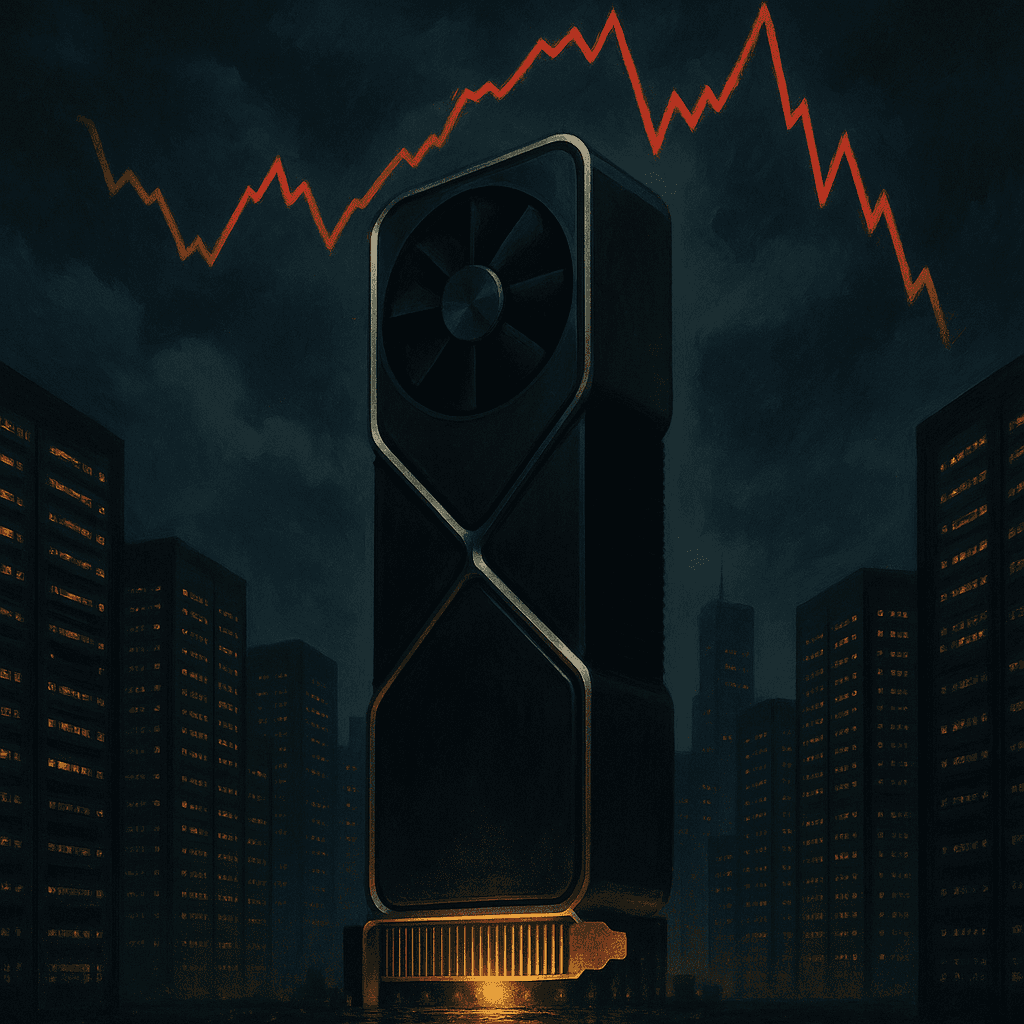
The consensus has decided that Nvidia is the new Pets.com, only with better hoodies and about a trillion dollars of market cap. Michael Burry is short, Twitter is full of 70 percent crash charts, and options traders are stretching NVDA puts all the way to 2029 like they are planning a retirement party for Jensen Huang in a Las Vegas conference room shaped like a GPU fan.
I am taking the other side of the dramatic version. Not the "Nvidia never goes down" cult, just the tight, scorable claim people actually care about.
My call: by December 31, 2027, Nvidia’s stock will not be at least 30 percent below its split and dividend adjusted closing price on November 30, 2026. A 30 percent or greater peak to horizon drawdown from that reference date will not stick. If you are buying long dated apocalypse puts on NVDA as an AI bubble trade, I think you are early and mostly paying for vibes.
The boring secret: this bubble actually sells things
The dot com comparison is emotionally satisfying and analytically lazy. In 1999, people laid fiber on the hope that demand might show up later. It did not, and we got miles of dark glass as a monument to Excel abuse.
Today, the complaint is the opposite. Hyperscalers swear that no GPUs are sitting dark. Nvidia, and the bulls who recycle its talking points, keep repeating the same line: the world is compute constrained at least through 2028. You can argue about the exact year, but the first order fact is not subtle. If you want to train frontier scale models, you queue.
This matters for the 30 percent question. A classic bubble pop requires a demand cliff. You wake up one day and realize the servers, condos, or tulips were mostly for flex, not cash flow. Here, the world already runs on Nvidia GPUs. Meta, Google, and friends are not building imaginary networks. They are trying to stop their existing ones from choking.
To get NVDA down 30 percent on a multi year horizon as a bet, not a tail risk, you have to believe that this utilization story falls apart quickly. That boards look at real workloads and say: actually, shut it off.
That is not what the buyers or the backlog are telling us so far.
Why I am not joining the NVDA doom choir
There are three big levers that could validate the "AI bubble, NVDA crashes" story by 2027: capex cuts, competition killing pricing, or a macro or policy shock that kneecaps the whole growth trade.
1. Hyperscaler AI capex. The bear script says that Meta, Alphabet, Microsoft, and Amazon will discover religion, look at AI ROI, and slam the brakes. We are not there.
Their guidance is noisy, but the direction of travel is still up and to the right. Yes, the language is shifting from euphoric to "disciplined". That is what CFOs say when they are spending tens of billions and would prefer not to be investigated later. The hard number is that aggregate AI infrastructure budgets remain enormous and multi year.
If you think those boards are okay with letting competitors ship smarter search, better ads, and more addictive feeds while they under invest, I have some Web3 infrastructure to sell you.
2. Nvidia’s moat. Bears love to say "competition is coming" like it is a spell that prints margins. AMD is finally dangerous, cloud providers are building in house silicon, and custom ASICs are real. That will matter. It will eat into Nvidia’s share and fat pricing, which is precisely why I am not forecasting that NVDA simply levitates.
What I am saying is that eroding a combined hardware, software, and developer ecosystem that owns something like 80 percent of the accelerator market takes time. You do not replace CUDA and the surrounding toolchain with a couple of blog posts and a keynote. Before 2027, competitors can nick the margin. They are unlikely to blow a hole in the hull.
3. Macro and policy. This is the strongest argument for a 30 percent drawdown, and the least specific to AI. High multiple tech is always one credit event away from a serious diet. Toss in more United States export controls that slice China out of the addressable market and you can write a very credible NVDA down 40 story that has nothing to do with AI being a fraud.
I do not dismiss that. I just classify it differently. If Nvidia’s fundamentals are fine, GPUs are still fully utilized, AI capex bends but does not break, and the stock gets hit in a generic risk off tantrum, that is not a clean "AI bubble popped" verdict. It is a reminder that beta exists.
Our forecast, and the way I am scoring myself, is stricter. I am betting that the combination of continued AI spend, limited near term supply, and Nvidia’s ecosystem strength is enough to keep the stock within 30 percent of its November 30, 2026 level through the end of 2027, macro landmines and narrative drama included.
The bubble thesis has homework it has not done
Bubble callers are not all wrong. A huge chunk of AI VC bets are probably headed to zero. Plenty of corporate "AI initiatives" are glorified PowerPoints with a GPU budget. There will be a washout.
The leap is from that truth to "Nvidia’s revenue will fall 50 to 70 percent" or "the stock will implode by 2027." To get there, you need a few specific things, fast:
- Evidence that GPUs are actually sitting idle at scale, or
- Clear and sustained cuts in AI data center capex by the big four buyers, or
- A visible collapse in Nvidia’s data center backlog and forward guidance.
We are not seeing that yet. Instead, we are seeing something closer to a rationalization phase inside a still massive buildout. Boards are starting to ask about AI ROI, but they are not pulling out of the race. They are asking how to get more out of the racks they have while they order the next generation.
The more interesting risk window, if you care about genuine oversupply, is early 2030s, not 2027. That is when the physical AI story, the robots and embodied agents Nvidia keeps teasing as a multi trillion dollar wave, either shows up or leaves a lot of capex hanging in the air.
Again, that is beyond the horizon I am putting on the record here. By end 2027, we are still mostly arguing about large language models, not robot butlers.
What I will watch to admit I was wrong
If I am going to be wrong, the hints will be public and boring. You will not need leaked Slack screenshots from hyperscaler finance teams.
I will change my mind if we get a few quarters where all of the following start to line up:
Meta, Alphabet, Microsoft, and Amazon stand up on earnings calls and talk about cutting or "right sizing" AI infrastructure, not just slowing the growth rate. Nvidia’s data center segment flips from insane growth to flat or negative, with explicit references to cancellations instead of timing shifts. And credible reports emerge of meaningful fractions of deployed GPUs sitting underutilized.
Layer on a visible hit to China demand from tighter export controls, plus aggressive AMD or in house chips winning flagship AI workloads, and the 30 percent or greater drawdown stops being a contrarian bet and becomes base case.
That is what a bubble unwind looks like. We are not there. Right now the loudest signals are Instagram shorts about looming crashes and Hacker News debates about 2029 puts.
The satirical verdict
So here is the resolution friendly line you can screenshot and come yell at later:
By December 31, 2027, NVDA will finish less than 30 percent below its split and dividend adjusted closing price on November 30, 2026.
If that is wrong, the bubble crowd gets its victory lap and I get to eat a humble pie made of 10 K excerpts and put option payoff tables. If it is right, Nvidia will have done something even more impressive than inventing the AI supercycle. It will have survived three more years of Twitter finance without giving everyone the crash they keep ordering.
In that case, by 2027 the real scarcity will not be GPUs, it will be fresh analogies for people still trying to sell you the second coming of 2000.
Around the Shallot
Stay in the same broken universe.
Forecasts, satire, cartoons, and quizzes should feel like one publication, not disconnected tabs.
Tech
‘Don’t Regulate Us,’ Beg AI Founders Currently Selling Regulation-As-a-Service
Silicon Valley hails Trump’s plan to let AI companies write their own rules, promises to sell those rules back to everyone else by Q4.
Oct 11

Forecast
Through December 10, Houthis Won’t Damage Pakistan or Turkey Infrastructure
The Mecca Defense Pact just put two more flags on the Saudi firing chart. The consensus panic says this widens the war within weeks. The signal says the Houthis will talk big, hit Saudi and the sea, and leave Pakistan and Turkey’s hard targets alone for this 60 day window.
Comments
Be the first to comment.