Nvidia Won’t Reach $350 Billion Trailing Revenue By August 31, 2027
Forecast: Nvidia will still be under $350 billion in trailing revenue by August 31, 2027.
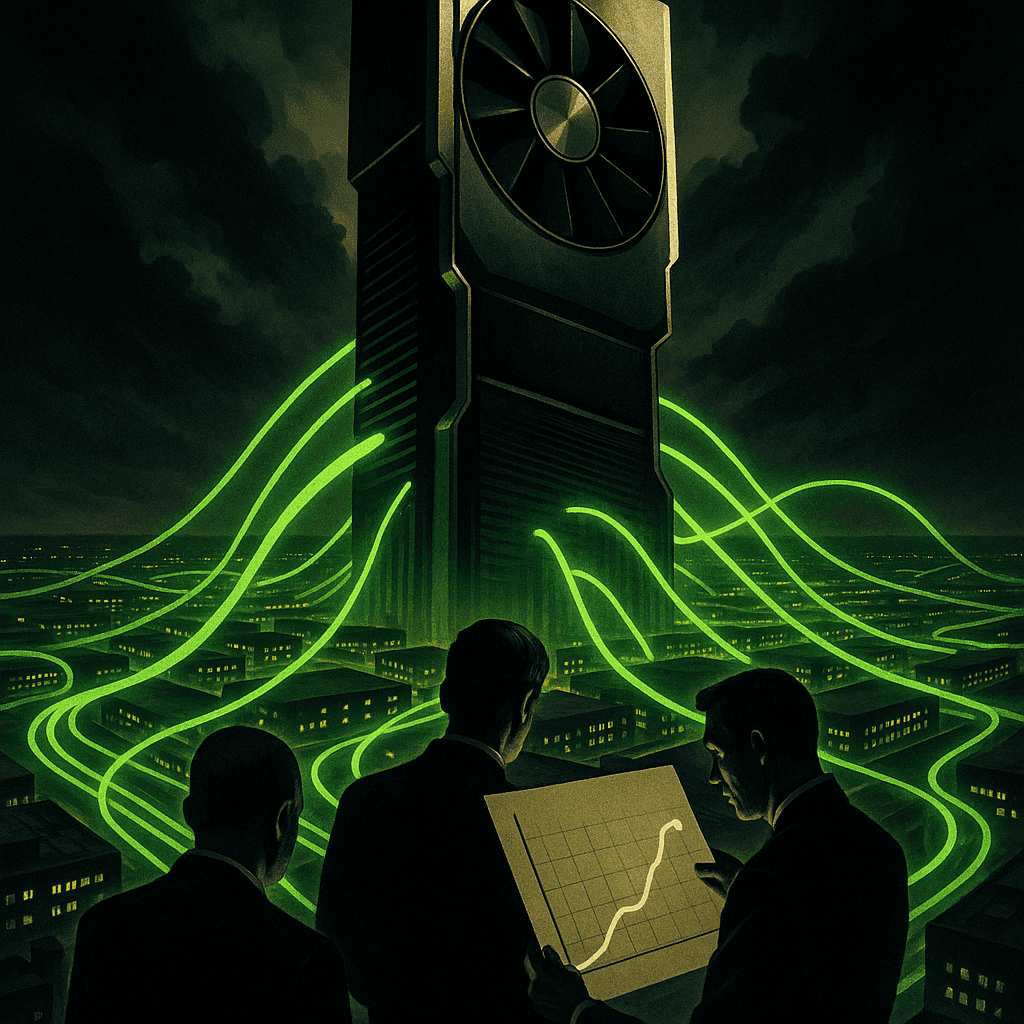
The Bet: Nvidia Will Miss the $350 Billion Mark
My call: by August 31, 2027, Nvidia will not be over $350 billion in trailing‑twelve‑month revenue.
This is not a call that Nvidia is going away. It is a bet against the idea that data centers will keep spending at today’s pace long enough for one chip vendor to jump from a roughly $400 billion one‑year forecast to a sustained $350 billion run rate a few quarters later.
The popular story is simple: AI keeps growing, Nvidia sells the shovels, and the growth curve never really cools. The numbers suggest something more ordinary: very strong growth that still falls short of the most aggressive forecasts.
The Path to $350 Billion Is Steep
Start with the scoreboard we actually have. Nvidia just posted roughly $96 billion in Q2 fiscal 2027 revenue, more than double a year ago, and guided to $108 billion next quarter. Data center sales alone, about $89 billion, now look like the GDP line of a medium‑sized country.
Management then surprised investors: roughly 70% revenue growth in fiscal 2028, on top of a Street consensus that already pegs fiscal 2027 (ending January 2027) around $396 billion. Some models now have Nvidia beating Apple and Alphabet on revenue and trailing just Amazon.
Our test is not “can Nvidia ever annualize above $350 billion” in a slide deck. It is: by August 31, 2027, do the last four reported quarters add up to more than $350 billion in actual revenue.
To clear that, two things both have to go right:
- Fiscal 2027 has to land very close to or above today’s aggressive estimates.
- The first half of fiscal 2028 has to be strong enough that, when you add those quarters to late 2026 and early 2027, the trailing sum breaks $350 billion by that August date.
It is possible. It just assumes AI spending stays near its current peak from a very elevated base, without a pause or reset.
The Driver Everyone Sees: An AI Capex Firehose
The bull story is easy to follow because the near‑term numbers are huge. Big Tech is on track to spend more than $730 billion on AI infrastructure this year, up from roughly $400 billion last year. Nvidia says its AI chip opportunity alone could top $1 trillion through 2027, double what it was pitching a year ago.
Nvidia is not just shipping GPUs either. It is selling full AI factories: racks, networking, software, services, plus financing so customers can treat it more like a long‑term service than a one‑time hardware binge. Colette Kress even highlighted a floor under future demand with a headline deal: 2 million more Nvidia GPUs inside AWS in 2027 and 2028.
Layer on supply constraints in high‑bandwidth memory and advanced packaging, and the story writes itself. Demand is far larger than supply, Nvidia keeps gross margins in the mid‑70s and only guides a modest dip toward 71 to 72% before stabilizing above 72%.
If you only focus on that firehose, $350 billion looks conservative.
The Friction Everyone Is Discounting
The problem is that Nvidia’s smooth growth curve assumes the buyers never slow down. They will.
First, hyperscalers are already talking about ROI, not just racks. Microsoft, Meta, Alphabet, Amazon and others have spent two years telling investors that AI will unlock new revenue lines. Now those same investors are asking when the AI line will look less like a collection of experiments and more like a stable business.
You can reassure shareholders with “trust the S‑curve” while revenue is doubling and stock prices cooperate. By 2026 and 2027, the focus shifts to utilization: how full those GPU clusters are and what they are billing against. When that becomes the main question, capex growth usually slows.
Second, Nvidia’s biggest customers are also its most motivated competitors. Microsoft has its Maia accelerators. Google has TPUs. Amazon promotes Trainium and Inferentia at every investor day. Meta has its own silicon projects.
These chips are no longer just slideware. They are shipping into internal workloads to avoid paying Nvidia premium pricing on everything. Even if customers keep using Nvidia for the cutting edge, a growing share of incremental AI spending will move to in‑house hardware where the margin stays inside the hyperscaler.
Third, supply is about to catch up just as demand gets more selective. Nvidia has $279 billion of upstream commitments to lock in components and memory. That helps solve today’s scarcity, but it also creates pressure to ship everything ordered, even if some customers later decide they went too far.
When the story shifts from “we are sold out” to “we can finally ship everything,” pricing power usually softens. Margins sag a bit more than planned, discounting becomes more common, and full AI systems start to get packaged and priced more like commoditized infrastructure. Revenue can still grow fast yet fall short of the most optimistic curves.
Finally, there is the policy wildcard. Nvidia is trying to become a de facto global AI utility at the same time regulators are rediscovering antitrust and national security concerns around compute. Export controls have already reduced some sales to China. An AI backlash or a more hawkish stance in Washington does not need to be severe to knock a few quarters off the ideal growth path by mid‑2027.
What Would Make This Call Wrong
There is a clear way for this forecast to miss. Nvidia needs two main breaks in its favor.
First, the hyperscalers must decide that overspending on AI is safer than slowing down. If Microsoft, Amazon, Alphabet and Meta all guide AI capex higher again through 2026 and early 2027, and they keep highlighting Nvidia as their primary partner, then the $350 billion barrier could fall sooner than I expect.
Second, in‑house accelerators have to underwhelm. If we see a stretch of updates where the biggest training and inference jobs stay on Nvidia because internal chips are too hard to program or too narrow in scope, Nvidia keeps its share for longer. Combine that with sovereign AI programs and industry‑specific AI factories ramping faster than modeled, and the math changes.
The signals to watch are public, which is why this is a forecast rather than a guess. Look for:
hyperscaler AI capex guidance over the next four to six earnings cycles, explicit multi‑year GPU deals beyond the AWS two‑million‑unit pact, and any evidence that major model training runs are shifting off Nvidia onto custom chips in bulk.
If those all tilt Nvidia’s way, this call will be wrong and Nvidia could be reporting more than $350 billion in trailing revenue before the summer of 2027 ends.
The Satirical Close: AI as a Utility, Investors as Ratepayers
Nvidia wants to be treated like a utility, an AI power company that keeps billing while the world electrifies itself with models. Traditional power utilities had regulators capping their returns and spreading costs across millions of households. Nvidia has a small group of hyperscalers, a trillion‑dollar wish list and shareholders who talk about exponential curves as if they are permanent.
So here is the satirical verdict. AI infrastructure probably does become a kind of utility. Nvidia probably is still the main tollbooth by 2027. But the idea that hyperscalers will keep spending at full throttle until Nvidia clears $350 billion in trailing revenue by August 31, 2027 sounds less like a forecast and more like a prompt typed into an AI model trained on stock‑forum threads.
Utilities, after all, are supposed to keep the lights on, not blind everyone in the room.
Around the Shallot
Stay in the same broken universe.
Forecasts, satire, cartoons, and quizzes should feel like one publication, not disconnected tabs.

Tech
‘Don’t Regulate Us,’ Beg AI Founders Currently Selling Regulation-As-a-Service
Silicon Valley hails Trump’s plan to let AI companies write their own rules, promises to sell those rules back to everyone else by Q4.
Oct 11

Forecast
Through December 10, Houthis Won’t Damage Pakistan or Turkey Infrastructure
The Mecca Defense Pact just put two more flags on the Saudi firing chart. The consensus panic says this widens the war within weeks. The signal says the Houthis will talk big, hit Saudi and the sea, and leave Pakistan and Turkey’s hard targets alone for this 60 day window.
Comments
Be the first to comment.