OpenAI Will Hit a $1 Trillion Valuation After Its IPO
My call: OpenAI will go public and tag $1 trillion by the end of 2027. The harder part starts the second tick above that line.
The $1.4 Trillion Question
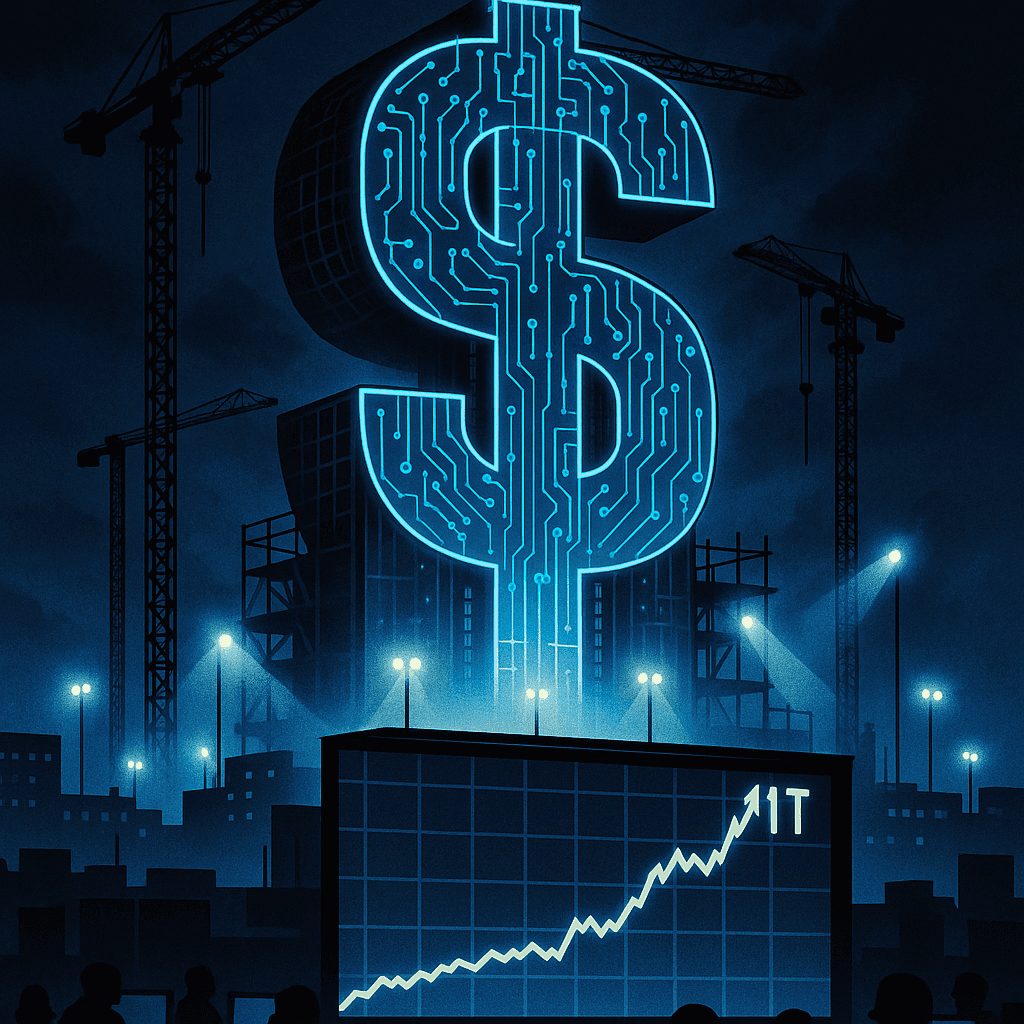
OpenAI is about to ask public markets a wonderfully rude question: will you pay a trillion dollars today for the right to fund $1.4 trillion of my problems tomorrow?
The consensus answer is a nervous shrug. The signal points to yes.
My call: by December 31, 2027, OpenAI will have gone public in the U.S. and its fully diluted market cap will have printed at or above $1 trillion at least once. It might close below, it might round trip spectacularly, but there will be a chart somewhere with a little spike that makes the number true.
This is not a bet that the valuation is sane. It is a bet that sanity is a lagging indicator in AI markets.
The Setup: Already Playing in the Boss Level
Start with the boring part: OpenAI is not approaching public markets like a normal IPO candidate. It is already priced like a mega cap in waiting. The March round that raised $122 billion put the private mark at roughly $852 billion. Goldman and Morgan Stanley are circling a confidential S1 that whispers the phrase "around one trillion" the way real estate agents say "school district." It is a tell, not a wish.
The revenue story is the part of the pitch that actually clears the bar. OpenAI hit a $25 billion run rate in February 2026, up from $20 billion just a couple of months earlier. Sam Altman is saying the quiet plan out loud: $100 billion annualized revenue by 2027. The reported growth rate is roughly four times what Alphabet or Meta managed at comparable scale.
Oh, and the company is already cash flow positive. Not free cash flow happy, but not venture subsidized either. For a firm that buys compute the way some people buy sneakers, that is not trivial.
Put differently, OpenAI is walking onto the trading floor with megacap numbers, top of cycle hype, and a cap table that already includes Microsoft, Amazon, NVIDIA, SoftBank, and a $3 billion dress rehearsal with retail investors. This is not a fragile little tech IPO. This is a pre sold blockbuster.
The Spend: Building a Money Furnace on Purpose
Now the part markets pretend to think deeply about: the cost. OpenAI wants to direct roughly $1.4 trillion into compute, data centers, chips, and talent. Stargate, the headline megaproject, is less a data center and more a civilization scale energy drink.
A lot of this spend does not sit neatly on OpenAI’s own balance sheet. That is where the ecosystem comes in. Look at SB Energy, SoftBank’s AI centric data center and power play. It is preparing a U.S. listing around a rumored $50 billion valuation on the promise of about $439 billion in future AI linked revenue, heavily orbited around OpenAI. The catch: no operational data centers yet.
This is the pattern. The AI trade is no longer just models and subscriptions. It is long dated infrastructure IOUs with software narratives stapled on top. Investors are being asked to treat multi decade capex as a moat, not as a margin leak.
In the short window that matters for this forecast, that framing helps rather than hurts. If markets are willing to value SB Energy’s notional pipeline before a single server turns on, they can certainly give OpenAI a speculative surcharge for actually having users.
The Drivers: Why $1 Trillion Is More Floor Than Ceiling
To get this bet right, three things have to line up.
First, OpenAI needs to hit the public tape by late 2027. That risk is real, but the confidential filing, the banking lineup, and the sheer weight of sunk capital from Microsoft, Amazon, NVIDIA, and SoftBank all argue against an indefinite delay. If regulators or governance fights were going to freeze this, the leaks would be louder.
Second, the numbers in the S1 must be impressive enough that investors feel dumb betting against them. At $25 billion run rate already, OpenAI does not need miracles. It needs to show that growth is still fast, that gross margins exist above the chip bill, and that the path to $100 billion revenue is a slope, not a leap of faith.
Third, AI has to stay a core market narrative. That does not require permanent euphoria. It only requires that the list of companies allowed to touch the trillion dollar club remains basically the same: Apple, Microsoft, Alphabet, Amazon, Meta, NVIDIA, and perhaps one more special guest star that literally sells the AI brain to everyone else.
Public markets are not shy about trillion dollar tags anymore. They are treated as a badge of strategic indispensability: you run the cloud, you run the phones, you print the chips, you get a T in your market cap. OpenAI’s pitch is simple: we run the models that make the rest of you look smart.
Once that pitch is live in an order book, there are too many ways to get a single $1T print: a hot IPO that prices below the whisper then rips, a speculative 2027 AI relief rally, or a short squeeze when someone loudly declares peak hype on CNBC. The number only has to happen once.
The Risks: Gravity Has Lawyers
The bear case is not subtle.
If the S1 exposes brutal unit economics, with Microsoft and NVIDIA quietly taking most of the profit pool through cloud and chip pricing, investors may decide OpenAI is just clever middleware for other people’s margins. The nonprofit / capped profit governance labyrinth could spook big index funds that prefer their megacaps without philosophical footnotes.
A macro shock or an AI backlash would also hurt. If regulators lean in with hard rules on safety, IP, or competition, or if a spectacular misuse incident turns into the AI version of the mortgage crisis documentary, the sector’s multiples will reprice much faster than GPU lead times.
There is also a non zero chance the whole story takes a detour: a deeper integration with Microsoft, a structural merger, or a regulatory block that keeps OpenAI from listing as a clean standalone. In my scoring, that still counts as a miss.
These are credible threats to durability. They are less effective against a narrow question like "will the stock kiss $1 trillion once in its first year or so as a public name." The market is perfectly capable of overpaying before it overthinks.
The Satirical Fine Print
The real tension in this IPO is not whether OpenAI can hit $1 trillion. It is whether public investors are being cast as partners in a new computing era or as co signers on the world’s biggest cloud bill.
My money, figuratively, is on at least one glorious $1T screenshot by the end of 2027, followed by a long argument over who actually keeps the profits: the model builder, the chip maker, the cloud landlord, or the regulators with the red pen.
OpenAI will probably get its trillion. The open question is whether shareholders are buying into artificial intelligence or very real depreciation.
Around the Shallot
Stay in the same broken universe.
Forecasts, satire, cartoons, and quizzes should feel like one publication, not disconnected tabs.
Tech
‘Don’t Regulate Us,’ Beg AI Founders Currently Selling Regulation-As-a-Service
Silicon Valley hails Trump’s plan to let AI companies write their own rules, promises to sell those rules back to everyone else by Q4.
Oct 11

Forecast
Through December 10, Houthis Won’t Damage Pakistan or Turkey Infrastructure
The Mecca Defense Pact just put two more flags on the Saudi firing chart. The consensus panic says this widens the war within weeks. The signal says the Houthis will talk big, hit Saudi and the sea, and leave Pakistan and Turkey’s hard targets alone for this 60 day window.
Comments
Be the first to comment.