Saudi Arabia Won't Invade Houthi Yemen With a Brigade by 2026
My call: Riyadh stops at the waterline.

My call: Saudi tanks stay home
The consensus says the US–Iran war drags Saudi Arabia back into Yemen, this time with a ground offensive to "finish the job" against the Houthis. The signal says Riyadh will hug the shoreline, not march on Sana'a, and will keep the tanks where they belong: posing in front of Expo renderings instead of Hodeidah roundabouts.
Here is the bet you can score: by November 30, 2026, Saudi Arabia will not have launched a Saudi‑led ground offensive into Houthi‑held Yemen that puts at least one reinforced brigade of Saudi regulars across the border or on a Yemeni beach for a week or more of overt combat.
There may be more airstrikes, more naval escorts, some special forces tourism, and plenty of leaked PowerPoints about decisive corridors. What you will not see is a visible, brigade‑scale Saudi ground campaign that looks anything like a sequel to the last quagmire, complete with press tours of freshly rebranded "stability zones" and limited time offers on reconstruction contracts.
The push: why everyone thinks Riyadh is going in
You do not have to squint to see why the invasion talk is back. The US–Iran war has spilled into every available theater, and the Houthis have read the memo.
They are again hitting Saudi‑linked shipping, threatening a blockade on Saudi vessels in the Red Sea and Bab al Mandab, and taking potshots at crude infrastructure. That is not just a regional nuisance, it is the artery that funds Vision‑style fantasy renders of Neom ski slopes and Red Sea resorts with more palm trees than residents.
Riyadh has already moved up the escalation ladder. It joined US strikes on Iranian‑aligned militias in Iraq. It resumed strikes on Houthi targets in Yemen. It is assembling something that looks a lot like a naval coalition to keep tankers moving. Yemeni sources tell reporters the kingdom is "preparing for a major offensive by sea and possibly by land" and note Saudi forces pulling back from eastern Yemen in ways that look like pre‑deployment.
From a distance, this lines up neatly: proxies attack Saudi exports, the US and Israel want Iran's network degraded without sending their own infantry, and the kingdom supplies the ground troops in Yemen in exchange for cover and hardware. Neater still if you forget the last decade.
The drag: Yemen is bad for business
The main thing restraining Riyadh is not sudden pacifism. It is math. Political, military, and financial math that all point in the same direction: avoid another land war in Yemen if at all possible.
The previous campaign produced years of bombing headlines, enormous civilian casualties, disease, famine, and a reputation that still haunts Saudi diplomacy. It also produced no decisive victory. The Houthis kept territory, kept missiles, and graduated from local insurgency to regional spoiler.
In the meantime, Mohammed bin Salman has rewritten the country's story around Vision‑style transformation. The pitch to investors is simple: Saudi Arabia is not just an oil state, it is a giga‑project theme park with reliable security and smooth shipping lanes. A televised ground war in Yemen, complete with mass displacement and messy urban fighting, shreds that narrative faster than any Houthi drone.
That is why the same crown prince who is green‑lighting joint strikes with the US is also on the phone to foreign leaders stressing the need to "prioritise dialogue" with Iran. He is not auditioning for a peace prize. He is trying to keep Iranian retaliation away from Gulf energy infrastructure and his own development schedule, which already assumes the cranes will be lifting hotels, not howitzers.
If your core product is stability, you do not casually re‑enter the one theater that already proved it can eat your budget, your international standing, and your calendar.
The alternative: bombs, boats, and borrowed boots
There is a cheaper, cleaner menu of escalation, and Riyadh is already ordering from it.
First, air and missile power. Expect more Saudi airstrikes on launch sites, depots, and command nodes, perhaps with US and Israeli intelligence and targeting support quietly stitched in. This satisfies the demand to "hit back" without parking thousands of Saudi soldiers in Houthi territory.
Second, maritime muscle. A Saudi‑led or US‑blessed naval coalition can escort tankers, intercept weapons shipments, and carry out limited strikes along the coast. This is lower risk than holding ground inland and is much easier to sell as defensive: protecting global shipping, not invading Yemen.
Third, proxies. Riyadh has spent years cultivating Yemeni partners who can operate on their own soil. None are perfect, all are fragmented, but they are still a more politically bearable option than another column of Saudi armor broadcasting its coordinates to every satellite, journalist, and militia propagandist in the region.
Even if there are cross‑border raids, special forces missions, or brief pushes to secure specific launch corridors, those are still a far cry from the scenario in the public imagination: a Saudi brigade or two driving deep into Houthi‑held zones and staying long enough to own the mess.
What would flip this call
This forecast is not a vibe, it is a conditional bet. Here is what would put it in danger.
If the Houthis manage a spectacular hit, think a disabled major export terminal or a Saudi tanker sunk on live video, the political demand for a visible, punishing response could overwhelm caution. A leader who has built his brand on decisive action is not immune to that pressure.
If Washington and Jerusalem decide Yemen is the most convenient arena for crushing an Iranian proxy, they could sweeten the offer for Riyadh: more guarantees, more weapons, more intelligence. The quiet subtext would be simple, you handle the mud while we handle the satellites.
Or if all the in‑between options fail. If the naval coalition cannot stop a steady bleeding of shipping and premiums, if defensive systems cannot keep critical infrastructure safe, and if Yemeni partners look too weak or divided, the argument for "taking and holding" specific ground, especially coastal strips, will grow louder in Saudi circles.
The key signals to watch are not op‑eds about resolve. They are satellite images of armor and logistics hubs building up near the border, Saudi media shifting from "protecting shipping" to "liberating areas," and credible reporting of US or Israeli support tailored to ground maneuver, like amphibious exercises or bridging kit quietly appearing near embarkation ports.
If you see all of that and then you see Saudi troops crossing into Houthi‑held Yemen in the thousands and staying for more than a week, this forecast is toast, and you can quote this line while it burns.
The stakes: oil, optics, and ownership of the war
The choice in front of Riyadh is not between war and peace. That ship sailed when the first drones went up. The choice is between contained, mostly remote participation in a region‑wide confrontation and fully owning a ground war that everyone else is happy to subcontract.
Investors, shippers, and governments all want the same narrow thing: enough stability along the Red Sea and Bab al Mandab to keep oil flowing and prices predictable. That goal does not require a Saudi ground incursion. In fact, it is probably safer without one.
So the forecast stands: more smoke on the horizon, more frigates in the strait, more precise destruction of anonymous warehouses. No Saudi brigade planting a flag in Hodeidah by November 30, 2026.
In a region that treats history as a list of sequels, Riyadh looks ready to try something radical: learning from the first Yemen war by refusing to buy a ticket to the second.
Around the Shallot
Stay in the same broken universe.
Forecasts, satire, cartoons, and quizzes should feel like one publication, not disconnected tabs.

Tech
‘Don’t Regulate Us,’ Beg AI Founders Currently Selling Regulation-As-a-Service
Silicon Valley hails Trump’s plan to let AI companies write their own rules, promises to sell those rules back to everyone else by Q4.
Oct 11
Forecast
Through December 10, Houthis Won’t Damage Pakistan or Turkey Infrastructure
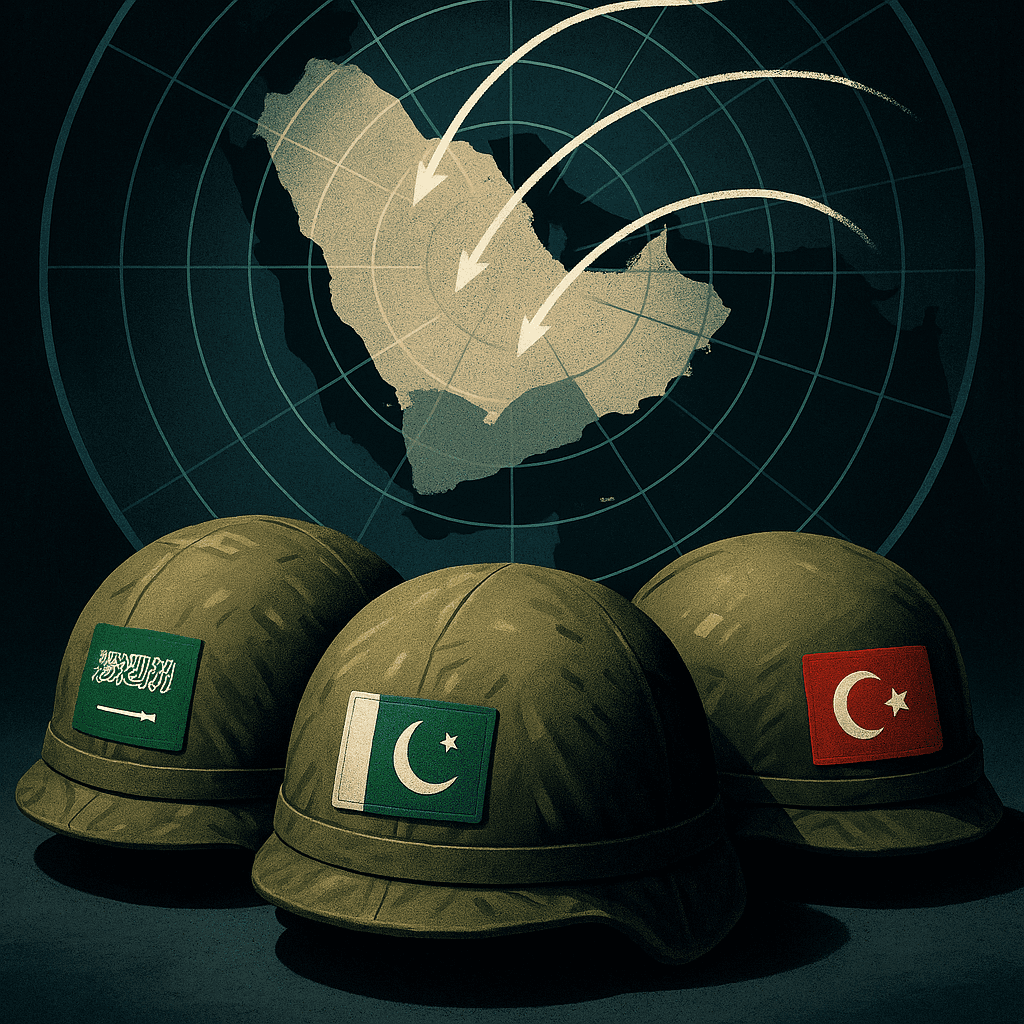
The Mecca Defense Pact just put two more flags on the Saudi firing chart. The consensus panic says this widens the war within weeks. The signal says the Houthis will talk big, hit Saudi and the sea, and leave Pakistan and Turkey’s hard targets alone for this 60 day window.
Comments
Be the first to comment.