USTA Will Keep 2027 Influencer Headcount, Add New Conduct Rules
My call: the USTA keeps its army of creators for 2027 and slaps on a no-ring-light, no-clout-during-play code of conduct instead.
The point where the match stopped for content
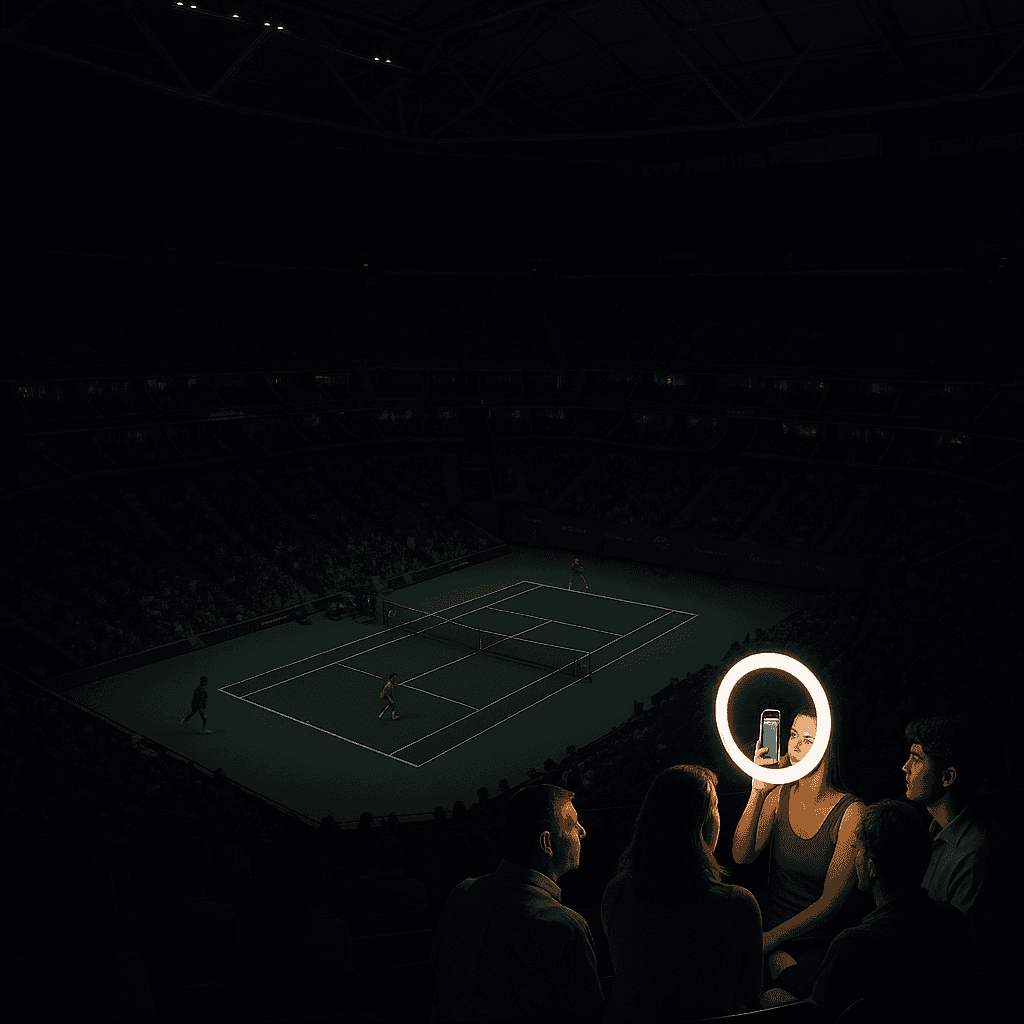
Play did not stop because of a bad call, or a medical timeout, or even a rogue fan streaking across Arthur Ashe. It stopped for a ring light.
Naomi Osaka was in a second set service game when a pod of influencers in primo seats started loudly filming, ring light blazing, like Ashe was a step and repeat that occasionally coughed up a forehand winner. Chair umpire Kader Nouni halted the match to tell them, in effect, to stop auditioning for TikTok and let Osaka serve.
Within hours, the clip was everywhere. Comment threads crowned it “the cringiest thing I have ever seen” and rebranded the US Open as an “influencer circus.” Jessica Pegula called the antics disrespectful. The sport that built an identity on hush fell silent for a new reason: embarrassment.
Now the question is simple enough to bet on. Do tournaments pull the plug on the influencer experiment, or do they tape a fresh rule sheet to the ring light and keep filming?
The call: fewer ring lights, not fewer influencers
Through January 15, 2027, the USTA will not reduce its influencer and content creator credentials below roughly 100 for the 2027 US Open. Instead, it will announce at least one specific new rule aimed at creator behavior or equipment, for example a written ban on ring lights in competition courts or filming during points.
In forecast terms, this is a quantity versus conduct bet. The number of creators stays at the new normal, the way they act in the stadium changes.
Follow the money, not the mentions
To understand why the number will not go down, look at what the USTA just did on purpose.
In 2025, the US Open issued 54 creator credentials, its first formal play for influencers. This year it pushed close to 100. That is not a rounding error, it is a strategy. You do not nearly double a program one year then shrink it the moment it finally breaks through into mainstream outrage. You claim victory and tighten guardrails.
UTA media operations director Jeanmarie Daly is already laying the rhetorical groundwork. She told Front Office Sports that she would not want blanket backlash to hinder access, especially for creators not even tied to sports. Translation: the institution thinks influencers are good for the brand, and this storm is about a few clowns, not the circus tent.
Credentialed creator Justin Morelli is humming the same tune. He says the reaction is blown a little out of proportion compared to streakers and drunk fans, and that most creators do good things for the game. If you are inside the program, that is exactly the narrative you want the USTA to buy: we are a growth channel, not a threat vector.
From the tournament’s perspective, the math is obvious. Influencers extend the Open beyond ESPN’s aging demo, into TikTok, Instagram Reels, and whatever short form app is currently eating teenagers’ attention spans. They juice sponsors and luxury suites. They give the USTA something to show partners who ask, “What is our social strategy, again?”
The incremental reach is fuzzy, but the decks and dashboards are already written. You do not walk that back because tennis Twitter had a righteous week.
The part the USTA cannot ignore
What the USTA cannot shrug off is that this was not just rowdy fans. The chair umpire literally stopped a Naomi Osaka match because content was too loud. Pegula and others framed it as a workplace issue, not just a vibe check. That is a threshold moment.
Once player focus enters the chat, tournament organizers have to show they did something structurally different, not just post a Notes app apology about respect for the game. Hence the incoming rulebook.
There is already a blueprint in the wild. Commentators and fans are calling for influencer etiquette rules 101. Media people are floating policy contours for free:
- No ring lights in the stands.
- No filming during points on show courts.
- Creator seating that does not sit on top of the baseline.
This is the path of least resistance. It lets the USTA tell players, “We heard you, here is the code of conduct.” It tells fans, “The circus has a noise curfew now.” And it tells sponsors, “Relax, we are not cutting your social reach, we are just banning portable suns during match point.”
Look at other sports. F1 has been hosting lifestyle influencers in paddocks and suites for years. Traditional fans hate it, but the series handled the friction with etiquette tweaks and controlled access, not a mass influencer exodus. Big events adjust decorum before they adjust dashboards.
The cap fantasy versus the code of conduct reality
There is a satisfying simplicity to the cap the influencers demand. Imagine the press release: “We heard you. Only 25 creators next year, all hardcore tennis people.” It would trend. It would also undercut everything the USTA has been selling partners about the modern, social first Open.
To get a real numeric rollback, you would need one of three things. A sponsor or broadcaster privately screaming that the influencer circus is tarnishing their premium brand. A player council moving from quotes to formal demands, tying influencer access to participation. Or a second, worse incident, ideally in a semifinal, that makes the Open look operationally incompetent, not just tacky.
We are not there yet. This Osaka moment is a warning shot, not a mutiny. Fan frustration is loud, but diffuse. Sponsors are still enjoying the selfie wall. The tournament is on the defensive, but not panicking.
The forecast that fits the incentives is narrower. Creator numbers stay at roughly 100, maybe edge up with some rebranding of categories, and the USTA publishes something concrete enough to point to later: no ring lights in stadium seating, no filming while the ball is in play, a clear warning and revocation process for credentials. Probably living in a media and creators handbook, maybe even in a cute explainer video titled “How not to get shushed by Kader Nouni.”
This is also how you know it will happen: it is cheap. Writing rules costs nothing. Enforcing a few obvious ones costs a little bit of staff time and the loss of the most chaotic creators, who will immediately convert their bans into follow bait.
How to score the bet
For the prediction desk, the resolution bar here is clear.
By January 15, 2027, we should see two things. First, that the official 2027 content creator or influencer credential count is not lower than the approximately 100 that the USTA issued this year. If they rename the category but hold the headcount, that still counts as a hold. A hard cap below that line breaks this call.
Second, we should see at least one new, explicit restriction for credentialed creators in public facing materials, applications, or media guides. Not a vague plea for respect, but rule language you can quote: no ring lights, no recording during live points on show courts, a stated sanction for violations, or similar.
If the USTA quietly scolds creators in private briefings and keeps the rulebook mushy in public, the new rule part of this forecast fails, even if enforcement gets tougher in practice. Prediction only counts what the outside world can see.
The Open that wanted vibes and got a union grievance
So yes, the US Open will get stricter. There will be etiquette PDFs, maybe a training module, probably a ring light ban that should have been common sense in the first place.
What it will not do is admit that its influencer experiment was a mistake. It will argue that the problem was not too many creators, just a few who treated a Grand Slam like a brunch backdrop.
Sports used to stop play for rain, darkness, and the occasional pigeon. The 2026 US Open may be remembered as the year it also stopped for content. The fix, in the USTA’s mind, is not fewer influencers.
It is making sure that the next time Naomi Osaka is about to serve, the only ring anyone sees at the US Open is the one she is trying to win.
Around the Shallot
Stay in the same broken universe.
Forecasts, satire, cartoons, and quizzes should feel like one publication, not disconnected tabs.
Tech
‘Don’t Regulate Us,’ Beg AI Founders Currently Selling Regulation-As-a-Service
Silicon Valley hails Trump’s plan to let AI companies write their own rules, promises to sell those rules back to everyone else by Q4.
Oct 11
Forecast
Through December 10, Houthis Won’t Damage Pakistan or Turkey Infrastructure
The Mecca Defense Pact just put two more flags on the Saudi firing chart. The consensus panic says this widens the war within weeks. The signal says the Houthis will talk big, hit Saudi and the sea, and leave Pakistan and Turkey’s hard targets alone for this 60 day window.
Comments
Be the first to comment.