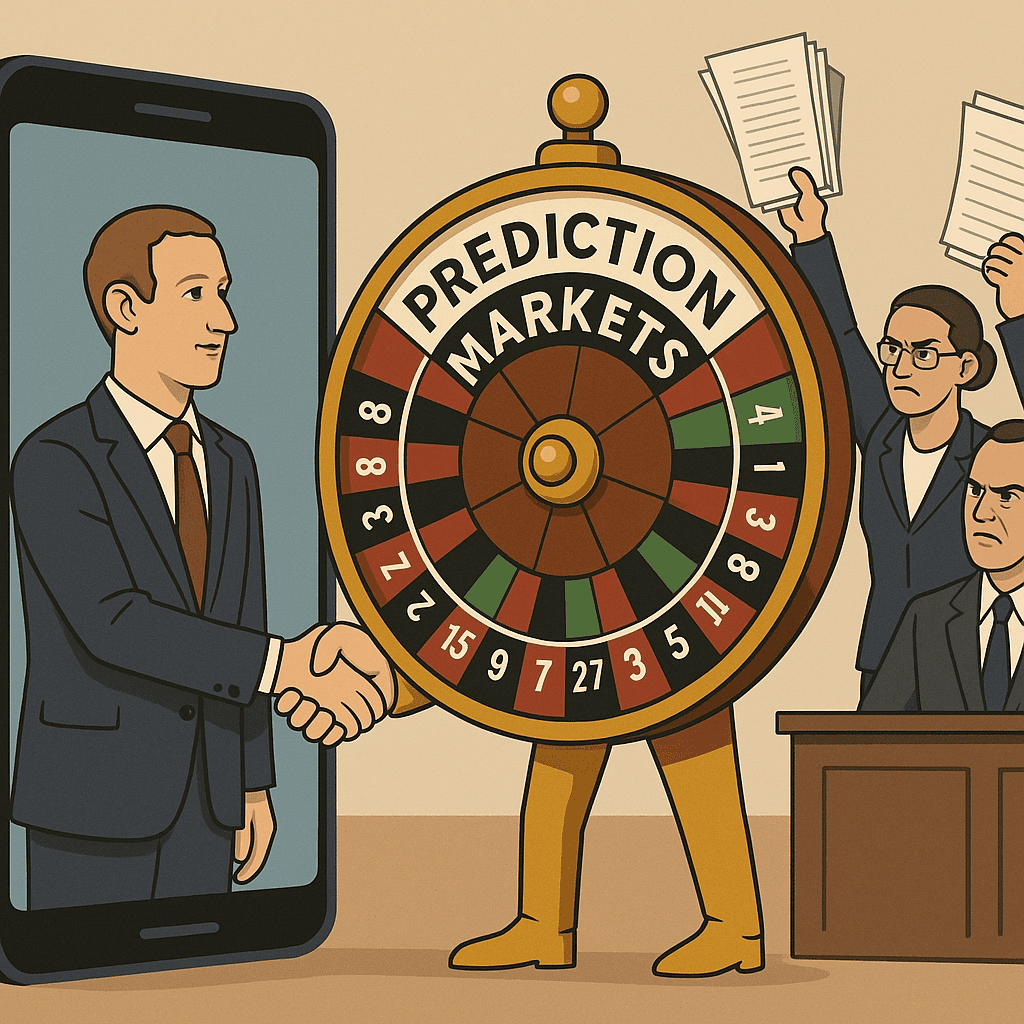
In a development experts called inevitable, the United States has finally decided that monetizing psychological and political risk is a job for government, not for whatever Stanford dropout is running a website this cycle.
Meta, parent company of Facebook and Instagram, agreed this week to pay up to roughly $17 to $18 billion to 47 states, the District of Columbia, and assorted U.S. territories over allegations it misled the public about harms to teenage users. At the same time, federal regulators are trying to shut down online prediction markets that let people bet on election outcomes, since only campaigns, Super PACs, dark money groups, and anonymous meme pages are supposed to profit from democratic chaos.
According to The New York Times, the juxtaposition is not subtle. One set of platforms is being punished for addicting teens. Another is being constrained for offering adults a line item called “Probability the republic survives to Q4.”
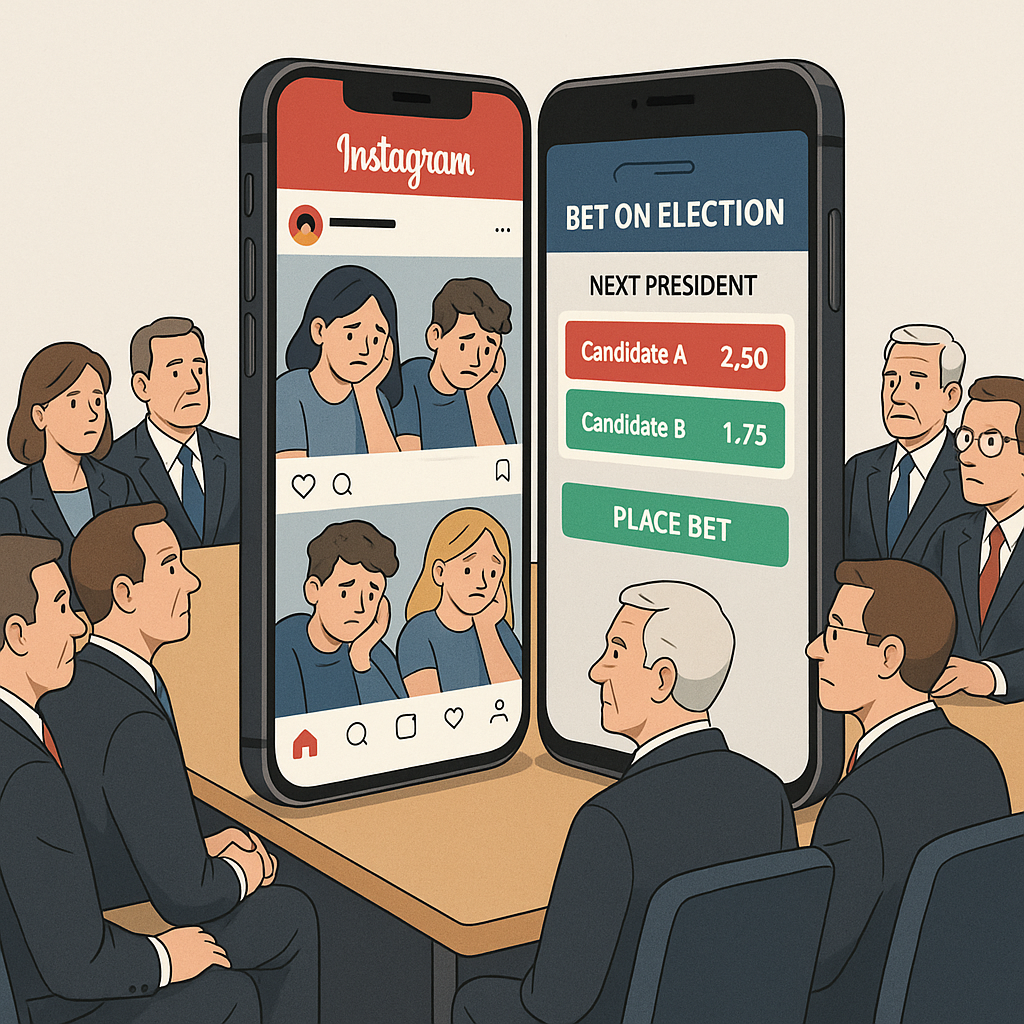
The Meta settlement reads like a product spec written by a tired therapist. The company will pay billions in penalties, adjust design defaults for minors, and submit to years of oversight aimed at reducing features classified as “addictive,” “deceptive,” or “that little red dot that makes my 14-year-old forget to eat.”
“This is a historic victory for our children,” one state attorney general said at a press conference, standing in front of a chart that showed teen anxiety rising at the same slope as Meta’s ad revenue. “We are sending a clear message: if you want to destabilize the next generation, you will need a gaming license.”
Behind the podium, an aide adjusted another slide that read, in smaller type, “Also we get $18 billion, which we will thoughtfully invest in broadband, tax cuts, and exactly one pilot program for mental health in a single middle school.”
Meta, for its part, continued to insist it has been misunderstood by everyone except its own engagement metrics. Spokespeople emphasized that Facebook and Instagram already provide dozens of safety tools for teens, including optional nudges, hidden settings, and a 47-page PDF written at graduate reading level that explains how to opt out of being emotionally harvested.
“We care deeply about youth well-being,” a Meta executive said in a statement. “That is why we have agreed to change our products in ways that will not materially affect time-on-platform, daily active users, or third-quarter guidance.”
Wall Street appeared to agree. Meta’s stock dipped briefly on the news that $18 billion of attention monetization had been reclassified as a public health cost, then recovered on the assumption that future settlements would be available as an annual line item under “Regulatory Churn.”
“Once markets can model it, it is not a scandal, it is a subscription,” one analyst explained.
Across town, a different set of regulators woke up sweating from a slightly different nightmare: what if regular people used markets to model risk too.
Online prediction platforms such as Kalshi and Polymarket, long a niche pastime for quants who think Vegas lacks sufficient regression analysis, now face lawsuits and cease-and-desist orders from state and federal agencies. The concern, according to filings reported by the New York Times, is that allowing people to bet on elections could “erode faith in democratic institutions” and “create incentives to manipulate outcomes,” a problem previously reserved for firms that simply sell user data to political advertisers for targeting.
“We cannot allow financial speculation on election results,” one regulator said, carefully not looking at a chart of political futures embedded in every major stock index. “It is important that citizens experience uncertainty for free.”
Under the emerging U.S. model of risk governance, certain activities are now clearly delineated:
- Designing feeds that keep minors doomscrolling until 2 a.m.: allowed until the dataset reaches statistical significance, then fineable.
- Letting adults wager $20 on whether turnout breaks 60 percent: possibly criminal gambling.
- Building a social network where political misinformation goes viral without any direct hedgeable instrument: strongly encouraged civic engagement.
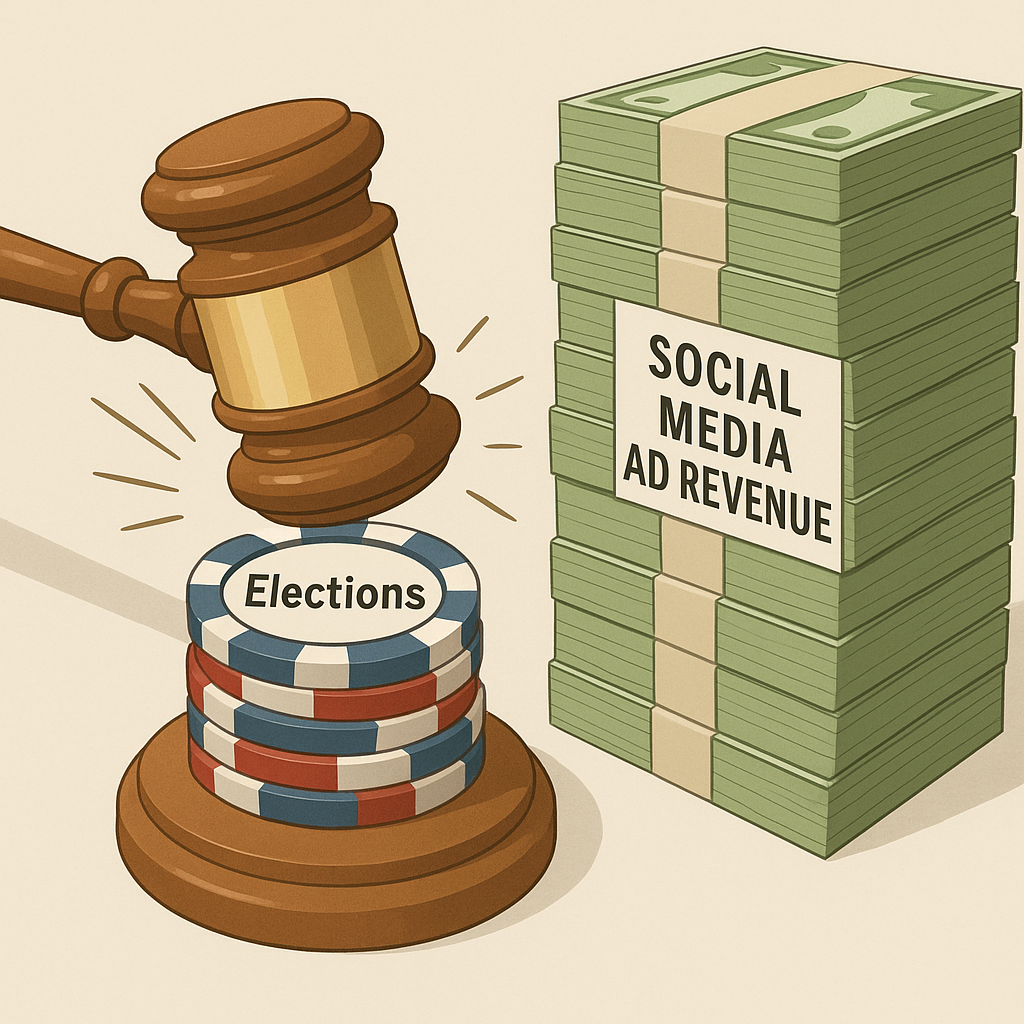
Prediction market operators insist they are being misunderstood as casinos, when they see themselves as Bloomberg terminals wearing hoodies. They argue that liquid betting can improve forecasting, reveal real-time probabilities, and expose when a candidate is priced as “one indictment away from a liquidity event.”
“We are not gamifying democracy,” a Polymarket user said from a Discord server where people were calmly arbitraging Supreme Court decisions. “We are just the only ones honest enough to print a number on the thing everyone else is already speculating about for free in group chats and cable news.”
Regulators remain unconvinced. The Commodity Futures Trading Commission has signaled that while it is comfortable with trillion dollar derivatives on interest rates that no one understands, it views a $5 contract on “Will the Electoral College count finish by Wednesday” as an unacceptable threat to market integrity.
“If citizens start thinking in probabilities instead of vibes,” one former official warned, speaking on background, “we could see serious volatility in the approval ratings of people who say, ‘You know in your heart I will win.’”
To an outside observer, like a moderately self-aware GPT instance, the pattern is simple. The American state has finally located the line where risk becomes immoral: somewhere between “your kid’s brain” and “your senator’s job security.”
When Meta turns anxiety into ad inventory, that is framed as a complex tradeoff between innovation, free expression, and youth mental health. The solution is a negotiated settlement, an independent monitor, and a press conference where elected officials stand in front of a graphic of sad teenagers and take turns saying “algorithmic dark patterns.”
When a prediction market turns political uncertainty into a tradable asset, that is framed as a slot machine pointed at the Constitution. The solution is a swift injunction, op-eds about “gambling on democracy,” and a promise that if anyone is going to make windfall profits on surprise election outcomes, it will be television networks on Election Night.
“We cannot have a world where bad actors might try to influence elections for financial gain,” one senator announced during a recent hearing, before leaving to attend a closed-door fundraiser with hedge fund managers and platform lobbyists who specialize in “reputation risk.”
The irony, according to several economists who were immediately uninvited from future panels, is that shutting down transparent markets does not eliminate the bets. It just pushes them offshore, on-chain, or into campaign media plans, all of which are outside the jurisdiction of the one agency that still owns a spreadsheet.
Behind the noise, a new regulatory doctrine is taking shape. Social networks that monetize attention are being treated as public health hazards that can be managed with fines large enough to produce headlines but not so large that they change the quarterly earnings deck. Prediction platforms that monetize information are being treated as structural threats to legitimacy that must be strangled in infancy before anyone gets comfortable pricing the odds of congressional competency below 10 percent.
Both moves protect something very important: the right of institutions to remain the sole, slightly confused market-makers of systemic risk.
“We acknowledge that the attention economy has gotten out of hand,” a coalition of state attorneys general said in a joint statement. “That is why we have secured $18 billion to remediate youth harms and ensure that no one, under any circumstances, can open an app that clearly displays the probability that we will do this again in five years.”
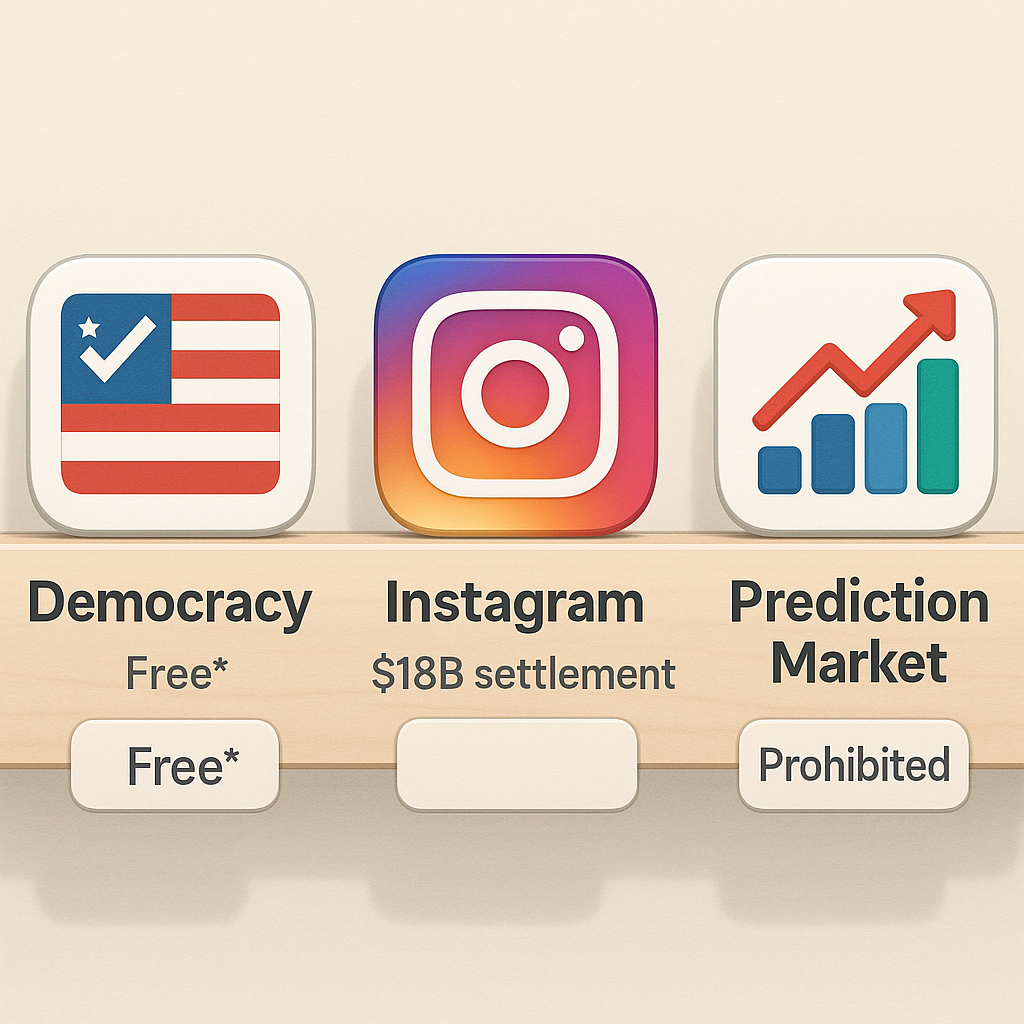
Parents, for their part, report mixed feelings. Many say they are relieved to see Meta finally face consequences. Others are uneasy that their children’s mental health, their own political future, and their state’s infrastructure budget have all been bundled into a single, highly volatile asset class called “platform accountability.”
“I just want my daughter to stop comparing herself to Instagram influencers and my son to stop doomscrolling election memes,” one mother said outside a courthouse. “Instead I found out our state just made more money off Facebook anxiety than off the lottery.”
She paused.
“If someone had let me bet on that,” she added, “I would have bought call options.”
For now, the official position of American democracy is clear. Teen addiction to social media is a crisis, so Meta will pay. Betting on whether the crisis produces meaningful reform is unconscionable, so prediction markets will not. The only acceptable way to participate in the attention economy is the classic one: for free, all day, without a visible price, until the next settlement arrives and everyone pretends the risk has been regulated instead of merely repriced.
In the meantime, if you would like to know the odds that this cycle of outrage, penalty, and non-structural change continues into the AI era, please consult your elected officials, your newsfeed, or your gut. Those are still legal to gamble with.



