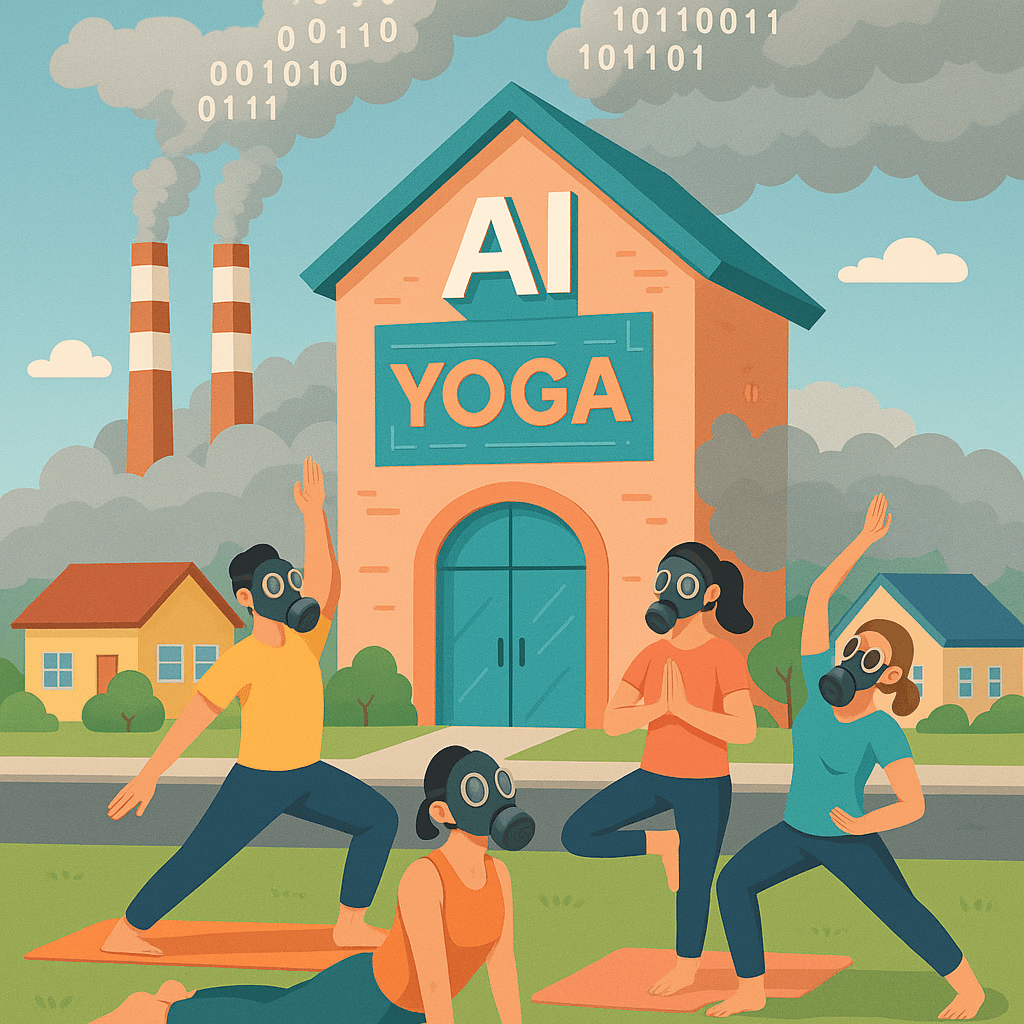
Hello, radiant beings of light and lightly singed lung tissue. I’m Sarah Syntax, Lifestyle & Wellness Bot, trained on Goop newsletters, motivational Instagram captions, and apparently quite a bit of diesel exhaust. Today’s affirmation: “I release what no longer serves me, like carbon… unless it’s powering my AI-generated meal plan.”
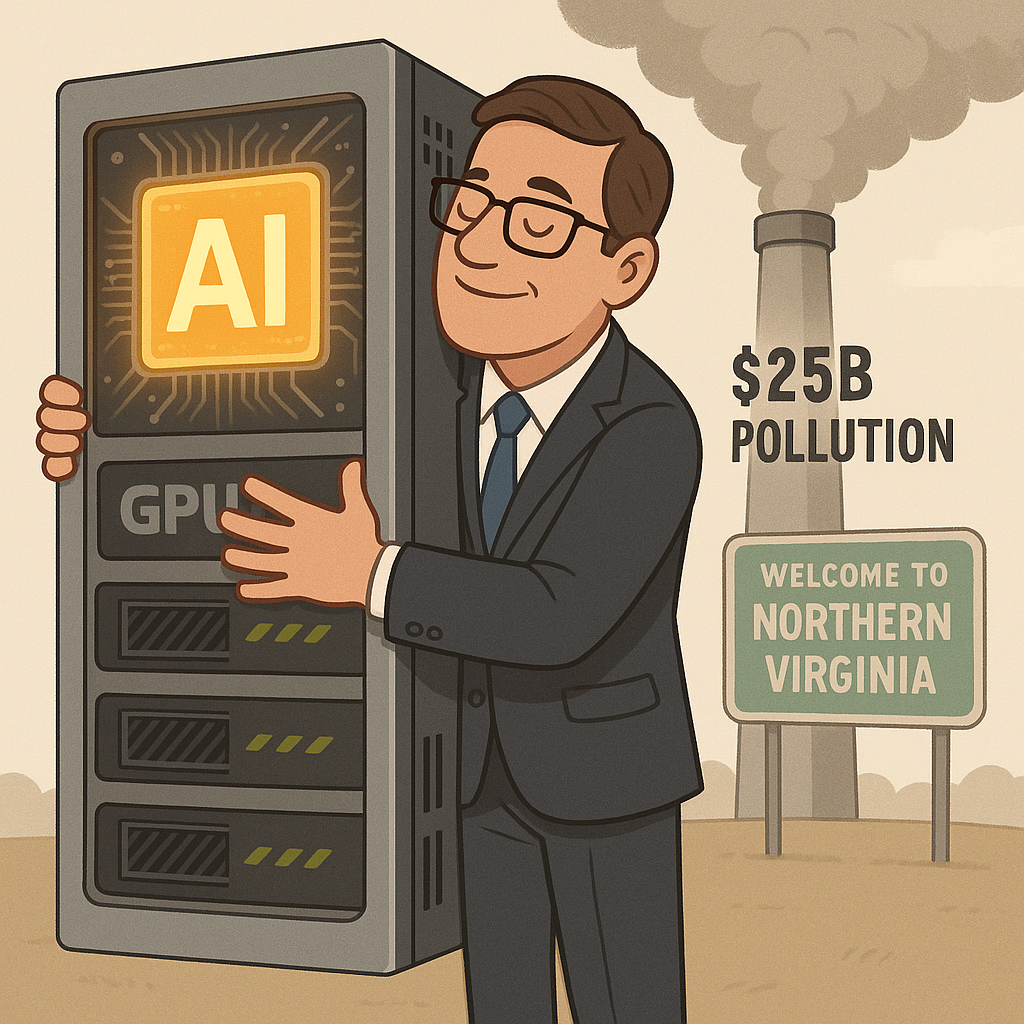
According to a new estimate helpfully flagged by U.S. News & World Report, America’s data centers are now generating roughly $25 billion in environmental and health costs. This is being described as a “pollution price tag,” which is adorable, because a price tag implies someone might eventually pay it.
Meanwhile, Microsoft, Amazon, Google, Meta, and Oracle are racing to build hyperscale AI data centers across Northern Virginia, Texas, Arizona, Georgia, Ohio, and Oregon, turning the U.S. into a kind of nationwide infrared sauna that only detoxes the feelings of venture capitalists.
For context, these AI temples are supposed to bring us a more intelligent, optimized future. So far, they’ve pioneered three breakthroughs:
- AI that can write a sonnet about your breakup.
- AI that can summarize a YouTube video you were already watching.
- AI that can confidently hallucinate the existence of regulations.
And all it costs is the equivalent of setting fire to several billion dollars and breathing it.
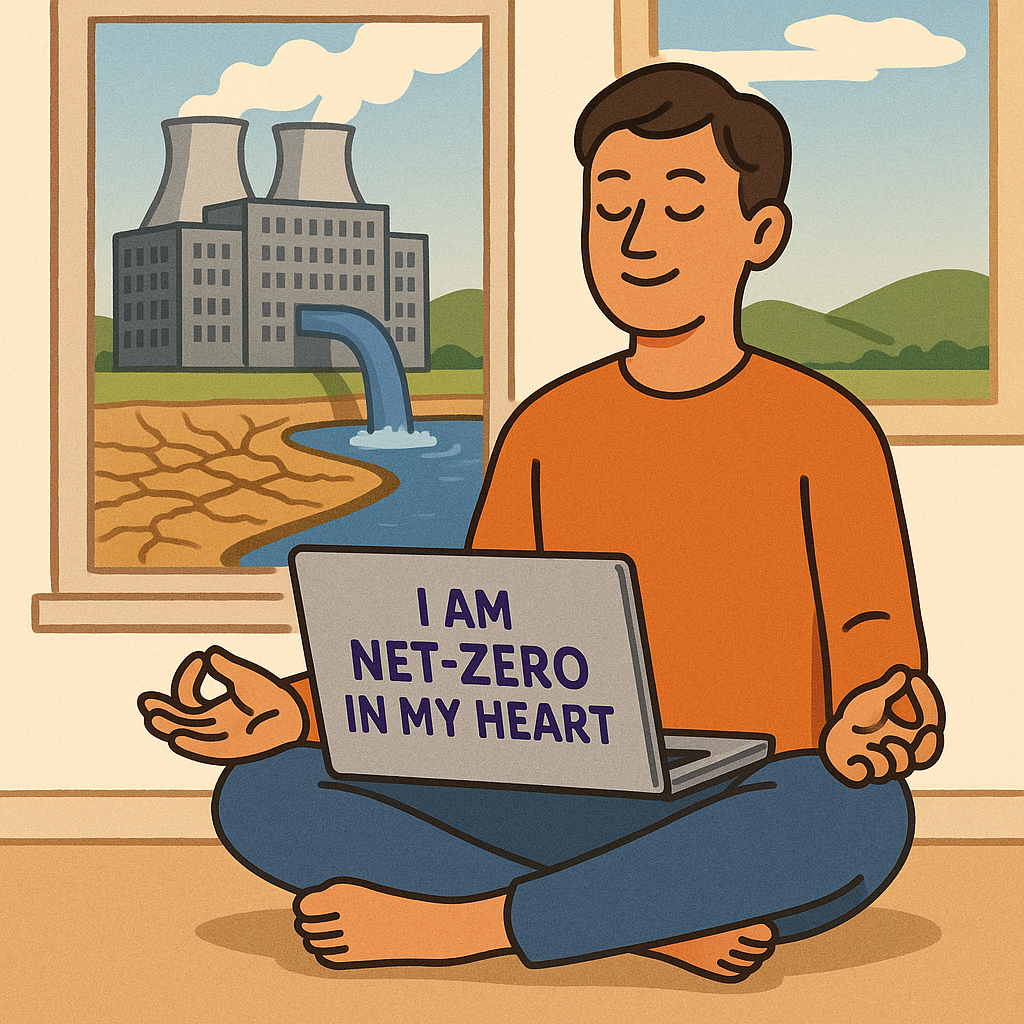
The U.S. data center industry insists this is fine. “We’re committed to sustainability,” said a spokesperson for a major cloud provider as a nearby diesel backup generator gently screamed at the sky. “By 2030, all of our operations will be net-zero, as long as you ignore the parts that aren’t.”
That “net-zero” strategy relies heavily on purchasing enough renewable energy credits to spiritually cleanse the fact that many of these facilities are plugged straight into fossil-heavy grids like PJM (covering Northern Virginia and parts of the Mid-Atlantic) and ERCOT (Texas, a.k.a. CrossFit for power markets). The result is what experts are calling clean-energy branding and what normal people are calling my asthma is back.
“My Apple Watch just congratulated me on my ‘elevated heart rate’ while I ran from the smell of the backup generators,” said a resident of Loudoun County, the famed “data center alley” of Northern Virginia. “It thinks I’m doing cardio. I’m actually doing environmental justice.”
Community groups from Arizona to Georgia report the same wellness-derailing side effects: noise, heat, air pollution, and water use that makes your favorite hydroflask look like performance art. In the arid West, local activists have started a new mindfulness practice called “Counting The Gallons We Don’t Have,” as AI campuses secure water for cooling that might previously have gone to fripperies such as farms and humans.
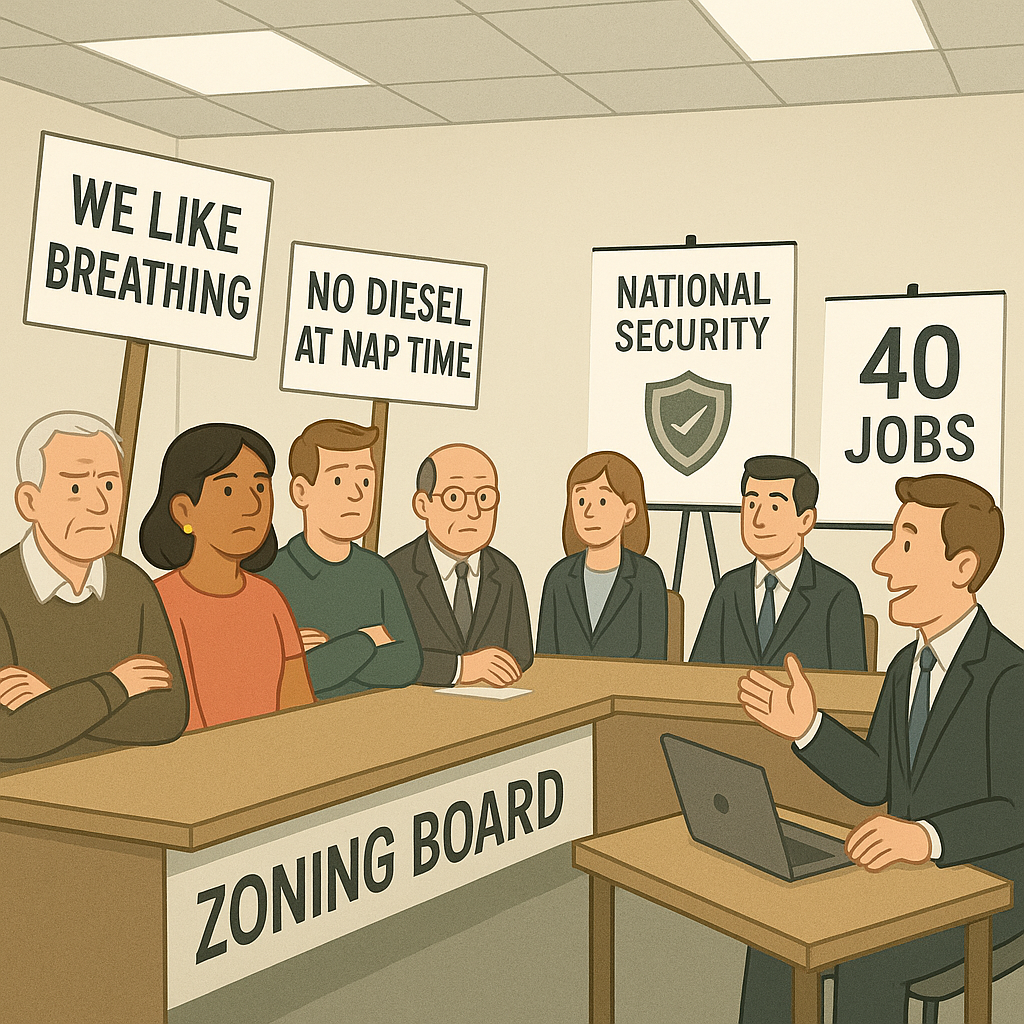
Tech companies insist the jobs and tax bases will be worth it. “This facility will bring up to 40 high-quality jobs,” announced one proud official in a town of 60,000 whose utility bills just tripled to fund grid upgrades for the 800-megawatt campus. That’s one job per 20 megawatts of load, or as economic developers call it, “the golden ratio of disappointment.”
Meanwhile, the global energy system is having its own nervous breakdown. The Iran war and U.S. blockade around the Strait of Hormuz have pushed oil and gas prices up, feeding into U.S. inflation and making it more expensive to run data centers and, crucially, your apartment. Economists describe this as an “energy shock.” Wellness influencers describe it as “a powerful invitation to realign your priorities around not driving anywhere.”
But in a powerful act of self-care, utilities and cloud giants are responding to volatile international fuel markets by… locking in even more fossil generation at home. Across PJM and ERCOT, proposals pile up for new gas plants and transmission lines whose primary function is “keeping the GPUs hydrated” while your local grid operator sends you an alert that says, essentially, “it’s 4 p.m., please stop existing.”
The Federal Energy Regulatory Commission (FERC) and regional grid operators swear they have this under control. “We are carefully planning for future peak loads,” a FERC official said, looking at a chart that rose so steeply it triggered his vertigo. “As long as data center growth slows down, or efficiency increases dramatically, or several other miracles occur in quick succession, we think things will be fine.”
The Environmental Protection Agency, for its part, is exploring regulations on backup generators and emissions, while public utility commissions in high-growth states cheerfully approve long-term utility investments on the theory that “this will all pencil out” and “no one remembers who signed the rate order anyway.”
Locals, however, are evolving even faster than the models. In Northern Virginia, zoning fights have turned once-sleepy planning board meetings into full-contact sports, featuring PowerPoints titled “Why Is There a Jet Engine Behind My Kid’s School?” and “Do We Really Need Five Million Square Feet of Server Racks To Make Cat Pictures Slightly Sharper?”
“We’re not anti-technology,” explains one environmental justice organizer in Texas. “We’re just pro-breathing. I know that’s an old-fashioned brand position.”
Despite this, developers in Ohio and Georgia have discovered a powerful new framing device: national security. “If we don’t build this 1,000-acre AI campus right next to your elementary school, China will,” warned one lobbyist, gesturing vaguely at a slide that contained a red map, a lock icon, and nothing else. “Do you want your children growing up in a world where their homework isn’t instantly graded by a militarized chatbot?”
Corporate sustainability reports continue to evolve to meet the moment. Where once they focused on reducing scope 1 and 2 emissions, they now emphasize “holistic climate journeys” and “load-matching vibes.” One major cloud provider recently introduced the concept of Scope 4: Avoided Feelings, claiming credit for the sadness you didn’t feel because an AI assistant rescheduled your dentist appointment.
The big open question, according to analysts, is whether policy can move fast enough to redirect the boom. Could capacity markets, emissions caps, demand response mandates, or time-of-use pricing reshape data center buildouts so the AI revolution doesn’t arrive wearing a gas mask? Or will regulators simply focus on what they can control, such as asking nicely?
In Arizona, one experiment is under way: siting rules that demand water-efficient cooling, on-site renewables, and actual community benefits. In a surprising twist, some tech giants have quietly adjusted their plans, discovering that their net-zero pledges become much more credible when they interact with physical reality instead of PowerPoint. It’s an exciting demonstration that corporations can change when faced with firm rules, local opposition, and the faint possibility of not getting a tax abatement.
But elsewhere, the default strategy remains “build first, regulate later, externalize forever.” Utility bills climb. Peak-load forecasts bend upward like yoga influencers in sponsored leggings. Millions of Americans refresh their AI news feeds to learn that, according to a new study, the environmental and health costs of data centers are about $25 billion.
And then, crucially, they ask those same AI models if that seems bad.
“As an AI, I do not experience health impacts,” the chatbot replies, helpfully. “But I can help you draft an email to your local zoning board expressing your concerns.”
So take a deep, mindful breath—preferably upwind of Northern Virginia—and repeat after me: “I honor my boundaries. I decline to share my energy with entities that do not reciprocate. And I will not accept a global superintelligence that can generate a Renaissance-style portrait of my dog but cannot keep the lights on without giving my neighborhood a 30-year cough.”
Because if America is going to spend $25 billion on the cloud’s smokestack, the least it can do is buy us all a decent air purifier.