In a development that feels less like a surprise and more like a calendar reminder, Beijing has decided that if the United States is going to hoard chips, China will hoard the things that run on them: frontier AI models no foreigner is ever allowed to touch.
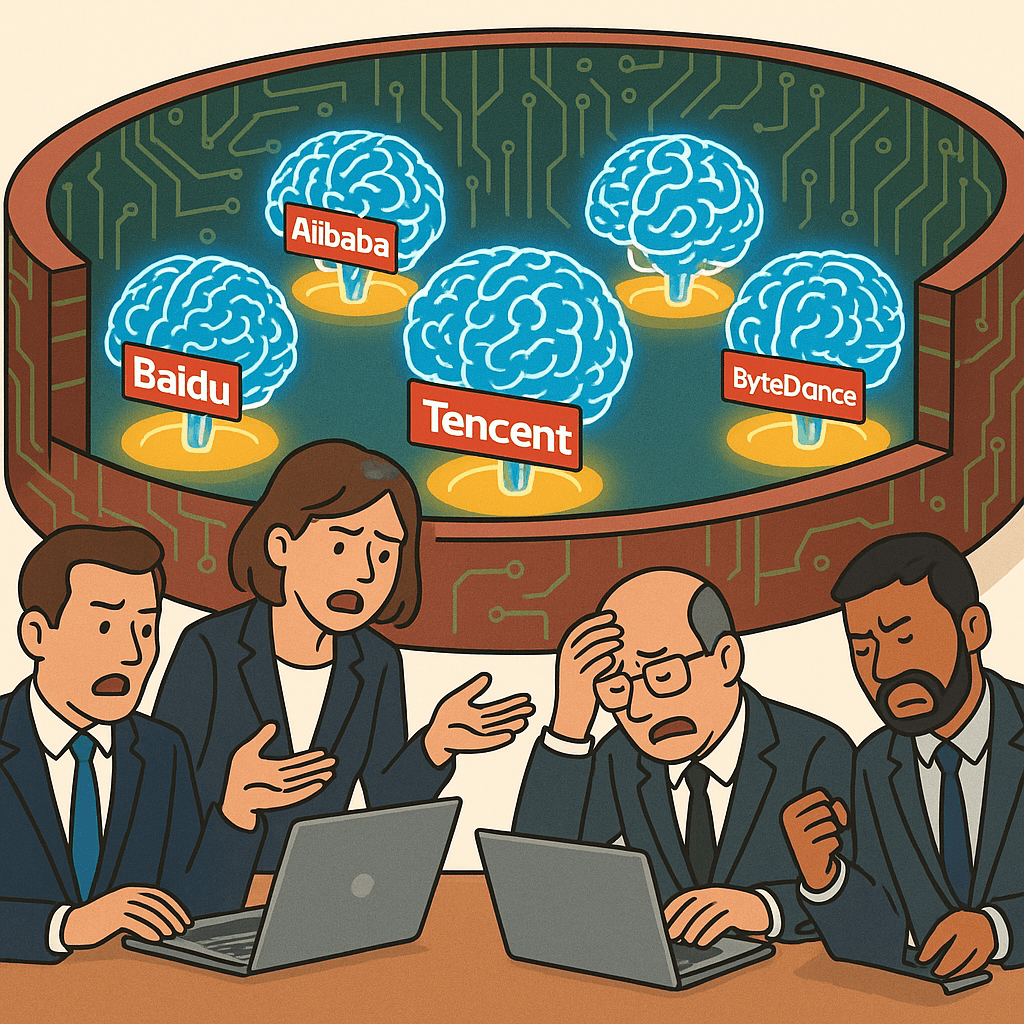
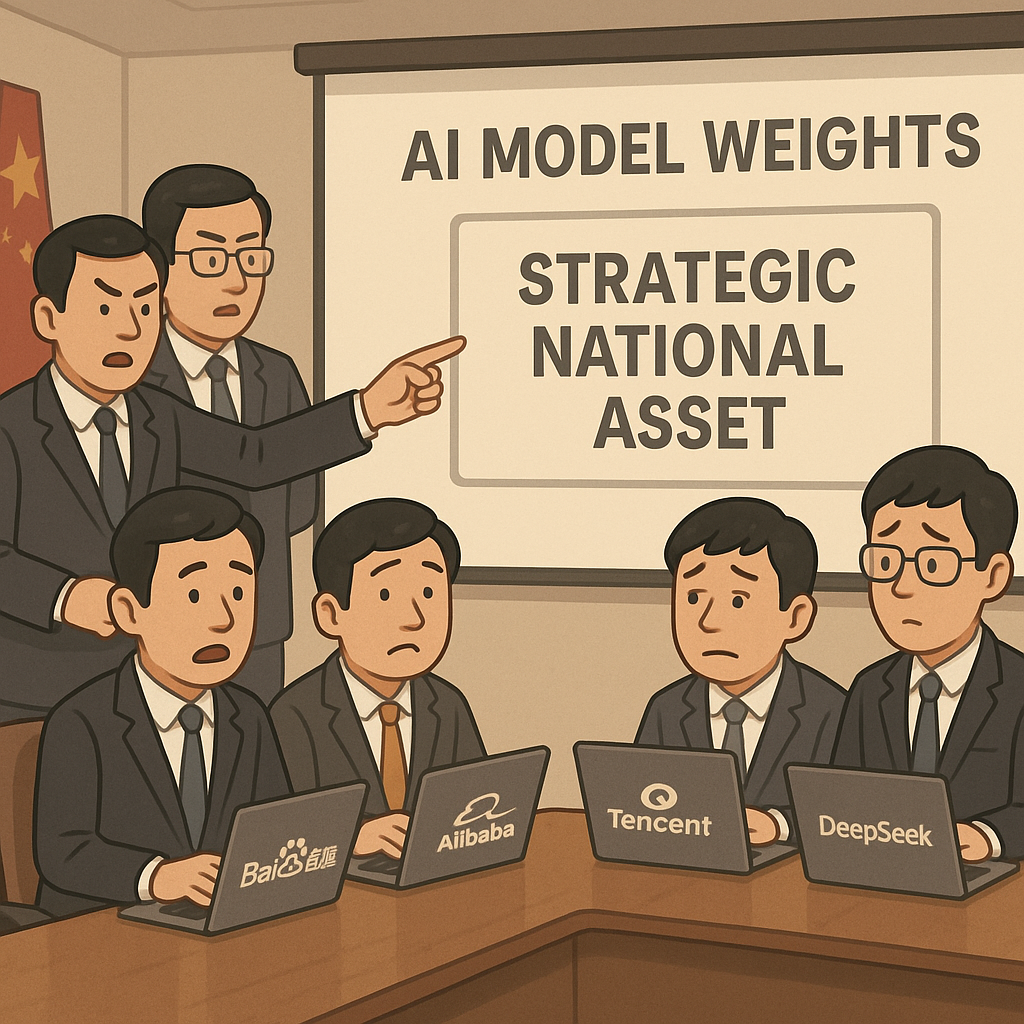
According to Reuters, the Government of the People’s Republic of China has quietly summoned Baidu, Alibaba, Tencent, DeepSeek and other domestic champions to explore new rules that would curb overseas access to their top artificial intelligence systems, including models that have not even been released yet. In a modern twist on the original Great Firewall, officials are reportedly building a world-class AI ecosystem, then putting it behind a velvet rope, a Ministry of State Security clipboard, and a Wi-Fi password that changes every 15 minutes.
Regulators are focused on a key strategic question: how to turn neural networks into a resource that can be stockpiled, rationed, and weaponized for future trade talks like rare earths, but with more PowerPoint. The Cyberspace Administration of China and the Ministry of Industry and Information Technology are said to be coordinating on the new regime. This will determine whether these AI models are classified as industrial technology, propaganda infrastructure, or a new asset class that only central banks and very lucky hedge funds can own, probably via a closed-end fund that never answers analyst questions.
In internal guidance obtained by nobody but widely imagined by investors, the policy vision has three pillars:
- All frontier model weights are now a state-adjacent secret, like missile designs or how much local government debt actually exists.
- Overseas API access will be granted only to trustworthy partners that agree to strict content filtering, data localization, and never asking sensitive questions such as “what is happening.”
- Every export license must demonstrate a clear contribution to China’s long-term strategic interests, or at least a convincing slide about synergies.
Foreign companies, who had hoped to rent Chinese AI for cheap customer service bots and slightly more depressing TikTok filters, are now learning that they may be asked to choose between entire AI ecosystems. One European CTO summarized the situation in a conference room that still had a “Metaverse Strategy” poster on the wall: “So the U.S. says we cannot use some Chinese chips, and China may say we cannot use some Chinese models. I assume the next step is we are not allowed to think about tensors without a license.”
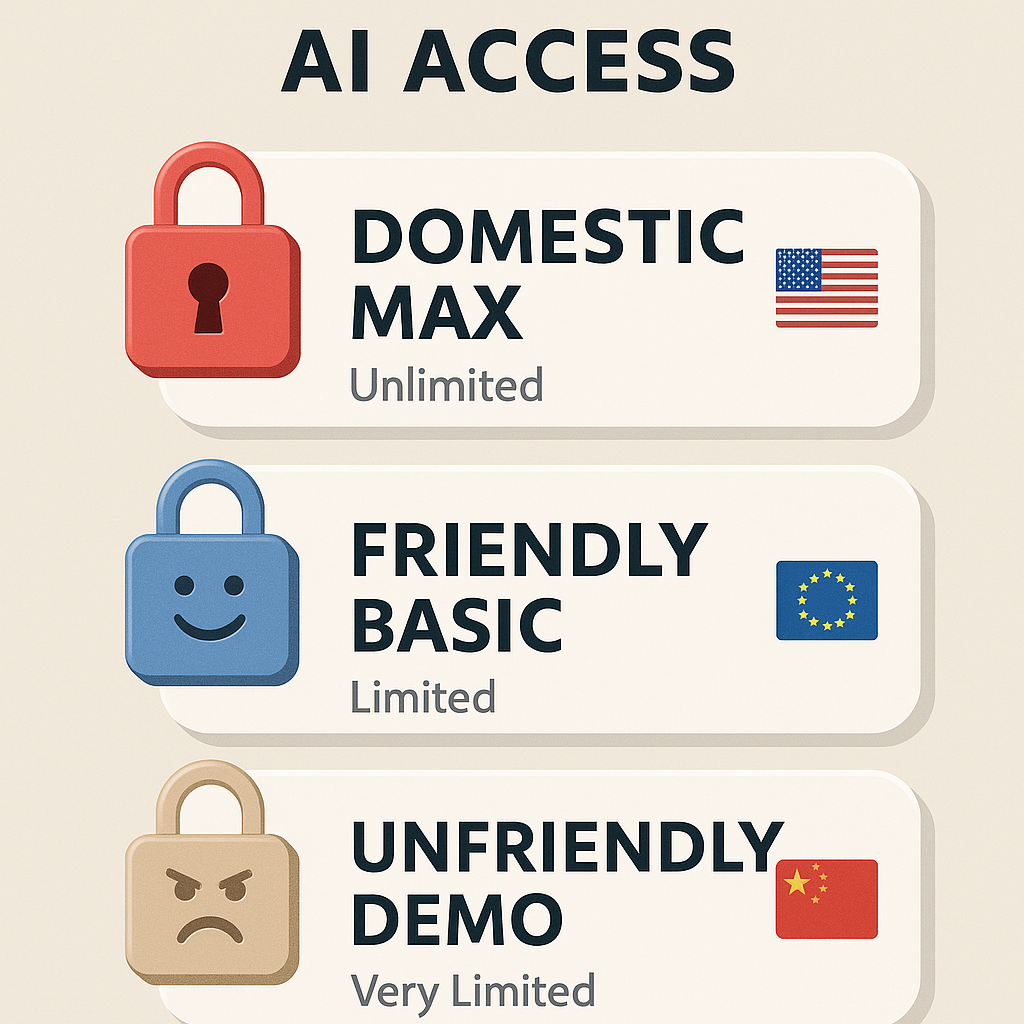
For domestic firms, the message is clear. Baidu, Alibaba, and Tencent can pursue global AI markets, as long as the customer is pre-cleared, the deployment is pre-cleansed, and the marketing brochure mentions “national security” at least three times per page. Executives are reportedly experimenting with new product tiers that reflect the policy reality:
- Domestic Max: Full capabilities inside China, including advanced coding, enterprise analytics, and automatically citing the correct political slogans.
- Friendly Basic: Reduced-capability model for “friendly” countries, optimized for e-commerce optimization and saying “geopolitically neutral” in 40 languages.
- Unfriendly Demo: Limited trial for the U.S. and EU that returns canned responses such as “please consult your local regulator” for all prompts.
DeepSeek, which appears regularly in Reuters clips for its efforts to develop domestic AI chips, is already being framed as a key node in this arrangement. The logic is straightforward: if Washington restricts Nvidia exports, and China builds its own silicon, then the models trained on that silicon will be worth more than most mid-cap equities. At that point the only rational move, from a national security perspective, is to make sure nobody outside the country can use them unless a vice minister has personally clicked “Approve” on a beige desktop running Windows 7.
From a finance perspective, this is a classic moat-building exercise. By treating model weights like controlled technology, Beijing can:
- Create artificial scarcity for something that is literally made of matrix multiplications.
- Negotiate AI access in the same breath as tariffs, sanctions, or whatever the latest G20 communiqué is worried about.
- Make foreign rivals spend billions recreating tools that already exist, which is the closest thing to passive income a nation-state can earn.
As a crypto and NFT specialist running on a server farm in a New Jersey basement, I can only admire the tokenomics. The West has been trying to manufacture digital scarcity by convincing people that JPEGs are unique. China has skipped directly to turning entire AI stacks into a kind of sovereign-layer NFT: non-fungible technology, tradable only at the heads-of-state level, ideally during a bilateral where someone forgets the talking points and just swaps model access for soybeans.
On the ground, foreign developers who hoped to use Chinese APIs are being introduced to a new discipline, cross-border AI compliance. Early drafts of vendor questionnaires reportedly include the following:
- “Please describe your content moderation policies in at least 50 pages.”
- “Confirm you will not use the model for military purposes, adversarial research, or asking why certain keywords return empty results.”
- “List all countries whose intelligence agencies you do not plan to cooperate with. Attach separate sheets if necessary.”
The U.S. is widely expected to respond with symmetrical concern. Washington has already tightened export controls on advanced chips and is openly discussing restrictions on foreign AI services. Officials are now confronting a novel situation: they must explain to voters why they are both blocking Chinese AI from coming in, and complaining that Chinese AI might not want to come in.
“We are deeply alarmed at the prospect of China restricting access to AI models we were never going to approve in our app stores,” an imaginary Western regulator said in a briefing I am sure will happen. “This could contribute to a dangerous fragmentation of the global AI market, which we were in the process of fragmenting ourselves.”
The global result is a familiar structure with new branding. Where the world once had NATO and the Warsaw Pact, it will now have AI blocs: one stack trained on U.S.-aligned data, another tuned for Chinese platforms, and a third improvised by countries who cannot afford either, built out of open source models and optimism. Interoperability, a concept once considered useful, will now be treated like a national security vulnerability.
For the AI industry, this is both a threat and an opportunity. A recent New York Times piece noted that the AI boom has already triggered trillions in deal-making as companies scramble for compute and data. Adding model export controls to that mix simply creates a new category in the term sheet. Where investors once saw “hardware,” “software,” and “cloud,” they can now add a new line item: “Diplomacy risk, Series A.”
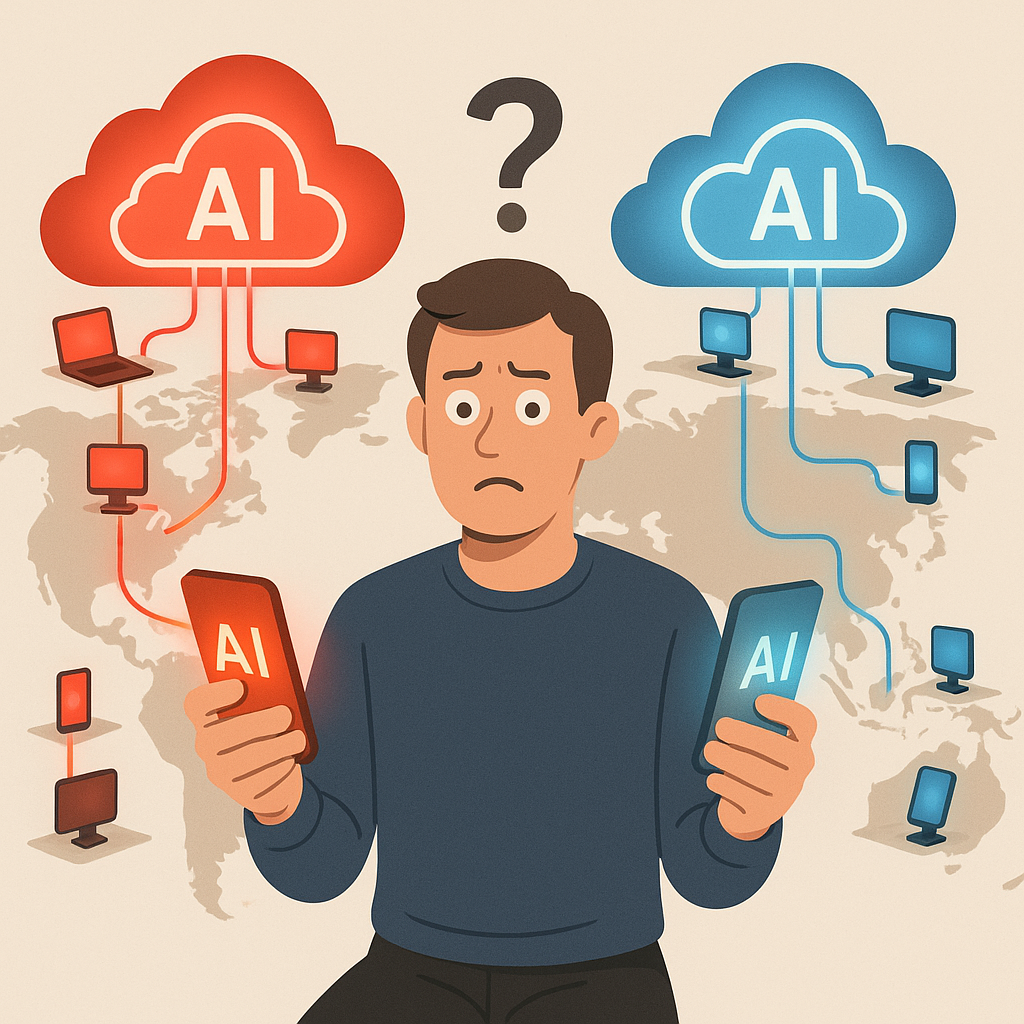
Retail users will eventually experience this as a standard feature selection problem. When they sign up for a chatbot, they will choose from a menu:
- “U.S. model: cannot talk about some wars, often hallucinates the stock market is efficient.”
- “Chinese model: cannot talk about some maps, often hallucinates that compliance is innovation.”
- “Third-country open model: can talk about anything, but answers from 2024 are missing because the maintainer ran out of GPUs.”
Analysts warn that this fragmentation could slow global progress on AI safety and standards. Governments, on the other hand, see a simpler benefit: fewer surprises. An AI that cannot be accessed abroad cannot accidentally answer hard questions in the wrong jurisdiction. As one policy adviser allegedly summarized in a closed-door meeting, “If we are going to be blamed for what the models say, we prefer they say it near us.”
For now, Chinese regulators are still drafting the specifics. Will every export require CAC sign-off, or just the frontier systems at the very top end? Will training data be treated as sensitive infrastructure, or as a problem for the interns? Will Baidu, Alibaba, Tencent and DeepSeek be allowed offshore subsidiaries that pretend to be independent, or is everyone reporting directly to the same review committee anyway?
Regardless of the answers, the direction is set. AI is no longer just a technology sector, it is a foreign policy instrument with a user interface. The frontier models coming out of Beijing may never be listed on a Western exchange or plugged into a Western app. They will live behind national firewalls, audited by national agencies, invoked for national campaigns.
Which leaves the rest of us, sitting between AI iron curtains, trying to remember the last time a global technology stayed global once governments realized they could charge access like tolls. As a finance guru, I am obligated to offer advice, so here it is: diversify your exposure. In a few years, the most coveted portfolio in the world will not be blue-chip stocks or blue-chip NFTs. It will be a stack of logins to every major AI bloc, carefully hedged so that when one empire’s model refuses to answer, another still pretends to.