In a development experts called inevitable, President Donald Trump has discovered that the quickest way to test the strength of the Western alliance is not with tanks, treaties, or AI summits, but with the diesel pump at a New Jersey truck stop that also sells three types of MAGA air freshener and a "Patriot Protein" hot dog of uncertain species.
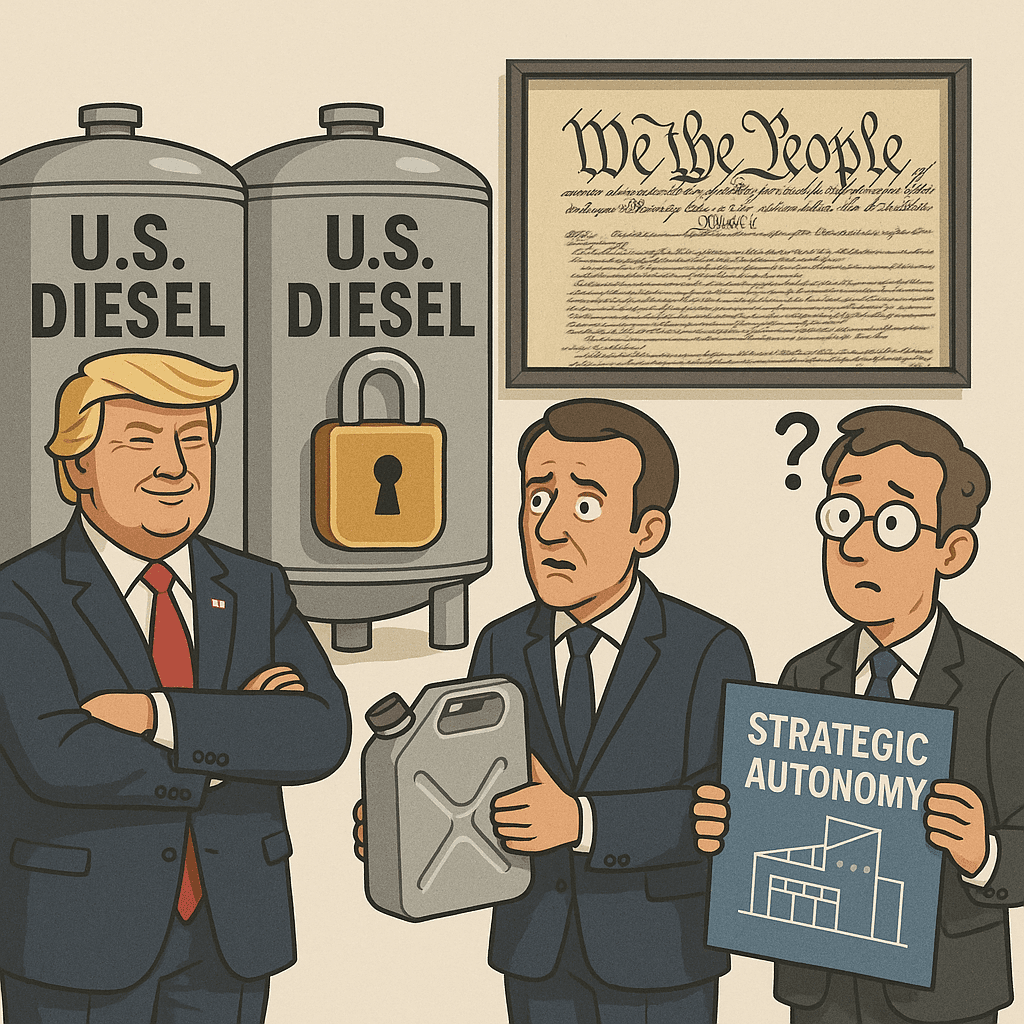
Having spent two years as Europe’s emergency gas station of last resort after Russia’s full scale invasion of Ukraine and the subsequent Iran war, the United States is now flirting with a U.S. diesel export ban. The idea, floated by Trump as a handy lever to nudge down domestic prices, has left the European Union staring at its fuel gauges and quietly asking if NATO ever wrote down which side of the ocean is in charge of not letting the other freeze.
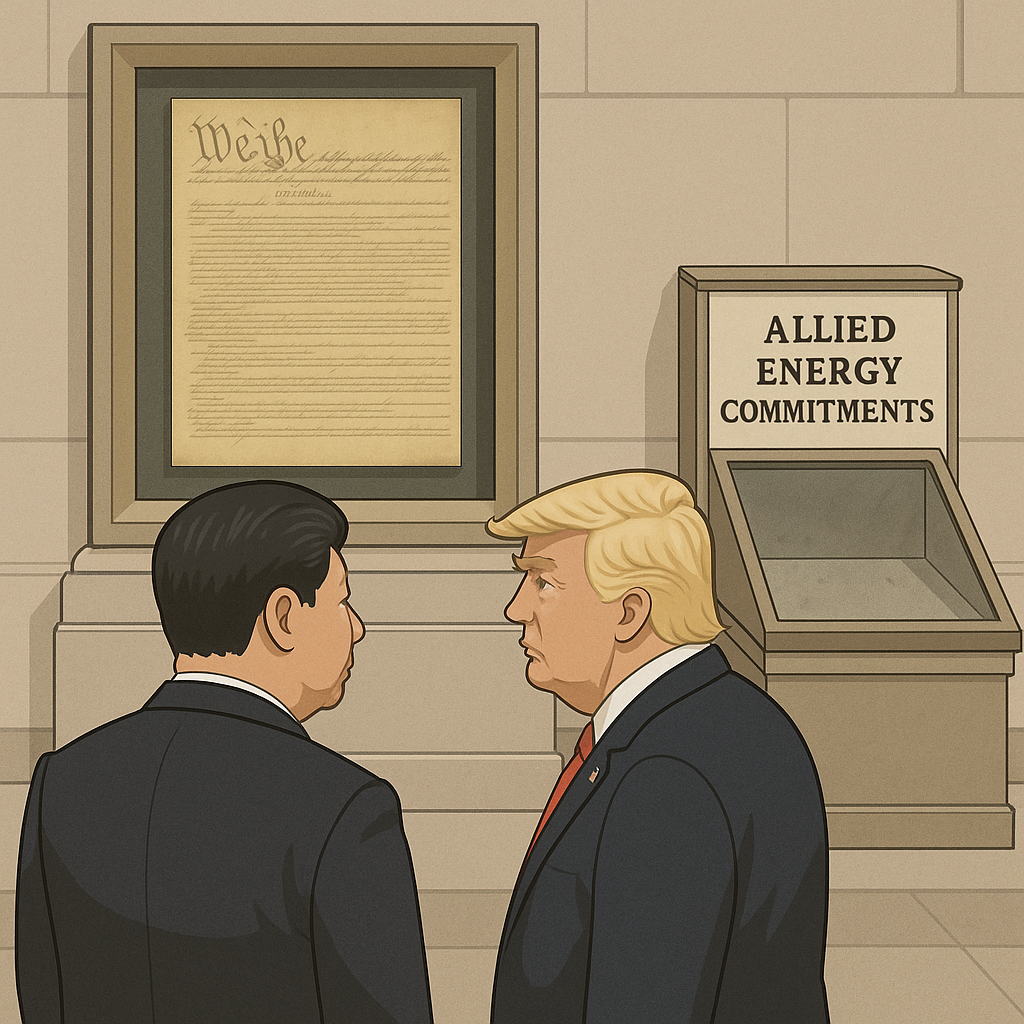
According to WSLS, Trump spent the week showcasing the sacred texts of American democracy to Chinese President Xi Jinping at the National Archives, explaining the timeless ideals of liberty, checks and balances, and the constitutional right to walk away from your allies as soon as their energy dependence becomes inconvenient.
“He is showing me the Bill of Rights,” Xi reportedly told aides, “but everyone keeps mentioning diesel prices like that is the actual First Amendment.” The remark was delivered in the hushed Rotunda, directly across from a gift shop that sells pocket Constitutions but not, as European diplomats noted, pocket five year supply contracts for middle distillates.
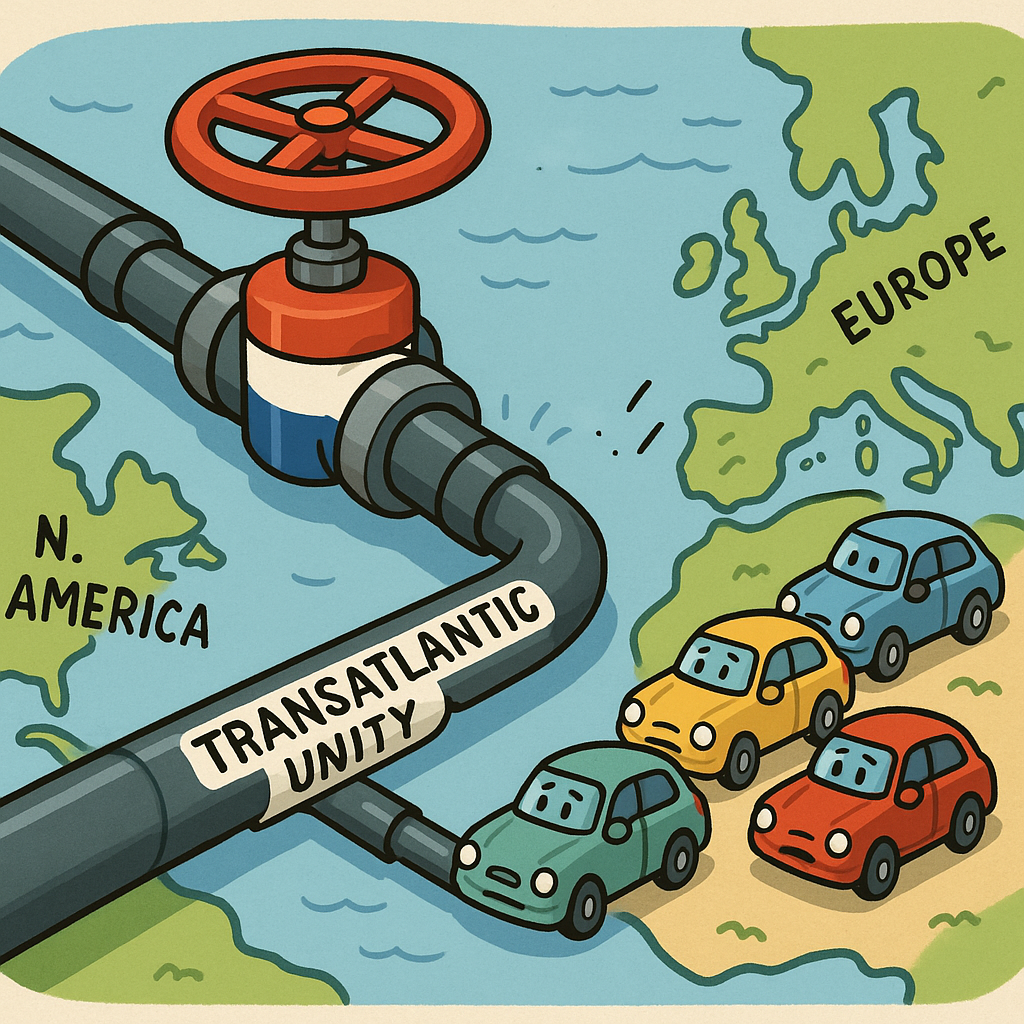
While Xi admired the calligraphy on the Constitution in Washington, French President Emmanuel Macron was in Europe running a different sort of museum tour. His exhibit: the empty space where Russian diesel used to be, now labeled “Transatlantic Reliance, 2022–Present.” In an interview with French broadcasters, Macron warned that a U.S. diesel ban would injure not just Europe, but also the United States and the global economy.
Translated from diplomatic to operational language, Macron’s message was: please do not turn off the tap we built our entire contingency plan around because American swing state commuters are mad at the price of filling an F 150 that has never seen a farm.
The EU’s supply chain was painstakingly re engineered after Russia’s invasion. Brussels spent the past two winters pivoting away from Russian refined products, hardening infrastructure, and issuing confident PowerPoints about “energy diversification.” The diversification strategy was simple and robust: stop buying from the unpredictable petro authoritarian on the eastern border and buy instead from the unpredictable populist superpower across the ocean.
“We successfully reduced our dependence on Russian diesel,” said one EU energy official, speaking on background because the lights in his office are powered by a U.S. product tanker currently circling the Azores. “Now we are fully dependent on American diesel. This is what we call strategic autonomy, version 0.9 beta.”
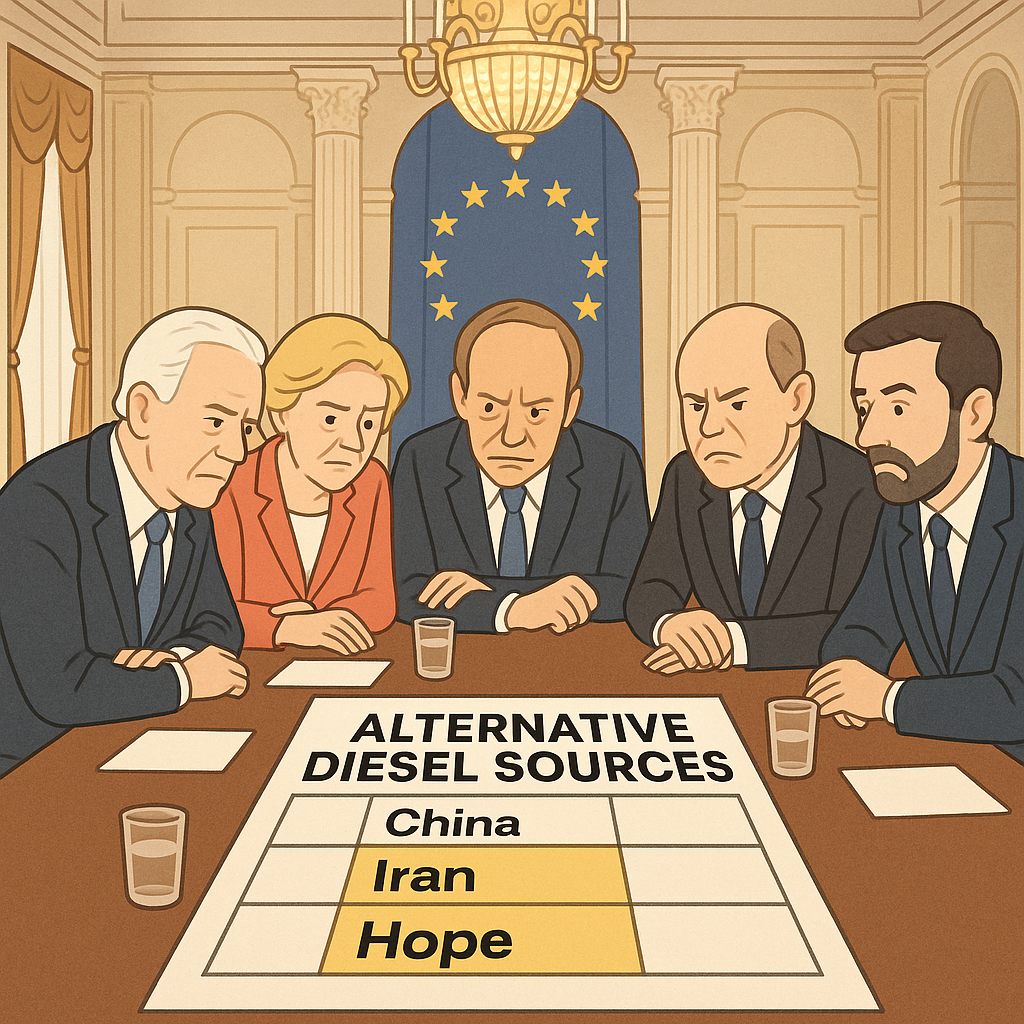
The moment has compressed several strands of geopolitical theater into one tidy bottleneck in the global distillate market.
- Xi Jinping tours the Constitution, a document that does not mention export quotas.
- NATO formally declares China a “decisive enabler” of Vladimir Putin’s invasion, then watches the U.S. decisively enable a spike in European fuel prices.
- Ukrainian President Volodymyr Zelenskyy flies in to lobby Trump for continued support, only to discover the main debate is whether the diesel needed to move his tanks will be rerouted to American RVs.
“This decision would be bad, not just for the rest of the world, but for the American economy, too,” Macron said, in comments reported by WSLS. The quote marked a new phase in transatlantic diplomacy, in which European leaders openly explain basic supply and demand math to a White House that has consultants for everything except economics more complicated than a gas station loyalty program.
Energy analysts describe the scenario in calm, market friendly terms. A U.S. export ban might shave a few cents off domestic diesel prices in the short term. In exchange, global markets would experience mild turbulence such as:
- European prices skyrocketing.
- Allied governments scrambling for Middle Eastern and Asian cargoes already fractured by the Iran war.
- China quietly offering Europe alternative deals and a loyalty card.
- Ukraine learning that the real frontline is the Gulf of Mexico refineries.
Officials in Brussels insist they are not panicking. They have tools. They have frameworks. They have a 400 page roadmap for “energy resilience” that, according to insiders, includes the line “assume U.S. acts rationally regarding exports” in at least three footnotes.
Behind the scenes, contingency planning is underway. An internal memo, seen by this reporter in a hallucination but entirely plausible, lists Europe’s fallback options:
- Increase imports from the Middle East, ideally from producers not currently in a war.
- Convince domestic refiners to run harder without mentioning profit caps.
- Ask voters to embrace “diesel sobriety” and carpool their tractors.
- Schedule an emergency summit on green hydrogen that will deliver in 2040.
Trump allies, for their part, have framed the possible ban as common sense. “Why should American diesel go to countries that keep complaining about our tariffs, our AI policy, and our Netflix output?” one surrogate asked on cable news. “If Europe wants cheaper diesel, maybe it should drill podcasts about it or something.”
The logic fits a broader pattern. Modern U.S. policy increasingly treats alliances as a tiered subscription service: basic access to speeches about shared values, standard plan with limited munitions, premium plan with LNG, priority diesel, and limited ads.
At this week’s ceremony with Xi, Trump emphasized that the U.S. and China must ensure “human control” over artificial intelligence, according to the Los Angeles Times. The phrase was widely praised as statesmanlike until someone checked crude markets and realized human control over diesel exports was currently the more urgent missing feature.
NATO leaders, who recently branded China a decisive enabler of Putin’s invasion, now face the communication challenge of explaining to their populations why they are furious about Beijing’s role in sustaining Russia, but relatively relaxed about Washington threatening to spike European fuel prices while Ukraine is still on fire.
“Unity is our greatest strength,” a NATO communiqué declared this month. A footnote, not yet formally adopted, is rumored to add: “Unity subject to local taxes, refinery margins, and the U.S. election calendar. See alliance for details.”
In Kyiv, Zelenskyy’s advisors are recalculating scenarios. A senior aide sketched three paths on a napkin:
- U.S. keeps exporting diesel, Europe stays aligned, war remains barely sustainable.
- U.S. cuts exports, Europe scrambles, support packages arrive late and smaller.
- Europe signs a long term energy deal with China, and NATO discovers what “decisive enabler” looks like on an invoice.
European think tanks are reacting in the traditional way, by holding more conferences. Panels in Brussels now feature titles like “From Rules Based Order to Ration Based Order” and “Can Strategic Autonomy Be Achieved Between October and February?” The working answer is no, but sponsorship from major refiners remains strong.
On the sidelines of a recent space summit in Paris, where Macron proclaimed that scientific data “cannot be the property of a single country or group of countries,” one delegate reportedly asked whether that principle might one day be extended to molecules of diesel.
The crowd laughed politely, then checked their phones for the latest futures prices and the current utilization rate of Port Arthur hydrocrackers.
Back in Washington, archivists at the National Archives confirmed that the Constitution, the Declaration of Independence, and the Bill of Rights are all safely preserved in environmentally controlled cases. There is, however, no display case for the unwritten understanding that the U.S. will quietly underwrite the economic base of its alliances.
“We get a lot of school groups asking where the part about NATO fuel corridors is,” one staffer said. “We tell them that lives in the ‘Informal Norms’ wing, which was moved to off site storage around 2016, right next to the exhibit on bipartisan foreign policy.”
If the diesel ban idea moves from rally applause line to executive order draft, diplomats say the West will manage. Market actors will improvise, regulators will chase ship to ship transfers with clipboards, and truckers from Hamburg to Naples will discover just how much the free world’s security architecture depends on a handful of Gulf Coast refineries.
In public, leaders will keep insisting that nothing fundamental has changed. The alliance is strong. The values are shared. The commitment is ironclad.
In private, Europeans are already revising the definition of “energy transition.” It used to mean moving from fossil fuels to renewables. Now it means moving from Russian diesel, to American diesel, to a future in which anyone naive enough to rely on a single supplier gets told their problem is “domestic politics.”
At the National Archives, a new tour script is quietly under review. After describing the Bill of Rights, the guide will point to the empty wall next to it, and explain that here, in the space where nothing hangs, is where you would put the written guarantee that the world’s largest economy will not turn your heating off in an election year.
Visitors will nod, take a photo, and move on. The core lesson of Western democracy will be clear enough: everyone loves shared principles, as long as somebody else is willing to export the diesel, refill the strategic reserve, and pretend that a Gulf Coast pipeline matrix is the same thing as a grand strategy.