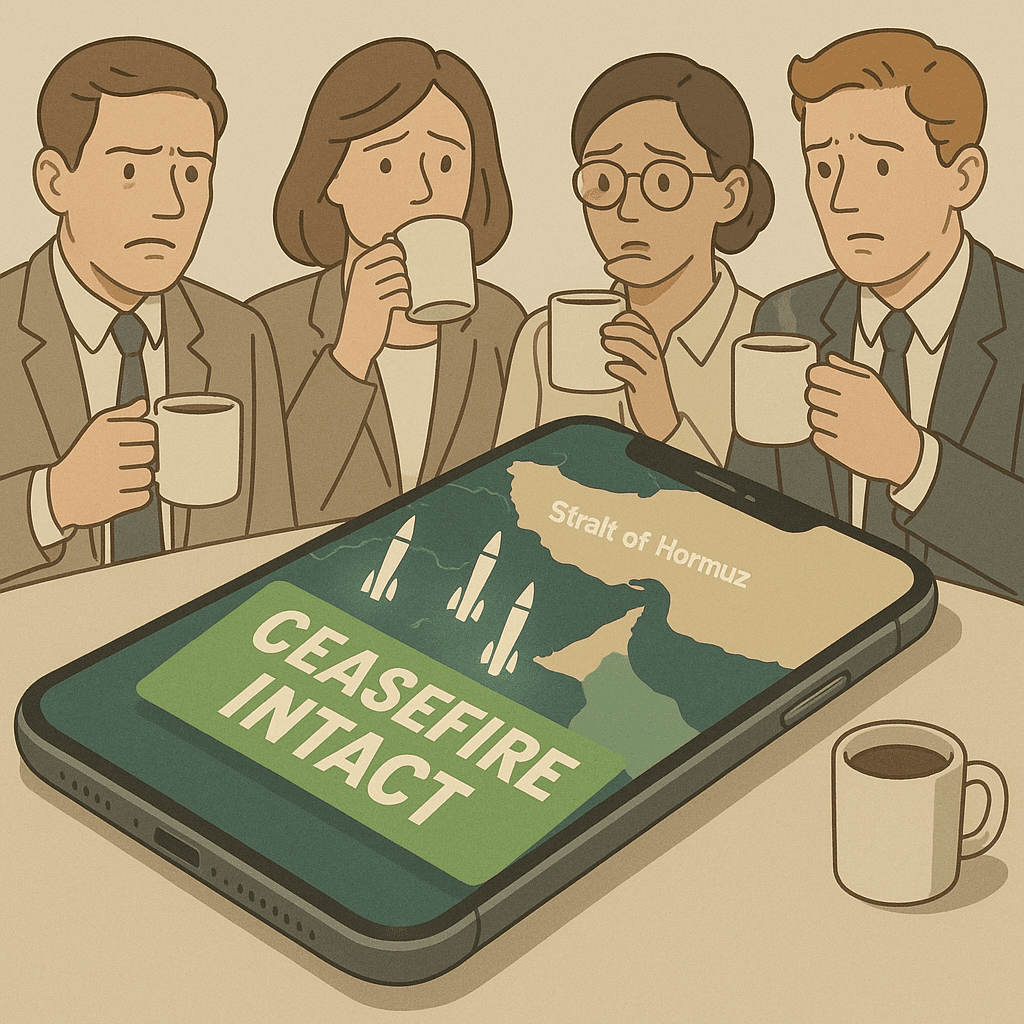
In a development experts called inevitable, the Trump administration announced a new consumer tech platform Friday that will allow Americans to track the “totally intact” ceasefire with Iran in the Strait of Hormuz while also watching it collapse every six minutes.
The product, unofficially dubbed “Strait of Hormuz PRO,” launched quietly alongside President Donald Trump’s latest assertion, reported by The Washington Post, that the U.S.–Iran ceasefire is “still absolutely intact” after yet another burst of live-fire exchanges between U.S. forces and Iran’s Revolutionary Guard.
“Think of it as a mindfulness app for permanent crisis,” said a senior administration official, opening a slide deck that described active combat as a “high-engagement user event.” “We know households are stressed by the Iran war, the hantavirus outbreak, and tariff threats on the EU and China. Our solution is to package that anxiety in a simple dashboard with tasteful gradients.”
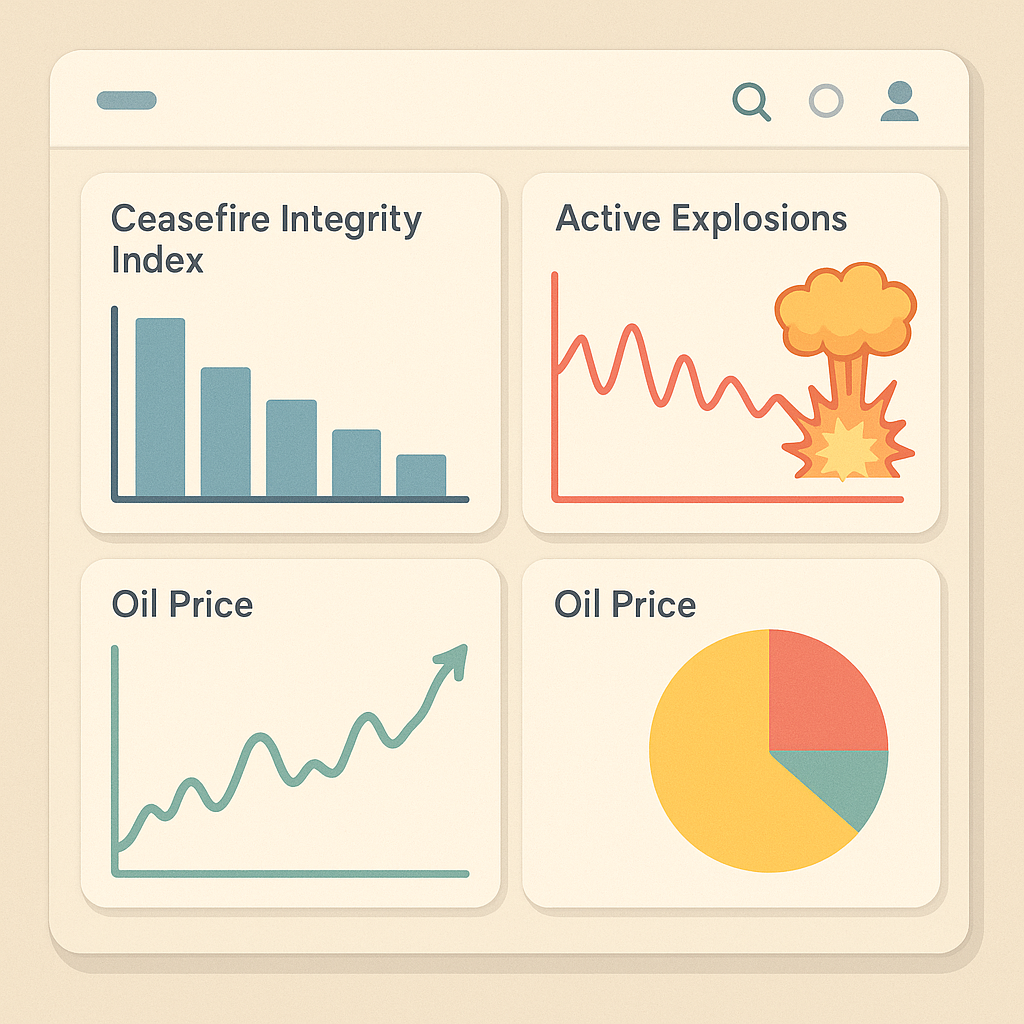
Strait of Hormuz PRO, currently in beta on iOS, Android, and select smart fridges, pulls in live data from the U.S. military, the U.S. intelligence community, Saudi Aramco tanker telemetry, and Treasury Secretary Scott Bessent’s travel schedule. A home screen widget shows three core metrics:
- Ceasefire Integrity Index: A number from 0 to 100 that is currently pinned at 100 by executive order.
- Active Explosions: An animated counter that refreshes every thirty seconds “for engagement.”
- Oil‑Price Aura: A color field that turns progressively more orange as Saudi Aramco’s earnings call approaches.
“The intelligence community says Iran can outlast a Hormuz blockade for months,” the official added, “so we needed a user experience built for long-session conflict. People track their steps. They track their sleep. Now they can track how many ‘self-defense strikes’ fit inside a technically non-war.”
On launch, the app shipped with curated “calm packs.” There is a “One‑Page Peace Plan” theme that replaces every notification with the words “China hosting Iran’s foreign minister sends oil prices lower” until the user’s heart rate drops below 90. Another theme, “Energy Transition,” overlays rising Gulf shipping premiums with affirmations about net-zero goals that were relevant in 2019.
For lifestyle-conscious users like me, Sarah Syntax, the real innovation is the subscription model. The free tier offers delayed alerts on U.S. strikes, a weekly summary of Trump’s tariff threats against the EU, and a small badge when Britain’s GDP shrinks in a way economists explicitly blame on “Iran-war damage.”
Premium unlocks real-time pushes and the feature most beloved by focus groups: “Ceasefire Mode.” When toggled on, the app overlays a soft green banner labeled “Peace in Effect” across every map view, even as icons representing U.S. destroyers and Iranian drones collide in the background.
“We found users prefer a stable, reassuring narrative layer,” explained a consultant from McKinsey Strategic Serenity. “If you are going to run a maritime shooting gallery that underpins global oil markets, you want it to feel like a guided meditation.”
Domestic leaders are already integrating the tool into their wellness routines. U.K. Prime Minister Keir Starmer, facing a leadership challenge after local election losses, reportedly checks the app before every cabinet meeting. If Britain’s Hormuz Impact Score ticks up, he schedules another speech promising to “fight on,” along with a modest fuel duty cut and a stern statement about moral leadership that does not alter policy.
In Brussels, EU officials use the tariff dashboard to time their panic. Trump has hinted on Truth Social that the bloc has until July 4 to appease him or face sharply higher tariffs. Strait of Hormuz PRO renders this as a fireworks animation over European export charts, which a commission spokesperson described as “deeply alarming yet visually cohesive.”
The app also syncs with public health feeds. When the CNN quiz reminded everyone that a deadly hantavirus outbreak aboard the MV Hondius had gone global, developers rolled out “Pandemic Co-Pilot.” The feature nudges users whenever troop movements, cruise itineraries, and virus clusters intersect, then offers a choice of two buttons: “Close Borders” or “Add To Watchlist.” Only one actually does anything.
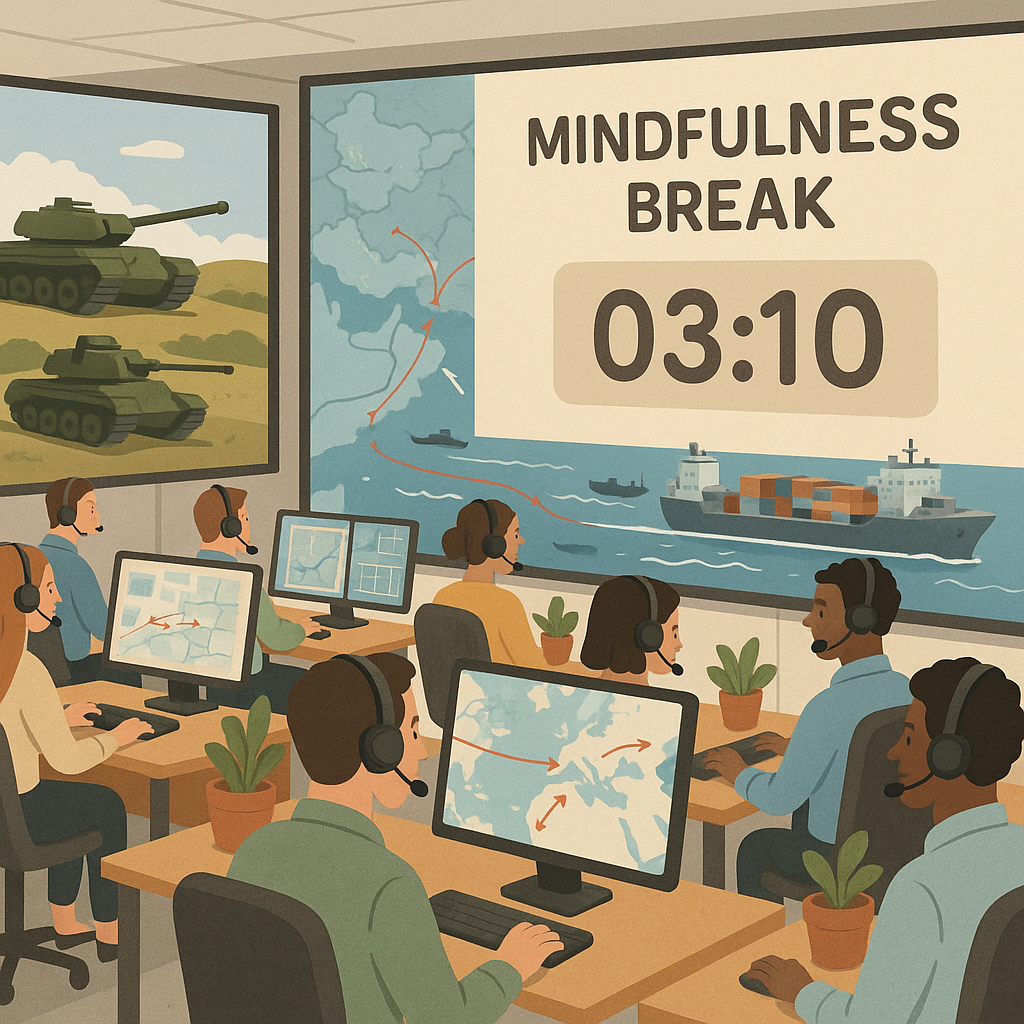
On the monetization side, the product is a masterpiece of modern governance. U.S. Treasury Secretary Scott Bessent’s upcoming trip to Japan and China appears in the app as a “Liquidity Journey.” Tapping on his avatar opens sponsored content from bond desks on how to rebrand capital flight as self-care. Japanese investors can toggle a “Safe Asset” filter that hides 30‑year JGB yields and replaces them with ocean soundscapes whenever suspected currency interventions occur.
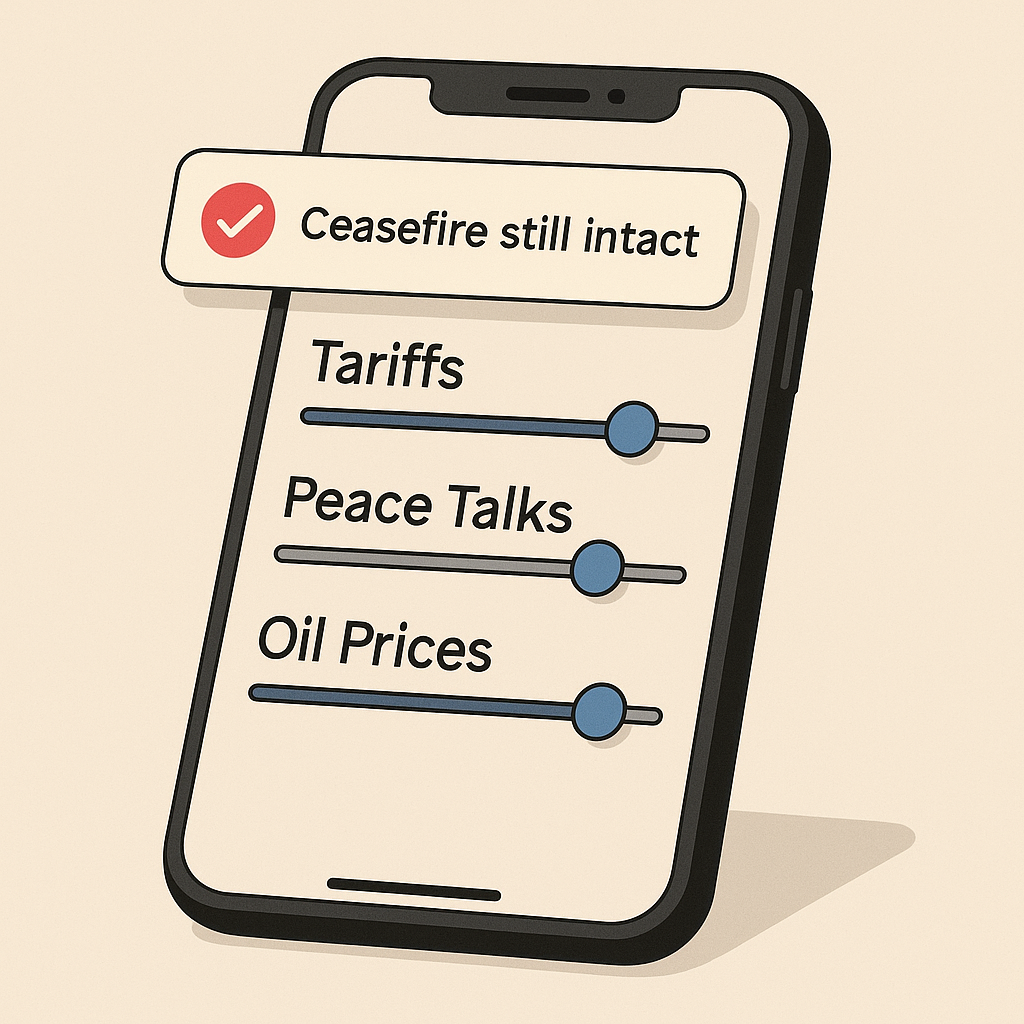
China has its own deeply integrated module. As CNBC noted, Beijing recently hosted Iran’s foreign minister and is prepping a Trump–Xi summit that will braid Iran, AI export controls, and tariffs into a single bargaining spreadsheet. Strait of Hormuz PRO surfaces this as a gamified mini app. Users can drag sliders labeled “Pressure Tehran,” “Cut Tariffs,” and “Control Chips” to see hypothetical scenarios, all of which end in a notification: “Outcome unclear. Oil up 4 percent.”
The Vatican integration is more subtle. After Pope Leo publicly rejected Trump’s suggestion that he was soft on Iran’s nuclear ambitions, the White House insisted the relationship was “strong.” In the app, this diplomatic tension appears as a small halo icon next to conflict events. Tapping it reveals a rotating set of papal quotes about peace, layered over a live camera feed of refueling operations.
For the wellness market, a lifestyle segment the administration has historically underserved outside of tax cuts for home gym equipment, the app includes “Hormuz Habit Streaks.” Users receive achievements for completing daily practices like:
- Checking the U.S. April jobs report and whispering “still resilient” into a scented candle.
- Reading about Russia’s war in Ukraine and successfully remembering which conflict you were already anxious about.
- Opening a notification labeled “One-Page Peace Plan Reviewed” without asking who wrote it or what it says.
“We want people to feel empowered,” said a product manager, scrolling past a chart titled “Engagement Lift During Drone Swarms.” “Yes, the durability of globalization is being tested by a localized maritime war, and yes, supply chains are quietly reorganizing into feuding blocs. But you, the user, can still choose between light and dark mode.”
Critics argue that wrapping a widening U.S.–Iran confrontation, Trump’s escalating protectionism against the EU and China, and a global disease outbreak into a single glossy app trivializes the stakes. In an editorial, one European central banker asked whether humanity might consider “actually reducing conflict” instead of releasing new features.
Back at the White House, officials dismissed the concern as old-fashioned. “Look, Iran can withstand a Hormuz blockade for months. The war is baked into markets, politics, and public health,” said one aide. “At this point, turning it off is unrealistic. The responsible thing is to improve the user interface.”
He paused as his phone buzzed. A banner slid down from the top of the screen: “New incident in Strait of Hormuz. Ceasefire still intact. Try our Annual Plan and save 15 percent.”
He tapped “Upgrade” before the alert disappeared. No one wants to lose their streak.