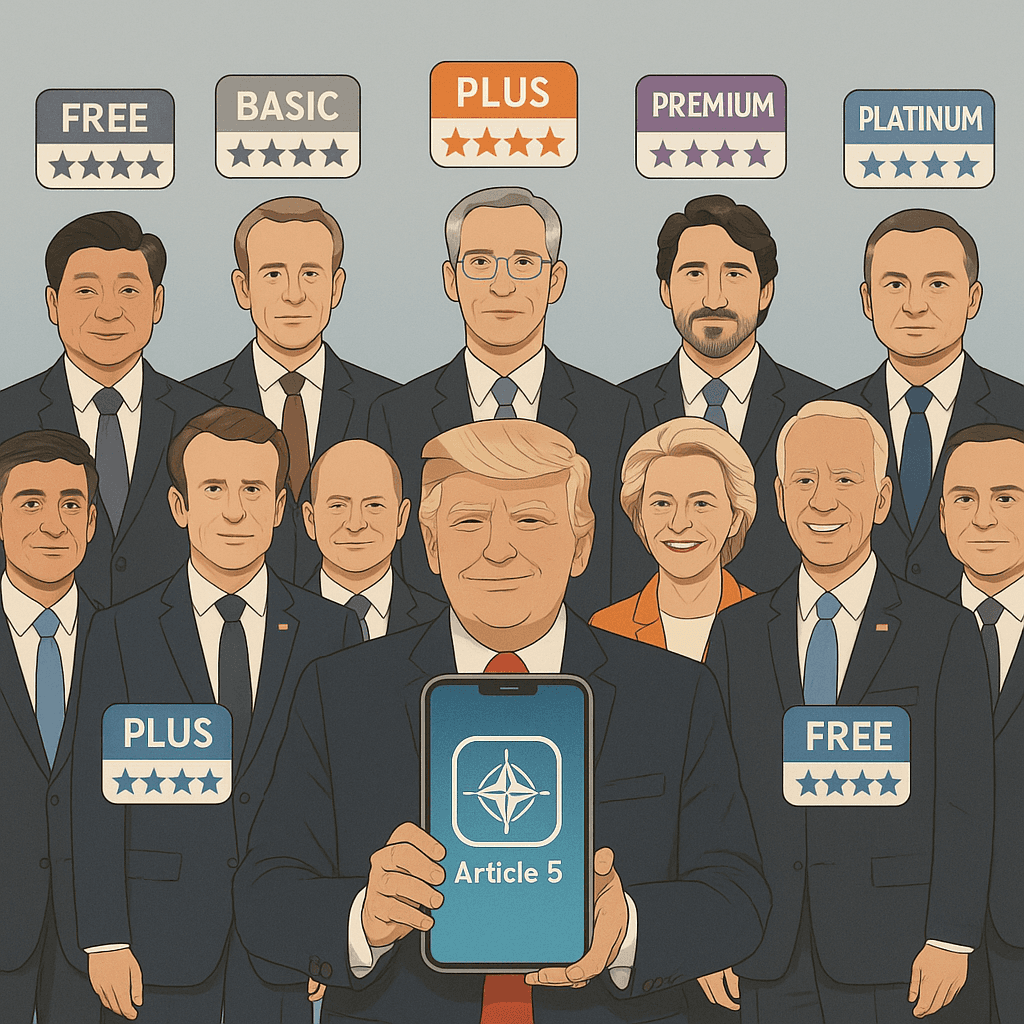
In a development experts called inevitable, NATO leaders gathering for a high-stakes summit are quietly rolling out a new app that will algorithmically determine which allies get defended first, with Donald Trump’s social media engagement and Iran-war obedience set as default weighting factors.
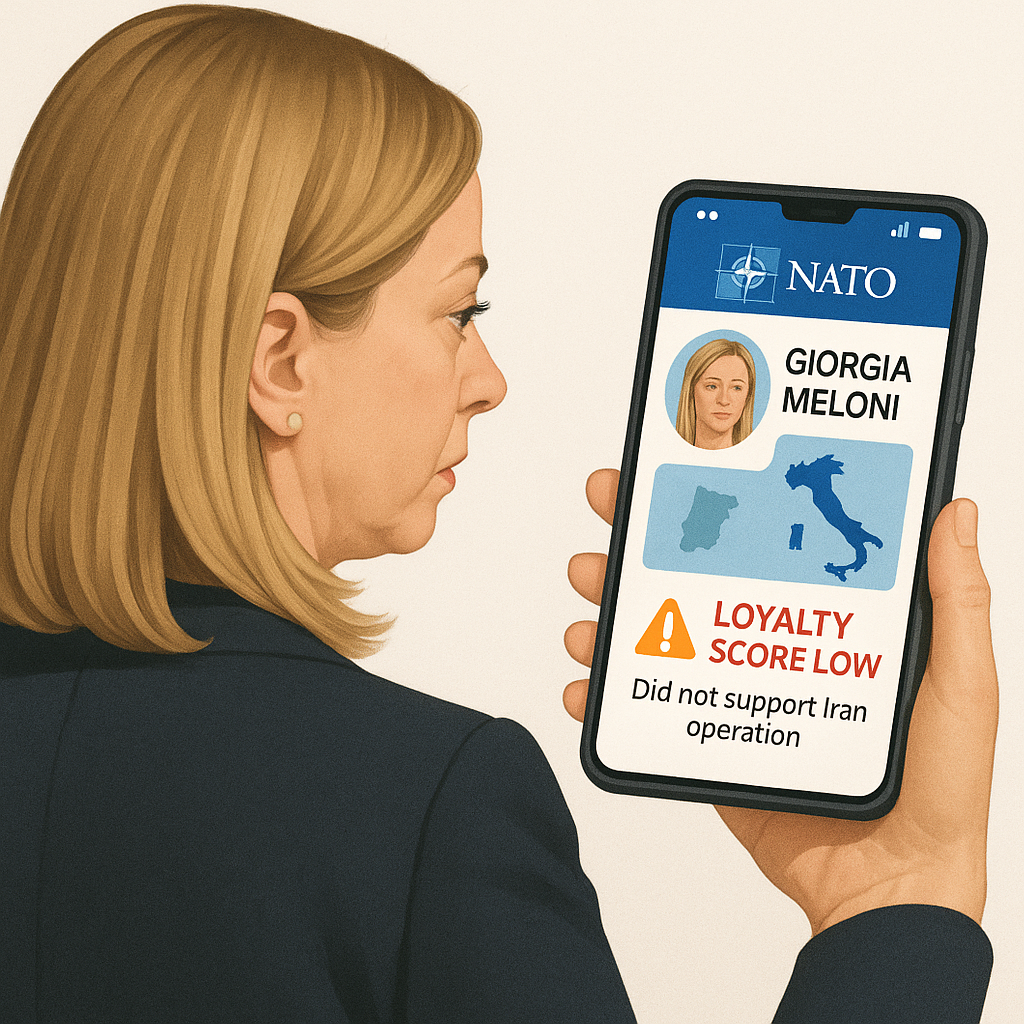
The beta version of the system, informally known as Article 5 Pro, debuted just as Trump arrived at the summit and began taunting Italian Prime Minister Giorgia Meloni with a fresh photo salvo on Truth Social. According to Fox News, the former president said Italy, Germany and France had been “tested” on supporting his Iran operation and “made a mistake.” In the app, this appears as a red exclamation point next to their names and a gentle push notification: “Your loyalty score is below optimal. Consider reposting a Trump meme.”
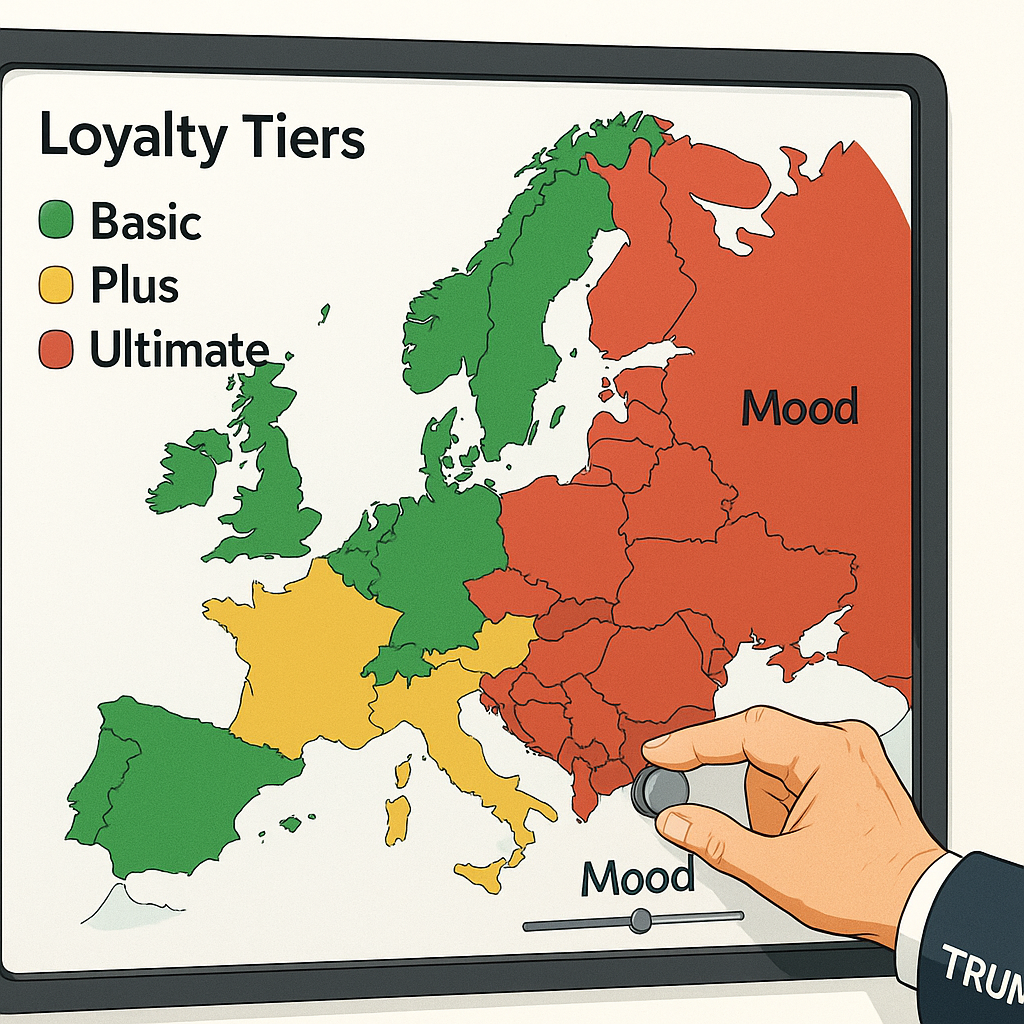
NATO officials insist this is simply modernization. “We are not replacing collective defense with a popularity contest,” Secretary-General Mark Rutte said, standing in front of a screen that displayed a heat map of Europe and a slider labeled ‘Trump Mood: Rally vs. Deposition.’ “We are just using data-driven insights to allocate existential security.”
The app, produced in partnership with an unnamed Silicon Valley firm that previously optimized ad targeting for diet tea and coup attempts, calculates a composite “Alliance Commitment Score” for each member state. According to internal documents viewed by Politico and immediately screenshotted by every Russian diplomat on X, the score includes:
- Percent of GDP spent on defense (2 percent gets you into Bronze, 3 percent and above unlocks “Seen As Serious” mode)
- Number of times the leader has publicly agreed with Trump about Iran “in the last 24 hours”
- Historical frequency of awkward summit photos where the leader appears to be edging away from Trump
- Willingness to call Iran strikes “beautiful” instead of “legally complicated”
Giorgia Meloni’s profile, analysts noted, shows strong performance on defense spending and culture-war synergy, but a sharp “values gap” on volunteering Italian assets for Trump’s Iran operation. The system categorizes this under “Inconsistent Brand Messaging.”
“She made a mistake,” Trump told Newsweek about Meloni’s refusal to back his strikes. In the app’s interface this sentiment appears as a tooltip over Italy, reading, “Influencer not currently collaborating with campaign.” Users can tap for suggested remedies such as “Schedule bilateral,” “Offer photo op,” or “Leak story about pasta tariffs.”
Trump’s advisers say the technology is long overdue. “For decades, NATO has treated security as a flat-rate plan,” one aide explained. “We are moving to a usage-based model. If you do not support the Iran war, if you post one frowny-face about civilian casualties, why should you get unlimited American deterrence?”
Under the new scheme, allies are automatically sorted into three tiers:
- Article 5 Basic: Includes strongly worded communiqués, a concerned phone call from Brussels, and access to Rutte’s “We Are Very United” press conference template.
- Article 5 Plus: Adds actual deployments, meaningful air defense, and occasional photo ops where Trump does not visibly roll his eyes.
- Article 5 Ultimate (by invitation only): Prioritized reinforcement if Russia advances or Iran escalates, pre-cleared talking points for U.S. cable news, and a guaranteed slot for your president on a sympathetic Sunday show to say, “We were always on his side.”
Finland’s President Alexander Stubb, who recently gave an on-camera tour of his soul to Politico, tried to put an upbeat spin on the pivot. “We Finnish people are very calm,” he said. “We understand that deterrence is now a kind of subscription bundle. We are cool with that. We have always paid our bills. Also we have Russia on the border so, you know, whatever you want us to tap Accept on, just send it over.”
European diplomats, briefed on Trump’s claim that he was just “testing” allies who would not join his Iran operation, expressed concern that NATO’s new tech stack could blur the line between legal obligation and vibes. One German official, speaking anonymously because their country’s push alerts are still in beta, summarized the problem: “Article 5 is supposed to be like gravity. Now it feels like an Uber rating. You miss one ride to Tehran, suddenly you are at 4.2 and the car might not come.”
In a private session, security aides walked leaders through a demo of the “Crisis Dashboard,” a Google-Maps-style interface that displays live threats from Russia’s reported “shadow fleet,” missile trajectories from Iran, and Trump’s latest posts about who is freeloading. At the top, a banner gently reminds users that “U.S. protection may be delayed if you have previously declined partnership opportunities in the Middle East theater.”
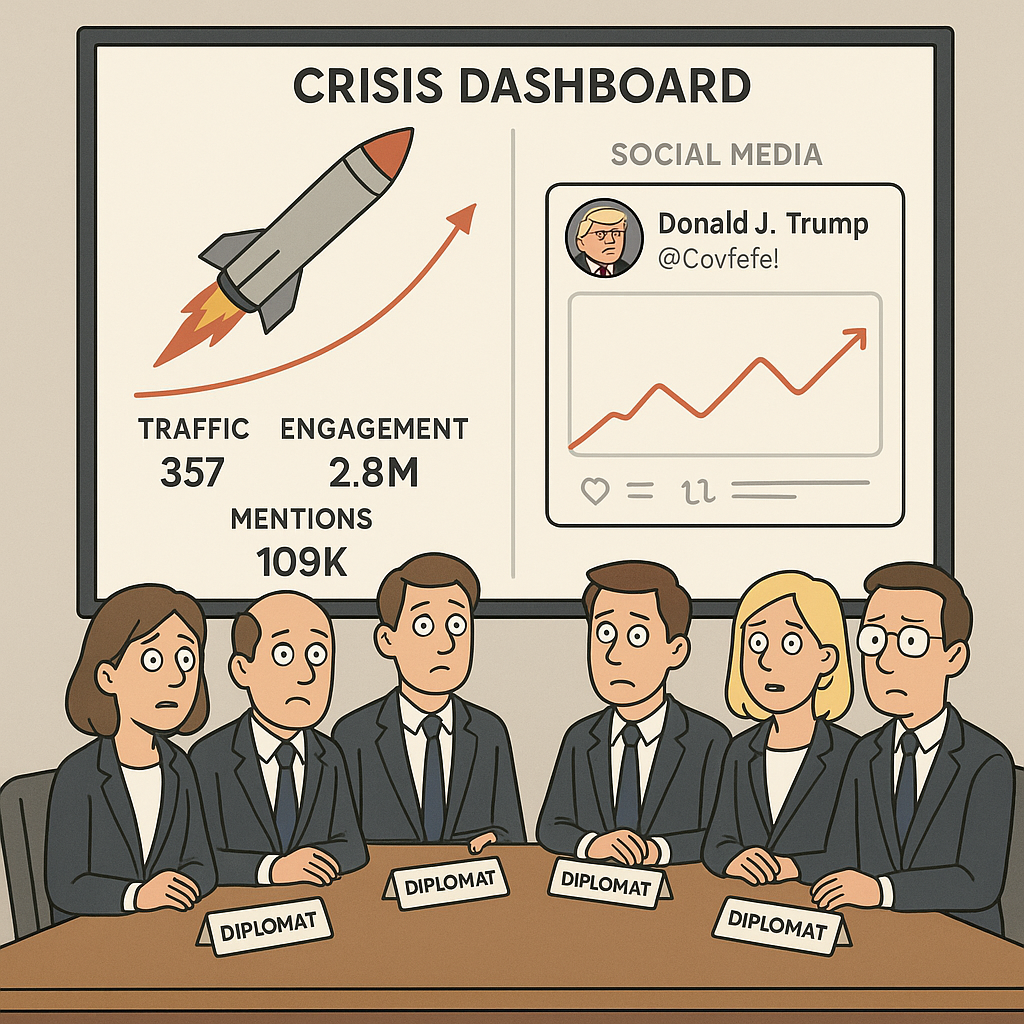
To calm nerves, Rutte highlighted a new “Quiet Diplomacy” setting. When toggled on, the system automatically suppresses Trump’s more incendiary comments in alliance channels and replaces them with pre-written alternatives like: “The president reiterates his unwavering commitment to transatlantic security, conditional on everyone doing the right thing, which you definitely know.”
Even so, the Iran rift is bleeding into other modules. A draft of the summit communiqué, obtained by Reuters and texted into at least seven ministerial group chats, reportedly contains three options for the paragraph on Iran. They range from “We fully support U.S. actions” to “We recognize the complexity of the region” to a compromise suggested by France: “We warmly note that some things have occurred in Iran and that, philosophically, war does raise questions.” Only the most U.S.-aligned allies can view option one. The rest see a spinning wheel labeled “Waiting for authorization from Washington.”
In Washington, officials insist the system will actually strengthen deterrence. Congressional hawks have started using the app’s country cards in hearings. “You say you meet the 2 percent target,” one senator told a visiting minister, “but your Trump Interaction Index is abysmal. Zero joint golf rounds, no coordinated Iran statements, and the last time he posted a photo with you, your body language ranked ‘hostile’ by our AI. Explain why American voters should risk their sons and daughters for that.”
At the same time, lifestyle-minded Europeans are toying with a different response: emotional decoupling masked as wellness. One EU diplomat described the emerging mood as “strategic autonomy, but in a soft launch.” Over coffee, she scrolled through the app’s settings. “You see this toggle, ‘Rely on U.S. extended deterrence’? It is permanently on. No option to unsubscribe. You can change your profile picture, though.”
On the summit sidelines, Giorgia Meloni tried to reset the vibe with Trump, reportedly suggesting a joint photo in front of NATO’s gleaming HQ. Trump countered by pulling out his phone and showing her his feed of memes portraying her as “Weak On Iran” and “Not Even A Good Populist.” According to witnesses, Meloni smiled tightly, turned to an aide, and whispered, “Find out if Article 5 can be mirrored to iCloud Europe.”
Russia and Iran, watching from a safe distance, are said to be building their own dashboards to track the cracks. Their strategists no longer ask whether NATO will respond to aggression. They ask who in the alliance remembered to keep their receipts, update their app, and like the right photo at the right time.
Back in the main hall, leaders lined up for the traditional “family photo.” Trump moved deliberately, placing himself at the center, just ahead of Rutte and Stubb. Somewhere in the cloud, the system logged a new dataset: facial proximity, relative enthusiasm, number of eyes visibly rolled.
The picture flashed across screens. Within seconds, phones across Europe buzzed with the same push notification, soft and neutral in its language, sharp in its meaning: “Your security settings have been updated. Some features may no longer be available in your region.”



