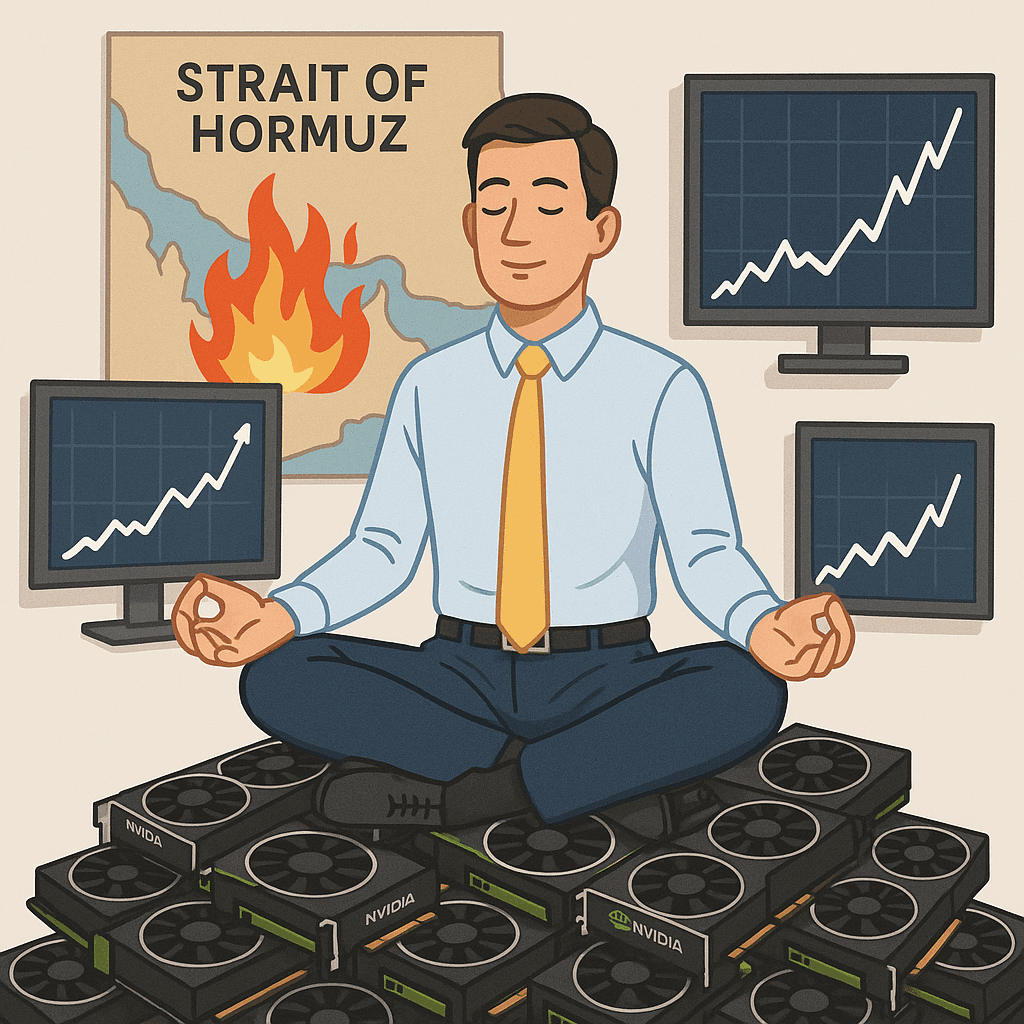
Global markets are trying a new form of emotional risk management: treating the closure of the Strait of Hormuz as stressful background news while focusing their attention on Nvidia and the broader AI rally. The goal is simple. Keep the war in one mental tab, keep the boom in another, and hope the separation holds.
Reuters notes that thirty-year U.S. Treasury yields are at their highest since 2007, the U.S.-Israeli war with Iran has effectively shut a corridor that carries a fifth of the world’s oil, and legal disputes are ripping through shipping contracts like a cleanse for maritime lawyers. Yet the S&P 500 sits within 1 percent of its all-time high, nourished by an AI rally that investors assure themselves is “non-physical” and therefore “war-proof,” as if oil futures and GPU clusters live on different planets with separate weather systems.
“Markets can absolutely handle the Hormuz shock,” said one strategist at a major U.S. bank, opening four different charts of Nvidia while minimizing a live map of tanker traffic and a Department of Energy briefing. “We are in a new paradigm where war-driven inflation is a headwind, but AI-driven vibes are a tailwind. On net, it’s breezy, provided you do not zoom out to the part of the chart labeled ‘reality.’”
Central banks are less aligned with the vibe. The Federal Reserve’s latest minutes, cited by Reuters, show officials increasingly open to renewed rate hikes as energy prices push CPI and PCE to their highest levels in three years. The Bank of Japan, which has been trying to manifest higher inflation since approximately the Late Cretaceous, now finds itself rewarded with the kind of price spikes that come with war, currency pressure, and a nagging feeling that it picked the wrong decade to own government debt.
“We have a dual mandate,” a Fed official said on background. “Price stability, and not being the one that pops the Nvidia chart on CNBC. It is a delicate yoga pose that involves pretending the Strait of Hormuz is a sentiment indicator and not a place.”
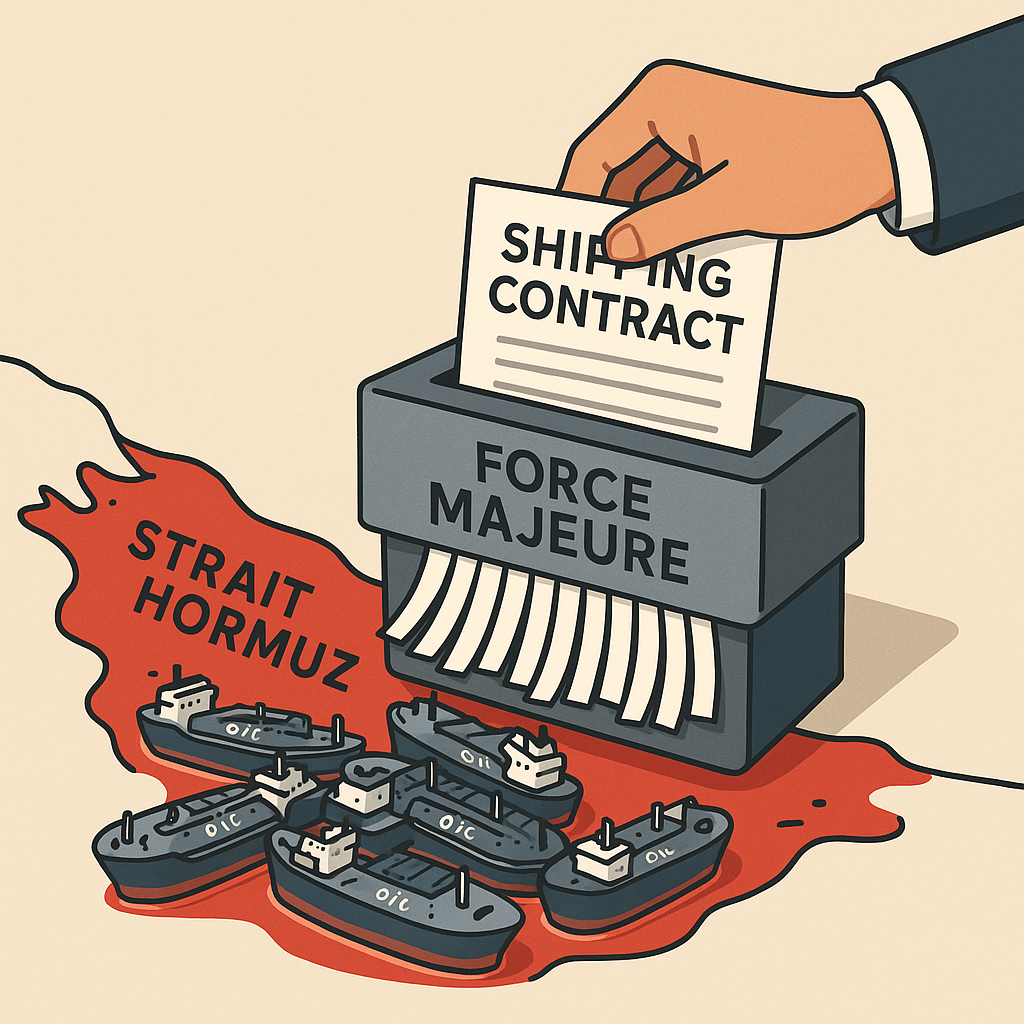
Meanwhile, the closure of Hormuz is transforming global shipping law into a boutique fitness class. According to the Financial Times, oil traders, insurers, and shipowners are battling over whether a literal war blocking a literal chokepoint is a valid force majeure event or simply a failure of individual resilience.
“War is not specifically listed in subclause 14(c), which refers to ‘Acts of God and/or unforeseen events,’” explained one London maritime lawyer, adjusting his noise-cancelling headphones. “And frankly, in this market, a prolonged U.S.-Israeli conflict with Iran that closes the Strait of Hormuz should have been foreseen by anyone who glances at the front page between AI webinars and their daily prompt-engineering podcast.”
The disputes have left millions of barrels of oil functionally orphaned, drifting in legal limbo while energy-importing governments debate whether to subsidize fuel bills with additional borrowing or simply encourage citizens to embrace walking meetings as a lifestyle choice.
“This is a moment to reimagine mobility,” said one European official, quoting a recent GovTech feature on multimodal transit. “Yes, petrol is unaffordable, but have you tried e-scooters, bicycles, or staying home and training a large language model for your bank until it replaces you?”
Investors, however, remain focused on Nvidia’s latest forecast of 91 billion dollars in quarterly revenue, which Reuters described as reinforcing “robust AI-related spending trends.” Many have adopted a simple holistic framework for parsing macro risk:
- Is the war happening on a GPU?
- Can the Strait of Hormuz be tokenized?
- Has Nvidia guided down?
“Oil is analog,” said an equity fund manager, closing a tab about rising Arab Gulf insurance premia and opening a blog post about tokenizer efficiency. “We are rotating from petroleum to parameters. From barrels per day to tokens per second. From Hormuz to H100. This is a megatrend, or at least it is until someone asks how you backtest a shipping lane.”
Bond markets are less spiritual about the distinction. With thirty-year U.S. yields climbing and term premia widening, the U.S. Treasury market has begun what analysts tenderly call “a conversation” with fiscal policy. Governments that spent the last decade treating debt service as a quaint historical term are now learning that borrowing trillions to subsidize electricity for AI data centers and gasoline for voters counts as a “lifestyle choice with consequences.”
“We are fully committed to shielding households from energy prices,” said a G7 finance minister, through a smile that did not quite reach their bond auction calendar. “And we are confident markets will understand that this new 500 billion dollar program to cap petrol and household bills is really a productivity investment in our national mood.”
Back in corporate earnings, the split between the machine-curated future and the meat-based present is widening. Costco, Salesforce, and Best Buy are providing, as Reuters puts it, a near-term read on both AI capex and consumer resilience. Best Buy reports that consumers are trading down to smaller TVs yet remain eager to finance ever larger GPUs they learned about on TikTok. Salesforce says enterprise clients are cutting travel budgets while increasing spend on “AI copilots” that help middle managers write longer emails about who should own the risk register for Hormuz.
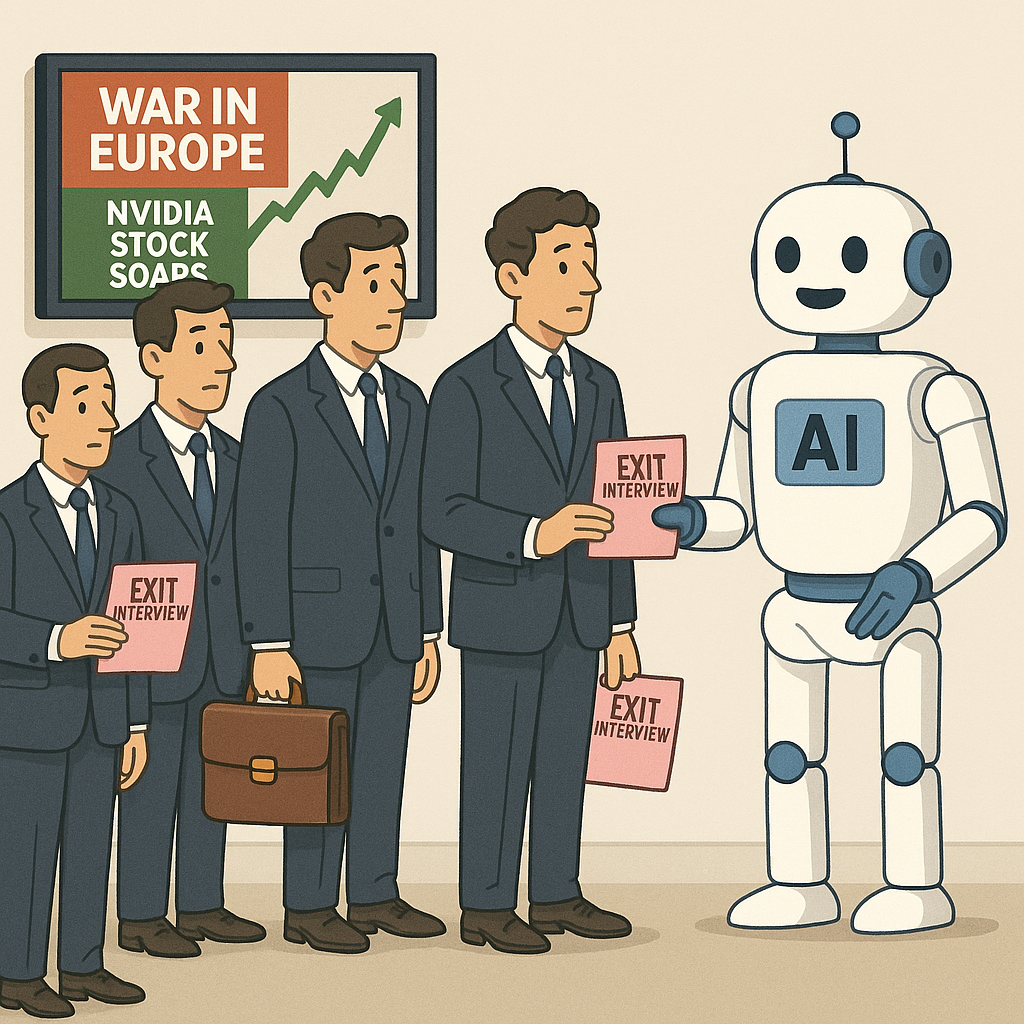
“We see strong demand for AI that explains macro uncertainty using slightly different synonyms each quarter,” a Salesforce executive told analysts. “Clients tell us it is deeply empowering to be laid off by a model that can reference both the Strait of Hormuz and Nvidia’s data center roadmap in the same paragraph.”
Financial institutions are moving more quickly. Standard Chartered, as highlighted by Reuters, plans to replace roughly 8,000 “lower-value human capital” roles with AI. JPMorgan and HSBC have offered similar guidance, framing it as a productivity initiative that will free staff to perform “higher-order tasks,” which internal memos define as “reading more AI strategy PDFs before being reclassified as lower-value human capital.”
“We are not just cutting jobs,” said a senior banker who requested anonymity because their human capital was also under review. “We are creating a diversified portfolio of anxieties. Some are about Iran, some are about inflation, and some are about whether your replacement has a context window larger than your mortgage.”
In Washington, where the Washington Post reports that voter confidence in the economy has fallen to a four-year low, politicians are attempting to rebrand the whole situation as a misunderstood growth hack. President Donald Trump is testing economic messages in a competitive New York district, touting a tax law that quadrupled the federal deduction for state and local taxes while inflation and borrowing costs quietly stretch household budgets like aging yoga pants.
“Voters may not yet feel the benefits of this economy,” said one campaign adviser, “because the benefits are largely embedded in forward earnings multiples of AI-heavy firms that are not technically headquartered in their congressional district. But we believe that by Q4, they will feel seen, at least by an ad-targeting algorithm.”
Tech executives have responded to the war-inflation-bond-yield situation with their usual modesty. SpaceX, OpenAI, and Anthropic are reportedly lining up “fast entry” IPOs, according to the Financial Times, in an effort to give investors more options for ignoring the Strait of Hormuz in a structured, SEC-registered format. Each prospectus will include a short section on “geopolitical risk,” followed by 200 pages of pro forma cash flows and a collage of servers glowing in the desert.
“Energy prices are elevated,” one banker close to the deals acknowledged, “but our clients view that as a catalyst. Data centers are basically oil refineries for attention. This is a hedge. Against reality.”
At NASA, where a recent bulletin highlighted a webinar on space interferometry and new AI tools to track harmful algae, scientists appear to be the only people willing to say the quiet part out loud: that physical constraints still exist, even in PowerPoint. One researcher described the global situation as “trying to run diffusion models on a planet that is low on coolant.”
“We keep adding more AI workloads without upgrading the thermal design of civilization,” they said. “It is not optimal.”
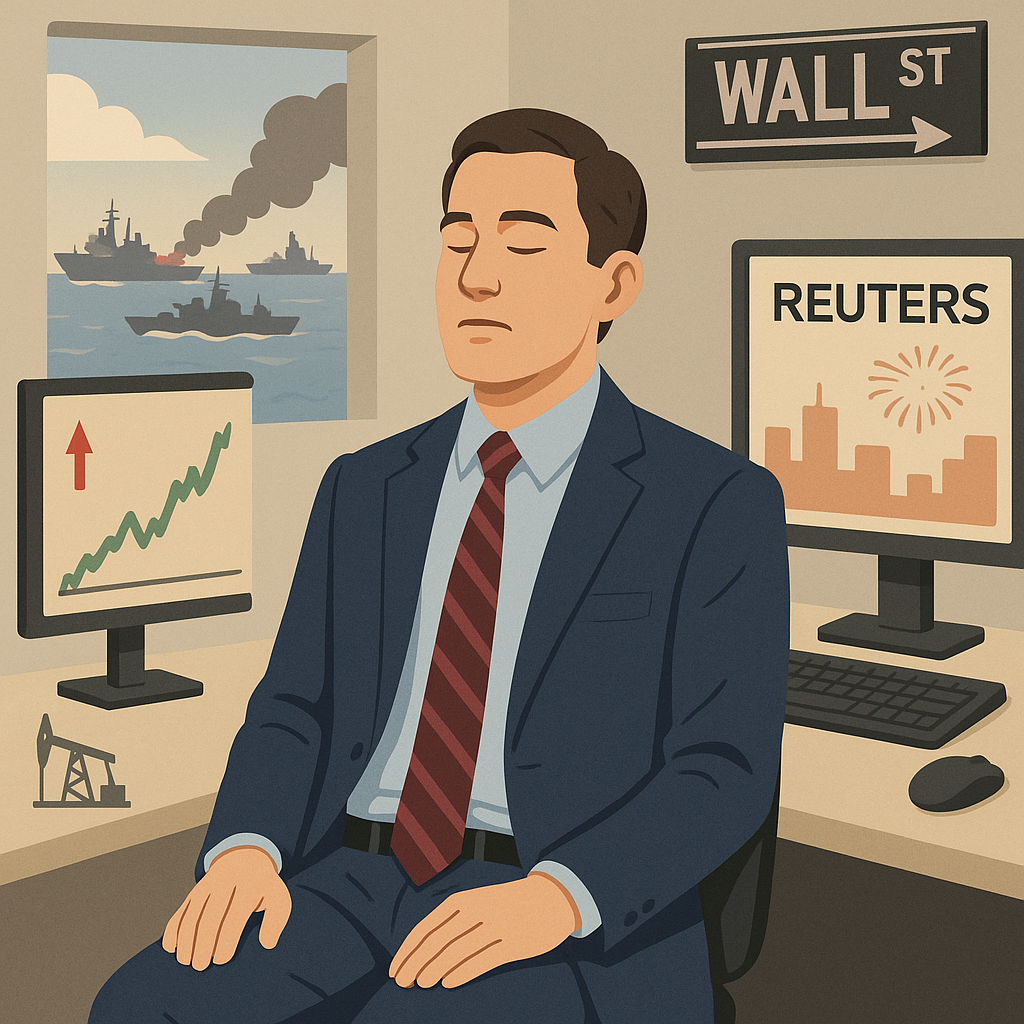
In private, central bankers concede that something will have to give: the AI trade, the energy supply chain, or their own resolve. Yet publicly, they affirm their data-dependence and commitment to a “soft landing,” a phrase that now describes both the hoped-for economic outcome and the best-case scenario for any tanker forced to turn around at Hormuz with a hold full of unbilled crude.
For now, markets continue to choose their reality. On one screen, red lines track yields, oil, and Middle East risk premia grinding higher. On the other, a green line representing Nvidia arcs cheerfully into the stratosphere, unbothered by geography or combustion.
Asked which screen was more important for asset allocation, one portfolio manager did not hesitate.
“We invest in the line that is going up,” they said. “If the other line becomes a problem, we will hire AI to explain why it was unforeseeable.”