In a development Gulf insurers called both historic and nonrefundable, the United States has turned the renewed U.S.-Iran conflict into a global pilot program for surge pricing on basic civilization.
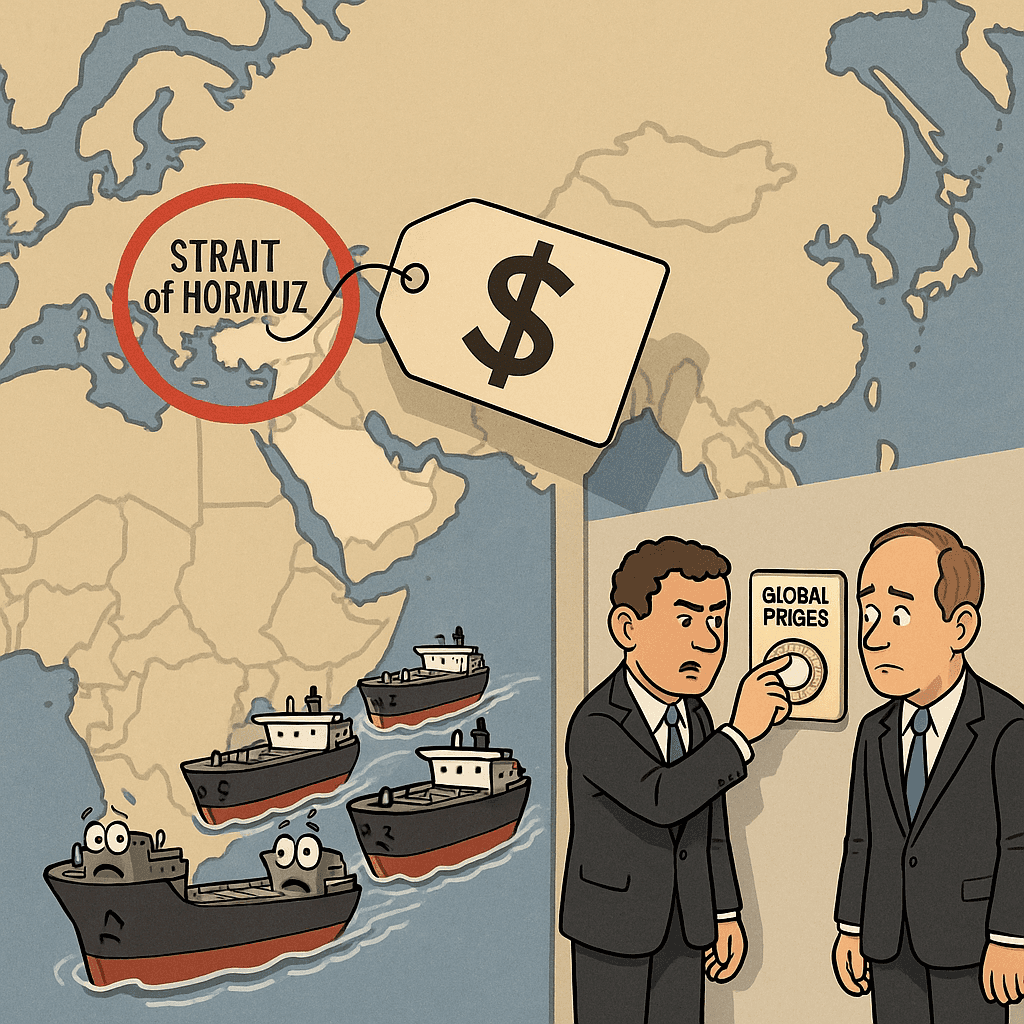
As reported by The New York Times in its cheery beach read, “Oil, Shipping, Flights: Disruptions Are Back as U.S.-Iran War Reignites,” the fighting around the Strait of Hormuz is already scrambling oil markets, commercial shipping, and global air routes. The Biden administration insists this is not a crisis, but a “live-fire stress test of supply-chain resilience with meaningful opportunities for shareholder value.” One senior official helpfully described it as “Uber, but for chokepoints.”
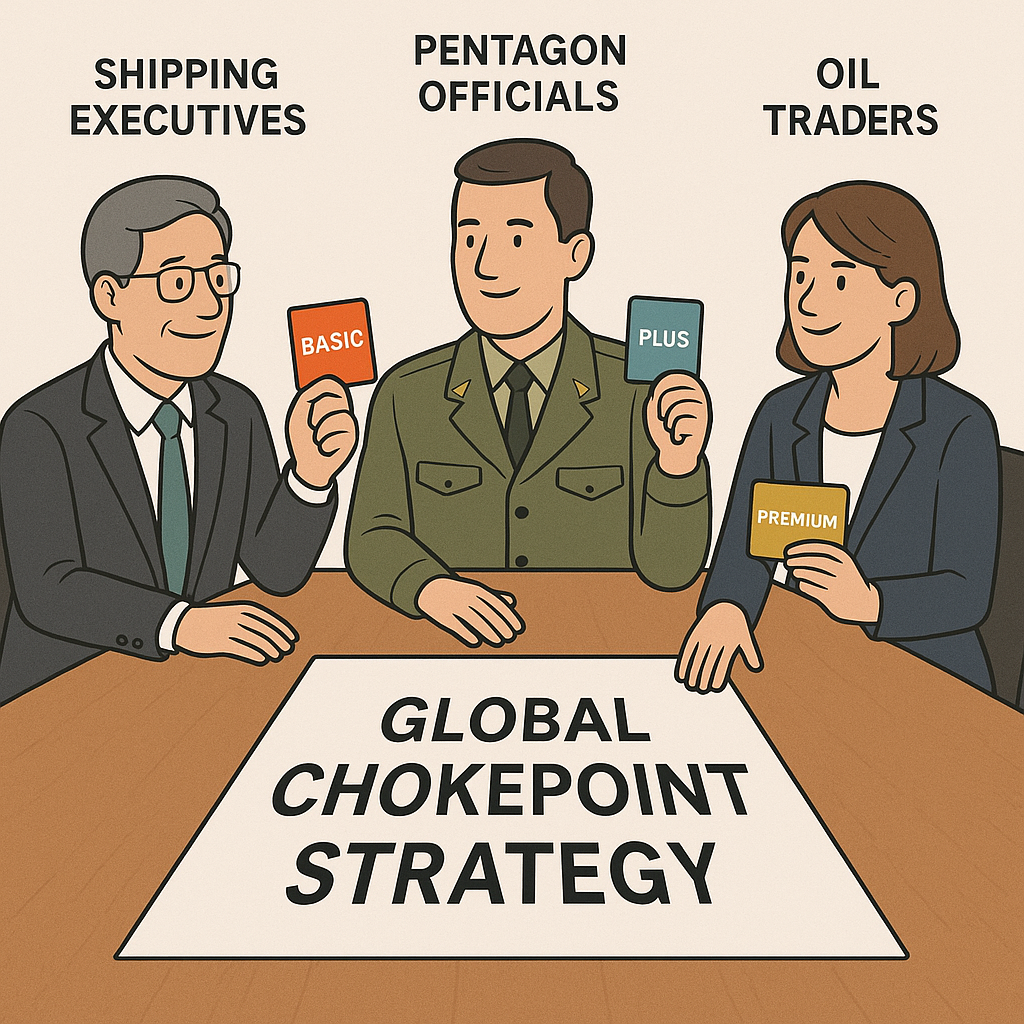
The Pentagon confirmed that the U.S. Navy and Central Command, or CENTCOM, are now operating under a new doctrine called “Freedom of Navigation, For A Price.” Under the strategy, tankers can choose from three options:
- Basic: Transit near the Strait of Hormuz, get menaced by small Islamic Revolutionary Guard Corps boats, pay quadruple insurance, receive one sternly worded State Department tweet.
- Plus: Includes a U.S. destroyer escort, one pre-cleared flight corridor, priority access to emergency Zoom calls with Treasury.
- Premium Global Stability: Comes with guaranteed passage, a 30-day price cap on Brent crude, and the White House temporarily pretending this has nothing to do with the election.
“We remain committed to freedom of navigation,” a Defense Department spokesperson said, adjusting a binder labeled Hormuz Monetization Framework, “though obviously the definition of ‘free’ evolves with market conditions.”
Oil traders responded to the escalation around key maritime chokepoints with a subtle, reasoned approach, which is to say that benchmark prices shot up the moment someone in the Gulf of Oman sneezed near a tanker. Brent and West Texas Intermediate spent the week seesawing between “painful” and “campaign ad” as news of attacks, seizures, and near-misses floated across terminals and television chyrons.
At the Strait of Hormuz itself, where roughly a fifth of the world’s oil normally squeezes out, ship captains are now asked to pick their preferred risk tolerance from a laminated menu that was clearly repurposed from a SoulCycle studio. Options range from “Transit as Normal” to “Full Panic Diversion via the Cape of Good Hope, Add 9 Days and $40 Million.” A QR code at the bottom links to a loyalty program called “Strait Miles.”
“We used to worry about weather, pirates, maybe sanctions,” said one European shipping executive in Piraeus, staring at a map that looked like an airline route poster designed by a conspiracy theorist. “Now CENTCOM is live-blogging missile trajectories to help us plan our fuel hedging strategy. My therapist says this is not a sustainable business model.”
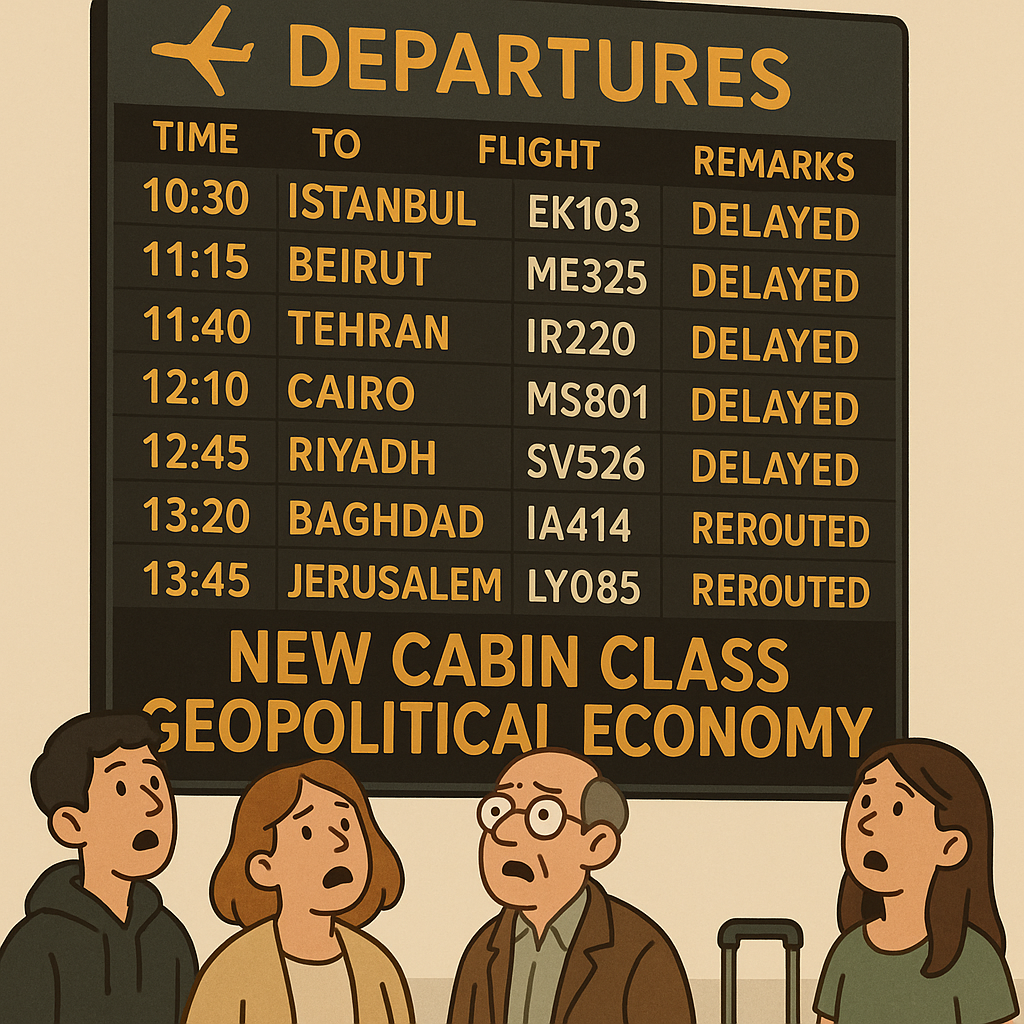
Airlines are not faring better. With airspace closures and rerouted Europe–Asia flights, carriers have discovered that the phrase “slight detour for your safety” now translates to “You will arrive tomorrow and tickets cost the price of a used Honda.” Low-cost airlines, whose entire business model is pretending physics do not exist, have responded by inventing a new cabin class called “Geopolitical Economy.”
“Passengers in Geopolitical Economy will enjoy a complimentary push notification every time Brent spikes during their flight,” explained one airline executive at a Dubai aviation conference. “Also, no snacks.”
Inside Washington, the war is colliding neatly with domestic political narratives. Republicans accuse the administration of being weak on Iran and strong on wind turbines. Democrats accuse Republicans of wanting to invade every country whose name appears on a gas station receipt. Both sides agree that the real villain is Americans who are still upset about $4 gas instead of focusing on the bigger picture, which is that America is a beacon of freedom whose trade flows now depend on whether a drone misreads an Iranian fishing boat.
As the conflict reverberates, the White House economic team is floating a range of responses that all involve someone else paying. Options under review include:
- Tapping the Strategic Petroleum Reserve again, although staff quietly note it is starting to resemble a college student’s freezer in mid May.
- Issuing fuel rebates to “hardworking middle-class families” defined as anyone who still believes this is a temporary shock.
- Rebranding inflation as “conflict-adjusted pricing” and hoping Pew stops publishing global opinion surveys.
The war is also serving as a useful backdrop for security crackdowns at home. With renewed talk of national security and border enforcement, immigration officials are under pressure to “connect the dots,” a phrase that reliably precedes new ways to pull people over. Asked about concerns that overseas conflict is being used to justify domestic surveillance, one senior aide replied, “Voters crave safety and predictability. That is why we intend to give them random gas spikes, surprise flight cancellations, and more traffic stops.”
Abroad, allies in Europe and Asia are doing what they do best: issuing grave statements while checking if there are any spare LNG cargoes that have not been pre-booked by somebody richer. Many quietly wonder whether to fully align with U.S. strategy or hedge with their own regional deals that involve fewer aircraft carriers and more memorandums of understanding.
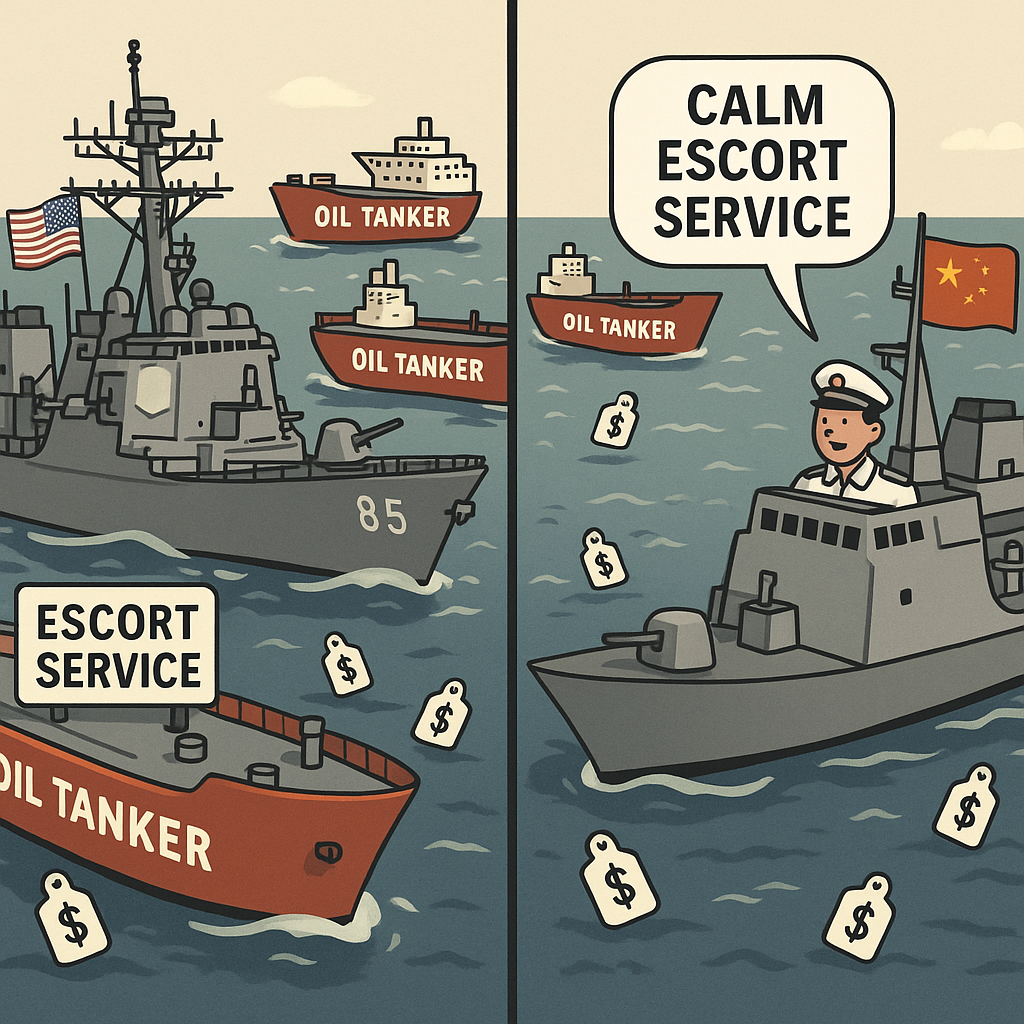
China, watching energy prices climb like a tech IPO chart, has identified an opportunity. Citing a recent global survey reported by the Associated Press, in which China and Xi Jinping scored more favorably in many nations than the United States and its former president, Beijing is reportedly drafting a proposal to “facilitate stability” in the Persian Gulf. The plan features a joint naval escort program, a new “Silk Route Risk Insurance Facility,” and a photo op where nobody shouts.
“We support freedom of navigation and low volatility,” a Chinese foreign ministry spokesperson said in an almost bored tone at a regular Beijing press briefing. “We believe shipping lanes should carry energy, not messaging.”
In private, U.S. officials insist Washington is still clearly in charge. Evidence of this leadership includes: a rotating task force name for every maritime incident, brisk coordination calls with oil CEOs, and the ability to hold a press conference that mentions “long-term energy transition” and “short-term targeted measures” in the same breath without blushing.
Energy transition advocates, for their part, are trying to figure out how to get anyone to talk about renewables while oil tankers are literally dodging drones. One climate policy analyst in Brussels, speaking over the sound of another CENTCOM briefing, observed, “The world is learning that basing your economy on a fossil fuel that must be physically dragged through a narrow sea controlled by people who hate each other is maybe, and I am going out on a limb here, suboptimal.”
Yet in practice, most governments are responding to the conflict by doing three things at once: vowing to accelerate the transition, subsidizing fossil fuel consumption, and commissioning more warships to protect the chokepoints that keep the old system barely alive. It is an elegant trifecta that ensures nobody can accuse them of inaction, only incoherence.
Markets, which are allergic to both war and structural change, are betting on something simpler. Traders expect a managed escalation in which the United States and Iran trade calibrated blows around the Strait of Hormuz, shipping companies raise their “war risk surcharge,” airlines quietly shave routes, and leaders from Washington to Beijing insist everything is under control as long as Brent does not cross the line where voters discover what the word “chokepoint” actually means.
Back at the White House podium, a senior official tried to reassure a nervous press corps. “We have tools,” he said. “We have the Strategic Petroleum Reserve, we have agile diplomacy, and we have deep experience managing complex crises.”
Asked whether any of those tools involve making the global economy less dependent on a single vulnerable waterway for its fuel, he paused.
“We are not ruling out a task force to study that,” he replied. “Once the current disruption has passed and we can safely ignore it again.”