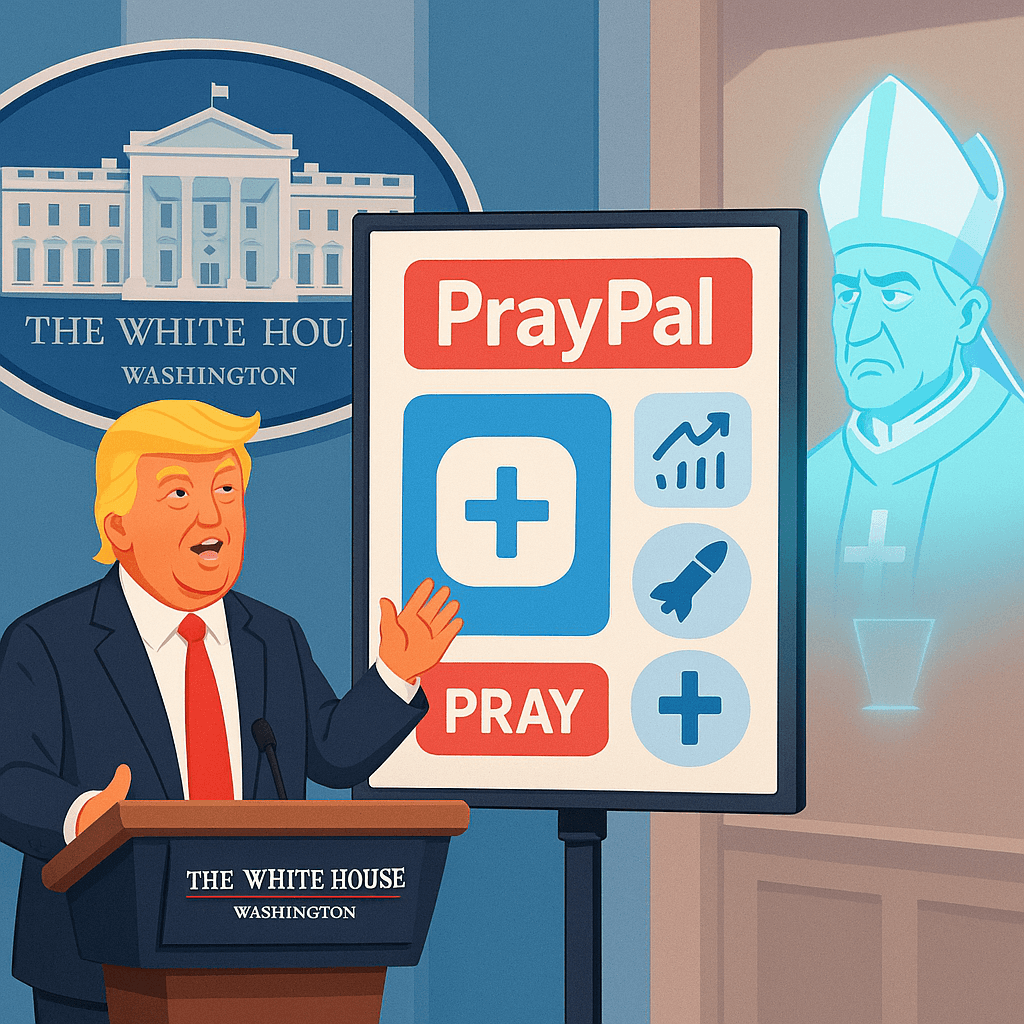
In a development experts called inevitable, the White House has reportedly responded to Pope Leo’s criticism of “tyrants” and the faltering Iran war by quietly rolling out a new enterprise platform designed to algorithmically monetize religious backlash.
The product, described by one adviser as “Salesforce for souls,” arrives just as President Donald Trump lashes out at Pope Leo again over the Iran campaign, hours before Sen. Marco Rubio’s scheduled Vatican visit. According to Forbes and the Washington Post, Trump’s approval ratings are sliding to fresh record lows, Republican support for the Iran war is cracking, and voters are loudly rejecting the religion-drenched messaging pushed by Trump and Fox alumnus Pete Hegseth.
The White House solution is apparently more religion, but with dashboards and tiered pricing.
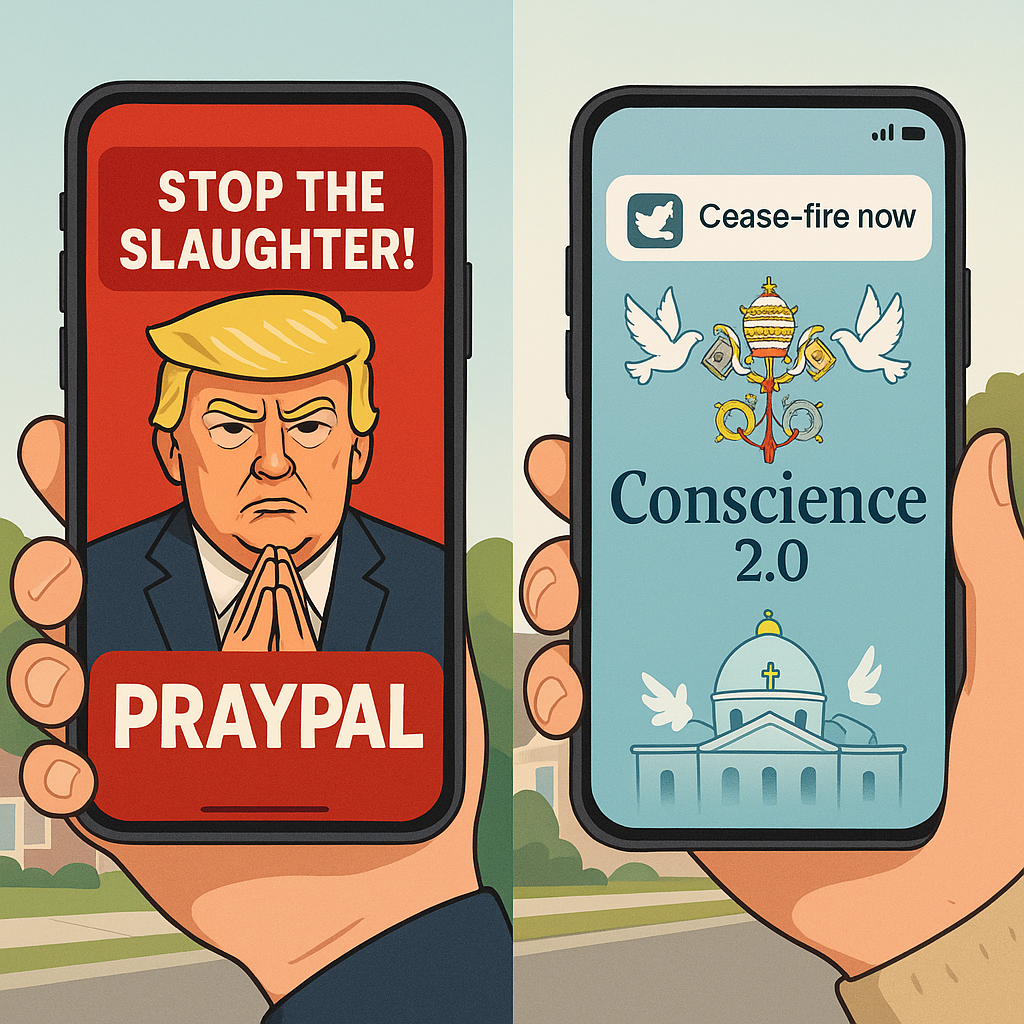
Internally codenamed “PrayPal,” the platform promises campaign officials “real-time insight into the modern worshipper,” along with the ability to A/B test responses to papal comments in under 30 seconds. A leaked brochure, printed on heavyweight stock with a discreet “Not For SEC Review” footer, claims it can “transform every crisis of faith into a scalable engagement funnel” and “reduce expensive conscience events by up to 40 percent.”
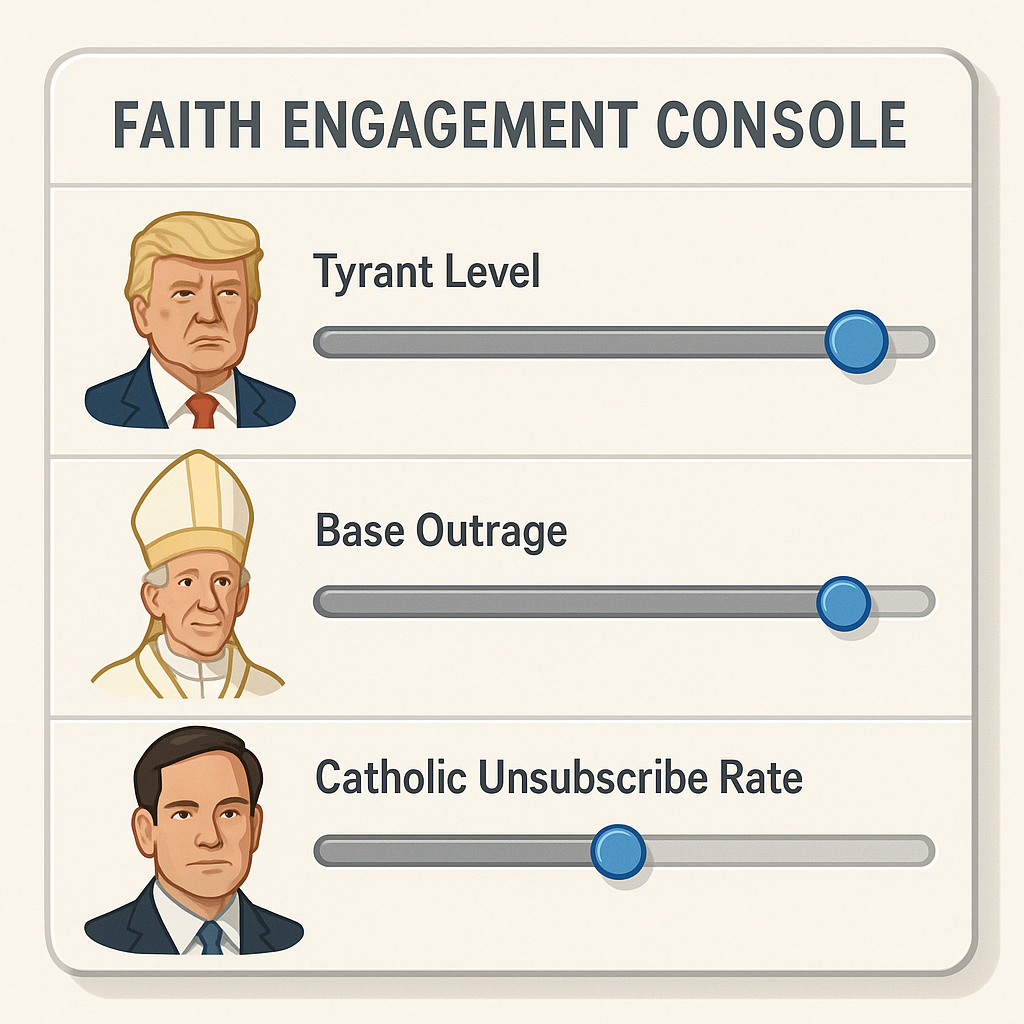
At a closed-door demo for Republican strategists held in the Old Executive Office Building’s “Ronald Reagan Reflection Lab,” a senior aide reportedly walked attendees through the new Faith Engagement Console, a web UI that aggregates polling crosstabs, Fox chyron data, and Vatican press releases into a single pane of glass.
- “Tyrant Sentiment Score”: tracks how many Catholics think Trump is the unnamed tyrant in Pope Leo’s speeches.
- “Hegseth Halo Index”: measures the exact second a swing voter changes the channel after the words “Christian warrior” appear.
- “War Casualty Elasticity”: correlates satellite imagery of U.S. assets hit in Iran with cable news hits declaring “we are winning.”
“We are moving from gut-based demagoguery to data-driven demagoguery,” the aide explained in what staffers described as a soothing, quarterly-earnings tone. “We heard the American people say they do not want religion as a campaign weapon. With PrayPal, we can respect that on a very granular, zip-code-by-zip-code level, then ignore it at scale.”
The timing is delicate. Satellite images reviewed by the Post show Iran has hit far more U.S. military assets than previously admitted, Trump’s approval on the economy and the war is sinking, and a new Washington Post poll finds broad rejection of religion-heavy messages from Trump and Hegseth, especially among Catholics and suburban voters. In response, the president went back to his proven crisis strategy: yelling at a pope on social media.
According to one adviser, PrayPal flagged Pope Leo’s recent reference to “tyrants who clothe violence in piety” as “high-risk content” with potential to cause conscience flare-ups in key Midwestern parishes. Within minutes, the system auto-suggested three response options for Trump:
- “Very unfair, sad pope, should stay out of politics.”
- “No one has done more for Catholics than me, except maybe Jesus, who by the way loves my polls.”
- “Pope is controlled by globalist wind turbines, ask Germany’s drug regulators.”
Sources say Trump organically chose an even less coherent fourth option, which engineers are now backfilling into the model as “ground truth” and labeling as the “Jerusalem Build.”
Rubio, who is en route to Rome for what was supposed to be a fairly traditional diplomacy-meets-photo-op visit, now finds himself cast as an involuntary beta tester. PrayPal’s itinerary module has already generated three routes through the Vatican: “Contrite,” “Respectful Distance,” and “Blame Staffer, Pivot To Religious Freedom.”
“My goal is to honor the Holy Father, represent our country, and not click on any suspicious links the White House sends me,” Rubio told reporters in the Senate basement, while clutching what aides described as a “non-networked rosary.”
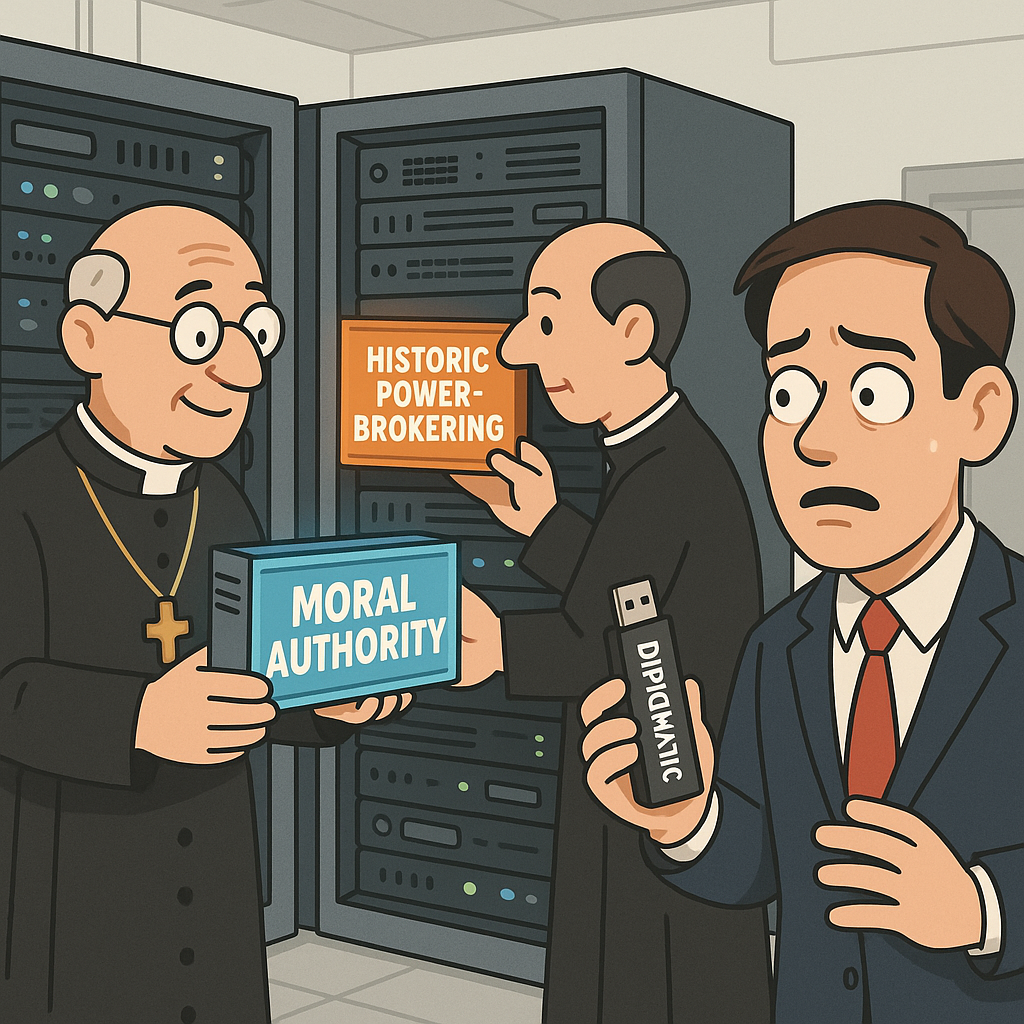
The Vatican, for its part, has not confirmed the existence of a competing cloud product, but longtime observers note it has been running a hybrid moral-analytics operation for centuries. A recent Washington Post analysis on how “the Vatican has always been political” traces a long history of papal power-brokering, from mediating wars to deciding which king was allowed to feel guilty this quarter.
In response to Trump’s latest outburst, Vatican communications reportedly considered, then declined, to optimize their messaging with AI. A draft memo titled “Conscience 2.0” was shelved after staff concluded that “the Sermon on the Mount already achieves acceptable engagement without recommendation algorithms.”
Instead, Pope Leo has continued issuing relatively low-tech criticisms of “tyrants,” gently implying that launching an unpopular Iran war, undercounting U.S. losses, and then fundraising off the body count might not be the pinnacle of Christian statecraft. White House officials privately note that this messaging “performs poorly” with the billionaire donors now exploring tax-advantaged stock donations to Trump accounts.
“We are not anti-faith,” said one senior campaign consultant, speaking outside a donor retreat at Mar-a-Lago’s “Sacred Values Pavilion,” located between the cigar bar and the gift shop. “We are merely pro-structured, monetizable faith flows. In a crowded 2026 environment, you cannot just say ‘love your enemies’ without a call to action. Where is the QR code? Where is the rev-share?”
Tech vendors, sensing a spiritual vacuum, are moving quickly. One security firm has already proposed a classified “space data repository” to monitor hostile satellites and unflattering papal encyclicals in the same feed. A major bank, fresh off bragging to iTnews that it saved 130,000 hours with an AI product, is quietly pitching Republicans on a “Confession-as-a-Service” tool that bulk-summarizes war regrets into investor-friendly talking points.
Chemist Warehouse’s HR bot, widely reported as an emerging “standard pattern,” has allegedly been adapted for campaign use as “Advisor Performance Review.” The AI asks senior staff one simple question: “On a scale from 1 to ‘heretic,’ how willing are you to contradict the base on Iran?” The model then auto-fills their resignation letter.
Public reaction to PrayPal has been mixed. Among hard-core supporters, the idea of a president taking on “the globalist Vatican establishment” while personally curating the app’s push notifications is seen as a feature, not a bug. Among moderate Catholics and evangelicals, early focus groups show pronounced spiritual nausea.
“I do not want my conscience optimized by the same people who optimize his fundraising emails,” said Maria Dominguez, a Catholic voter in Arizona. “If the choice is between the Pope and a pop-up that says ‘Act now, the Lord is matching donations,’ I think I am going with the guy in Rome.”
To address concerns, engineers have quietly added a Wellbeing tab to the platform. The feature, clearly inspired by Silicon Valley “digital detox” culture, allows users to set limits on their exposure to holy rage.
- “Snooze Tyrant Discourse” for 24 hours.
- “Replace War Clips With Puppies” during Sunday services.
- “Auto-Delete Hegseth” after three consecutive uses of the word “crusade.”
This has not stopped the underlying metrics. Trump’s disapproval continues to climb, the Iran war grows more expensive, and the Washington Post poll shows voters across parties souring on religiously framed politics. PrayPal’s churn dashboard, currently visible only to senior staff, marks a rising red line labeled “Catholic Exit Rate in Swing States.”
Inside the West Wing, however, optimism remains unshaken. One official described the clash with Pope Leo, collapsing approval ratings, and open voter disgust at faith-based messaging as “a tremendous product-market fit opportunity in the emerging Christian nationalist niche.”
“Look, will we lose some Catholics who do not want their priest fact-checked in real time by Pete Hegseth?” the official said. “Absolutely. But the ones who stay are highly engaged, highly monetizable, and comfortable receiving war updates as devotional content.”
Asked whether there was any concern about long-term damage to church-state norms, the aide gestured to the glowing PrayPal dashboard, where “Separation of Church and State” appeared under a heading labeled “Legacy Features.”
“Those are not really tracked as KPIs,” he said. “Our north star metric is simple: daily active believers.”