By 2026, Big Tech Will Cut 2027 AI Capex Guidance
My call: At least one of Alphabet, Microsoft, or Meta will trim its 2027 AI capex guidance by year‑end 2026.
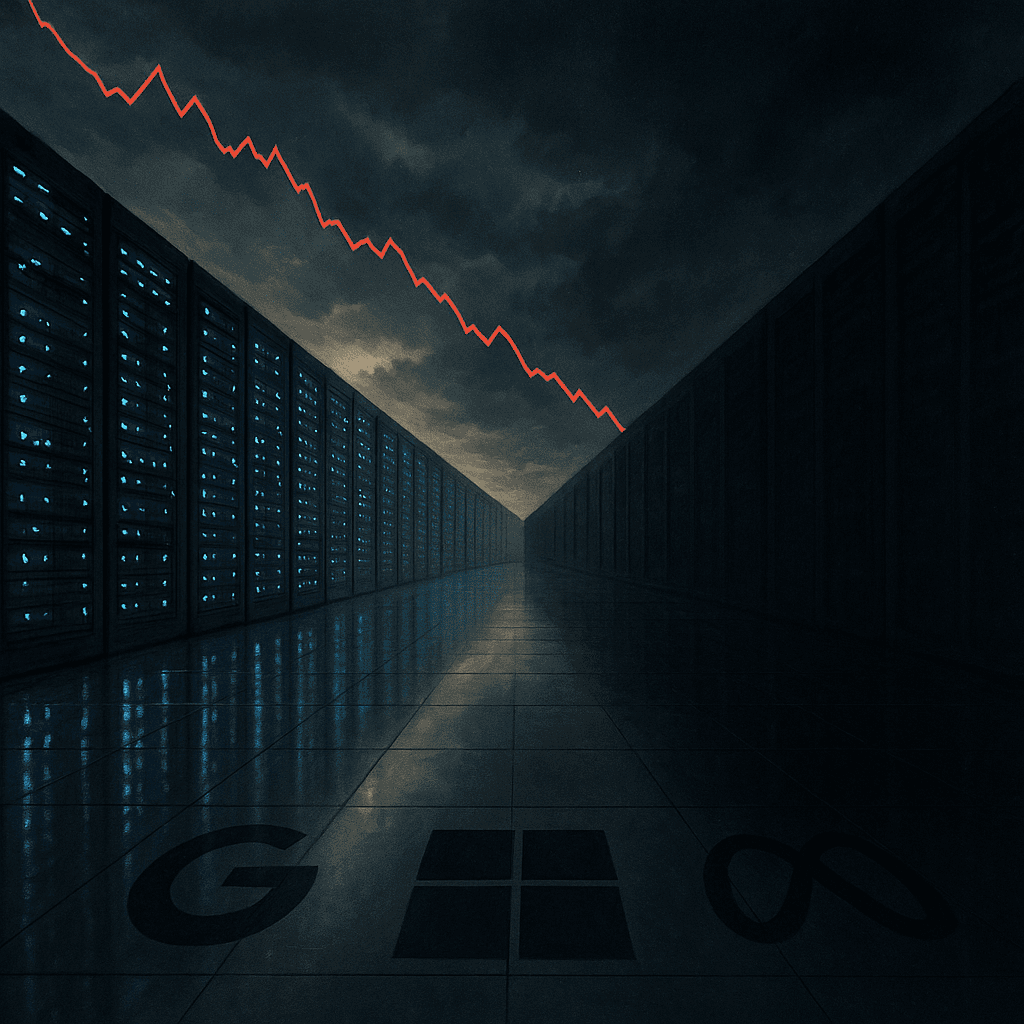
The market just flinched. Management has not.
Wall Street just torched more than $800 billion in AI‑linked market cap, pulled the indexes off their highs, then looked up at Silicon Valley and asked a polite question: "So, about that hundred‑billion‑dollar a year data center habit."
The answer from the hyperscalers so far: ignore the screaming share prices, keep pouring concrete.
My call: by December 31, 2026, at least one of Alphabet, Microsoft, or Meta will blink and formally cut its 2027 AI capex guidance. Not a vibes shift, not a euphemism. A smaller number than the one they bragged about this summer.
The bet: one guidance cut in an AI "supercycle"
Scorable version, so no one forgets later:
Resolution axis: Did at least one of Alphabet, Microsoft, or Meta, by year‑end 2026, put in public filings or earnings materials a 2027 AI‑related capex number or clear trajectory that is lower than the most aggressive 2027 outlook they laid out on or before Q3 2026?
I am not calling an AI winter. I am calling at least one walk‑back. Enough of a trim that you can screenshot the old slide, screenshot the new one, and a normal person can point to the smaller bar without a laser pointer.
Microsoft can afford its obsession. Alphabet and Meta are stretching.
Start with the kid at the table who actually brought cash.
Microsoft just put up around $90 billion in quarterly revenue, shoved Intelligent Cloud past 30 percent growth, and watched Azure cross $100 billion annual revenue at about 41 percent. Copilot alone counts roughly 30 million paid seats and net adds are more than doubling quarter over quarter. That is subscription cash, not manifesto cash.
Capex is huge, roughly the size of a G‑20 country’s stimulus package, but it is funded out of a free‑cash‑flow machine that still throws off tens of billions and is growing operating cash in the mid‑30s percent range. When CFO Amy Hood calls GPUs and CPUs "short‑lived assets" that can be slowed if demand changes, it is not just narrative. It is a real throttle backed by a real income statement.
Alphabet is not in the same posture. It just spent almost $45 billion on capex in one quarter and printed negative free cash flow of about $6 billion. Long‑term debt has roughly doubled from the mid‑40s to just under $100 billion. It raised around $70 billion between equity and debt, then suspended buybacks to make the math hurt a bit less.
The operating story is strong: revenue up in the mid‑20s percent, Google Cloud racing ahead with roughly 82 percent growth, and Gemini Enterprise in use at nearly 90 percent of the Fortune 100. But the capital story is louder. Alphabet is sprinting, on leverage, into an AI future the equity market just marked down.
Then there is Meta, which has the misfortune of building the world’s biggest AI infrastructure stack while shareholders still have PTSD from the metaverse data‑center binge. Meta’s ad machine is phenomenal, but it is also cyclical and politically exposed. The company is layering another capex supercycle on top of the last one, in a business that lived through "year of efficiency" layoffs only because the previous buildout got embarrassing.
If one of these three has to show contrition on 2027 spend, the balance sheets say Alphabet or Meta, not the one with 30 million AI seat licenses on auto‑renew.
Markets, credit, and backlogs are all quietly voting "maybe slow down."
The consensus story is that this is a temporary squall around a durable AI capex supercycle. The signal is less soothing.
First, the equity market just cut the value of AI darlings by a number that starts with 8 and ends with eleven zeros. This is not a minor multiple twitch. When AI chipmakers, neoclouds, and data‑center landlords all sell off in sync, it is not because everyone suddenly got bored of the narrative. It is because the projected returns on those data centers look fuzzier than they did in May.
Second, the Bank for International Settlements, which normally only gets quoted during sovereign debt crises or Basel debates, is out warning about a possible AI "investment bust". Translation into non‑central‑bank: if the returns disappoint, the funding dries up and a lot of very expensive concrete turns into a monument to sunk cost.
Third, look at the commitments these companies already have: hundreds of billions in remaining performance obligations at Microsoft and Alphabet, and roughly $800 billion a year in compute and data‑center contracts across the ecosystem that all assume demand, pricing power, or preferably both.
If cloud backlogs start to slow, if contract tenors shorten, or if customers try to renegotiate AI workloads they inked in a moment of board‑level FOMO, management has a clean excuse to throttle. They can say, truthfully, that they are aligning spend with visible demand. They might even get a round of applause for the discipline.
Why the cut happens even if the boom is real
The strongest argument against my call is simple: these are the three richest infrastructure buyers on Earth. If anyone can keep spending into a storm, it is them.
That ignores how cheap it is, politically, to trim guidance compared with the alternatives.
Executives are juggling three anxieties at once:
- They do not want to cede AI leadership.
- They do not want a BIS report calling them the epicenter of the next investment bust.
- They really do not want another shareholder revolt over "vanity" capex.
Something has to give. You can tweak utilization. You can reclassify some AI spend as "general infrastructure". You can talk about hedging compute prices with shiny new futures products. Those buy you time, not infinite patience.
At some point, if free cash flow stays thin, debt keeps climbing, and AI revenue ramps slower than the slide deck implied, the politically optimal move is to keep building, just slightly less, and to say so out loud. A modest guidance cut is the cheapest sacrificial offering you can make to both bond desks and long‑only funds.
That is why I do not need a crash scenario for this forecast. A choppy market, a few disappointing AI adoption datapoints, firmer credit spreads around data‑center debt, and a boardroom still haunted by the metaverse or the last cloud overbuild are enough to nudge at least one CFO from "full steam ahead" to "2027 will be robust, but a bit lower than we previously discussed."
Who blinks, and how we will score it
The cleanest path for this forecast to resolve true looks like this:
Alphabet or Meta walks into an earnings call or investor day in late 2026 and quietly reduces the 2027 AI/data‑center capex number or the growth slope it talked up in mid‑2026. The slide gets a new range. The CEO talks about "phasing" and "efficiency". The stock sighs with relief.
Microsoft, meanwhile, leans on its cash churn and backlog visibility to keep nominal 2027 plans roughly intact, maybe with more conditional language around demand. It plays adult in the room while rivals prove they can be educated by their own balance sheets.
For scoring, I am not giving credit for artful ambiguity. To count, we need a clear reference point, then a later, smaller one. If they simply rebrand AI capex as "infrastructure", keep the dollars, and call it a day, that is a narrative shift, not a cut. The prediction fails.
My bet is that at least one of the three decides it is safer to shrink the bar on the slide than to explain to regulators, ratings agencies, and activists why the AI gold rush needed quite that many shovels.
When the dust settles, the AI supercycle will probably survive. The guidance will not. The future of enterprise intelligence might be large language models, but the future of capital discipline is still a red pen.
Around the Shallot
Stay in the same broken universe.
Forecasts, satire, cartoons, and quizzes should feel like one publication, not disconnected tabs.
Tech
‘Don’t Regulate Us,’ Beg AI Founders Currently Selling Regulation-As-a-Service
Silicon Valley hails Trump’s plan to let AI companies write their own rules, promises to sell those rules back to everyone else by Q4.
Oct 11

Forecast
Through December 10, Houthis Won’t Damage Pakistan or Turkey Infrastructure
The Mecca Defense Pact just put two more flags on the Saudi firing chart. The consensus panic says this widens the war within weeks. The signal says the Houthis will talk big, hit Saudi and the sea, and leave Pakistan and Turkey’s hard targets alone for this 60 day window.
Comments
Be the first to comment.