By 2027, At Least One Big Three Will Hit 10 Percent AI Revenue
My call: By the end of 2027, at least one of Meta, Apple, or Tesla will claim that 1 in 10 of its dollars now comes from explicitly AI‑branded products.
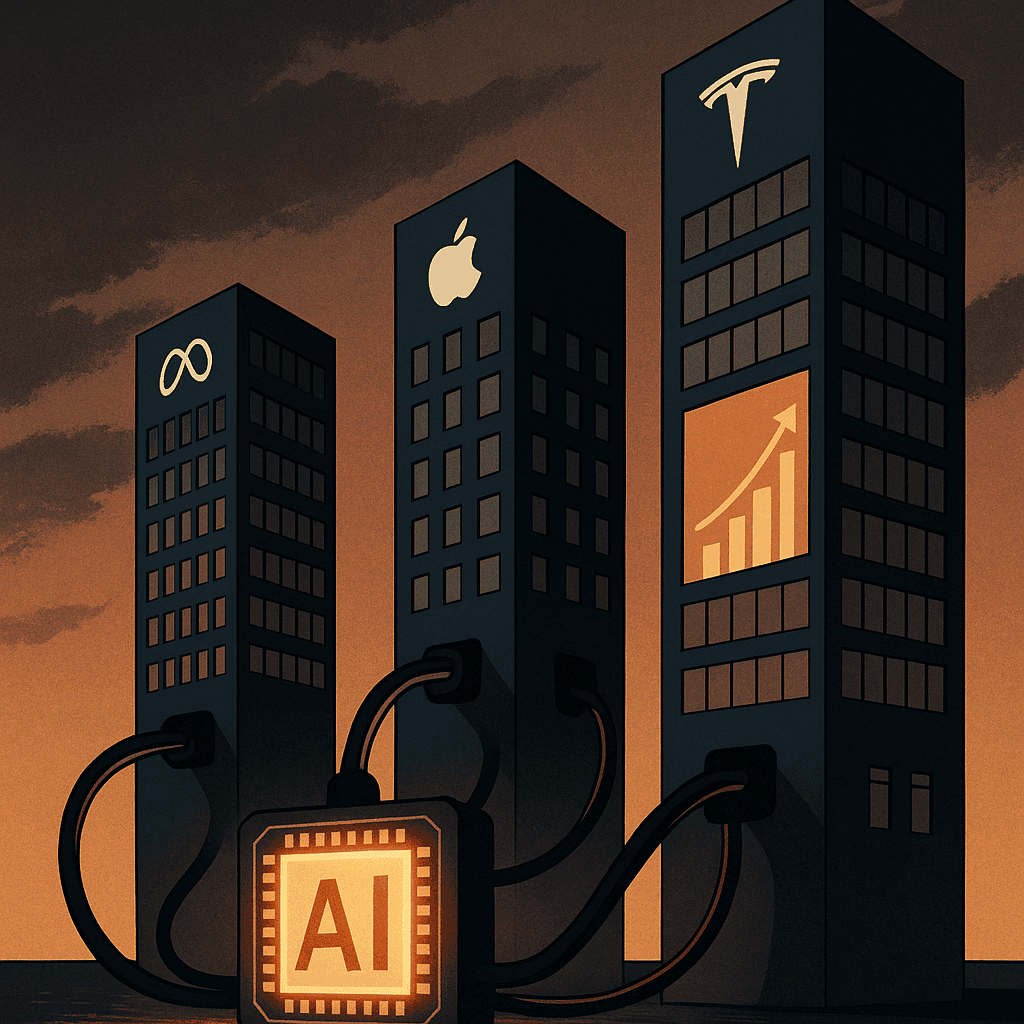
My call: at least one hits 10% AI revenue by 2027
The consensus story is that Big Tech is "all in" on AI. That is not a forecast, it is a vibes report. The scorable version is this: by the end of 2027, at least one of Meta, Apple, or Tesla will tell investors that 10% or more of its revenue now comes from explicitly AI or Intelligence branded products and services.
Not "AI‑enhanced engagement." Not "machine learning across our platform." A clean, on‑the‑record claim that a tenth of the top line is coming from something with AI on the label: Apple Intelligence, Meta AI, Full Self‑Driving, Autonomy AI, whatever the lawyers let through.
My money is on Apple or Tesla making that claim first. Meta has the biggest AI bill, but the messiest story. When you live on ad RPMs, every dollar is "because of AI" and none of it is.
The capex binge needs a hero product
Look at the 2026 capex charts and you could mistake Meta, Microsoft, Alphabet, and Amazon for utilities. Meta alone is guiding toward a number that belongs in a national infrastructure plan. Texas is pausing new data center connections while SpaceX and Tesla sketch out a US$16.8 billion Terafab chip complex that wants a terawatt of power. If AI were a startup, you would stage an intervention.
That kind of spend only survives two more years if someone can point to a crisp, growing line called something like "AI Services" and say: this pays for that.
Investors are already cranky. Chip and storage names can rally 390% on AI demand, then get punished for merely meeting expectations. The Council on Foreign Relations is publishing explainers on AI unit economics as if they were a public health warning. At some point before 2028, "trust us, AI lifts everything" stops working as disclosure.
That is the driver behind my call. The accounting story has to catch up to the narrative story. And the easiest way to prove AI is a business, not a line item in electricity costs, is to carve out 10% of revenue and pin an AI badge on it.
Apple: the quiet favorite to label and charge
Apple, ironically the last major to say the word "AI" out loud, probably has the cleanest route to the 10% milestone.
On‑device Apple Intelligence is tailor‑made for accounting theatre. Tie premium AI features to the expensive phones and Macs. Float a higher‑end subscription tier in Services. Talk about ARPU uplift from Intelligence usage. Then, in an analyst day slide or a 10‑K footnote, attribute a revenue slice to Apple Intelligence features and gently circle the fact that it is above 10% of total sales.
The EU will help. Its AI rules are pushing companies to label AI systems and AI‑generated content. If regulators are going to force you to put a big "this is AI" sticker on half the experience, you might as well collect a surcharge and count it.
The risk for Apple is philosophical. The company likes to say "it just works," not "it just works because of a large transformer model." It can decide AI is table stakes and keep the economics blended into the iPhone blob. But this time the financial incentives cut the other way. Services has been the growth darling. "Intelligence revenue" is the perfect sequel.
Tesla: if you call it Autonomy AI, it practically labels itself
Tesla already sells an AI product with a price tag on it. Full Self‑Driving, whatever its actual capabilities on your local freeway, is marketed as software, updated over the air, and periodically repriced like a streaming bundle for your car. Attach a subscription model at scale and you are halfway to a discrete AI revenue line before the robots even show up.
Add in the Optimus robot fantasy, plus any external chip or compute sales flowing out of Terafab, and you have the skeleton of an "Autonomy & AI Services" segment. This is Musk's favorite story anyway: Tesla as an AI and robotics company that occasionally sells vehicles as containers for software.
The obstacle is execution. Tesla has been promising FSD breakthroughs on an annual cadence that would embarrass a vaporware SaaS startup. Regulators still treat "self‑driving" with suspicion. Terafab has to get built in a state where the grid is already blinking nervously at AI data centers. A lot has to go right, fast.
Still, if any CEO is going to rename an earnings segment "AI" the minute it clears 9.9%, it is the one who live‑tweets rocket blowups as learning experiences.
Meta: all in on AI, allergic to clean attribution
On paper, Meta should be the most obvious 10% candidate. It is pouring the most money into AI infrastructure, from GPUs to new data centers. It is racing to slap AI assistants into every chat box, feed, and headset. It wants its Ray‑Ban glasses to be the aspirational version of Kmart's AU$89 Anko camera shades, the ones privacy advocates already call a "nightmare."
The problem is the business model. Meta makes money because advertisers chase your attention inside the company's walled gardens. Better AI means better targeting, slicker ad tools, more watch time. That is all real. It is just terrible fodder for a clean AI revenue number.
Meta can spin up an "AI assistant services" line, or break out AI creative tools for advertisers, or count smart‑glasses hardware as AI revenue. It might eventually do some version of that. But the core cash machine will still be a performance ad auction, with AI woven into every part of it, too entangled and too defensible to tease apart.
I expect Meta to talk very loudly about being an AI company, then keep nearly all of the AI economics buried inside "Family of Apps" and "Reality Labs." When you already live under antitrust and political spotlights, the last thing you want is an "AI revenue" segment begging for its own hearings.
Regulators, cheap glasses, and the label problem
There is a counter‑story where this 10% threshold never appears on paper, even if it exists in reality. In that version, AI becomes a dirty word. The EU, privacy advocates, and a parade of watchdogs make "AI‑powered" feel like a legal risk, not a marketing asset. Companies quietly bury the term under softer labels like "Intelligence" or "Pro features" and avoid ever tying it to a revenue figure.
The spread of cheap AI hardware nudges in the same direction. When AU$89 AI glasses are selling out at Kmart and everyone owns an ambient microphone disguised as eyewear, "AI wearable" stops sounding premium and starts sounding like a discount bin SKU. At that point, branding your quarter on "AI units shipped" feels less like visionary leadership and more like admitting your business depends on the impulse rack.
This is the main way my forecast can miss: AI stays everywhere and nowhere, assumed but never isolated. The power bills soar, the talent costs stay "insane," and the CFO keeps AI tucked into old segments to avoid giving activists, regulators, and short sellers a new toy.
The stakes: when the hype hits the 10‑K
The 10% line is not magic. It is simply the point where AI stops being a keynote and starts being a business for at least one of these firms. The day Apple or Tesla claims "a tenth of our revenue is now AI / Intelligence / Autonomy," the arms race narrative shifts. Every other board will be asked why their AI spend is still filed under "miscellaneous optimism."
So here is the scorable bet in plain language: By the time Meta, Apple, and Tesla file their full‑year 2027 numbers, at least one of them will disclose that 10% or more of its trailing 12‑month revenue comes from products or services it explicitly markets as AI or Intelligence.
If the filings arrive and none of them takes that victory lap, the consensus will have been right all along. AI will have stayed what it is today: a very expensive comfort object for executives, helpfully labeled in slide decks and quietly deleted from the income statement.
And somewhere in Texas, a half‑lit Terafab will be explaining to the grid operator that it is not an AI plant at all, it is a small artisanal heat producer with software aspirations.
Around the Shallot
Stay in the same broken universe.
Forecasts, satire, cartoons, and quizzes should feel like one publication, not disconnected tabs.
Tech
‘Don’t Regulate Us,’ Beg AI Founders Currently Selling Regulation-As-a-Service
Silicon Valley hails Trump’s plan to let AI companies write their own rules, promises to sell those rules back to everyone else by Q4.
Oct 11
Forecast
Through December 10, Houthis Won’t Damage Pakistan or Turkey Infrastructure
The Mecca Defense Pact just put two more flags on the Saudi firing chart. The consensus panic says this widens the war within weeks. The signal says the Houthis will talk big, hit Saudi and the sea, and leave Pakistan and Turkey’s hard targets alone for this 60 day window.
Comments
Be the first to comment.