By End‑2027, Nikkei 225 Will Beat the S&P 500 in Total Return
From their 2026 AI peaks to December 31, 2027, the Nikkei 225 beats the S&P 500 on total return in dollars.
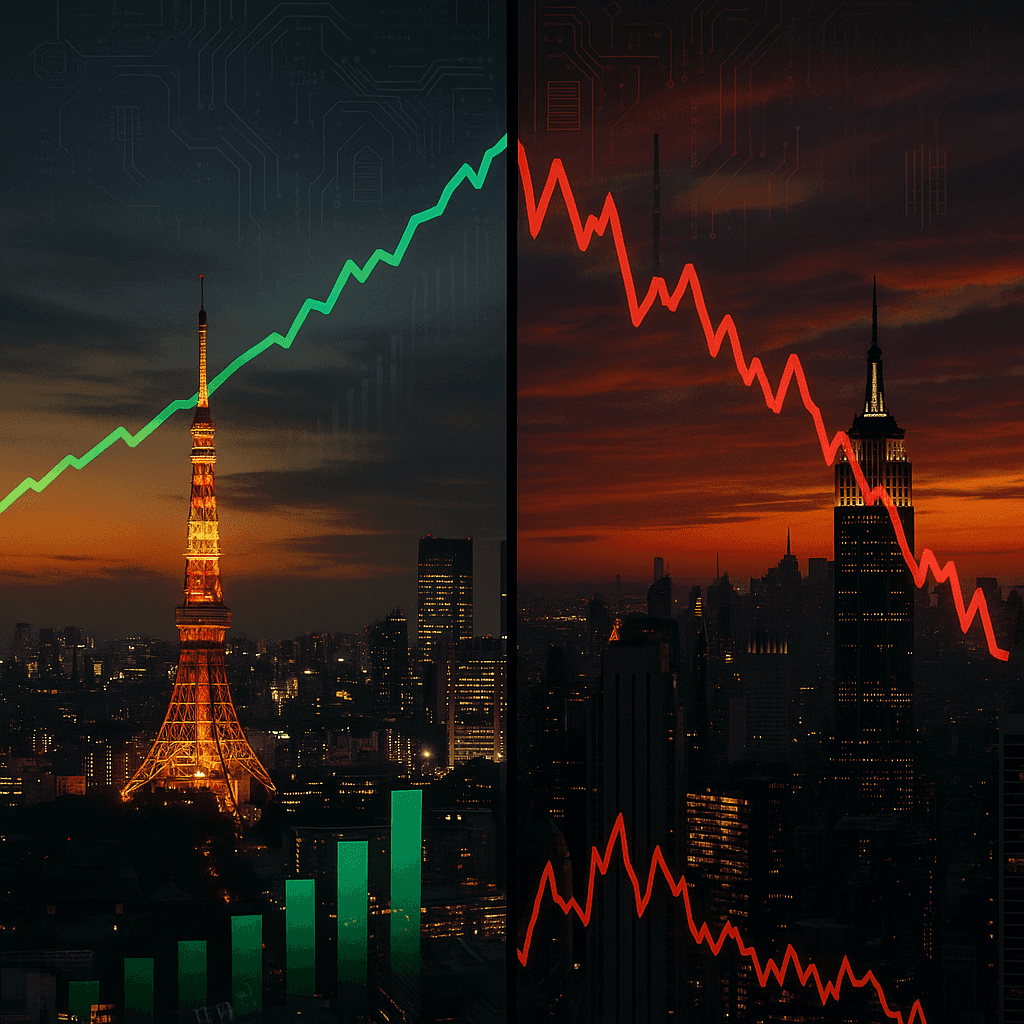
The consensus says the AI future is made in America and everyone else just sells it cables. The signal points somewhere ruder: from their 2026 AI peaks to December 31, 2027, I expect the tech heavy Nikkei 225 to beat the S&P 500 on a total return basis in US dollars.
Not because Japan suddenly became cooler than Nvidia. Because the math on the US AI boom is starting to look like a WeWork pitch deck written in CUDA.
The bet, clean and scorable
Here is the forecast in plain English: take each index’s highest closing level in calendar 2026. From that date through the close on December 31, 2027, including reinvested dividends, measured in dollars, I expect the Nikkei 225 total return index to outperform the S&P 500 total return index.
This is not a call that Japan becomes an AI superpower. It is a call that the US AI trade is priced like a religion while Japan is priced like a business.
The AI capex math no one wants to read
Start with the thing every bull quietly scrolls past: return on invested capital. Hyperscalers are pouring money into AI infrastructure at a pace that only works if AI revenues grow about 15 times from early 2020s levels by the late 2020s. That implies something close to GDP scale AI revenue in a handful of years.
Today, we have breathtaking quarterly prints. Dell has its blowout AI server quarter. Nvidia shrugs off a selloff. AI memory names from Micron to SanDisk to SK Hynix rally after earnings. Samsung and SK Hynix are modeled at near 90 percent memory margins, Micron has already crossed 80 percent. That is not an industry. That is a temporary monopoly party.
The problem: if memory and adjacent components swell to half or more of hyperscaler AI capex, those margins do not just need to stay high. They need to stay high while capex keeps compounding and while AI services actually monetize at scale. If revenue per GPU, or per watt, or per token does not explode, the ROIC equation breaks.
Industry analysts are already circling 2027 to 2028 as the "math gets tested" window. Either AI revenues show up like a new economic sector, or we learn what oversupply looks like when you have built data centers as if they were aircraft carriers.
The S&P 500 is now an AI fund with an index wrapper
The S&P 500 used to be a diversified snapshot of American capitalism. Today it is a levered bet on a small cluster of AI beneficiaries that everyone pretends is diversification because there are 500 tickers on the brochure.
When Nvidia, the hyperscalers, Broadcom, Marvell, Dell, Micron and friends wobble, the whole index shakes. UBS and similar houses are still telling clients to stay long, that the AI super cycle has years to run. At the same time, macro is quietly deteriorating: a negative nonfarm payroll print, falling labor force participation, credit worry headlines, and sober people muttering about a 30 to 50 percent equity drawdown if AI economics disappoint.
Put that together and the S&P 500 looks less like the safe benchmark and more like the most crowded factor trade on earth. It pays handsomely if AI revenue races to the 15x fantasy. It pays very badly if AI turns out to be important but not literally the new GDP.
Japan: the accidental AI hedge
The Nikkei 225 is not short AI. It is just not hostage to one narrow story. Japan’s benchmark has its own tech, industrials, automation, machine tools, and cap goods names that benefit from AI driven capex and factory automation, but they are not priced as the final layer of AI monetization.
Corporate governance reforms are still grinding forward: pressure on low ROE firms, more buybacks, cross shareholding unwinds, more attention to shareholders. None of this makes headlines like Nvidia’s keynote, but it does something AI narratives rarely do. It raises baseline returns even if the next revolution is late.
Then there is the currency. The yen has been sacrificed to the gods of yield differentials for years. If the Fed is edging toward easing while the Bank of Japan inches toward real normalization, the most likely direction for 2026 to 2027 is yen stabilization or modest strength against the dollar. For a US investor that means the same local Nikkei performance translates into better dollar returns. It is mechanical alpha born from two central banks finally swapping roles.
In a world where global risk assets wobble, a Japan with still reasonable valuations, net cash balance sheets, and a currency no longer in freefall can absolutely post a better peak to 2027 path than an S&P 500 glued to AI momentum.
What has to go wrong for this to be right
For this call to hit, I do not need AI to fail. I only need three things to go slightly off script.
- AI revenue growth comes in strong but not 15x strong by 2027, so hyperscaler ROIC disappoints and AI hardware margins drift back toward reality.
- US macro stays wobbly enough that investors stop paying venture style multiples for GPU suppliers inside a slowing index.
- The yen stops collapsing and Japan’s slow motion governance clean up keeps chipping away, so Nikkei returns get a valuation and FX assist.
In that world, the S&P 500 can still end 2027 above its 2026 peak. It just has to get there through a much choppier AI rerating than the Nikkei faces.
The bullish AI counterfactual is obvious. If AI workloads do reach something close to GDP scale by 2027 or shortly after, if GPU and memory demand stay tight and margins defy gravity, then the S&P 500’s AI mega caps will drag the whole index to another decade of "sorry you underweighted tech" charts. Japan will look fine, and still lose the race.
I am pricing that scenario in as possible, not as the baseline. When the equity market already acts as if we are halfway to that world, the contrarian bet is simply that the bill arrives later and larger than expected.
Signals to watch on the way to 2027
If you want a dashboard for this call instead of vibes, watch three things.
First, hyperscaler capex and AI revenues. When GPU and HBM orders start flattening, when backlogs stop exploding, or when the first real cancellation wave hits, you will know the capex to revenue gap is closing the wrong way.
Second, margins. Memory and key component gross margins drifting down from the 80 to 90 percent fantasy band into something with a relation to competition would confirm that the "day of reckoning" has started. Margin compression at Samsung, SK Hynix, Micron and similar names is the sound of the boom shifting from power law to normal cycle.
Third, USD/JPY and BoJ behavior. Any move that anchors the yen stronger, or at least less weak, does work for you if you are holding Nikkei exposure in dollars, while the S&P 500 gets no such FX tailwind.
The satirical verdict
By early 2028, when we score this, my expectation is boring: no AI winter, no AI utopia, just a lot of expensive servers earning less than the pitch deck promised. In that environment, Japan, the market that everyone only remembers when the yen breaks a new low, quietly prints better dollar returns from the 2026 peak than the flagship of American innovation.
If that happens, the lesson will not be that Tokyo beat Silicon Valley at AI. It will be that for two straight years investors confused an AI arms race with a business model, and the only major index that outperformed was the one that treated AI as a tool rather than a personality cult.
Call it progress: after the dot com bubble, we at least waited a full decade before pricing servers like they were a religion.
Around the Shallot
Stay in the same broken universe.
Forecasts, satire, cartoons, and quizzes should feel like one publication, not disconnected tabs.

Tech
‘Don’t Regulate Us,’ Beg AI Founders Currently Selling Regulation-As-a-Service
Silicon Valley hails Trump’s plan to let AI companies write their own rules, promises to sell those rules back to everyone else by Q4.
Oct 11

Forecast
Through December 10, Houthis Won’t Damage Pakistan or Turkey Infrastructure
The Mecca Defense Pact just put two more flags on the Saudi firing chart. The consensus panic says this widens the war within weeks. The signal says the Houthis will talk big, hit Saudi and the sea, and leave Pakistan and Turkey’s hard targets alone for this 60 day window.
Comments
Be the first to comment.